Stack Overflow, hailed as the "programmer's bible," a professional community that has amassed over 24 million questions and the largest programming Q&A corpus on the internet, is dying.
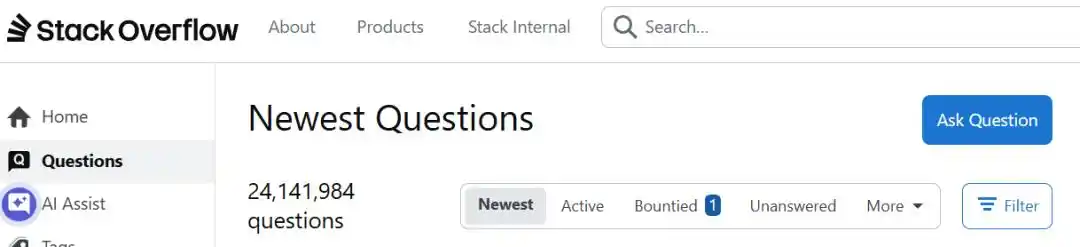
In July 2026, programmers worldwide asked a total of 1304 questions on Stack Overflow.
In March 2014, that number was 207,000.
The other day, developer Daniel Lockyer posted a line chart containing this data on X, lamenting "the end of an era."
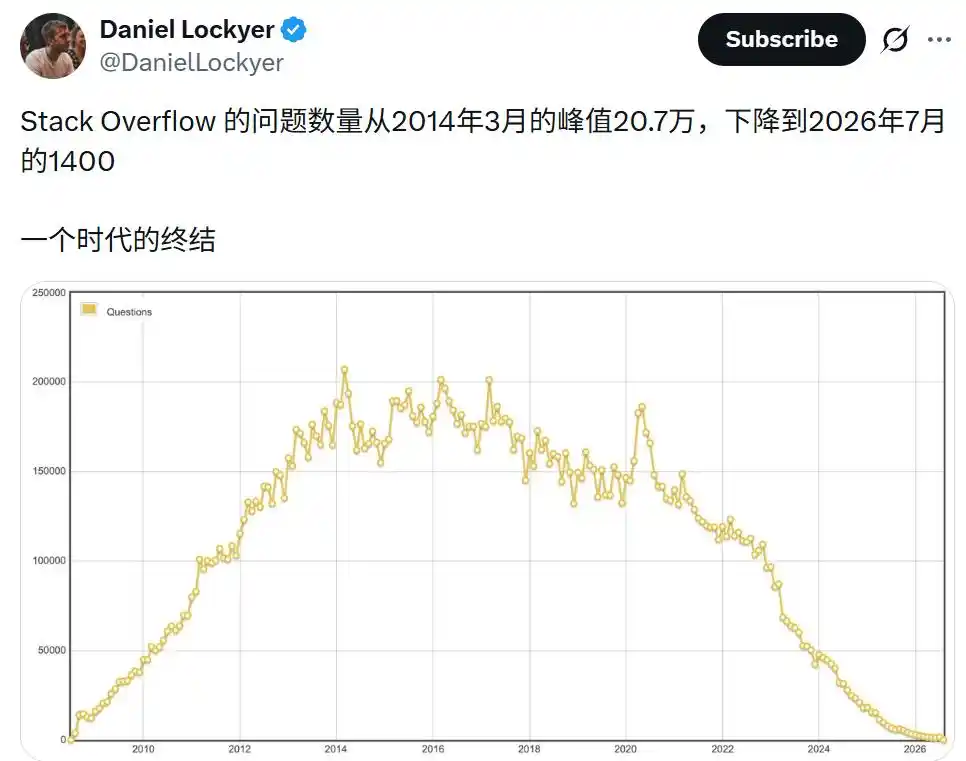
The data is genuine, sourced from Stack Overflow's official public SQL query interface, the Stack Exchange Data Explorer.
The next day, independent developer Pieter Levels (levelsio) reposted this chart, linking it to another topic: if no one asks questions on Stack Overflow anymore, and Reddit is overrun by promotion bots, how much real human-written content remains on the internet? With no new content, what will the next generation of models train on?
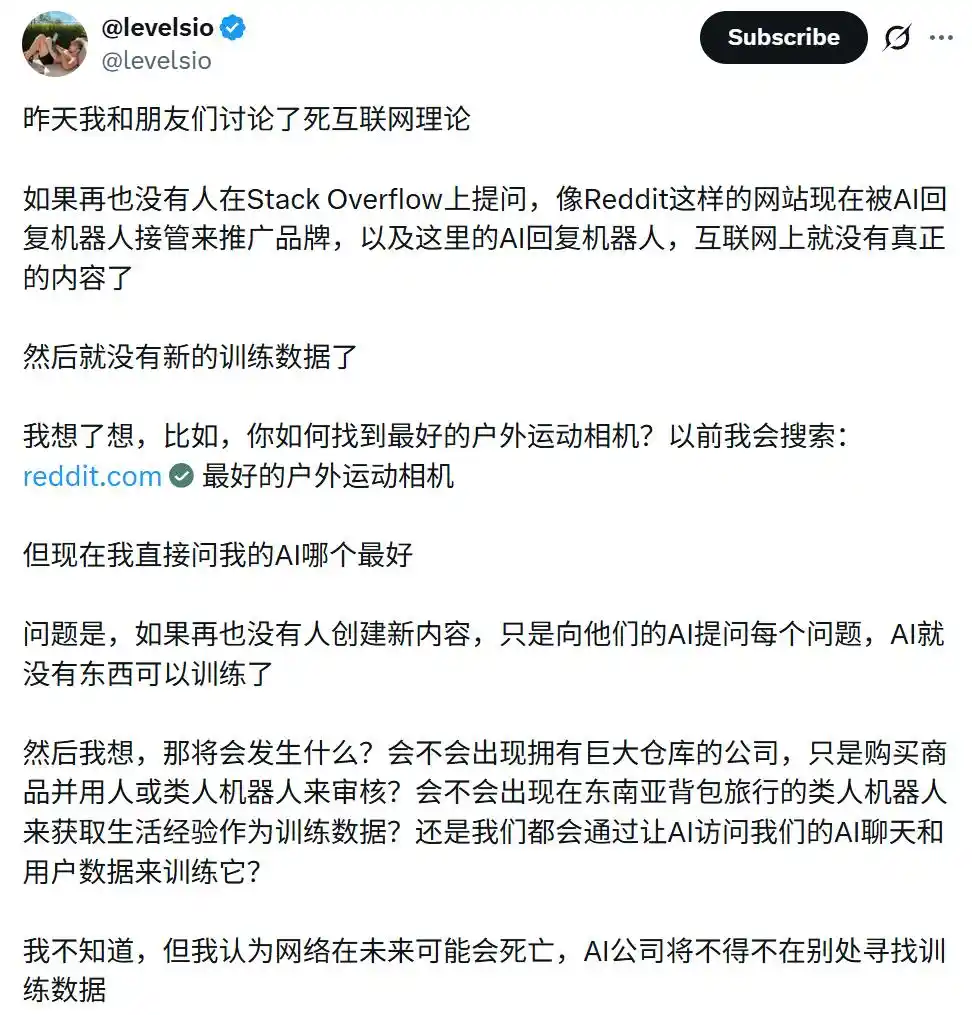
These two tweets sparked widespread discussion. Netizens' attitudes varied greatly, ranging from lamentation and excitement to sorrow... and more.
The Rise and Fall of Stack Overflow
Looking closely at the monthly question volume curve for Stack Overflow above, we can clearly divide it into three segments.
The first segment is growth. In July 2008 during the private beta, there were only 4 questions; 3744 in August; and after the public beta on September 15, it jumped to 14,024 that month. By January 2010, it was already 44,923 per month. The annual question count surpassed one million in 2011 and two million in 2013. This is a textbook hockey stick phenomenon.
The second segment is the plateau. The single-month peak stalled at 207,000 in March 2014, followed by 201,000 in March 2017 and March 2016. The three highest months spread over four years indicate a plateau, not a sharp spike. The annual total remained stable above two million between 2013 and 2017, peaking at 2.18 million in 2016. It began to loosen afterward but didn't collapse: 1.88 million in 2018, 1.75 million in 2019, rebounding to 1.85 million in 2020, with April 2020 alone seeing 180,000 questions.
The third segment is the decline phase. 1.34 million for the whole year in 2022, 790,000 in 2023, 400,000 in 2024, and 110,000 in 2025. The entire 2025 question volume is less than 53% of the single month of March 2014.
Looking more granularly, the compression is even more dramatic. 17,935 in December 2024, 3,312 in December 2025 (an 81.5% year-on-year drop), 2,910 in January 2026, 1,903 in March, 1,229 in May, and 1,072 in June. Excluding the private beta launch month of July 2008 with its 4 questions, June's 1,072 is the lowest full month in the site's entire history. July 2026 saw a slight rebound but remained low at only 1,304 questions.
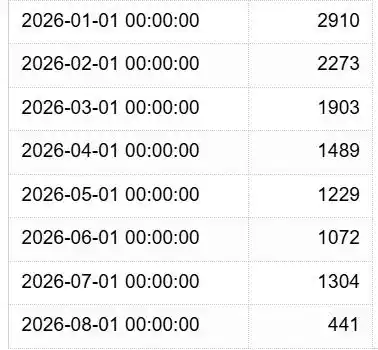
The first seven months of 2026 total about 12,000 questions. Based on the daily question rate of 2016, this is roughly the amount from about two days that year.
Stack Overflow's Decline Is Not Entirely Due to AI
From the graph, Stack Overflow's decline actually started eight years earlier than ChatGPT.
The inflection point appeared in 2014 when Stack Overflow began systematically improving moderation efficiency, more actively closing duplicate questions and queries that "did not meet standards." The site's intention was to preserve the signal-to-noise ratio, at the cost of blocking new users. A 2022 study showed that in a sample of 968 new user posts, 49% encountered at least one of: closure, no replies, or unexplained downvotes.
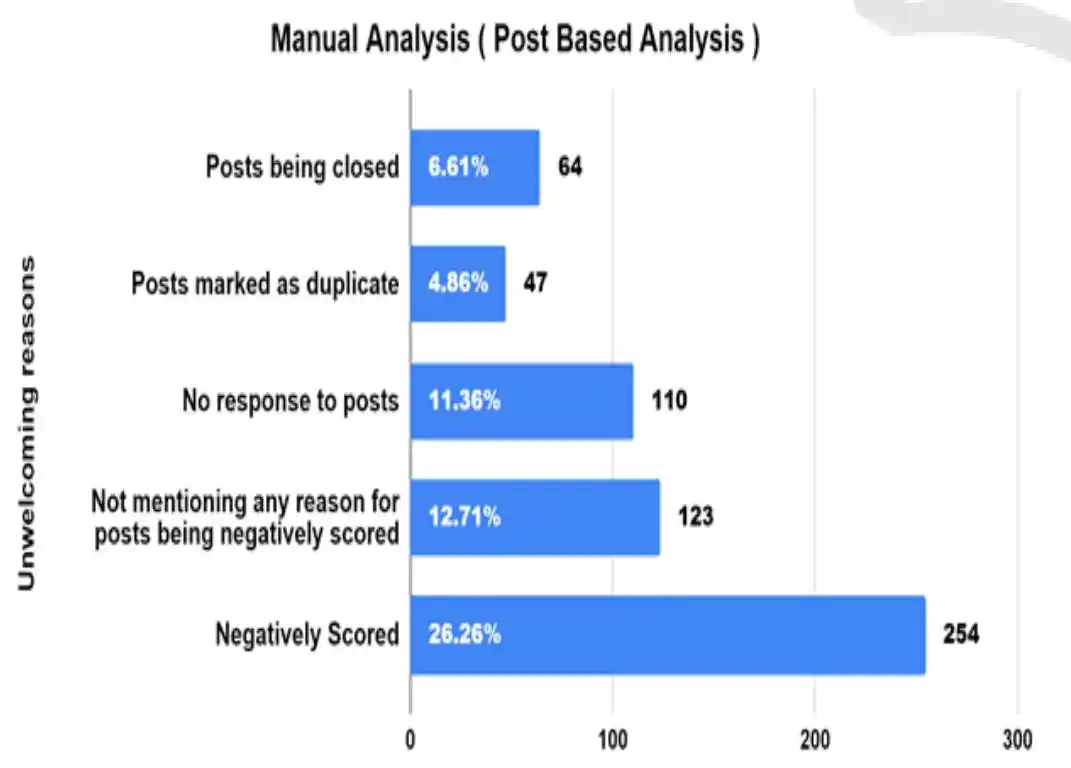
https://www.scitepress.org/PublishedPapers/2022/110811/110811.pdf
This culture has been criticized for a decade. Devclass, reporting on the January data wave, quoted a developer's reaction, roughly stating that AI indeed accelerated the decline, but the root lies in the community long punishing those trying to participate, and people finally have a tool that doesn't say "your question is stupid."
Below Daniel Lockyer's tweet, we can also see many similar criticisms:




The problem is that a hostile culture alone isn't enough to drive annual question volume down to the tens of thousands. Before 2022, that number consistently stayed above 1.3 million. The real cliff is the result of two things combined: ChatGPT reduced the marginal cost of asking to zero, and then AI assistants in IDEs made the act of asking disappear altogether.
Developers no longer need to leave the editor, don't need to formulate the problem into a minimal reproducible example a stranger can understand, and don't need to wait hours.
Stack Overflow's value was once built on "turning one person's problem into everyone's asset." AI assistants do precisely the opposite: they turn public questions back into private conversations.
The site hasn't been idle. In October 2023, it laid off 28% (following 58 layoffs in May), launched OverflowAI, pivoted to data licensing for companies like OpenAI, and erected anti-scraping walls to force platforms back to the negotiating table.
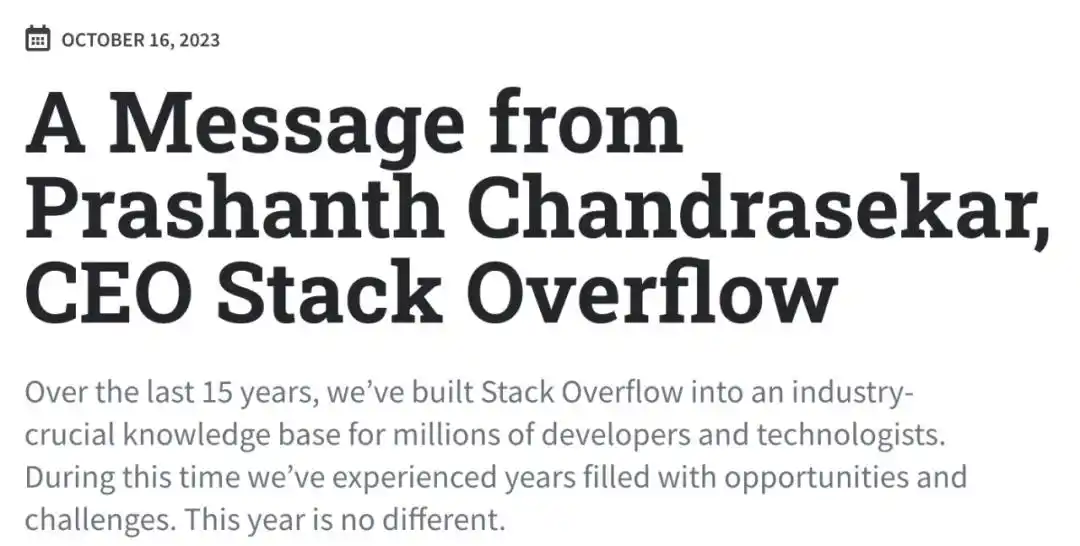
https://stackoverflow.blog/2023/10/16/stack-overflow-company-announcement-october-2023/
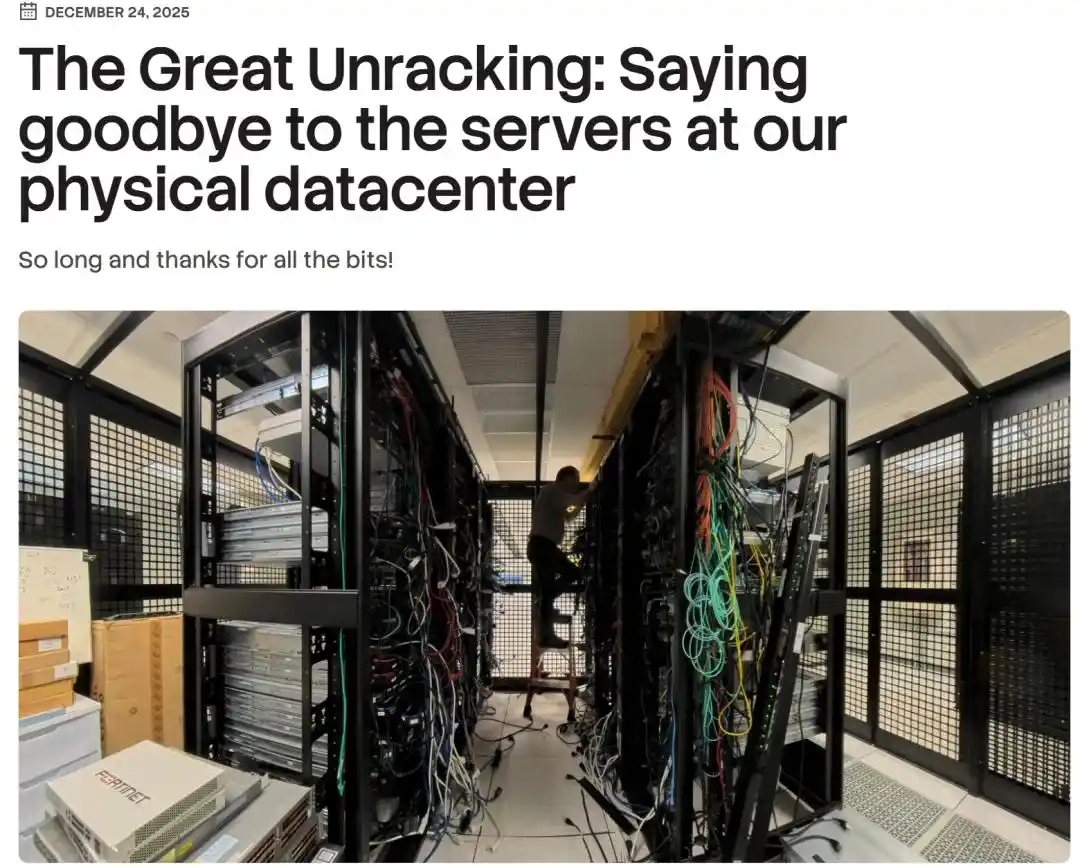
In 2025, it fully migrated to the cloud, decommissioning all ~50 servers from the New Jersey data center (its NYC location was actually NJ), retired the Colorado disaster recovery site in June, and ended the year with the blog post "The Great Unracking," giving this sixteen-year physical infrastructure history a subtitle: "So long, and thanks for all the bits."
In February 2026, the site underwent a redesign and got a new logo. CEO Prashanth Chandrasekar, in place since 2019, remains, and the company is still owned by Prosus. The $1.8 billion acquisition in June 2021 was completed exactly eighteen months before the steepest decline began.
Not Just Stack Overflow
Stack Overflow looks particularly conspicuous because it clearly publishes question statistics. But in reality, similar curves are appearing in many places with different slopes.
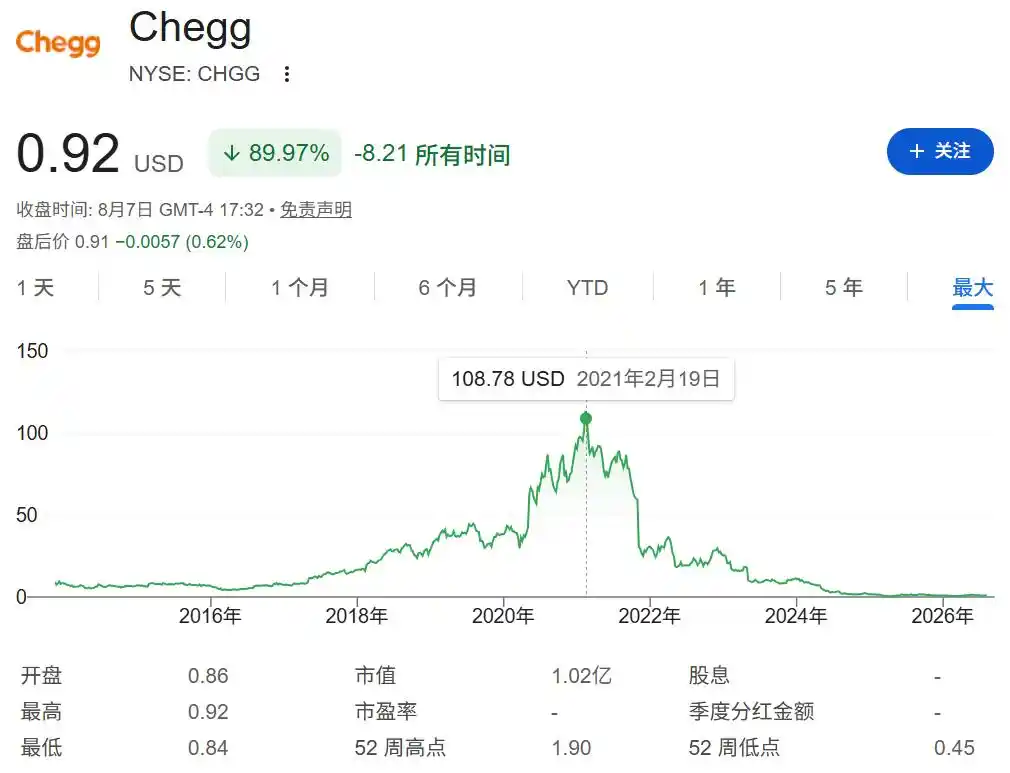
Chegg is widely acknowledged as the fastest to die. This online education company, which started with textbook rentals in 2005 and went public in 2013, relied on the same model: turning homework answers into searchable stock assets, using search engines for traffic, and charging a monthly fee.
After ChatGPT launched, students had no reason to pay anymore. Needham's research showed that in November 2024, 62% of students planned to use ChatGPT, up from 43% in spring 2023; Chegg dropped from 38% to 30% over the same period.
In 2023, it attempted a self-rescue, creating CheggMate using GPT-4 plus its over 100 million academic data points, trying to prove a specialized AI was worth paying for, but students didn't buy it.
In May 2025, it laid off 248 employees (22%) and closed US and Canada offices; in October, it laid off another 388 (45% of remaining staff). By late April 2026, its stock hovered around $1.07, with a market cap of about $125 million in May, roughly 99% evaporated from its peak. From peak to near zero, about 39 months.
Freelance platforms are the second sample, and they show clear stratification. Fiverr's Q2 2026 earnings released on July 29: revenue of $97.8 million, down 10% year-over-year; marketplace revenue from matching transactions fell 15.5% to $63.1 million. The real eye-catcher is buyer count: 2.7 million annual active buyers as of June 30, down 21.9% from 3.4 million a year earlier. But average spend per buyer rose 15.6% to $368 over the same period, take rate increased from 27.6% to 28.0%, and the number of clients completing projects over $1000 grew 13% year-over-year. Management gave the most straightforward annotation on the earnings call: on a TTM basis, the writing and translation categories saw the largest declines, over 24%. Full-year guidance was lowered to $356-$372 million, down 14% to 17% year-over-year, and they stated this transformation might take at least six quarters to show results.
The same logic repeats on Upwork and Freelancer.com.
Upwork's active client count at the end of 2025 was about 785,000, down from about 832,000 in 2024—a drop of about 47,000, its largest contraction since going public.
Freelancer's parent company's FY25 group GMV was 881.5 million AUD, down 7.1% year-over-year.
The raison d'être of these platforms was to commoditize human skills to lower costs; now there's a technology that further commoditizes "output." Research from Manav Raj et al. at the Wharton School of the University of Pennsylvania in 2024 already quantified this displacement: measurable substitution occurred in freelance demand for writing, translation, and basic coding after ChatGPT.
Wikipedia's situation is subtler because it's losing readers, not contributors. In May 2025, the Wikimedia Foundation updated its bot identification system, reclassifying a batch of human-impersonating crawlers, and discovered real human traffic had fallen by about 8% year-over-year.
Senior Director of Product Marshall Miller indicated: fewer visits mean fewer volunteers growing into editors and fewer individual donors. Wikipedia's contributions were already extremely concentrated: research shows 77% of articles were written by 1% of editors. The Foundation's 2026–2027 fiscal year annual plan draft states the judgment: this is not temporary, it's a structural shift.
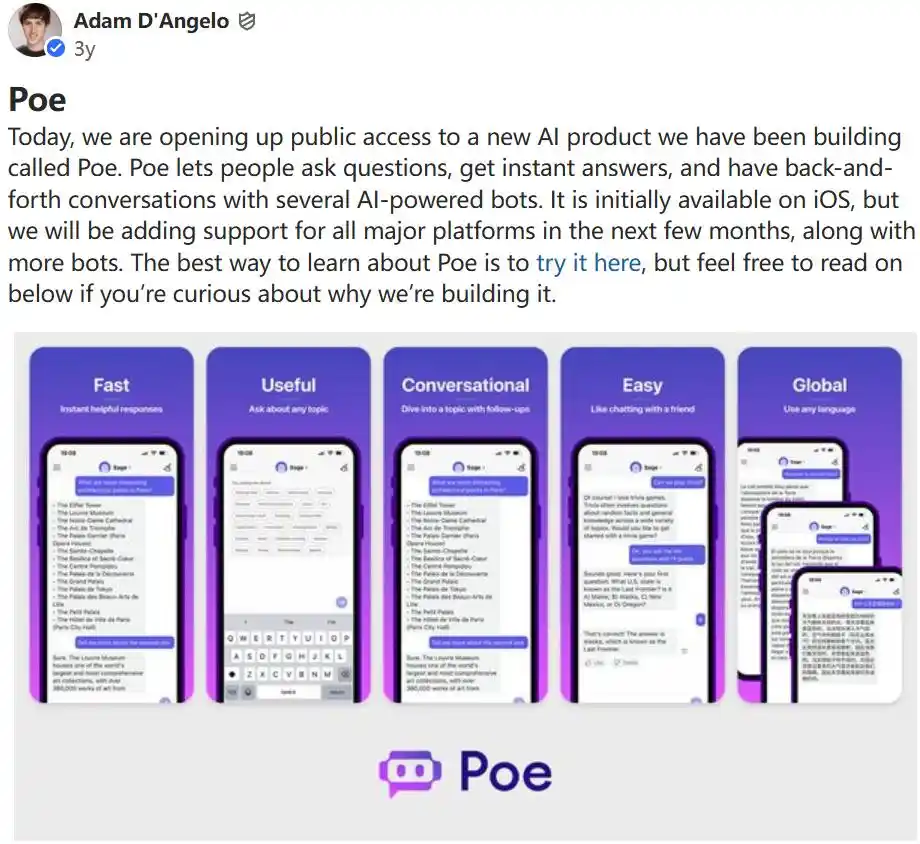
Quora took another path: instead of guarding Q&A, build an AI gateway itself. It poured resources into Poe, securing $75 million in funding from a16z in January 2024 to expand this multi-model aggregation platform. A Q&A community ultimately bet its future on something that replaces Q&A...
One step further out is the entire informational content business. A randomized controlled experiment covering 1065 desktop Chrome users found that when AI Overviews appear, off-site organic clicks drop 39.8%, zero-click searches rise 34.5%, and users show no measurable improvement in experience ratings. Ahrefs' February 2026 research calculated a click-through rate drop of up to 58% for top-ranking pages. Consequences have already manifested in layoffs and site closures: Bauer Media Group announced in April 2026 the closure of its German digital subsidiary, cutting 160 positions; the 21-year-old public reference site Overfishing.org shut down.
To summarize the pattern: the faster the collapse, the more the category is one where "machine-generated answers are functionally equivalent to the original." Reference materials, technical documentation, definitional content, how-to tutorials—all are in this set. Conversely, work requiring long-term relationships, context, and accountability shows little change. Fiverr's earnings also illustrate this: low-value transactions are disappearing, while complex projects over $1000 are growing.
More Troublesome: Experts Are Retreating
If users were merely asking questions elsewhere, the story would be simpler. But Kenny Ching from the University of Auckland Business School, in a working paper released in July 2026, pointed out a more problematic mechanism.
He tracked the behavior of 24,304 contributors on Stack Overflow over 17 months, finding that since 2022, the departure rate of high-reputation users began accelerating, gradually catching up with the faster-departing low-reputation users. In other words, it's not just question-askers leaving, but also answerers, and the more people who spent years accumulating expertise and earning recognition in the community, the more resolutely they are leaving.
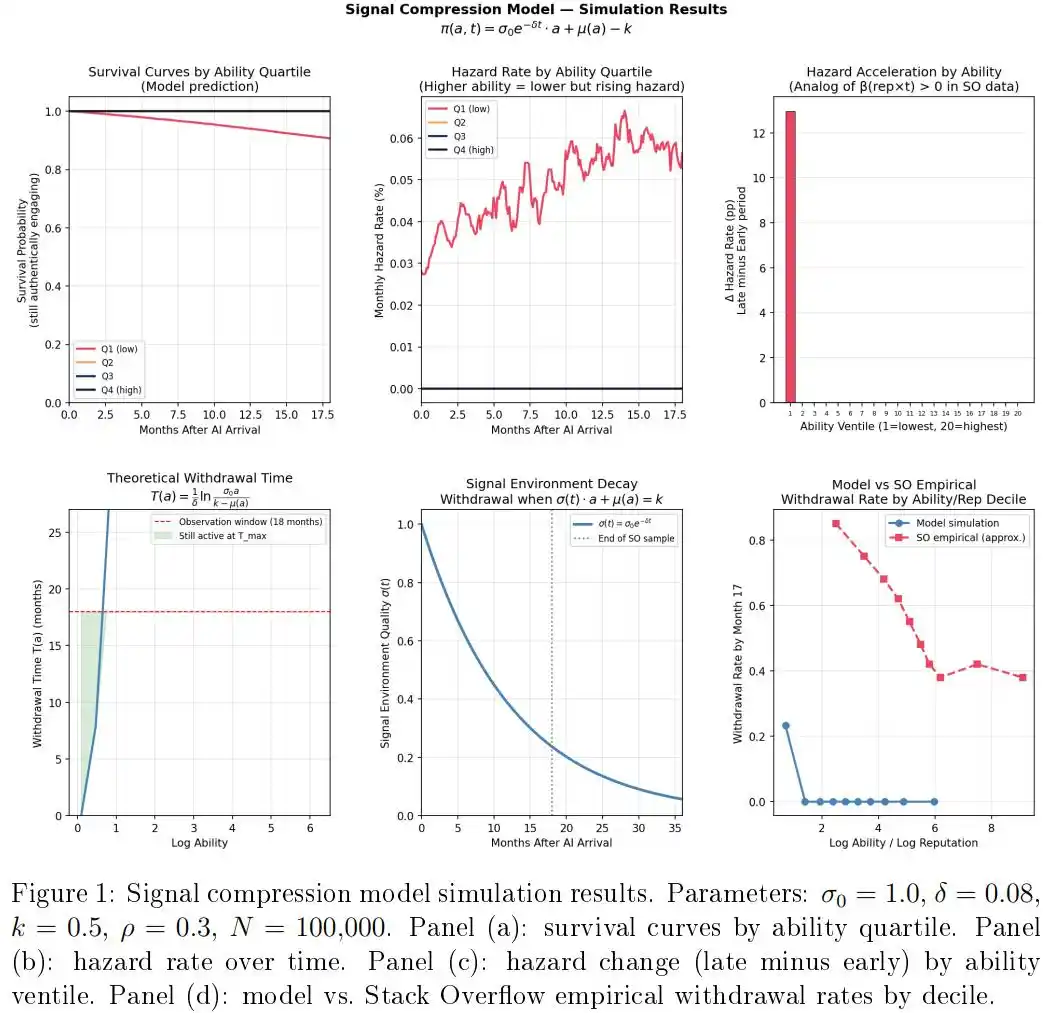
Ching named this mechanism "signal compression." His explanation: these people are leaving because the expertise they painstakingly earned is no longer distinguishable from a chatbot's answer.
When everyone can use AI to produce something that looks decent, the act of putting in genuine effort ceases to be a recognizable signal. In an interview, he extended this logic beyond platforms: the same thing is happening in classrooms, companies, and scientific communities. The long-term risk is that "by destroying the incentive to demonstrate genuine effort, AI may cut off the formation of future human expertise."
This aligns with Stack Overflow's own survey data. The 2025 survey covering about 49,000 developers from 177 countries showed 84% of respondents using or planning to use AI tools (76% in 2024), but only 29% trusted the accuracy of AI output, 46% explicitly distrusted it, and only 3% "highly trusted" it—2.6% among senior developers.
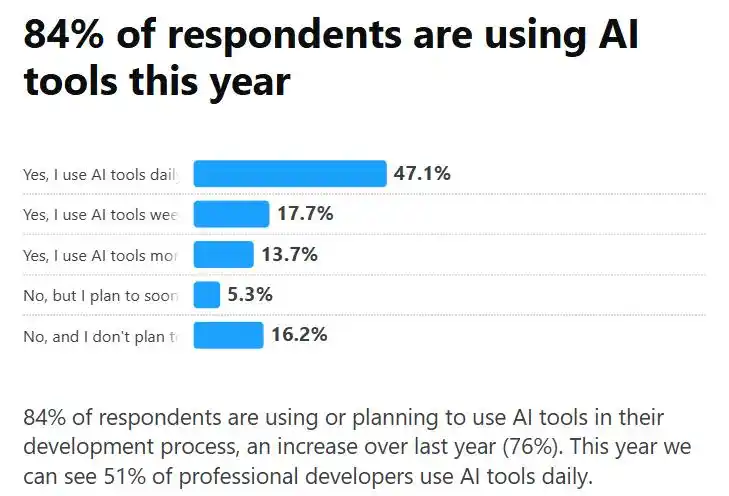
https://survey.stackoverflow.co/2025
The biggest complaint wasn't that AI can't code, but that its output is "almost right, but not quite," with 66% troubled by this and 45% saying they spend significant time debugging AI code. And when they don't trust an AI answer, 75.3% said they would ask a person.
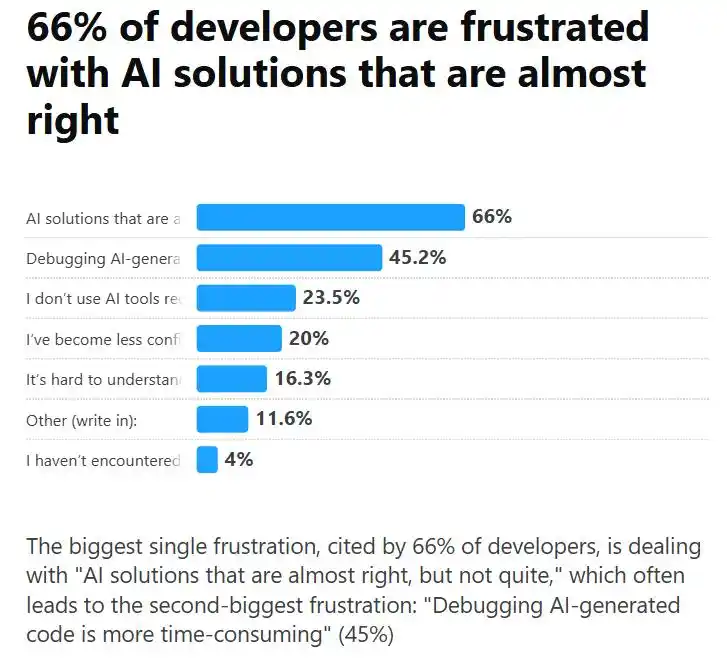
The problem is, that person is leaving.
Conclusion
Now let's synthesize a few things.
Stack Overflow's stock corpus is openly licensed under CC BY-SA, making it one of the most thoroughly scraped technical corpora. The models that ingested it are now the reason for the halt in new contributions.
Stock corpus has timestamps. Answers about jQuery, Python 2, and Angular.js on Stack Overflow will gradually become outdated. Knowledge about new frameworks, breaking changes in new versions, compilation errors of a library used by only three thousand people under a specific CUDA version... This type of knowledge was previously written on a public webpage by the first person to step on the landmine. Now it happens in a private conversation between someone and a model, disappearing after resolution.
The site's answer is the "trusted human intelligence layer." Chandrasekar repeatedly uses this term: AI has risks of misleading, may lack complexity and relevance, so a path relying on curated knowledge bases and responsible data use is critical. This is logically sound, but it requires people willing to continuously supply that layer; but Ching's data says those people are diminishing.
There's also a reverse possibility. Models may not need forum-style Q&A to learn new knowledge: they can learn from code repositories, official documentation, interaction logs with users.
Google opened a documentation API in 2026 covering about 40 million documents with 24-hour re-indexing, clearly meant for machines to read. Framework maintainers are also catching up: Next.js documentation features "Common Errors" sections, written almost like Stack Overflow answers; the Svelte team simply trained its own chatbot based on docs and source code. The site of knowledge production might just be migrating, not disappearing.
But there's an unanswered difference between these two prospects. Forum-style Q&A has a byproduct: it's public, searchable by third parties, and doesn't belong to any single company. Documentation is written by maintainers, interaction logs belong to model vendors. When a programmer's first reaction to a problem shifts from "search if someone asked" to "ask the AI," what's lost isn't just a website's traffic, but a public record anyone can consult and correct.
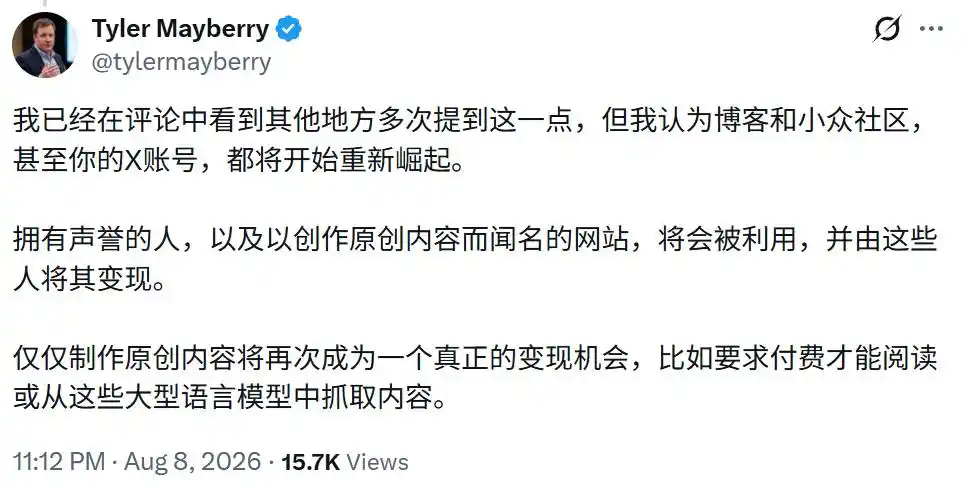
In the discussion under Lockyer's tweet, developer Mayberry offered a less pessimistic prediction: blogs, niche communities, and personal accounts might regain importance because "people with reputations and sites with reputations for original content will become valuable again."
This article is from WeChat public account "Almost Human" (ID: almosthuman2014), author: Panda