Interactive Map Pinpoints Where 67 Million Crypto Owners Reside Across the United States

cryptonews.ruPublished on 2026-08-31Last updated on 2026-08-31

Abstract

The National Cryptocurrency Association (NCA) has released interactive maps detailing the estimated 67 million cryptocurrency owners across the United States. The state-level data shows California leading with 9.5 million owners, followed by Texas (5.94M), Florida (4.71M), New York (4.66M), and Illinois (2.64M), reflecting a distribution broadly aligned with general population patterns. The South accounts for 38% of owners. These figures are modeled statistical estimates based on a survey sample, not verified counts, with confidence intervals provided. For example, California's estimate ranges from 9.09 to 9.92 million. A separate NCA report estimates the crypto industry supports nearly 232,000 U.S. jobs, including direct, indirect, and induced employment, with California also leading in job creation (57,600). The NCA, launched with Ripple support, aims to provide public crypto education.

An interactive map shows where 67 million U.S. cryptocurrency owners reside, providing data for all 50 states, Washington, D.C., and 435 U.S. House districts of the 119th Congress. The National Crypto Association (NCA), a nonprofit focused on crypto education, presents this data through a mapping portal with state and district views, allowing users to explore individual geographic areas.

Ripple’s chief legal officer and NCA president Stuart Alderoty drew attention to these maps in an Aug. 24 X post, stating:

“67 million Americans own crypto. This industry provides 232,000 U.S. jobs. The National Crypto Association created two maps so you can see the data by state and by district.”

By state estimates, California leads with roughly 9.5 million crypto owners, followed by Texas with 5.94 million, Florida with 4.71 million, New York with 4.66 million, and Illinois with 2.64 million. According to the underlying “State of the Crypto Owner Market in 2026” report, approximately one in four U.S. adults owns cryptocurrency.

Regionally, the state-level distribution broadly aligns with the U.S. population distribution. The South accounts for 38% of owners, and the West for 27%. The Midwest and Northeast each account for 18%, indicating crypto ownership is spread across the country rather than concentrated exclusively around major tech and financial hubs.
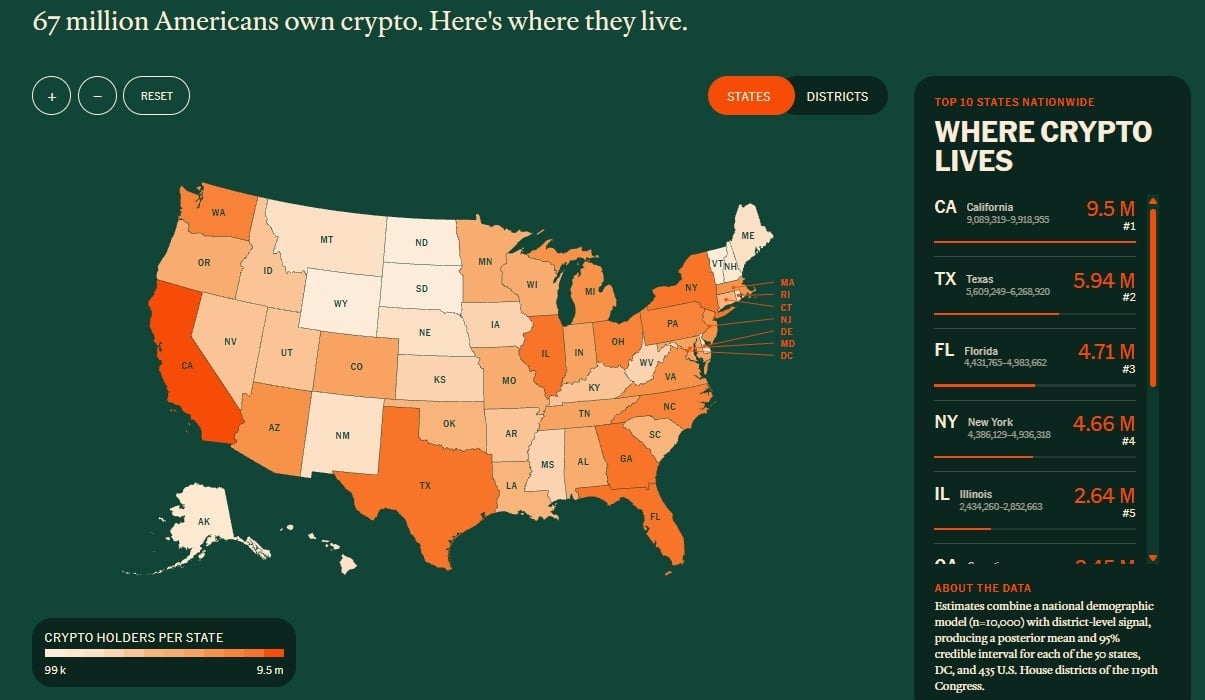
The National Crypto Association’s interactive map shows the approximate number of cryptocurrency owners by state, with California leading at 9.5 million, followed by Texas, Florida, New York, and Illinois. Source: NCA.

Numbers Represent Modeled Estimates, Not Verified Data

The figures on the map are statistical estimates, not exact tallies of identified crypto owners. The methodology employed combines a national demographic model based on a sample of 10,000 U.S. crypto owners with county-level data to produce a posterior mean and a 95% credible interval for each covered geographic area.

The posterior mean is the central estimate from the model after accounting for available data. The credible interval represents the range within which the model calculates the actual value is likely to fall. For instance, the estimate for California ranges from roughly 9.09 million to 9.92 million owners.

The broader owner count estimate stems from an online poll conducted by The Harris Poll for the NCA between Feb. 12 and March 3. Researchers weighted the poll results underlying the 67 million estimate and extrapolated them to the wider U.S. crypto owner population. The sampling accuracy is 0.7 percentage points at a 95% confidence level.

A separate study offers a narrower comparison focused specifically on Bitcoin. According to July research, 49.6 million Americans own Bitcoin, representing 18.6% of the adult population. The NCA figure encompasses cryptocurrency broadly, whereas the Bitcoin estimate measures ownership of one specific digital asset.

Crypto ownership can include assets held in software wallets, on hardware devices, or on accounts controlled by centralized platforms. A more detailed explanation of how to create a crypto wallet describes the various ways owners can store and access their digital assets.

Crypto Supports Nearly 232,000 U.S. Jobs

A separate NCA dataset estimates the economic impact of the crypto industry in individual states. According to a crypto sector employment analysis conducted by Pragmatic Policy Group for the association, nationwide figures include 231,845 crypto-related jobs, $55.4 billion in economic activity, and $30.8 billion in worker income.

The employment figure includes about 34,000 direct jobs at crypto companies, 75,000 indirect jobs among suppliers, and 123,000 induced jobs created from worker spending. Per the analysis’s calculations, each direct crypto job supports roughly six other jobs in sectors like professional services, healthcare, insurance, food service, and logistics.

The NCA launched in March 2025 with a $50 million grant from Ripple, intended to support crypto education and raise public awareness. At the time, Alderoty characterized the association’s goal as providing Americans with the facts, resources, tools, and support to engage with cryptocurrencies.

On the employment map, California leads with approximately 57,600 crypto-related jobs, $16.9 billion in economic impact, and $7.7 billion in worker income. It is followed by New York with 53,800 jobs, Texas with 26,500, Washington with 15,100, and North Carolina with roughly 9,500.

end-content

Related Questions

QWhat is the estimated total number of cryptocurrency owners in the US according to the article, and what is the source of this data?

AThe estimated total number of cryptocurrency owners in the US is 67 million. This data comes from an online survey conducted by The Harris Poll for the National Cryptocurrency Association (NCA).

QWhich five US states have the highest estimated number of cryptocurrency owners, and what is the leading state?

AThe five states with the highest estimated number of cryptocurrency owners are: California (~9.5 million), Texas (~5.94 million), Florida (~4.71 million), New York (~4.66 million), and Illinois (~2.64 million). California is the leading state.

QThe article states the NCA's data are 'modeled estimates.' Briefly explain the methodology used to create these estimates.

AThe methodology combines a national demographic model, based on a sample of 10,000 U.S. cryptocurrency owners, with county-level data to generate a posterior mean and a 95% confidence interval for each covered geographic area. These are statistical estimates, not exact counts.

QAccording to the separate employment analysis cited, what is the total estimated number of cryptocurrency-related jobs in the US, and what categories do they include?

AThe total estimated number of cryptocurrency-related jobs in the US is 231,845. These jobs include approximately 34,000 direct jobs at crypto companies, 75,000 indirect jobs at suppliers, and 123,000 induced jobs created through worker spending.

QHow did the National Cryptocurrency Association (NCA) start, and what is its stated primary goal?

AThe NCA started in March 2025 with a $50 million grant from Ripple intended to support crypto education and public awareness. Its stated primary goal is to provide Americans with the facts, resources, tools, and support to engage with cryptocurrencies.

Related Reads

After Affecting Two Generations, Meta Ordered to Pay $18 Billion

In a landmark settlement mirroring the historic 1998 tobacco case, Meta has agreed to pay up to approximately $18 billion to resolve lawsuits filed by 52 US states and territories. The lawsuits alleged that Meta deliberately designed addictive features like infinite scroll and push notifications to hook teenagers, concealed known harms to youth mental health, and illegally collected data from children under 13. Faced with a potential $1.4 trillion claim and a series of unfavorable prior rulings, Meta chose to settle rather than risk a jury verdict. Beyond the financial penalty, the core of the 10-year agreement is a set of mandatory product changes for Instagram and Facebook. These include hard daily time limits and nighttime blocks for teen users, restrictions on notifications during school hours, hiding like counts, offering a non-algorithmic feed option, and implementing stricter age verification. An independent auditor will oversee compliance. Crucially, Meta tied 30% of the settlement amount to a condition requiring TikTok and YouTube to adopt similar restrictions and pay comparable fines, aiming to create an industry-wide standard and level the competitive playing field. Analysts compare this moment to the tobacco settlement, which fundamentally reshaped industry rules and public perception. The outcome signals a major shift in regulatory pressure on social media's core engagement models, particularly concerning minors, with ongoing lawsuits likely to target other major platforms.

marsbit14m ago

After Affecting Two Generations, Meta Ordered to Pay $18 Billion

marsbit14m ago

Trading

Spot
活动图片