Splashing Out 27 Billion Yuan, OpenAI Establishes New Company to Accelerate AI Deployment

marsbitPublished on 2026-05-12Last updated on 2026-05-12

Abstract

On May 11th, OpenAI announced the formation of a new company, "OpenAI Deployment Company," with an initial investment of over $4 billion (approximately 27.2 billion RMB). This venture aims to help businesses build and deploy AI solutions. OpenAI is also acquiring the AI consulting firm Toromo to rapidly scale the deployment company's capabilities. This new entity, majority-owned by OpenAI, brings together 19 investment, consulting, and system integration partners, led by TPG with co-lead founding partners including Advent International, Bain Capital, and Brookfield. OpenAI's Chief Revenue Officer, Denise Dresser, stated that while AI is becoming increasingly capable, the current challenge lies in integrating these systems into core business infrastructure and workflows. The deployment company is designed to bridge this gap and translate AI capabilities into operational impact. This move comes as OpenAI emphasizes the next competitive phase will depend on the efficiency of deploying AI in real business scenarios. The company reports over 1 million businesses already use its products and APIs. OpenAI is significantly increasing its investments in computing power, with co-founder Greg Brockman stating the company expects to spend $50 billion on compute this year, a dramatic increase from $3 million in 2017. The announcement follows OpenAI's recent completion of a record $122 billion funding round in late March, led by Amazon, Nvidia, and SoftBank, valuing the company at $852 ...

On May 11th local time, OpenAI announced the establishment of a new company called 'OpenAI Deployment Company,' with an initial investment exceeding $4 billion (approximately 27.2 billion yuan), aiming to help enterprises build and deploy AI. Simultaneously, OpenAI will also acquire the AI consulting firm Toromo to rapidly expand the scale of the deployment company.

The deployment company is controlled by OpenAI and brings together 19 investment, consulting institutions, and system integrators. OpenAI stated that this is a long-term collaborative project led by TPG, with Advent International, Bain Capital, and Brookfield serving as joint lead founding partners. Goldman Sachs, SoftBank, and others are also founding partners. Among them, Brookfield announced on May 11th that it had agreed to invest $500 million in OpenAI Deployment Company.

According to the introduction, the AI consulting company Toromo, which OpenAI plans to acquire, will bring about 150 AI engineers and 'deployment experts' to the deployment company. Toromo was founded in 2023 and formed an alliance with OpenAI, with clients including Mattel, Red Bull, Tesco, and Virgin Atlantic.

OpenAI Chief Revenue Officer Denise Dresser believes that AI is becoming increasingly capable of performing tasks within organizations, but the current challenge is how to help enterprises integrate these systems into the infrastructure and workflows that support their businesses. Therefore, the purpose of the deployment company is to help organizations bridge this gap, turning AI capabilities into real operational impact.

OpenAI stated that over the past few years, over 1 million enterprises have adopted OpenAI products and APIs. The next stage of competition will depend on the efficiency of AI deployment in actual business scenarios and the support capabilities of OpenAI and its ecosystem partners.

OpenAI is increasing its investment in computing power and the AI field. OpenAI co-founder and president Greg Brockman said on May 5th local time that the company is expected to invest $50 billion in computing power this year. Brockman noted that as OpenAI develops more advanced AI models and provides services to a broader user base, its computing costs have surged from about $30 million in 2017 to hundreds of billions of dollars this year. Informed sources stated in February this year that OpenAI aims to achieve a total computing expenditure of around $600 billion by 2030.

At the end of March, OpenAI announced the completion of $122 billion in financing, the largest single financing round in Silicon Valley corporate history, with a post-investment valuation of $852 billion. This round was led by Amazon, Nvidia, and SoftBank, with Microsoft continuing its participation. SoftBank co-led the round with a16z, D. E. Shaw Ventures, MGX, TPG, and T. Rowe Price Associates, Inc. Additionally, institutions such as ARK Invest managed by Cathie Wood, Blackstone, Sequoia, Temasek, and Thrive Capital widely participated.

Previously, OpenAI had revealed that some strategic investors had committed $110 billion as the basis for this financing round, including $50 billion from Amazon, $30 billion from Nvidia, and $30 billion from SoftBank.

OpenAI is also intensifying the research and development of large models. At the end of March, OpenAI announced it would cease using its video generation tool Sora. It is reported that OpenAI will refocus team efforts on developing advanced robotics and AI models capable of interacting with the physical world. On April 14th, OpenAI announced allowing select users access to a new model more adept at discovering software security vulnerabilities, with fewer restrictions on user probing methods for such tasks. On April 20th, reports indicated that OpenAI is set to release a completely new image model in the coming weeks, with significantly enhanced capabilities in generating complex images and charts.

Separately, according to previous remarks by OpenAI founder Sam Altman, OpenAI may go public in 2027. Reports suggest that OpenAI's IPO (Initial Public Offering) valuation could be as high as approximately $1 trillion, with a potential filing for listing with regulators as early as the second half of 2026.

This article is from 'Jiemian News,' reporter: Hou Ruining

Related Questions

QWhat is the name of OpenAI's new company and what is its initial investment amount?

AThe new company is named 'OpenAI Deployment Company', with an initial investment exceeding $4 billion (approximately 27.2 billion RMB).

QWhich consulting firm is OpenAI acquiring to scale its deployment company, and what does it bring?

AOpenAI is acquiring the AI consulting firm Toromo, which will bring about 150 AI engineers and 'deployment specialists' to the deployment company.

QAccording to OpenAI's Chief Revenue Officer, what is the current challenge for AI adoption in organizations?

AThe current challenge is how to help enterprises integrate AI systems into the infrastructure and workflows that support their business, bridging the gap between AI capability and real operational impact.

QHow much does OpenAI plan to spend on computing power this year, and what is its long-term target by 2030?

AOpenAI plans to spend $50 billion on computing power this year, with a long-term target of approximately $600 billion in total compute expenditure by 2030.

QWhat was the amount of OpenAI's latest funding round and its post-money valuation?

AOpenAI announced the completion of a $122 billion funding round in late March, which is the highest in Silicon Valley history, with a post-money valuation of $852 billion.

Related Reads

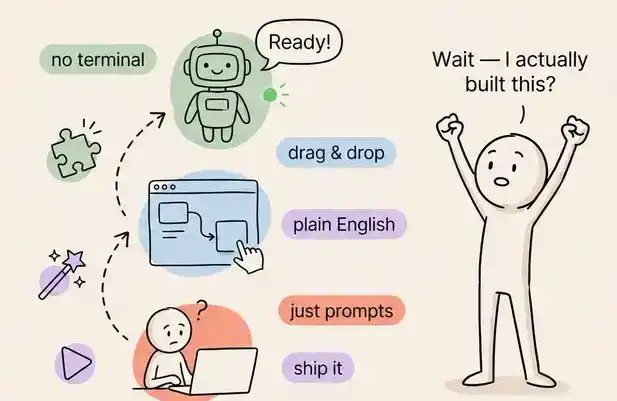
No Coding Required: Build Your First AI Agent in 2 Days (Complete Tutorial)

A No-Code Guide to Building Your First AI Agent in a Weekend This article presents a weekend, zero-code tutorial for beginners to build a functional AI Agent using tools like Claude. It clarifies the core difference between a chatbot, which responds to queries, and an Agent, which autonomously plans and executes multi-step tasks using tools to deliver a final result. The process is broken into four stages over two days: 1. **Saturday Morning: Understanding Agents.** Learn that an Agent requires a clear Goal, a Plan, necessary Tools, and an execution Loop. Identify a simple, multi-step task from your own work/life as your first project. 2. **Saturday Afternoon: Building with Claude.** Create a one-page "Agent Blueprint" answering: the Goal, sequential Steps, required Tools, the desired Output format, and error-handling rules. Implement this blueprint in Claude (Desktop Cowork or web Projects) and run the Agent for the first time. 3. **Sunday Morning: Debugging & Optimization.** Review the initial (often 60-70% accurate) output. Identify flaws, trace them back to vague instructions in your blueprint, and refine it with more specific criteria and error handling. Iterate this run-review-refine cycle 3-4 times to reach ~90% reliability. 4. **Sunday Afternoon: Expansion.** Apply the learned workflow to quickly build a second, different Agent (e.g., for research, content repurposing, or meeting prep), experiencing the compounding efficiency gains. The core skill is not writing a perfect blueprint initially, but rapidly iterating based on output. By the end of the weekend, you'll have built two usable Agents, moving beyond just chatting with AI to automating multi-step workflows, fundamentally changing how you approach repetitive tasks.

marsbit7h ago

No Coding Required: Build Your First AI Agent in 2 Days (Complete Tutorial)

marsbit7h ago

Trading

Spot
Futures
活动图片