Aave founder under scrutiny for $10M token purchase amid governance drama

cointelegraph2025-12-24 tarihinde yayınlandı2025-12-24 tarihinde güncellendi

Özet

Aave founder Stani Kulechov faces criticism for purchasing $10 million worth of AAVE tokens, with allegations that the move was intended to increase his voting power in a key governance proposal. Critics, including DeFi strategist Robert Mullins, claim the purchase could be used to vote against token holders' interests, highlighting concerns about governance attacks and the concentration of voting power. The controversy arises amid a heated vote on reclaiming control of Aave's brand assets through a DAO structure. Critics argue the proposal was rushed and note that a small group of large holders controls over 58% of the voting power, raising questions about the fairness of token-based governance.

Aave founder Stani Kulechov is facing scrutiny over his recent $10 million purchase of AAVE tokens, with some in the crypto community claiming it was used to boost his voting power in a key governance proposal.

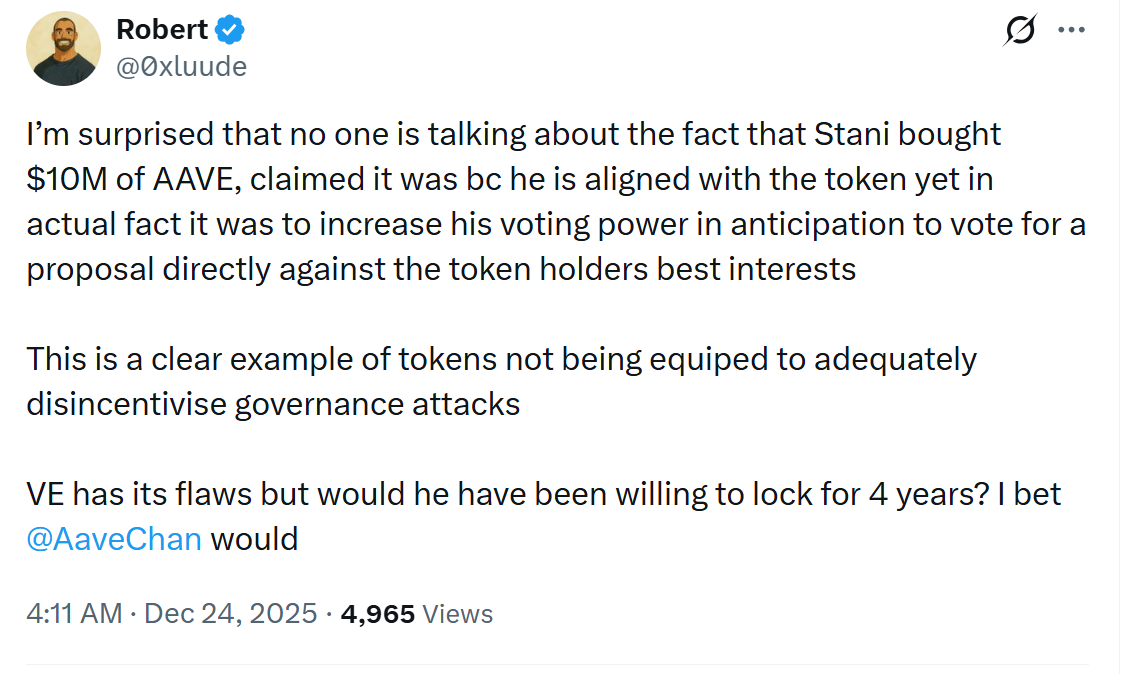
In a Wednesday post on X, Robert Mullins, a decentralized finance (DeFi) strategist and liquidity specialist, argued that the purchase was meant to increase Kulechov’s “voting power in anticipation to vote for a proposal directly against the token holders best interests.”

He added: “This is a clear example of tokens not being equipped to adequately disincentivize governance attacks.”

Prominent crypto user Sisyphus echoed those concerns, claiming that Kulechov might have sold “millions of dollars” worth of Aave (AAVE) tokens between 2021 and 2025, questioning the economic rationale behind the move.

The controversy comes as Aave token holders debate how governance power is exercised within one of DeFi’s largest protocols, with critics arguing that large token purchases can materially influence voting outcomes on high-stakes proposals. The dispute has reignited concerns about whether token-based governance adequately protects minority holders when founders or early insiders retain significant economic leverage.

Robert Mullins questions Kulechov’s motive behind recent purchase. Source: Robert Mullins

Aave governance vote sparks backlash

As Cointelegraph reported, Aave’s governance vote has triggered a backlash after a proposal on reclaiming control of the protocol’s brand assets was pushed to a snapshot vote despite ongoing debate.

The proposal asks whether AAVE token holders should regain ownership of domains, social accounts and intellectual property through a DAO-controlled legal structure.

Several stakeholders disputed that decision, arguing that the proposal was escalated prematurely.

Former Aave Labs CTO Ernesto Boado, listed as the proposal’s author, said the vote escalated without his consent and broke community trust.

Related: Aave founder outlines 2026 ‘master plan’ after end to SEC probe

Voting power concentration in Aave DAO

Samuel McCulloch of USD.ai pointed out the concentration of voting power. In an X post, he described the Aave vote as “silly,” adding that a small group of large holders accounted for about half of the total voting weight.

Snapshot data from the Aave DAO shows that the top three voters alone control more than 58% of the entire vote. The top voter, 0xEA0C...6B5A, holds 27.06% of the voting power (333k AAVE), while the second-largest voter, aci.eth, controls 18.53% (228k AAVE).

Cointelegraph reached out to Kulechov for comment, but did not receive a response by publication.

Magazine: Bitcoin whale Metaplanet ‘underwater’ but eyeing more BTC: Asia Express

İlgili Sorular

QWhy is Aave founder Stani Kulechov facing scrutiny for his recent token purchase?

AStani Kulechov is facing scrutiny because some in the crypto community claim his $10 million purchase of AAVE tokens was used to boost his voting power in a key governance proposal, potentially acting against token holders' best interests.

QWhat specific governance proposal has caused controversy in the Aave community?

AThe controversial proposal asks whether AAVE token holders should regain ownership of the protocol's brand assets, including domains, social accounts, and intellectual property, through a DAO-controlled legal structure.

QHow concentrated is the voting power in the Aave DAO according to the article?

AVoting power in Aave DAO is highly concentrated, with the top three voters controlling more than 58% of the total voting weight, and the top single voter holding 27.06% of the voting power.

QWhat criticism did Robert Mullins raise about Kulechov's token purchase?

ARobert Mullins argued that Kulechov's purchase was meant to increase his voting power to vote for a proposal that goes against token holders' best interests, calling it a clear example of tokens not being equipped to disincentivize governance attacks.

QWhat concern has this controversy reignited about token-based governance systems?

AThe controversy has reignited concerns about whether token-based governance adequately protects minority holders when founders or early insiders retain significant economic leverage and can influence voting outcomes through large token purchases.

İlgili Okumalar

Global Asset Rotation: Why Does Liquidity Drive the Cryptocurrency Cycle? (Part 1)

This article introduces a new series on global asset allocation and rotation, arguing that liquidity—not new narratives—is the primary driver of cryptocurrency market cycles. While narratives like RWA or X-402 can attract attention, they are triggers, not fundamental drivers. The real force is capital flow: ample liquidity amplifies even weak narratives, while liquidity contraction undermains the most compelling ones. The framework begins by mapping global assets not by traditional labels (stocks, bonds, commodities) but by their roles and dependencies within economic and liquidity cycles. Cryptocurrency is reclassified not as a traditional risk asset (like equities, which have cash flows and valuation models) but as a non-cash-flow alternative asset. Its price action is driven primarily by capital inflows and outflows, making it highly sensitive to liquidity and risk appetite. Five key macro indicators are identified as core drivers: interest rates (especially real rates), inflation metrics (CPI, PCE), economic growth indicators (PMI, GDP), systemic liquidity (central bank balance sheets, money supply), and risk appetite (volatility indices, credit spreads). A causal chain is proposed: inflation influences interest rates, which affect liquidity, which then drives risk preference and ultimately asset prices. The U.S. remains the anchor for global capital flows, and understanding its monetary policy cycle is crucial. During loose monetary conditions, risk assets like crypto thrive; during tightening, defensive assets like cash and bonds outperform. The article concludes that a structured framework focusing on macro drivers and cyclical patterns is essential for understanding asset rotation, avoiding emotional decisions, and identifying when liquidity shifts toward high-risk assets like cryptocurrency.

marsbit45 dk önce

Global Asset Rotation: Why Does Liquidity Drive the Cryptocurrency Cycle? (Part 1)

marsbit45 dk önce

İşlemler

Spot
Futures

Popüler Makaleler

Tartışmalar

HTX Topluluğuna hoş geldiniz. Burada, en son platform gelişmeleri hakkında bilgi sahibi olabilir ve profesyonel piyasa görüşlerine erişebilirsiniz. Kullanıcıların AAVE (AAVE) fiyatı hakkındaki görüşleri aşağıda sunulmaktadır.

活动图片