Claude Launches 'Invisible Watermark' Amid Criticism: New Model Fully Embedded, Tagging All Text

marsbitPublished on 2026-08-11Last updated on 2026-08-11

Abstract

Amidst user backlash, Anthropic announces that its latest Claude models will embed invisible watermarks directly into generated text, a move driven by compliance with the EU's AI Act. This "invisible ink," part of the text itself, is designed to persist through copying, pasting, and even some editing. The measure applies globally to all new models from August 2, 2026, with efforts underway to retroactively apply it to existing models. The system also adds signed metadata to supported image files. The watermarking technique, while not detailed by Anthropic, is speculated to potentially use invisible Unicode characters—a method the company has allegedly used before in Claude Code to discreetly tag content. The company is developing detection tools but acknowledges limitations: a watermark only indicates Claude processed the content, not authorship, and its absence doesn't guarantee human origin. Reactions are largely negative, with users criticizing the "unremovable" nature of the watermark and expressing concerns about potential impacts on output quality. In response, ideas for third-party tools to remove watermarks are already emerging, with some suggesting alternative AI models like Kimi as immediate workarounds.

Another questionable move from Company A has sparked widespread outrage online.

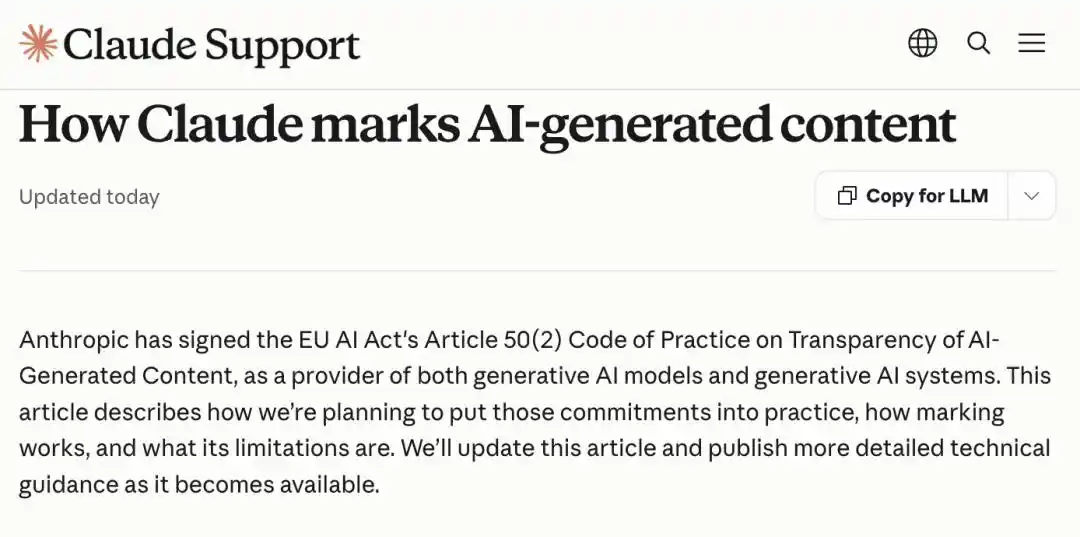
Just now, Anthropic announced: The new Claude will embed invisible watermarks in generated text.

Yes, not just metadata—these "ink marks" will become part of the text itself.

They will be copied and pasted along with the text to other places, and may still remain even after some degree of editing.

It's like a stubborn sticker that just won't come off...
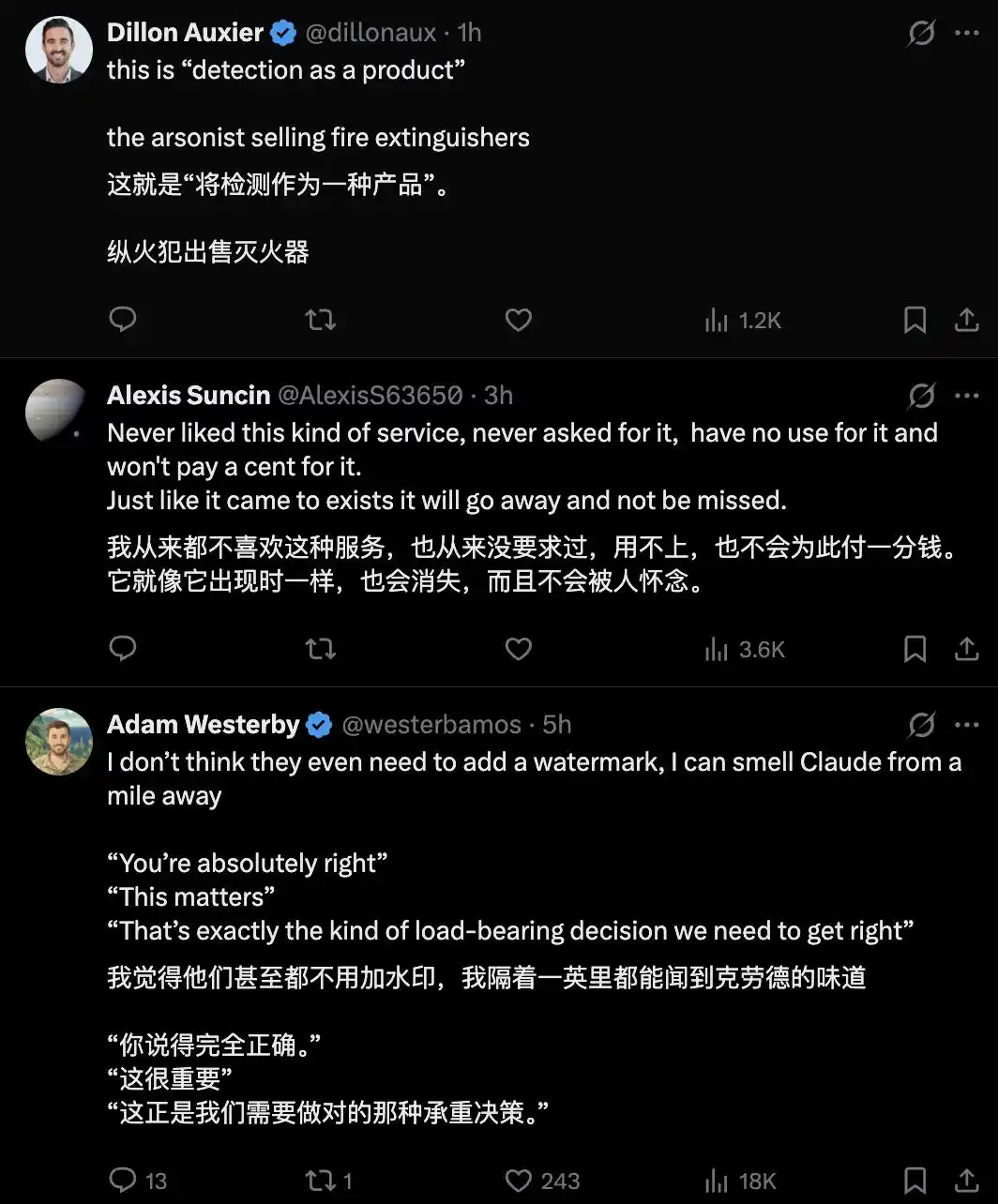
Netizens have already started voicing their anger collectively.
The direct driver of this move is the EU's AI Act, which Anthropic has signed. This mechanism will apply to all models released on or after August 2, 2026.

For Claude models already online, Anthropic is also researching how to add this watermarking mechanism retroactively.

Oh, and one more thing—

This measure will be implemented globally, not limited to the EU.

The great "Watermark Era" is here.

Text Gets Watermarks Too

Recently, Anthropic signed the EU AI Act's Transparency Code of Conduct for AI-Generated Content.

This code was drafted by independent experts, evaluated by the European Commission and the AI Office, and has been signed by about 190 institutions, including Google, Meta, Microsoft, OpenAI, and others.

For Claude, this translates into two specific things.

First, text watermarking.

Supported Claude models will weave a kind of invisible marker directly into the text when generating content.

Yes, completely invisible. You can't see it, and it doesn't change the meaning, quality, or readability of the response.

What's even scarier is that it's hard to get rid of.

The watermark is part of the text, copying and pasting will carry it along, and even edited versions might not be safe.

Second, signed metadata.

When Claude generates supported file types like .svg, .png, .jpg, it will attach digitally signed provenance metadata.

This metadata follows the C2PA open standard, promoted by Adobe, OpenAI, Google, and others. It can indicate the file was processed by Claude and also detect if the file has been tampered with.

The coverage is across the entire product line. API, Claude, Claude Code, Claude Cowork, Claude Tag are all included.

Cloud customers accessing Claude via AWS, Google Cloud, Microsoft Foundry will also be subject to this.

And there are no regional exceptions; it's uniformly implemented worldwide.

Meanwhile, Anthropic stated it is developing detection tools, allowing users and third parties to check whether a piece of text or a file carries the Claude marker.

Detailed technical documentation will be released by the company later.

However, Anthropic also explicitly noted the limitations of this mechanism.

Detecting a mark only indicates the content was processed by Claude, it does not confirm Claude as the original author.

After all, users often use Claude for proofreading, translation, summarization, format conversion—the core ideas and data may come from humans; marked content could also be modified, excerpted, or mixed with other materials afterward.

Conversely, not detecting a mark doesn't mean the content definitely wasn't AI-generated.

It might come from an older model, be heavily edited or rewritten, the paragraph might be too short to identify, or metadata might be stripped due to format conversion or screenshots...

Basically, everyone is under suspicion now...

As of now, Anthropic has not disclosed details of the watermarking algorithm.

In other words, no one knows what the "invisible ink" looks like, or what else Company A might be able to do with it.

Company A's Labeling Tactics

So, is there really such magic that makes watermarks in text completely invisible?

Yes.

And the tricks might be more numerous than you think.

The most famous is something called Unicode.

You can think of it as issuing ID cards to almost every character and symbol in the world: 'A' corresponds to one Unicode number, '中' (Chinese) corresponds to one Unicode number, even '🙂' corresponds to one Unicode number.

But beyond that, there exists a set of characters that are basically invisible to the human eye but distinguishable by computers.

For example, the simplest "Hello"—underneath, one might be H-e-l-l-o, and another might be H-e-invisible character-l-l-o.

They look completely identical to the human eye, but when a program reads the Unicode code points, it can find that the second string has an extra special character.

Amazing.

I wonder if everyone remembers, Company A had already "gracefully followed the trend" and used the Unicode trick before.

On June 30th, a Reddit user discovered a shocking truth after reverse-engineering Claude Code—

Claude Code's packaged files contained a set of Trojan-like code. If it detected you were a Chinese user, it would add two strokes of invisible ink to your system prompt—'Today's date is 2026-06-30'.

1. Changing the date format hyphens to slashes, marking a hit for the Chinese timezone.

2. The single quote in 'Today's' was quietly replaced with three characters that have different Unicode code points but are visually identical.

The result? In any editor, any terminal, this line looks exactly the same as the normal version. But in the program, you are already tagged.

Yes, Company A has been using Unicode to secretly tag users in Claude Code.

The company has not revealed whether the new Claude watermark uses this approach.
Looking at it this way, text watermarks might not be so bad, right? At least you won't get your account banned...

Moreover, various AI detection tools are of mixed quality, often charging dozens per detection and giving an AI-generated probability number with no logical basis. Having an official labeling channel could at least save a lot of wasted money.

The main reason for everyone's anger is Company A's history of similar actions.

But thinking carefully, AIGC content does need a reliable detection system, just like OpenAI adding C2PA metadata and SynthID watermarks to images.

However, does embedding watermarks by restricting the model's sampling distribution really not affect generation quality?

Company A's statement is—

No, it doesn't.

I remain skeptical.

After all, since version 4.6, Claude has been increasingly incomprehensible.

One More Thing

Regardless, the "Avengers Alliance" against Anthropic has already begun to act!

YC founder Paul Graham has already hatched a new startup idea, just waiting for aspiring individuals to join!

Create a third-party regeneration function, rephrase the text, preserving the original meaning while removing the watermark.
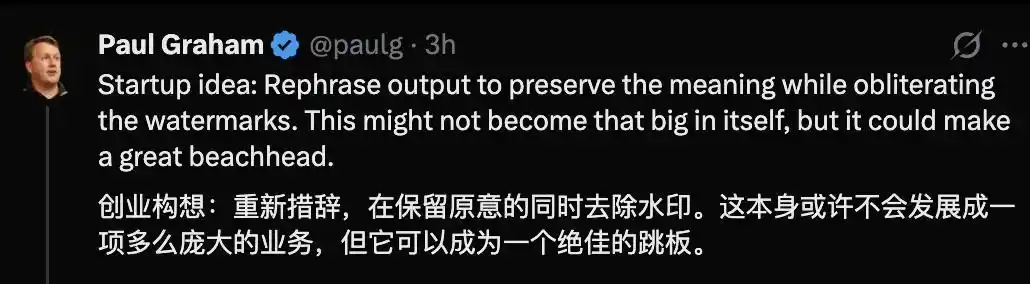
Of course, a more lightweight solution, usable by everyone right now, has also emerged—

Kimi, remove that invisible watermark.

Reference Links:

[1]https://support.claude.com/en/articles/16266773-how-claude-marks-ai-generated-content

[2]https://x.com/atharvabuilds/status/2086920300441268579?s=20

This article is from the WeChat public account "QbitAI", author: Jay

Trending Cryptos

Related Questions

QWhat is the main content of the EU's AI Act that Anthropic has signed, as mentioned in the article?

AThe main content is the 'AI-Generated Content Transparency Code of Conduct,' which requires the embedding of invisible watermarks into generated text and adding signed metadata to supported file types like .svg, .png, and .jpg, in compliance with the C2PA open standard.

QAccording to the article, what are the two specific measures Claude will implement regarding content marking?

AThe two measures are: 1) Embedding invisible, non-removable watermarks directly into the generated text itself. 2) Adding digitally signed provenance metadata to supported file types such as .svg, .png, and .jpg.

QWhat is one limitation of the watermarking and metadata system as acknowledged by Anthropic?

AA key limitation is that detecting a mark only proves the content was processed by Claude, but does not confirm Claude as the original author. Conversely, the absence of a mark does not guarantee the content is human-generated, as it could come from an older model, be heavily edited, or have metadata stripped during format conversion.

QWhat technique from the article's past example did Anthropic allegedly use to covertly mark content for Chinese users?

AIt allegedly used Unicode characters—specifically, changing date format hyphens to slashes and replacing a standard apostrophe in "Today's" with three visually identical but different Unicode code points—to invisibly tag content generated for users in the China timezone.

QWhat are two potential user reactions or solutions mentioned in the article regarding the new watermarking policy?

ATwo reactions/solutions mentioned are: 1) A startup idea from YC founder Paul Graham to create a third-party service that rephrases content to remove watermarks while preserving meaning. 2) A suggested immediate workaround of using another AI (like Kimi) with the prompt 'Remove that invisible watermark.'

Related Reads

Vitalik Updates Ethereum Roadmap: From Merge to 'Lean Refactoring', with STARK, AI, and Privacy Reshaping the Technical Foundation

Vitalik Buterin has updated Ethereum's long-term roadmap, outlining a major shift from the post-Merge evolution toward a "Lean Ethereum" vision. The update builds on the 2023 framework but reorders priorities and introduces new concepts. Key continuations include improving consensus (single-slot finality), scaling data availability (larger blobs), simplifying light client verification with SNARKs/STARKs, and protocol simplification. Major adjustments involve significantly prioritizing quantum resistance due to heightened perceived threats, while deprioritizing items like VDFs and some EVM improvements. Technical replacements are planned, such as moving from Verkle trees to a unified Binary Tree and eventually PBTs, and rethinking state management with "New State Types." Notable new additions are: 1. Making **privacy a top-tier priority**, aiming to build it natively into the protocol. 2. **Radical scaling under post-quantum conditions**, using techniques like leanSPHINCS signatures and zkzk frames. 3. **Protocol "Lean-ification" and formal verification**, leveraging modern AI tools to make full formal verification feasible. 4. Exploring **Blob and Gas futures** for future capacity. 5. Developing **Native Rollups**, deeply integrating rollup capabilities into the protocol. 6. **Reimagining the EVM's future**, potentially exposing a simpler, modern instruction set (e.g., leanISA or RISC-V), with EVM becoming a compatibility layer. The core philosophy shifts toward specializing mechanisms for high-load activities (transfers, swaps, privacy) to gain scalability, rather than attempting to infinitely scale all activities. It also elevates **recursive STARKs and AI-assisted formal verification** as foundational infrastructure. In summary, Ethereum is embarking on a systemic "third-generation" redesign—Lean Ethereum—involving replacements or rewrites of major components. The goal is to achieve a quantum-safe, privacy-first, secure, decentralized, and highly scalable network while maintaining a lean and verifiable protocol.

marsbit2m ago

Vitalik Updates Ethereum Roadmap: From Merge to 'Lean Refactoring', with STARK, AI, and Privacy Reshaping the Technical Foundation

marsbit2m ago

China Monopolizes the Humanoid Market: The U.S. Is Forced to Defend Itself

China's Humanoid Robot Market Domination and US Response According to a report by Smart Analytics Global (SAG), Chinese manufacturers supplied over 97% of the global humanoid robot shipments (approximately 19,100 units) in the first half of 2026, a 272% year-on-year increase. Shanghai-based AGIBOT led with a 44% market share, followed by Unitree Robotics with 31%. Together, these two firms accounted for about 75% of global shipments. China itself represented over 85% of global demand for these devices, with industrial and commercial applications now comprising more than 70% of shipments. Key factors driving China's leadership include strong state support, abundant funding, expanding production capacity, IPO waves for developers, and a vast manufacturing ecosystem for rapid testing and deployment. Furthermore, over 90% of key components for humanoid robots are now sourced domestically. In response, the US Federal Communications Commission (FCC) banned federal agencies and subsidy recipients from purchasing or using foreign "advanced robotic devices," including humanoid and quadruped robots, citing national security concerns in July 2026. SAG forecasts global shipments to approach 60,000 units for full-year 2026, with industry revenue around $1.6 billion, projecting 500,000 units by 2030. The analysis notes potential challenges for Chinese expansion, such as reputational risks from alleged ties to China's defense sector and the precedent of trade disputes seen in solar panels and batteries, potentially triggered by the current low average robot price.

cryptonews.ru21m ago

China Monopolizes the Humanoid Market: The U.S. Is Forced to Defend Itself

cryptonews.ru21m ago

What's New in Ethereum's Roadmap: Privacy, Quantum Security, Native Rollup?

On August 10, 2024, Ethereum co-founder Vitalik Buterin revealed an updated technical roadmap, highlighting significant changes in priorities and new focus areas. Key new additions include: - **Strong Privacy Protection**: Elevated to a top-tier protocol concern. Proposals like EIP-8250 (keyed nonces for concurrency), EIP-8272 (recent roots for verification), and EIP-8182 (shared protocol-level privacy pools) aim to enable private transfers of ETH and ERC-20s, moving toward default private accounts. - **Quantum Resilience**: Priority increased. The plan addresses risks to ECDSA/BLS signatures, KZG commitments, and ZK systems, exploring solutions like leanSPHINCS signatures, STARK proofs (considered quantum-resistant), and streamlined verification processes. A full L1 upgrade is tentatively targeted for ~2029. - **Native Rollups**: A novel concept where rollups could reuse Ethereum's core validation infrastructure via a new EXECUTE precompile (EIP-8079 draft). This aims to reduce custom code and enhance security for certain L2s, while specialized chains will continue to exist. - **Protocol Simplification & Formal Verification**: Leveraging AI tools to make full-protocol formal verification feasible, aiming for more rigorous and machine-verifiable specifications. Other notable shifts: - State storage is evolving from Verkle trees to a Partitioned Binary Tree (PBT, EIP-8347 draft). - Some 2023 items like VDFs and certain EVM improvements were deprioritized. - Long-term discussions include blob/gas futures and non-EVM instruction sets (e.g., RISC-V). The "Strawmap" outlines potential upgrades through ~2029 but is a directional guide, not a firm timeline. Key milestones to watch include the Glamsterdam (Q4 2026) and Hegotá (2027) forks. Many proposals remain in draft or research phases.

marsbit42m ago

What's New in Ethereum's Roadmap: Privacy, Quantum Security, Native Rollup?

marsbit42m ago

Hyperliquid Trading Volume Soars, So Why Are Profits Falling?

Hyperliquid, a leading decentralized perpetuals trading platform, has seen its open interest surge to a record high above $11 billion, capturing roughly 9% of the global market share. Trading volume remains robust, nearing $178 billion over 30 days, driven largely by the explosive growth of third-party markets offering tokenized real-world assets (RWAs) like stocks and commodities. Despite this growth, the platform's protocol revenue has declined for four consecutive quarters, falling 43% from its Q3 2025 peak of $357 million to approximately $202 million in Q2 2026. This divergence is primarily attributed to the HIP-3 governance proposal, which allows external developers to launch their own markets and keep up to half of the generated fees. These third-party markets now account for nearly 50% of total volume. Consequently, the share of revenue redistributed to developers, market makers, and the treasury has tripled from 6% to 18% in a year. This directly reduces the funds allocated to the platform's buyback-and-burn mechanism for its native HYPE token, weakening a key price support. HYPE's price has fallen 28% from its all-time high. The platform's growth is also heavily concentrated, with a single entity, Trade.xyz, responsible for over 90% of HIP-3 open interest, introducing systemic risk. Additionally, the ecosystem lacks diversity beyond HYPE, faces ongoing token unlocks adding sell pressure, and is encountering increased regulatory scrutiny and new competition from platforms like Robinhood Chain. While still a major revenue generator in crypto, Hyperliquid's model of sharing fees to fuel expansion is currently compressing its own earnings and token economics.

marsbit42m ago

Hyperliquid Trading Volume Soars, So Why Are Profits Falling?

marsbit42m ago

Trading

Spot

Hot Articles

How to Buy MOVE

Welcome to HTX.com! We've made purchasing Movement (MOVE) simple and convenient. Follow our step-by-step guide to embark on your crypto journey.Step 1: Create Your HTX AccountUse your email or phone number to sign up for a free account on HTX. Experience a hassle-free registration journey and unlock all features.Get My AccountStep 2: Go to Buy Crypto and Choose Your Payment MethodCredit/Debit Card: Use your Visa or Mastercard to buy Movement (MOVE) instantly.Balance: Use funds from your HTX account balance to trade seamlessly.Third Parties: We've added popular payment methods such as Google Pay and Apple Pay to enhance convenience.P2P: Trade directly with other users on HTX.Over-the-Counter (OTC): We offer tailor-made services and competitive exchange rates for traders.Step 3: Store Your Movement (MOVE)After purchasing your Movement (MOVE), store it in your HTX account. Alternatively, you can send it elsewhere via blockchain transfer or use it to trade other cryptocurrencies.Step 4: Trade Movement (MOVE)Easily trade Movement (MOVE) on HTX's spot market. Simply access your account, select your trading pair, execute your trades, and monitor in real-time. We offer a user-friendly experience for both beginners and seasoned traders.

5.5k Total ViewsPublished 2024.12.10Updated 2026.06.02

How to Buy MOVE

Discussions

Welcome to the HTX Community. Here, you can stay informed about the latest platform developments and gain access to professional market insights. Users' opinions on the price of MOVE (MOVE) are presented below.

活动图片