Football Draw Harvests Whales: Extreme Profit-Loss Divergence on Polymarket's World Cup

Foresight NewsPublished on 2026-06-18Last updated on 2026-06-18

Abstract

A bettor known as "fishalive" made a stunning profit of nearly $9 million on the Polymarket prediction platform by correctly wagering against favorites during the 2026 FIFA World Cup group stage. The account, registered just before the tournament, risked roughly $400,000 on two contracts for a Spain vs. Cape Verde match: one that Spain would *not* win, and another on a Cape Verde +2.5 goal handicap. The resulting 0-0 draw triggered both payouts. This single event, with a total market volume of $64 million, highlighted extreme profit-and-loss divergence. Other traders, like "betoor619" and "leeeeroyjenkins," lost millions by betting heavily on favorites Spain and Belgium to win outright—contracts that become worthless in a draw. The article explains that while markets heavily favored strong teams, the "team to win" contracts are binary and do not account for the common outcome of a draw. This creates high-risk, low-reward scenarios for favorite backers, while asymmetric profits flow to those betting on underdogs or against outright wins. The transparency of Polymarket's on-chain ledger publicly documents these massive wins and losses, driving mainstream media coverage. As the tournament progresses, the author suggests traders may shift towards hedging strategies that account for draws. The piece also notes growing regulatory scrutiny in the US and Europe, questioning whether such large-scale, anonymous sports prediction markets should be regulated as gambling or financial d...


By: Gino Matos

Compiled by: Saoirse, Foresight News


In the June 14th match where Spain faced Cape Verde, Spain dominated possession at nearly 75% and fired off 27 shots — statistics that, in most tournaments, would guarantee a victory. However, the final score was 0-0, with Cape Verde's 40-year-old goalkeeper Vozinha named Man of the Match. This draw caused significant losses for many bettors on Polymarket, while simultaneously allowing an unknown wallet to rake in approximately $9 million in a single day.


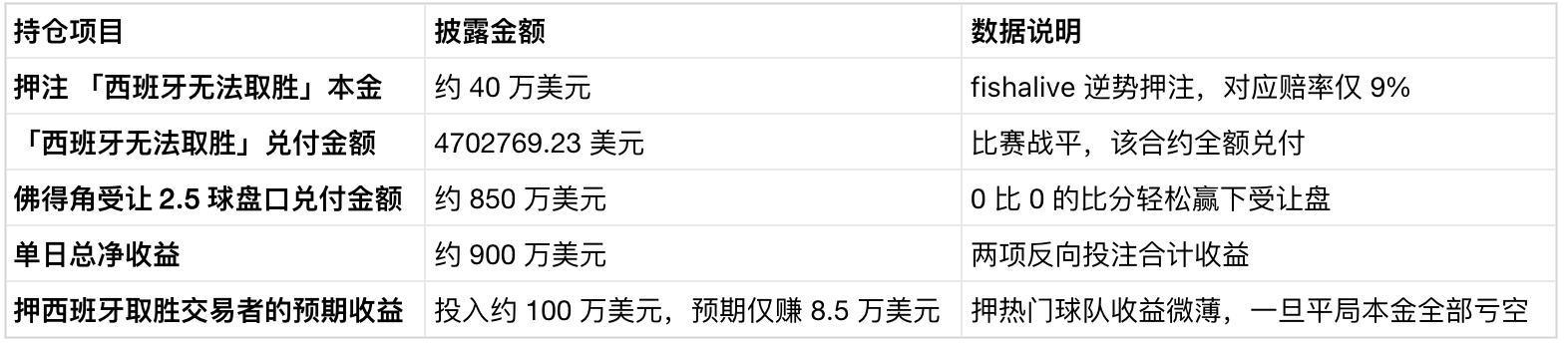
The wallet, belonging to an account named 'fishalive', was only registered on Polymarket in June 2026, with only two predictive bets in its public record. The account bet on the contract "Spain will not win," cashing out around $4.7 million; simultaneously, it placed a bet on the Cape Verde +2.5 handicap spread (a sports betting rule to balance odds between strong and weak teams, manually adding 2.5 goals to Cape Verde's total before comparing scores), securing another approximately $8.5 million. With an initial investment of only about $400,000, it netted nearly $9 million.


Data from Polymarket's sports section shows that this $400,000 bet had an initial implied probability of only 9%, with a final payout reaching $4,702,769.23. The bet's size, timing (placed just 8 minutes before kickoff), and the account's recent registration sparked extensive online discussion. Commenters noted that the $4.5 million position was established just 8 minutes before the match started.


This newly registered wallet accurately predicted Cape Verde's chances, and the platform's fully public on-chain ledger allowed everyone to witness the entire process of this massive profit realization in real-time.


Position and Profit Data Overview:


In the single market for the World Cup winner alone, Polymarket's trading volume reached $24.6 billion. Market odds show France leading in championship expectations at about 17.6%, followed closely by Spain at 13.9%; Portugal and England are not far behind at 10.8% and 10.5% respectively. The winner contract will settle around July 20th. Polymarket states that for the 2026 World Cup, there are a total of 362 active trading markets across all categories, with total volume exceeding $25 billion.


The enormous trading scale turns individual football matches into independent financial trading events. For the Spain vs. Cape Verde match alone, platform trading volume reached $64 million.


Popular Teams Suffer Upsets, Bettors Face Widespread Losses


A trader named 'betoor619' bet on a Spain win with an implied probability as high as 92%. He invested nearly $1 million in principal, with a potential profit of only $85,000. The draw rendered this position completely worthless.


Days earlier, Polymarket's sports section had recorded a similar operation: another user invested $1 million betting on Spain to defeat Cape Verde, which would have returned only $1,085,943.48 if successful. Cape Verde held firm for the entire match, not conceding even in stoppage time, earning their first-ever World Cup point and voiding both bets on a Spanish victory.


The same script played out again within 24 hours. Media outlet Inc. reported that trader 'FlickRaw' incurred total losses of approximately $4.2 million: $2.7 million betting on the Netherlands to defeat Japan and $1.5 million on Belgium to defeat Egypt. Japan equalized twice, with an 88th-minute goal locking the final score at 2-2; Belgium conceded to Egypt in the 19th minute, equalized in the 66th, but ultimately settled for a 1-1 draw.



The draw between Belgium and Egypt also wiped out the single largest bet of the tournament so far: trader 'leeeeeroyjenkins' invested $8.6 million on a Belgium win. Had the team succeeded, he would have received a payout of about $13.1 million. Polymarket's sports section updated the match odds in real-time, first announcing Egypt's 1-0 halftime lead and finally confirming the draw, resulting in a complete loss for this massive bet.


Why Do Bets on Favorites Lead to Widespread Losses?


Theoretically, Spain, the Netherlands, and Belgium were clearly stronger, a judgment shared by the trading markets. However, "team to win" contracts only pay out under a single outcome, while draws are common in football. Once the final whistle blows with a tied score, even the most dominant performance renders the bet slip worthless.


Shares for "team to win" were priced as high as 92 cents, with the market assuming victory was almost certain. But if the team fails to score one more goal, the share value plummets to zero. 'fishalive's' two bets were profitable because the "Spain will not win" contract and the Cape Verde +2.5 handicap spread both pay out in the event of a draw. All traders betting on favorites to win this week fell victim to the draw.


The championship expectation rankings reflect shifts in market sentiment. As match results come in, traders continuously reassess each national team's probability of winning. Single-match contracts have extremely high visibility: they settle in 90 minutes, and screenshots of large profits and losses spread easily on social media, meaning unreasonable large bets pay the price immediately.


Large traders concentrated heavily on favorites to win, but the contracts offering high asymmetric returns are always those like handicap spreads and "team will not win" bets, which price in the risk of a draw in advance.


Pre-tournament predictive models from Goldman Sachs gave Spain a 26% probability of winning the tournament, higher than France's 19%. However, after Cape Verde held Spain to a draw, Polymarket's market funds repriced, and France's championship expectations directly overtook Spain's.


The World Cup has a global audience, and fans generally understand match outcome logic. The dense group stage schedule creates new market hotspots every few hours. National team events carry strong emotional attributes, independent of financial gains or losses. Simultaneously, the transparent settlement mechanism generates a complete, screenshot-worthy transaction record for every large bet. All these characteristics allow prediction markets to break through the crypto industry bubble and reach a mainstream audience.


Two Major Development Trends Ahead


As the knockout stage approaches, World Cup-related trading volume will continue to expand. Public on-chain wallet records, real-time odds movements, and emotionally charged national team events keep Polymarket a focal point for ongoing sports media coverage.


The profit story from the Cape Verde match and the massive loss case from the Belgium match are just the beginning of this tournament. New high-profile, large-scale trading stories will emerge every few days. Compared to traditional sports betting, single-match trading markets offer a faster pace and more immediate impact from profits and losses.
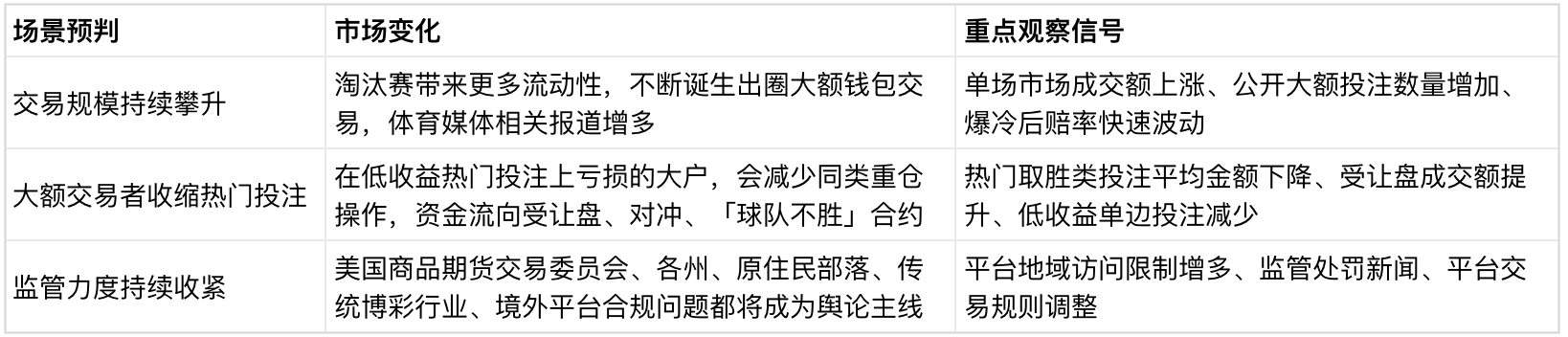


A scenario where major players reduce their betting is foreseeable: many traders, like those betting on Spain to win, invested millions expecting only tens of thousands in returns. After consecutive losses, they will reduce one-sided heavy positions, and funds will shift towards contracts that hedge draw risk in advance, such as handicap spreads and反向投注合约 contracts.


Regulatory resistance will further accelerate this trend. On June 10th, the U.S. Commodity Futures Trading Commission (CFTC) released a draft rule proposal aiming to establish a federal regulatory framework for prediction markets, while acknowledging the price discovery value of sports-related contracts. However, U.S. states, Native American tribes, and the traditional gambling industry collectively oppose this regulatory approach. A survey by the American Gaming Association shows that 85% of the U.S. public classify these prediction contracts as gambling.


As early as late May, Spain briefly banned Polymarket and Kalshi due to compliance qualification issues. This incident also shifted the focus of public debate from market growth to regulatory controversy: whether anonymous wallets and multi-million dollar sports bets should be subject to the same regulatory standards as financial derivatives.


It is currently impossible to determine whether 'fishalive's' massive profit resulted from accurate market judgment, pure luck, or exploitation of a pricing flaw in one-sided "win" contracts — Polymarket's on-chain ledger alone cannot provide the answer. But the ledger clearly records, match after match, funds flowing from bettors convinced of the favorite's certain victory to traders who understand the risk of a football draw.


Trending Cryptos

Related Questions

QWho was the biggest winner in the Spain vs. Cape Verde match on Polymarket, and what was their approximate profit?

AThe biggest winner was a user with the account name 'fishalive'. This user placed bets on contracts for 'Spain cannot win' and 'Cape Verde +2.5 handicap'. With an initial investment of approximately $400,000, they earned a net profit of nearly $9 million.

QWhat does the article suggest is a key risk for traders who heavily bet on favored teams to win on Polymarket?

AThe article suggests a key risk is the prevalence of draws in football. Bets on a team to win ('win-only' contracts) only pay out if that specific outcome occurs. If the match ends in a draw, these bets become worthless, regardless of how dominant the favored team was during the game.

QAccording to the article, how did the Spain vs. Cape Verde result impact the championship odds for Spain and France on Polymarket?

ABefore the match, Spain had higher championship odds than France. However, after Spain's draw with Cape Verde, the market repriced the odds, and France's championship expectation surpassed Spain's on the Polymarket platform.

QWhat are the two major future trends for prediction markets like Polymarket discussed in the article's conclusion?

AThe two major trends discussed are: 1) Large traders may shift their strategies away from heavy, one-sided bets on favorites towards contracts that hedge against draws, such as handicap or 'cannot win' bets. 2) Increased regulatory scrutiny and challenges, as authorities debate whether these anonymous, large-scale sports prediction contracts should be classified and regulated as gambling or financial derivatives.

QWhat was the total trading volume for the Spain vs. Cape Verde match alone on Polymarket, according to the article?

AAccording to the article, the total trading volume for the Spain vs. Cape Verde match on Polymarket reached $64 million.

Related Reads

Ethereum 2026 Q1 Review: On-Chain Activity Hits Record Highs, Tokenized Assets Lead the Industry

Ethereum Q1 2026 Review: Record On-Chain Activity, Tokenized Assets Lead the Industry. Despite a price correction impacting USD-denominated metrics, Ethereum's on-chain usage hit all-time highs in Q1 2026. Monthly active addresses surged 85.9% year-over-year to 13.2 million, while L1 transactions and throughput also set new records. This growth occurred alongside a significant 47.9% quarterly drop in L1 transaction fees, demonstrating the impact of network scaling via upgrades like the Blob Parameter Fork. The ecosystem maintained its dominance in decentralized finance (DeFi), holding 71% of the total value locked among top chains and 79.2% of active borrowing. Ethereum solidified its position as the primary platform for tokenized real-world assets (RWAs), with a total market cap of $203.4B. It holds leading shares in stablecoins (61.8%), tokenized funds (73%), and tokenized commodities (84%) across major chains. Key developments included the ERC-8004 standard for AI agents and heightened institutional engagement at forums. Major financial institutions like BlackRock, JPMorgan, and a European banking consortium announced new tokenized products on Ethereum throughout the period. The report draws parallels to the early internet, suggesting Ethereum is sacrificing short-term fee revenue for long-term network expansion and adoption. Its strategy focuses on becoming a neutral, open settlement layer for global finance, with scaling roadmaps aiming for tens of thousands of TPS by 2029.

marsbit10m ago

Ethereum 2026 Q1 Review: On-Chain Activity Hits Record Highs, Tokenized Assets Lead the Industry

marsbit10m ago

Matrixdock Featured Again in SBMA’s 《Crucible》: Discussing How Tokenisation Enhances Efficiency in the Precious Metals Market

Matrixdock's research article, titled "Why Tokenisation Matters for the Bullion Industry and How Carrying Costs Fit In," has been featured again in the SBMA's industry publication *Crucible*. Authored by Matrixdock lead Eva Meng, the piece examines how tokenisation enhances the efficiency and utility of the precious metals market. The article argues that tokenisation builds upon the accessibility improvements brought by gold ETFs, not by redefining gold's value but by enabling it to function within digital finance. It extends gold's role beyond a portfolio holding, potentially facilitating instant settlement, digital collateral, and operation in 24/7 markets. A key focus is transparently handling the unavoidable carrying costs (storage, insurance) of physical assets like gold and silver. Matrixdock introduces the Fungible Reserve Standard (FRS) framework, based on an "Economic Purity Principle," which aims to reflect these real-world economic costs clearly within the token mechanism, rather than bundling them opaquely. The platform's practical applications are highlighted, including its gold token XAUm and its silver token XAGm, the first built on the FRS framework. As the tokenised gold market surpassed $6 billion in February 2026, the industry's focus is shifting from initial proofs of reserves to broader concerns of market efficiency and capital utilization. Tokenisation is positioning gold and other precious metals to become active components within the evolving digital financial system.

marsbit42m ago

Matrixdock Featured Again in SBMA’s 《Crucible》: Discussing How Tokenisation Enhances Efficiency in the Precious Metals Market

marsbit42m ago

New Huo Research: Dense Bottom Fishing in the $60K BTC Range, a 'High Value-for-Money Zone' Sees a Handover Surge

Bitcoin has shown a significant oversold rebound this week, with extreme panic in the crypto market easing. Multiple data points indicate a notable market bottom is forming. On the market front, the net outflow from Bitcoin spot ETFs has continued to shrink, and the negative premium between Coinbase and USDT is steadily correcting. Industry fundamentals suggest the shutdown cost for mainstream miners is concentrated between $30,000 and $50,000, potentially solidifying a阶段性 industry cost floor—a classic signal of market bottoms in previous cycles. Institutional capital is notably positioning against the trend. For instance, Sinohope Group's weekly OTC trading volume surged over 8 times环比, with active platform users doubling, both reaching record highs. This confirms a sharp increase in large capital transaction activity and a spike in off-exchange funding demand. Sinohope Research also observed on-chain data showing that funds from entities with public company attributes and long-term "whale" wallets are actively accumulating Bitcoin around the key $60,000 price level. The research institute has maintained since mid-May that a high-value investment window has reopened, and the market is now undergoing a shift from panic selling to long-term holding. Looking ahead, the core drivers for an upward market move will be liquidity release and macro policy developments. The successful and strong performance of SpaceX's IPO has reignited market optimism, and the massive liquidity frozen during its subscription period is now being unlocked. This substantial capital is expected to seek new value opportunities, potentially flowing into currently undervalued assets like Bitcoin. On the macro and policy front, the tone set in Kevin Warsh's upcoming speech at the FOMC meeting is crucial for near-term monetary policy expectations. Furthermore, the potential passage of the CLARITY Act by late July could significantly boost institutional confidence for capital entry. Considering these bottoming signals alongside favorable liquidity and policy factors, Sinohope Research remains optimistic about the market's subsequent trajectory.

marsbit46m ago

New Huo Research: Dense Bottom Fishing in the $60K BTC Range, a 'High Value-for-Money Zone' Sees a Handover Surge

marsbit46m ago

Trading

Spot
Futures

Hot Articles

Discussions

Welcome to the HTX Community. Here, you can stay informed about the latest platform developments and gain access to professional market insights. Users' opinions on the price of S (S) are presented below.

活动图片