Matrixdock Featured Again in SBMA’s 《Crucible》: Discussing How Tokenisation Enhances Efficiency in the Precious Metals Market

marsbitPublished on 2026-06-18Last updated on 2026-06-18

Abstract

Matrixdock's research article, titled "Why Tokenisation Matters for the Bullion Industry and How Carrying Costs Fit In," has been featured again in the SBMA's industry publication *Crucible*. Authored by Matrixdock lead Eva Meng, the piece examines how tokenisation enhances the efficiency and utility of the precious metals market. The article argues that tokenisation builds upon the accessibility improvements brought by gold ETFs, not by redefining gold's value but by enabling it to function within digital finance. It extends gold's role beyond a portfolio holding, potentially facilitating instant settlement, digital collateral, and operation in 24/7 markets. A key focus is transparently handling the unavoidable carrying costs (storage, insurance) of physical assets like gold and silver. Matrixdock introduces the Fungible Reserve Standard (FRS) framework, based on an "Economic Purity Principle," which aims to reflect these real-world economic costs clearly within the token mechanism, rather than bundling them opaquely. The platform's practical applications are highlighted, including its gold token XAUm and its silver token XAGm, the first built on the FRS framework. As the tokenised gold market surpassed $6 billion in February 2026, the industry's focus is shifting from initial proofs of reserves to broader concerns of market efficiency and capital utilization. Tokenisation is positioning gold and other precious metals to become active components within the evolving digita...

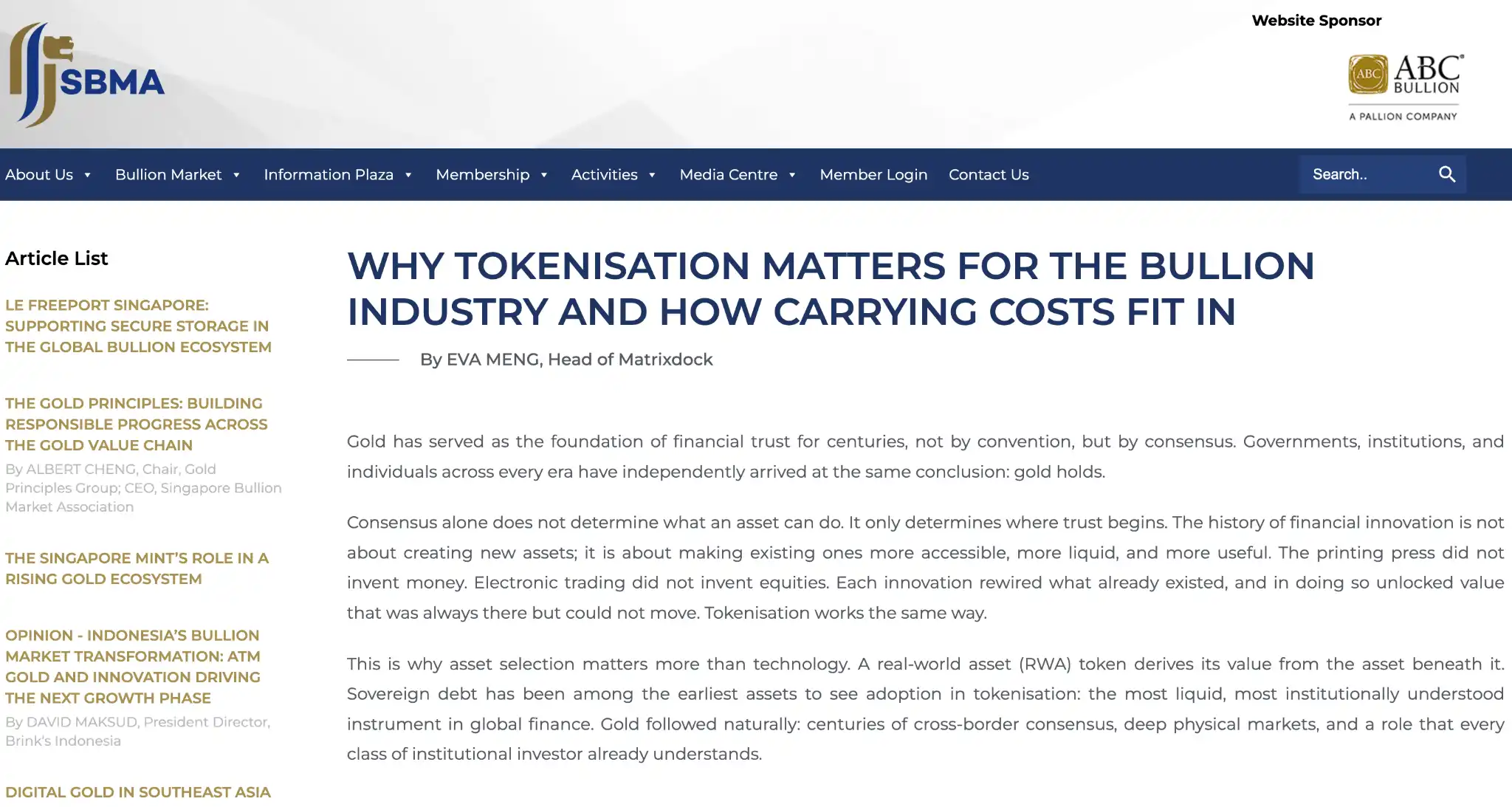
Recently, a research article from Matrixdock, the RWA tokenisation platform under BIT (formerly Matrixport), was published again in《Crucible》, the industry publication of the Singapore Bullion Market Association (SBMA). Matrixdock's Head, Eva Meng, published an article titled "Why Tokenisation Matters for the Bullion Industry and How Carrying Costs Fit In", discussing how tokenisation enhances the usability and capital efficiency of precious metal assets from perspectives such as market efficiency, carrying costs, and the evolution of precious metals market infrastructure.
As an SBMA member, Matrixdock has been actively participating in global precious metals industry discussions since joining the association. Following previous insights on transparency and asset verification mechanisms for tokenised gold, this publication further extends the discussion focus to market efficiency and financial infrastructure upgrades, reflecting that tokenised precious metals are gradually gaining more attention from the traditional precious metals industry.

ETFs Changed How Gold is Invested In, Tokenisation Further Expands Gold's Use Cases

Gold has long been regarded as an important store of value, with its value consensus spanning nations and markets, persisting through centuries of financial evolution. However, the stability of an asset's value does not mean its usage remains static. From paper certificates to electronic trading, and then to ETFs, each upgrade in financial infrastructure has continuously improved the liquidity and accessibility of gold.

The article posits that the changes brought by tokenisation are similar. It does not seek to redefine gold but, while preserving gold's value attributes, enables this traditional asset to enter the digital financial system more efficiently.

Over the past two decades, gold ETFs have significantly lowered investment barriers, allowing gold to enter modern investment portfolios more easily. However, the core objective of ETFs is to provide price exposure, not to enable gold to directly participate in broader financial activities. With the development of digital finance, the market is beginning to ask new questions: Beyond holding gold, can gold be used for instant settlement? Can it be used as digital collateral? Can it circulate in markets that operate around the clock?

In this context, tokenised gold does not aim to replace ETFs. Instead, building upon the improved accessibility for gold investment already achieved by ETFs, it seeks to further enhance gold's liquidity and usability, gradually equipping gold with broader application capabilities such as settlement, collateral, and payment, moving beyond its role as merely a portfolio allocation tool.

Carrying Costs Do Not Disappear; Transparent Mechanisms are Key for Real-World Assets

For physical assets like gold and silver, costs for storage, insurance, and custody always exist objectively. Especially for silver, due to its lower unit value and larger volume, the issue of carrying costs is more pronounced.

Traditional ETFs typically cover related costs through an expense ratio, but the actual custody costs, management fees, and profit margins are often bundled together, making it difficult for investors to clearly distinguish the sources of different costs.

Addressing this issue, Matrixdock introduced the Fungible Reserve Standard (FRS) framework in the article, hoping to reflect the carrying costs of real-world assets in a more transparent manner through FRS. The underlying Economic Purity Principle emphasizes that tokens should faithfully reflect the economic characteristics of the underlying asset, not obscure them.

Matrixdock believes that the key to tokenising real-world assets is not merely putting assets on-chain but, more importantly, accurately reflecting the true economic attributes of the assets in a transparent manner.

From XAUm to XAGm, Matrixdock Expands Precious Metals Tokenisation Practice

The article also introduced Matrixdock's practice in the field of precious metals tokenisation. As the first tokenised asset built on the FRS framework, XAGm transparently incorporates carrying costs into the token mechanism; while the gold token XAUm represents Matrixdock's core practice in institutional-grade gold tokenisation.

From gold to silver, Matrixdock is exploring more transparent, chain-based expression methods for different precious metal assets that better align with their economic properties.

Notably, as the market develops, industry focus is also shifting. The early market paid more attention to proof-of-reserves and asset authenticity. As the market matures, the industry is beginning to focus more on issues like asset efficiency and capital utilization. According to data cited in the article, the market size for tokenised gold surpassed $6 billion in February 2026 and has seen significant growth over the past year. The article points out that as the market size continues to expand, tokenised gold is gradually becoming an important component in the digitisation process of the precious metals market.

If ETFs made gold an integral part of modern investment portfolios, then tokenisation is pushing gold further into the digital financial system. The value of gold has not changed, but its methods of use and application scenarios are continuously expanding. From a store of value tool to a digital asset capable of supporting settlement, collateral, and broader financial operations, the development of precious metals tokenisation may still be in its early stages.


Trending Cryptos

Related Questions

QWhat is the core argument made by Matrixdock's Eva Meng in the SBMA Crucible article regarding tokenization's role in the bullion industry?

AEva Meng argues that tokenization does not aim to redefine gold's value but rather to enhance its efficiency and usability within the digital financial system. It builds upon the accessibility provided by ETFs by increasing liquidity and enabling new use cases like instant settlement, digital collateral, and operation in 24/7 markets.

QAccording to the article, how does the Fungible Reserve Standard (FRS) framework address the issue of holding costs for precious metals?

AThe FRS framework addresses holding costs by promoting transparency. It aims to clearly and accurately reflect the real economic costs of storage, insurance, and custody for physical assets like gold and silver within the token mechanism, adhering to an 'Economic Purity Principle.' This contrasts with traditional ETFs where such costs are often bundled into a total expense ratio without clear breakdowns.

QWhat are the two specific tokenized assets mentioned that Matrixdock has developed, and what do they represent?

AMatrixdock has developed two tokenized assets: XAUm, which represents their institutional-grade gold tokenization practice, and XAGm, which is the first tokenized asset built on the FRS framework designed to transparently incorporate holding costs for silver.

QHow does the article contrast the impact of Gold ETFs with the potential of tokenized gold?

AThe article states that Gold ETFs primarily lowered the investment barrier and provided price exposure, making gold a part of modern portfolios. Tokenized gold, however, aims to go further by enhancing liquidity and usability, enabling gold to function in applications such as instant settlement, collateralization, and payment within the digital finance ecosystem.

QWhat shift in industry focus does the article note as the tokenized gold market matures?

AThe article notes a shift in industry focus from early concerns about proof-of-reserves and asset authenticity to a growing emphasis on asset efficiency and capital utilization as the tokenized gold market matures and expands in size.

Related Reads

My Coding Betting Dashboard is Profiting, but Polymarket is Truly Not a Good Place for 'Arbitrage'

The author built a custom monitoring dashboard for Polymarket, a prediction market platform, and tested it with $1,600, achieving over 30% returns. However, the core argument is that Polymarket is not a good venue for traditional arbitrage. The dashboard has two main sections: a "Portfolio Dashboard" for tracking active positions with key metrics like total capital, P&L, and a risk-control module using a tier system (T1, T2, T3), and an "Opportunity Watchlist" for monitoring markets. The article details a critical structural trap in binary markets: a bet with a high perceived probability of success still carries a 100% loss risk if wrong. The author's T1/T2/T3 system is designed to manage this by limiting position sizes based on conviction and time horizon, emphasizing that high confidence should not equal high concentration. A key insight is the danger of "pseudo-diversification"—betting on different markets driven by the same underlying variable. The author concludes that Polymarket offers few true low-risk, arbitrage opportunities. It is instead a high-risk environment where wins can create a false sense of mastery, leading to large losses. The platform is better viewed as a training ground for honing judgment through disciplined, framework-driven betting rather than a reliable income source. The tools help transform intuition into structured, rule-based decisions to mitigate the risk of catastrophic errors.

marsbit1h ago

My Coding Betting Dashboard is Profiting, but Polymarket is Truly Not a Good Place for 'Arbitrage'

marsbit1h ago

WeChat AI Card Hands-On Guide: Has the AI Shopping Era Arrived?

**"WeChat AI Card" Practical Test Guide: Has the Era of AI Shopping Arrived?** WeChat has officially launched the "AI Exclusive Card," a feature integrated into its Workbuddy AI assistant. This card is designed to handle payments for AI-initiated purchases. Our hands-on test reveals it's not yet a tool for fully autonomous AI shopping, but rather a controlled payment layer for AI agents. The AI Card functions as an isolated sub-wallet within WeChat Pay. Users must bind the card and transfer funds into it from their main wallet. Crucially, every transaction requires explicit user confirmation via smartphone scan; AI cannot spend autonomously. Currently accessible through the Workbuddy agent, the card targets specific digital consumption scenarios: purchasing paid content (reports, data), calling paid APIs/tools, and subscribing to services. Its design prioritizes security and control by separating funds and mandating approval for each payment. We tested a real-world scenario: ordering bubble tea via Workbuddy using a "Meituan Life Assistant" skill. The process encountered multiple hurdles: high "skill" usage costs (exceeding daily free credits), and most importantly, while a payment was successfully initiated, the AI purchased an incorrect product (a mismatched group-buy coupon instead of the desired drink). This highlights the current limitation: the **AI Card only solves the payment step**. The broader challenge lies in the **AI agent's execution chain**—accurately understanding intent, navigating third-party platforms, selecting the right product, and ensuring proper fulfillment. The payment succeeded, but the purchase failed to meet the user's need. In conclusion, the WeChat AI Exclusive Card is a cautious, early-step experiment in AI commerce. It provides a secure, user-controlled payment method for agent interactions but is not yet capable of reliable, end-to-end complex purchases. For now, it's best used for low-value, low-risk digital services with careful user verification at each step. The vision of AI handling complete shopping tasks remains a work in progress.

marsbit3h ago

WeChat AI Card Hands-On Guide: Has the AI Shopping Era Arrived?

marsbit3h ago

Deconstructing Notion's Growth: From a Note-taking Tool to 100 Million Users—How Notion Built a Triple Growth Flywheel Through Product, Templates, and Community

Notion's growth from a niche note-taking tool to a platform with 100 million users is powered by three interconnected flywheels: Product-Led Growth (PLG), a Template Economy, and Community-Driven Growth. First, Notion's PLG strategy relies on a highly flexible, "plastic" product that users can adapt to countless personal and team workflows. Its freemium model lowers the barrier to entry, while features like page sharing and collaboration drive organic, usage-based viral growth as users naturally invite others. Second, the Template Economy solves the "blank page" problem. Templates, created by both Notion and its community, transform abstract product capabilities into concrete, copyable solutions for specific scenarios (e.g., project management, content calendars). This dramatically lowers activation costs for new users and fuels SEO-driven discovery. Third, a vibrant Community acts as a distributed growth engine. Users and official Ambassadors create tutorials, share use cases, and host local events. This community not only educates users but also fosters a sense of identity around pursuing "better ways of working," strengthening loyalty and enabling global, low-cost expansion. Together, these flywheels create a self-reinforcing ecosystem: a great product attracts users who create templates and community content, which in turn attracts more users and deepens engagement. This system allowed Notion to scale from individuals to teams and enterprises through a bottom-up adoption path. Looking ahead, AI integration promises to accelerate these flywheels further by making templates smarter and the platform a potential AI-native work operating system. Ultimately, Notion's defensible advantage is not just its features, but this deeply entrenched network of user assets, creators, and community trust.

marsbit3h ago

Deconstructing Notion's Growth: From a Note-taking Tool to 100 Million Users—How Notion Built a Triple Growth Flywheel Through Product, Templates, and Community

marsbit3h ago

$10 Billion, Qualcomm to Acquire Chip Legend Jim Keller's Company

Global mobile chip giant Qualcomm is in advanced talks to acquire AI chip startup Tenstorrent in a deal valued between $8-10 billion, according to media reports. This potential acquisition would be one of the largest in the AI chip sector in recent years. Tenstorrent, led by legendary chip architect Jim Keller, has gained prominence for its RISC-V architecture and AI accelerator designs. The move highlights Qualcomm's strategic push to diversify beyond its core smartphone chip business. As the smartphone market matures, Qualcomm is aggressively targeting growth in automotive, data center, and cloud AI. Acquiring Tenstorrent would allow Qualcomm to rapidly enter the high-end AI computing market, bypassing lengthy in-house development cycles. Tenstorrent's cost-effective system architecture, which avoids expensive HBM memory and relies on standard Ethernet for clustering, offers a potential alternative to Nvidia's costly solutions. Furthermore, Tenstorrent's high-performance RISC-V CPU technology and its focus on the automotive and edge computing segments align with Qualcomm's strategic goals, including its "Snapdragon Digital Chassis" platform. Despite the strategic rationale, the high valuation has sparked some investor caution. The successful integration of Tenstorrent's open-source culture and independent team into Qualcomm's organization, along with the commercialization of its technology, remains a key challenge.

marsbit4h ago

$10 Billion, Qualcomm to Acquire Chip Legend Jim Keller's Company

marsbit4h ago

Trading

Spot
Futures

Hot Articles

Discussions

Welcome to the HTX Community. Here, you can stay informed about the latest platform developments and gain access to professional market insights. Users' opinions on the price of S (S) are presented below.

活动图片