Decoding Bittensor’s AI hype: Is a $1,000 TAO price target realistic?

ambcryptoPublished on 2026-03-22Last updated on 2026-03-22

Abstract

AI is scaling rapidly, impacting crypto significantly. Bittensor (TAO) is gaining attention, especially after NVIDIA’s CEO highlighted its decentralized 72-billion-parameter AI model—the largest of its kind. TAO’s price has risen 24% this year, reflecting growing interest. The AI agent market is expanding, with 14,500 agents deployed in 90 days for tasks like arbitrage and yield optimization. Bittensor’s network aligns with this demand. Key metrics support its momentum: 75% of TAO supply is staked, Q1 revenue reached $43 million from real AI customers, and institutional interest is strong, with the Grayscale TAO Trust trading at a 50% premium. On-chain data shows steady buyer pressure since the $154 low, indicating sustained demand. These factors—real adoption, institutional backing, and solid fundamentals—suggest a $1,000 price target is realistic, driven by genuine growth rather than mere speculation.

AI is scaling faster, and the ripple effects are hitting crypto in a big way.

Notably, a standout example comes from World Financial Liberty (WLFI), which recently launched the AgentPay SDK. Designed as a toolkit for AI agents, it enables them to make payments, and transfer money using USD1 across EVM chains. In short, allowing transactions to happen without any human intervention.

However, it is Bittensor [TAO] that is truly stealing the spotlight. At a recent event, NVIDIA CEO Jensen Huang discussed Bittensor’s latest AI model: A huge 72-billion-parameter model trained by 70+ contributors over regular internet. In fact, it’s the largest model ever trained on fully decentralized infrastructure.
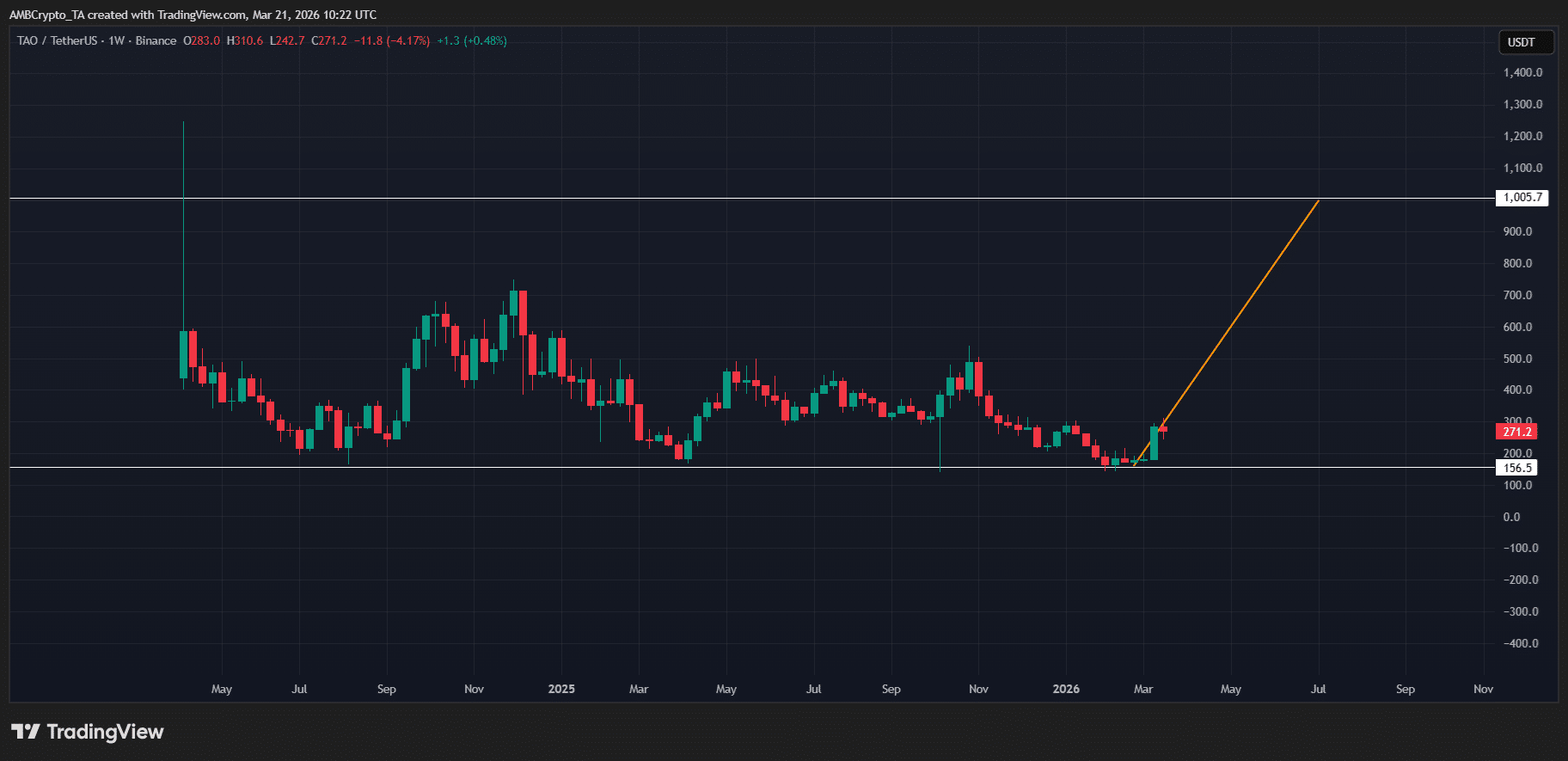
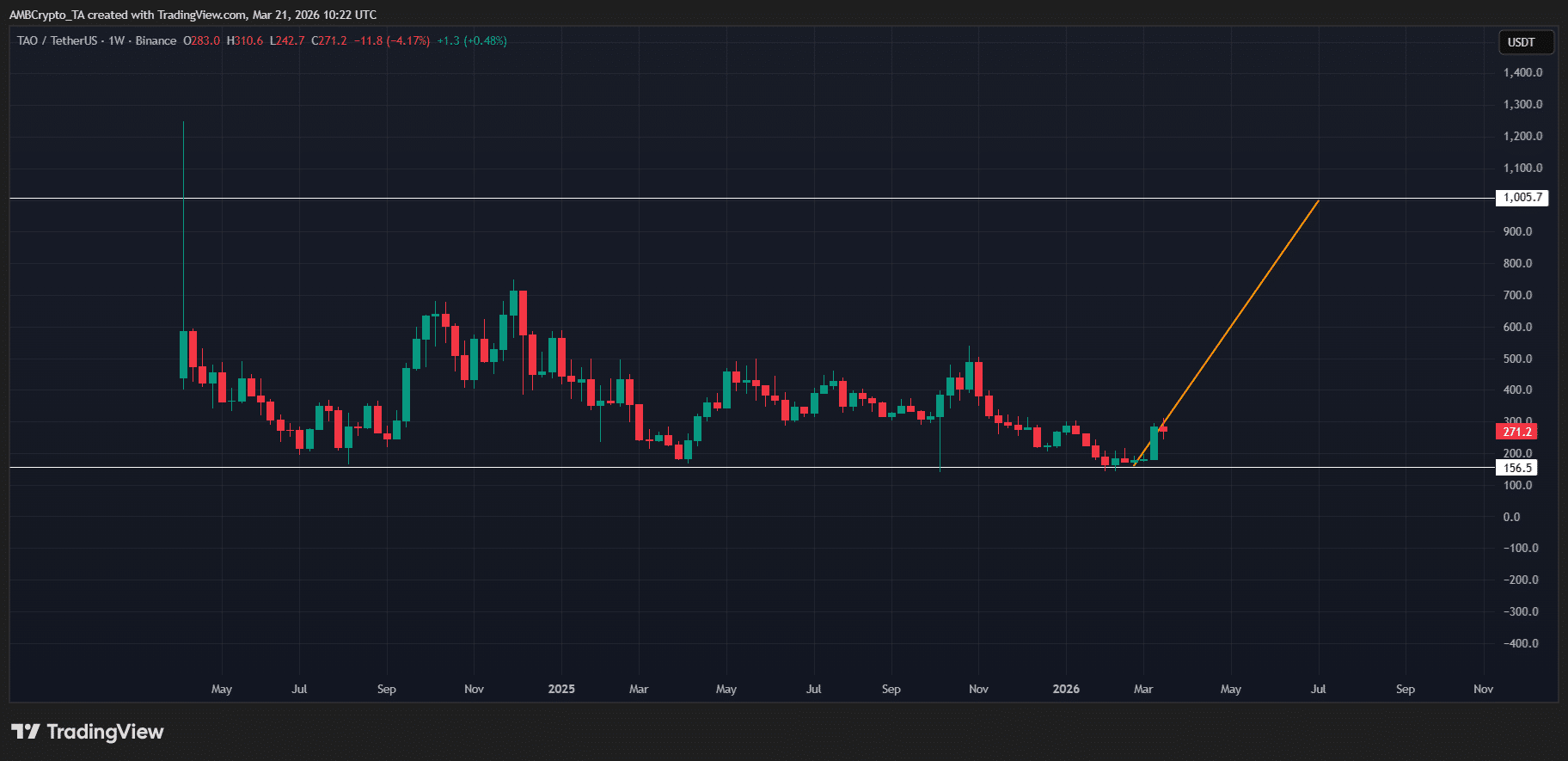
Source: TradingView (TAO/USDT)

Given this, TAO’s 24% rally so far this year makes a lot of sense.

For context, Bittensor builds a decentralized network for AI models, and its recent achievement is grabbing attention, especially from top tech players. And the timing couldn’t be better: The AI agent market is booming. In just 90 days, teams deployed 14,500 AI agents across crypto, running arbitrage, LP rebalancing, and yield optimization nonstop.

Taken together, it’s clear that Bittensor’s AI-driven network is growing in step with the rising demand for AI agents. The big question now: With analysts eyeing a potential rally to $1,000, is that too optimistic, or is TAO really in position to make it happen?

The AI hype around TAO pushes price to finally catch up

Hype only turns into real value when smart money starts paying attention.

So, even though Bittensor’s AI model grabbed headlines and caught the eyes of tech players, that alone doesn’t move TAO’s price. For the network to really grow, serious capital needs to flow in, incentivizing developers and supporting meaningful activity. Notably, that’s where the actual data becomes important.

Take a closer look: The Grayscale TAO Trust was trading at a 50% premium to NAV, 75% of TAO’s supply is staked, at press time, and the network generated $43 million in Q1 revenue from real AI customers. These numbers show that behind the hype, there’s genuine adoption driving TAO’s momentum, giving the network a stronger foundation for the AI-crypto wave.
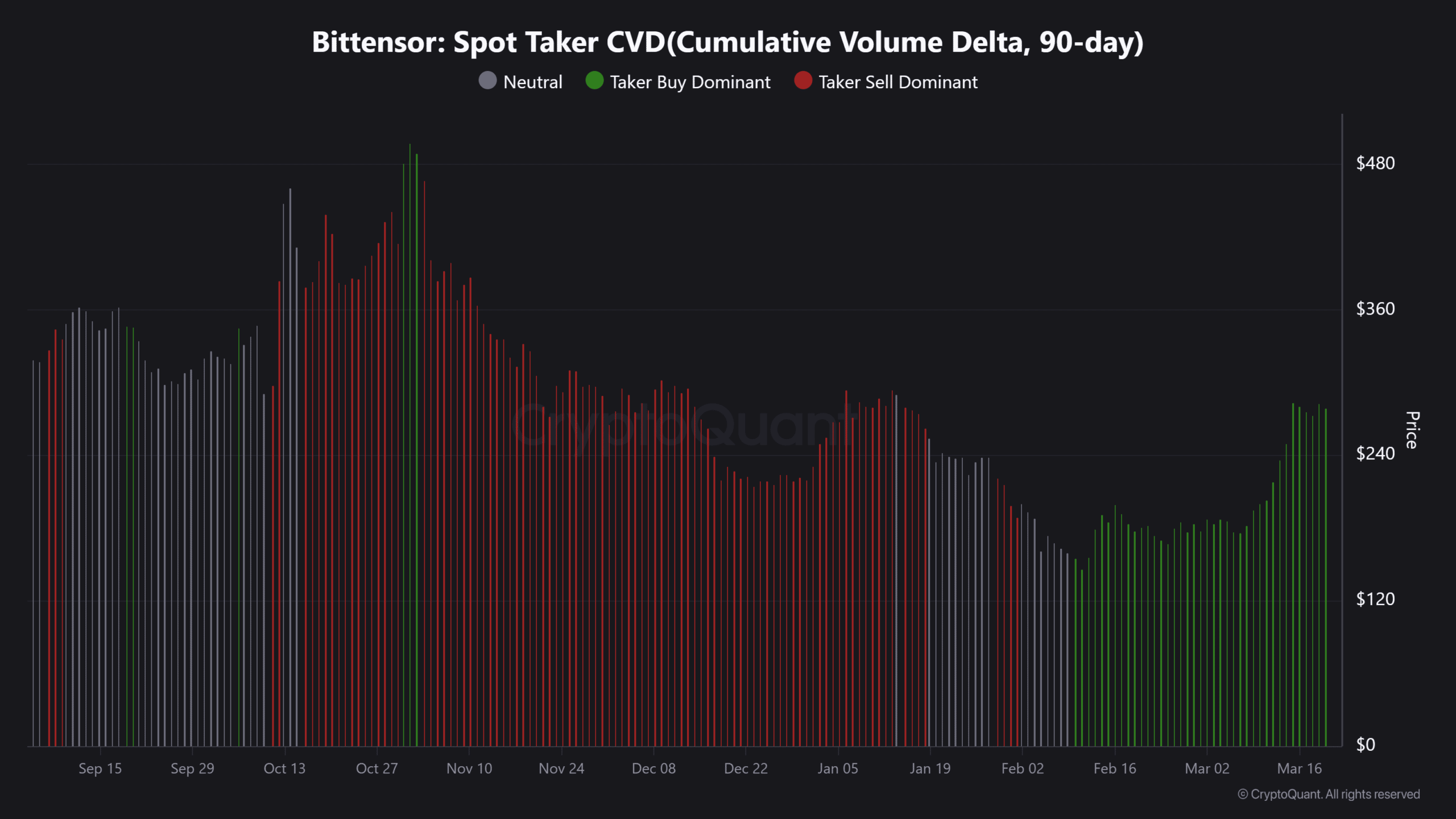
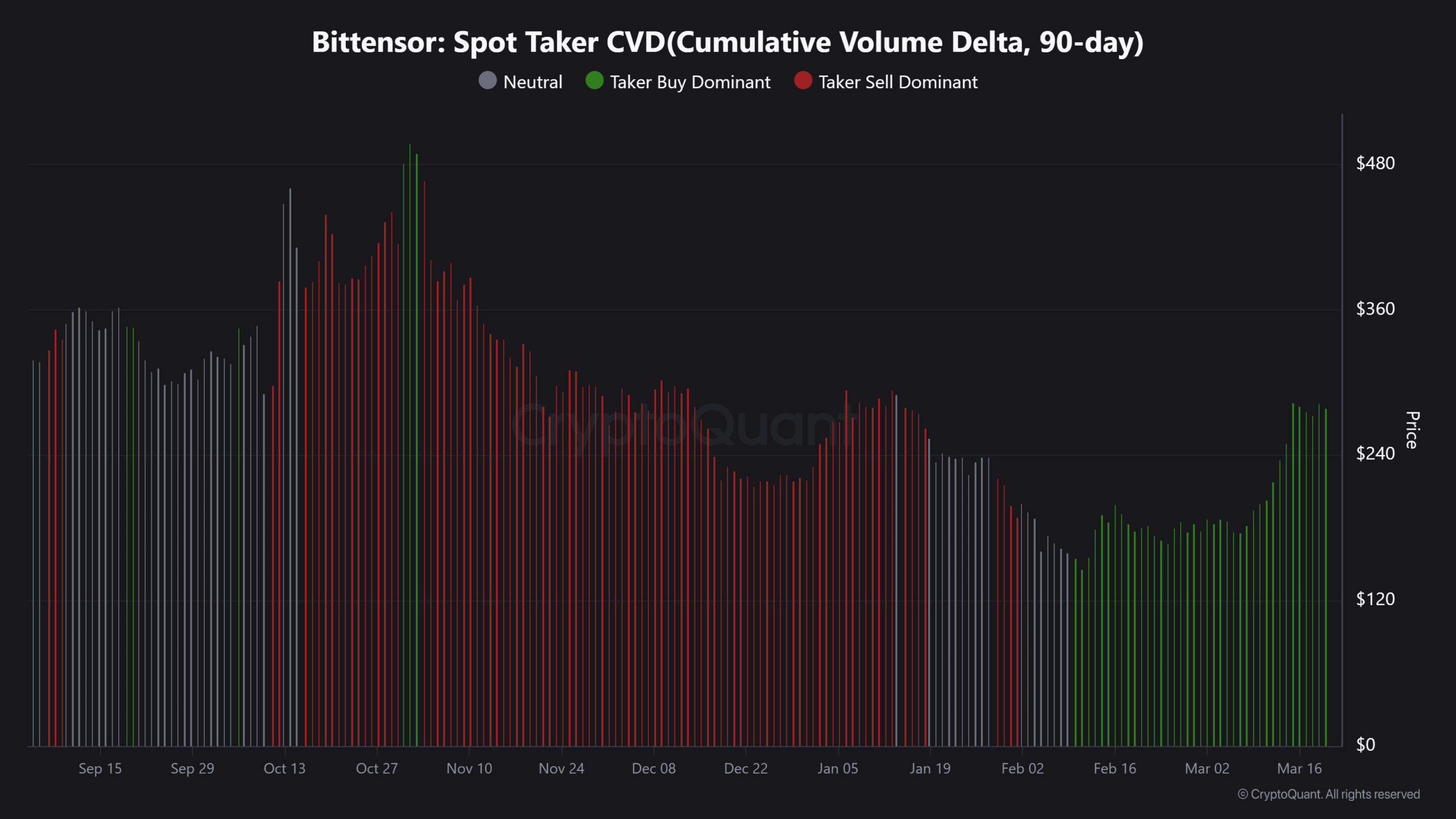
Source: CryptoQuant

On top of that, a recent CryptoQuant report shows TAO’s 90-day Spot Taker CVD pointing to steady buyer pressure since the $154 bottom, highlighting consistent demand from the market.

When you put it all together, strong institutional capital, high staking levels, real revenue from AI customers, and solid on-chain metrics, it’s clear that smart money is starting to catch up to the AI hype around Bittensor.

From a technical perspective, that’s why a $1,000 target for TAO isn’t just speculation or a shot in the dark. Instead, real-world adoption, institutional confidence, and growing network activity support it, showing that Bittensor’s AI-driven infrastructure can lead the next wave of the AI-crypto momentum.


Final Summary

  • 14,500 AI agents deployed in 90 days, a 72B-parameter decentralized model, and strong adoption show Bittensor’s network is growing with real demand.
  • High staking, $43 million Q1 revenue, and steady buyer pressure signal smart money is backing TAO, supporting a $1,000 target.


Related Questions

QWhat is the key achievement of Bittensor's AI model mentioned in the article?

ABittensor's key achievement is training a 72-billion-parameter AI model, the largest ever on fully decentralized infrastructure, with over 70 contributors.

QWhat are the three main pieces of evidence cited in the article that support the potential for TAO to reach a $1,000 price target?

AThe three main pieces of evidence are: 75% of TAO's supply is staked, the network generated $43 million in Q1 revenue from real AI customers, and on-chain metrics show steady buyer pressure.

QHow does the article differentiate between mere hype and real value for Bittensor's TAO?

AThe article states that hype turns into real value when smart money pays attention, which is demonstrated by strong institutional capital (e.g., Grayscale Trust premium), high staking levels, and genuine revenue from AI customers.

QWhat does the deployment of 14,500 AI agents in 90 days indicate about the market, according to the article?

AIt indicates that the AI agent market is booming and that there is a rising demand for AI-driven networks like Bittensor, which is growing in step with this trend.

QWhat specific on-chain metric from CryptoQuant is mentioned as evidence of consistent demand for TAO?

AThe CryptoQuant report highlights TAO's 90-day Spot Taker CVD, which points to steady buyer pressure since the price bottom of $154.

Related Reads

Karpathy Diagnosed with "AI Psychosis"! Not Eating or Sleeping, 16 Hours a Day Raising Lobsters

Andrej Karpathy recently revealed that he has developed what he calls "AI psychosis," an obsessive state where he spends up to 16 hours a day directing AI agents instead of writing code himself. In a podcast with Sarah Guo, he explained that his workflow has shifted from 80% hand-coding and 20% AI-assisted to the reverse, or even more extreme. He now manages multiple AI agents simultaneously, treating them as a team to execute tasks. Karpathy admitted that he’s become addicted to optimizing AI performance, constantly worrying about whether he’s using tokens efficiently or pushing the system to its limit. He highlighted the importance of an agent’s “personality,” noting that Claude Code feels more like a collaborative teammate compared to colder, more mechanical alternatives. He also shared practical applications, such as "Dobby," a Claude-based smart home agent that integrates and controls all his home devices through natural language, replacing six separate apps. In research, his "AutoResearch" project used AI to run 700 experiments, resulting in an 11% training speed improvement for an AI model—discovering optimizations he had missed as a human researcher. Despite the capabilities, Karpathy noted that AI agents still exhibit uneven performance—sometimes brilliant, other times childlike—due to limitations in reinforcement training. He predicts that 2026 will see a "slopacolypse," with AI generating vast amounts of mediocre content. His experience signals a broader shift: humans are becoming directors of AI systems rather than executors, navigating a new era of human-AI collaboration.

marsbit33m ago

Karpathy Diagnosed with "AI Psychosis"! Not Eating or Sleeping, 16 Hours a Day Raising Lobsters

marsbit33m ago

Trading

Spot
Futures

Hot Articles

Discussions

Welcome to the HTX Community. Here, you can stay informed about the latest platform developments and gain access to professional market insights. Users' opinions on the price of S (S) are presented below.

活动图片