Solana’s Network User Base Expands With Rapid Rise in Returning Participants

bitcoinistPublished on 2026-06-08Last updated on 2026-06-08

Abstract

Despite a prolonged price decline that tested the $60 level, the Solana network shows no signs of slowing down. Recent data reveals significant growth in its user base, driven by a rapid increase in returning participants. Over 1.7 million users are returning to the network daily, reaching the highest level since February, which is seen as a key indicator of long-term health and user confidence. Furthermore, Solana is outperforming Ethereum in key metrics. Over the past week, Solana processed nearly double the perpetual futures volume and more than double the DEX aggregator volume compared to Ethereum. This growing disparity leads some analysts to believe Solana could lead the next wave in finance. Currently, SOL is trading around $65, showing a slight price increase.

Even after a lengthy period of downward price action, bringing Solana’s value to retest the $60 level, the network does not seem to be slowing down in any way. During this highly negative phase, the SOL network has persistently seen positive activity across its ecosystem, with some activity reaching unprecedented levels.

Returning Users Fuel Solana’s Network Growth

Solana network continues to demonstrate robust strength in the face of heightened volatility across the altcoin and the broader cryptocurrency market. Recent data shows that Solana is witnessing a significant growth in its network user base as the number of returning participants increases at an accelerated rate.

Zensei unveiled this network growth on the X platform, which has notably captured the attention of the community, with many expressing optimism toward the altcoin. The development suggests that current users are also becoming more active throughout its expanding array of services and applications, in addition to continuing to interact with the ecosystem.

In the midst of criticism, SOL is steadily recording more than 1.7 million users, who are returning to the network every day. Such a strong rise in returning users is often seen as a crucial indicator of the network’s health, indicating long-term interest rather than short-term speculation.
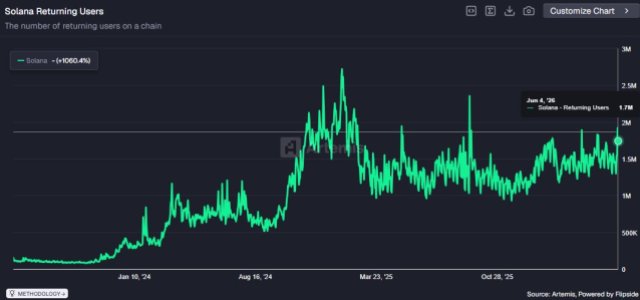
Source: Chart from Zensei on X

As seen on the Solana Returning Users chart, these players recently surged to their highest level since February this year. Zensei has referenced this growth to continued confidence among these users because more people are sticking around instead of just trying to exit the network.

Furthermore, the expert has highlighted SOL network’s superiority against other major chains across the crypto sector. In his view, there is nowhere else in the crypto sector where millions of users keep showing up every day as Solana does on a daily basis.

Why SOL Could Lead The Next Wave Of Finance Ahead Of Ethereum

In another X post, Zensei revealed that the gap between Solana and Ethereum keeps getting wider, with SOL dominating Ethereum in several key areas. Data shared by the expert shows that SOL has surpassed Ethereum in both Perp volume and Decentralized Exchange (DEX) aggregator volume over the past week.

During the period, SOL processed over $19.0 billion in perp volume compared to Ethereum, which saw about $10.1 billion, representing a lead of nearly 89%. On the DEX aggregator side, SOL captured approximately $10.2 billion in volume compared to the $4.8 billion of Ethereum, indicating a lead of roughly 115%.

After this robust disparity in growth between the two leading networks, the expert is confident that Solana will lead the future wave of finance ahead of Ethereum. This noteworthy SOL performance demonstrates the network’s growing usefulness and capacity to handle rising activity levels.

CoinMarketMap’s data is showing that the SOL price is trading at $65, demonstrating a nearly 2% increase in the last 24 hours. However, trading volume is moving in a different direction, dropping by more than 3% over the past day.

SOL trading at $66 on the 1D chart | Source: SOLUSDT on Tradingview.com

Related Questions

QAccording to the article, what key metric is highlighted to show Solana's network health despite recent price volatility?

AThe significant growth in returning users, with over 1.7 million returning daily, is highlighted as a key indicator of the network's long-term health and interest.

QWhat data does Zensei present to argue that Solana could lead the next wave of finance ahead of Ethereum?

AZensei presents data showing Solana dominating Ethereum in Perp volume (approx. $19.0B vs $10.1B) and DEX aggregator volume (approx. $10.2B vs $4.8B) over a recent one-week period.

QWhat does the chart from Zensei show about the level of Solana's returning users recently?

AThe chart shows that the number of Solana's returning users recently surged to its highest level since February of this year.

QAccording to the expert cited, what does the sustained high number of returning users suggest about user behavior?

AThe expert suggests it indicates continued confidence among users, with more people sticking around and engaging with the ecosystem's services rather than just trying to exit the network.

QWhat are the current price and 24-hour trading volume trend for SOL as mentioned at the end of the article?

AThe SOL price is mentioned as trading at $65, with a nearly 2% increase in the last 24 hours, while its trading volume decreased by more than 3% over the same period.

Related Reads

Michael Saylor's Latest Long Read: Who Defines the Soul of Bitcoin?

Michael Saylor's essay outlines four key ideological factions within the Bitcoin community, each shaping its future. **Bitcoin Maximalists** view Bitcoin as the dominant monetary network—a breakthrough offering superior property rights and sound money. They focus on its moral imperative and resist dilution. **Bitcoin Capitalists** believe Bitcoin's full potential is unlocked through deep integration with the global economy—into capital markets, corporate treasuries, and financial instruments. Their risk is excessive financialization. **Bitcoin Technologists** advocate for ongoing protocol improvements in scalability, privacy, and security to meet evolving demands and threats. Their core risk is destabilizing changes to the foundational layer. **Bitcoin Fundamentalists** prioritize protecting Bitcoin's core principles: self-custody, running nodes, decentralization, and its use as money. They guard against corruption, capture, and compromise. The essay argues that Bitcoin's success requires a balanced synthesis of these perspectives: maintaining its sacred core (Fundamentalists), recognizing its dominance (Maximalists), enabling global integration (Capitalists), and allowing carefully considered innovation (Technologists). The goal is disciplined expansion where most innovation occurs in higher layers, preserving the integrity of the base protocol while making Bitcoin useful for all.

marsbit55m ago

Michael Saylor's Latest Long Read: Who Defines the Soul of Bitcoin?

marsbit55m ago

SpaceX's Blazingly Hot IPO Breaks Records; The Previous Record Holder Was a Chinese Company

SpaceX's upcoming IPO has ignited a feverish market response, poised to break records as the largest in US and global history with a targeted valuation of $1.77 trillion and fundraising of $75 billion. Elon Musk's assertive stance, rewriting IPO rules by allocating 30% of new shares to retail investors—far exceeding the typical 5-10%—and slashing underwriting fees below 0.75%, has fueled the frenzy. This event surpasses the previous US IPO fundraising record set by Chinese e-commerce giant Alibaba in 2014. Alibaba's landmark 2014 NYSE listing raised over $25 billion, crowning it the world's fourth-largest tech company. It symbolized China's rising consumer class and digital economy, ushering in a golden era for US-listed Chinese tech firms and even prompting Hong Kong's exchange to reform its listing rules. However, Alibaba's fortunes shifted post-2020 peak. It faced a record antitrust fine for "choosing one from two" practices, internal cultural crises, and strategic missteps. A focus on premium consumption eroded its core e-commerce market share to around 30%, while costly expansions into new retail and media incurred massive losses. In late 2023, its market value was overtaken by PDD (Pinduoduo). Now, Alibaba is pivoting to AI as a new growth engine. Its Tongyi Qianwen model boasts high user engagement, and Alibaba Cloud remains China's leading public cloud provider, with AI-related revenue growing significantly. The company is integrating AI across its ecosystem. Yet challenges persist, including strong competition from ByteDance's Doubao model, talent retention issues, and an unclear strategic focus between consumer and enterprise AI. Alibaba's journey—from its record-setting IPO peak, through periods of regulatory scrutiny and strategic overreach, to its current AI-driven recalibration—highlights the cyclical fate of tech giants and underscores the critical role of core technological innovation in navigating industry shifts.

marsbit1h ago

SpaceX's Blazingly Hot IPO Breaks Records; The Previous Record Holder Was a Chinese Company

marsbit1h ago

Why Does Ethereum Still Need Kohaku? Privacy Concerns Aren't Just in Transactions

The article "Why Ethereum Still Needs Kohaku: Privacy Issues Extend Beyond Transactions" explains the Kohaku initiative as a suite of privacy-first tools designed to improve user privacy on the Ethereum network. It addresses the problem that while Ethereum's transparency enables innovation, it also exposes users' financial activities, asset holdings, and social connections when they reuse a single address. Kohaku aims to bridge the gap between existing privacy protocols (like Railgun, Privacy Pools) and practical user experience by integrating privacy features into wallets, developer tools, and daily interactions. Key focuses include: enabling wallets to manage multiple accounts for different purposes ("many accounts, many you"), facilitating controlled visibility for transactions instead of full transparency, protecting user data during RPC queries and network activity, and providing developers with easier ways to integrate privacy. The article clarifies that Kohaku is not a single product but an ongoing effort to make privacy a default, usable component of the ecosystem, moving beyond complex protocols to practical application. It counters common misconceptions, arguing that privacy is a fundamental user right for normal activities, not just for anonymity, and that it can coexist with compliance through selective disclosure. Ultimately, Kohaku represents an essential step for Ethereum's maturation, ensuring users can participate in the open network while maintaining control over their personal information boundaries.

marsbit1h ago

Why Does Ethereum Still Need Kohaku? Privacy Concerns Aren't Just in Transactions

marsbit1h ago

Trading

Spot
Futures

Hot Articles

Discussions

Welcome to the HTX Community. Here, you can stay informed about the latest platform developments and gain access to professional market insights. Users' opinions on the price of S (S) are presented below.

活动图片