Solana reduced slot time to 350 ms

cryptonews.ruPublished on 2026-08-22Last updated on 2026-08-22

Abstract

Solana has successfully implemented the first stage of its plan to reduce slot times, lowering the target from 400ms to 350ms in mainnet epoch 1020. This 12.5% reduction is part of the approved SIMD-0525 upgrade, the first of four planned steps to ultimately achieve a 200ms slot time. The change, activated by validators on the Agave v4.2 client, aims to accelerate transaction confirmations and improve network resilience. Future reductions to 300ms, 250ms, and finally 200ms will each be activated in subsequent epochs, with the upgrade schedule allowing for a pause if missed block rates increase. Following the update, the network's average slot time was approximately 366-370ms. The SOL token price reacted positively, gaining nearly 4.5% to approach $95. The article also notes a recent incident where Solana neared a transaction finality halt due to multiple validator outages.

The Solana team has enabled the first stage of reducing the average slot time — from 400 to 350 ms — in the mainnet, as part of implementing the SIMD-0525 improvement proposal.

BREAKING: @Solana slot time has dropped to 350ms for the first time as the first reduction under SIMD-0525 goes live at epoch 1020, cutting the previous 400ms target by 12.5%.

The upgrade is the first of four planned steps toward 200ms slots. pic.twitter.com/fnC4AsQS8Y

— SolanaFloor (@SolanaFloor) August 21, 2026

Solana validators on the Agave v4.2 client have activated the first of four stages to reduce slot time. This is the first reduction in slot length since the network's launch.

A slot is a fixed window during which the validator-leader forms a block. Shortening the slot should accelerate transaction confirmations. Further plans include moving to 300, 250, and 200 ms.

Each subsequent stage has its own activation mechanism and is enabled sequentially in a later epoch. One such period in Solana lasts 432,000 slots, or approximately two to three days. The approved schedule allows the upgrade to be halted if the rate of missed blocks increases.

At the time of writing, the average slot time is 370 ms, and over a 10-minute timeframe — 366 ms.
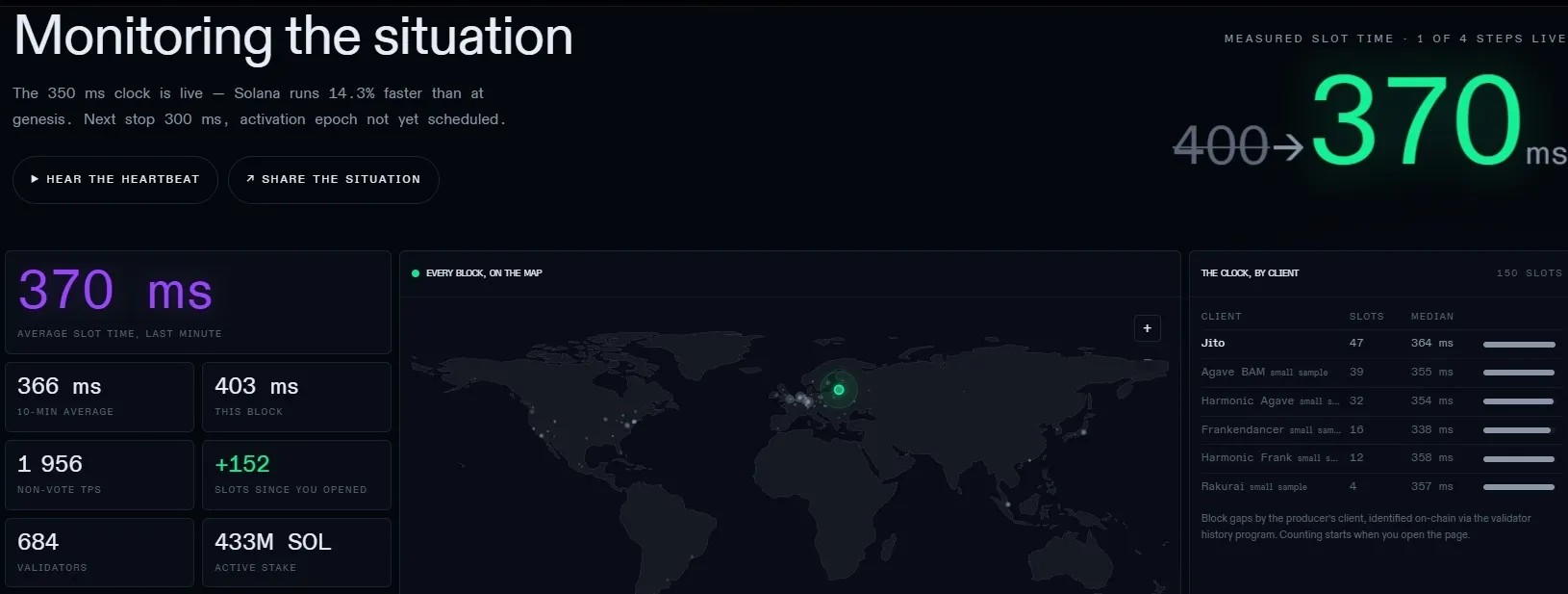
Source: Solana.

The Solana Foundation lists among the update's goals reducing latency and increasing censorship resistance. A shorter slot reduces the time during which a single leader controls block assembly. The Solana team has also linked these changes to already implemented improvements, including Turbine and Replay, which optimized block propagation and re-processing by clients.

The price of $SOL has gained nearly 4.5% over the past day, approaching $95. The token has outperformed Bitcoin (+1.6%) or Ethereum (+2.6%) in terms of dynamics but lags significantly behind, for example, XRP and Dogecoin — 21% and 10% respectively.
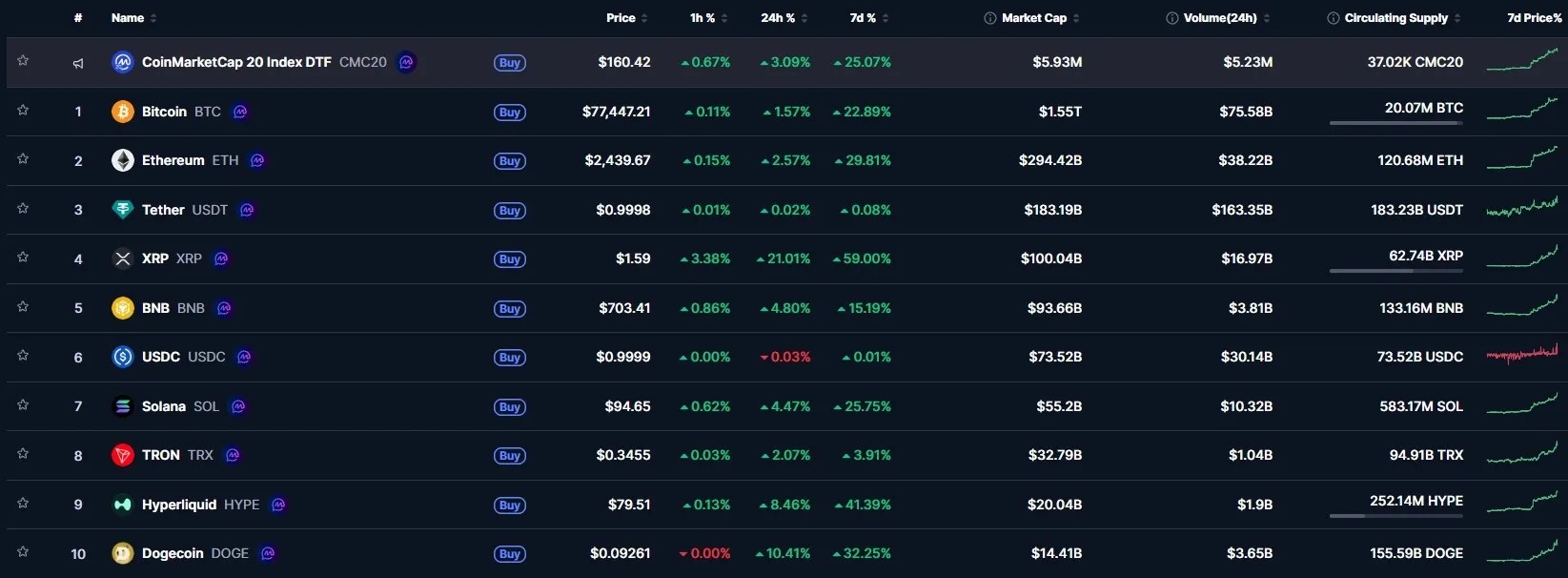
Source: CoinMarketCap.

Recall that in August, Solana came within a step of stopping transaction finalization — validators with a total combined stake of 28.83% $SOL went offline simultaneously, with the critical threshold being 33.34%.

The Chaos of Rising $SOL
end-content

Trending Cryptos

Related Questions

QWhat is the new slot time for the Solana network after the first stage of reduction?

AThe new average slot time for Solana has been reduced to 350 milliseconds.

QWhat is the proposal or improvement that this slot time reduction is part of?

AThis reduction is part of the implementation of the SIMD-0525 improvement proposal.

QHow many total reduction stages are planned to eventually achieve a target slot time of 200ms?

AThere are a total of four planned reduction stages to achieve the 200ms slot time target.

QAccording to the article, what are the two main goals of this upgrade cited by the Solana Foundation?

AThe Solana Foundation cites reducing latency and increasing resistance to censorship as the main goals of this upgrade.

QWhat recent event highlighted a vulnerability in the Solana network, bringing it close to a halt?

AIn August, validators with a combined 28.83% stake in $SOL went offline simultaneously, bringing the network close to the 33.34% critical threshold for halting transaction finalization.

Related Reads

Grayscale Report: Financial Privacy in the AI Era, Why Zcash Should Not Be Overlooked?

Title: Grayscale Report: Financial Privacy in the AI Era – Why Zcash Should Not Be Overlooked The article argues that privacy is a fundamental, not niche, attribute of functional money. It highlights that technological shifts, like the rise of AI and stablecoins, are driving a new wave of public focus on financial privacy. Zcash, a decentralized digital currency similar to Bitcoin but with built-in privacy via zero-knowledge proofs, is positioned to address this need. Unlike transparent blockchains, Zcash offers users the option to conduct "shielded" transactions that hide sender, receiver, and amount while remaining verifiable. The report details Zcash's evolution, noting key upgrades that improved usability and security. It points to rising on-chain usage of privacy features as evidence of real demand. Currently, ZEC holds a minimal share (~0.4%) of the total crypto market cap. Grayscale suggests this reflects a market assumption that privacy is a marginal concern. The investment thesis hinges on a potential market re-evaluation: if privacy is recognized as a core monetary feature in an era of enhanced surveillance, Zcash's current valuation represents significant upside potential. Key risks discussed include regulatory challenges, historical trusted setup concerns for older pools (mitigated by newer protocols), quantum computing threats, and execution risks associated with future technical upgrades. The conclusion is that while the future scale of private digital currency is uncertain, the market currently prices in little chance of its value increasing substantially, presenting a potential opportunity for investors.

marsbit1h ago

Grayscale Report: Financial Privacy in the AI Era, Why Zcash Should Not Be Overlooked?

marsbit1h ago

Vitalik Moves to Local Mixing as Obfuscation Series Reaches Third Stage

Ethereum co-founder Vitalik Buterin published the third part of his series on cryptographic obfuscation, focusing on a method called "local mixing." This method abandons lattices and elliptic curves in favor of ideas borrowed from hash function design. Buterin described local mixing as a "completely different way of cryptography," free from elliptic curves, prime factorization, and lattices, making it more akin to symmetric cryptography used in everyday encryption. The process begins with a circuit of logic gates like XOR, AND, and NOT. It undergoes a pipeline that ensures a correct output while obscuring any trace of the internal logic. Key steps include adding reversibility, strengthening, mechanization, mixing, and finally obfuscation. The mixing step scatters extra logic gates and shuffles their arrangement. Reversibility is foundational, allowing gates to be rewritten as other reversible gates with similar behavior. Buterin acknowledged local mixing is a "wild and risky undertaking," lying on the "graveyard of failed attempts at white-box cryptography." However, its proponents argue it needs more research effort and a willingness to accept higher overhead costs. Buterin suggested AI could accelerate its development. He called obfuscation the "final boss of cryptography," with the most complex constructions having runtimes exceeding the universe's age. The article concludes by explaining obfuscation's utility: it can encrypt a program so it still functions with normal inputs and outputs while hiding the code. Combined with blockchain, this moves toward a "trusted third party that requires no trust," enabling applications like private, collusion-resistant voting without relying on a trusted committee.

cryptonews.ru1h ago

Vitalik Moves to Local Mixing as Obfuscation Series Reaches Third Stage

cryptonews.ru1h ago

Trading

Spot

Hot Articles

Discussions

Welcome to the HTX Community. Here, you can stay informed about the latest platform developments and gain access to professional market insights. Users' opinions on the price of SOL (SOL) are presented below.

活动图片