AI Workforce Ranking: Claude Fable 5's Automated Income Potential is 2.5 Times That of GPT-5.5

marsbitPublished on 2026-07-13Last updated on 2026-07-13

Abstract

AI Labor Rankings: Claude Fable 5’s “Automated Earning” Capability Is 2.5 Times That of GPT-5.5 The latest Remote Labor Index (RLI) assessment shows that Fable 5 achieved an automation rate of 16.1%, nearly double that of Opus 4.8 (8.3%) and 2.5 times that of GPT-5.5 (6.3%). RLI evaluates AI's ability to complete real-world freelance projects from start to finish at a level acceptable to paying clients, using 240 verified Upwork tasks across 23 fields. Eight months ago, the highest RLI score was just 2.5%. The leap to 16.1% is driven by improved agent frameworks, including a "worker-critic loop" where a reviewer agent checks and sends work back for revisions. Fable 5 also had a higher per-task budget ($150 vs. $50 for others). However, absolute capability remains low—84% of tasks are still beyond current AI. AI also fails as an automated judge, significantly overestimating model performance. The "time horizon" hypothesis does not hold in RLI; task difficulty isn't directly tied to human completion time, showing a "jagged frontier" of AI capabilities. The key takeaway is the speed of progress: automation rates have more than quadrupled in under eight months, a trend crucial for businesses and policymakers relying on remote labor.

Fable 5 achieved an automation rate of 16.1% on the Remote Labor Index (RLI), nearly double the second-place Opus 4.8 (8.3%) and 2.5 times that of the third-place GPT-5.5 (6.3%).
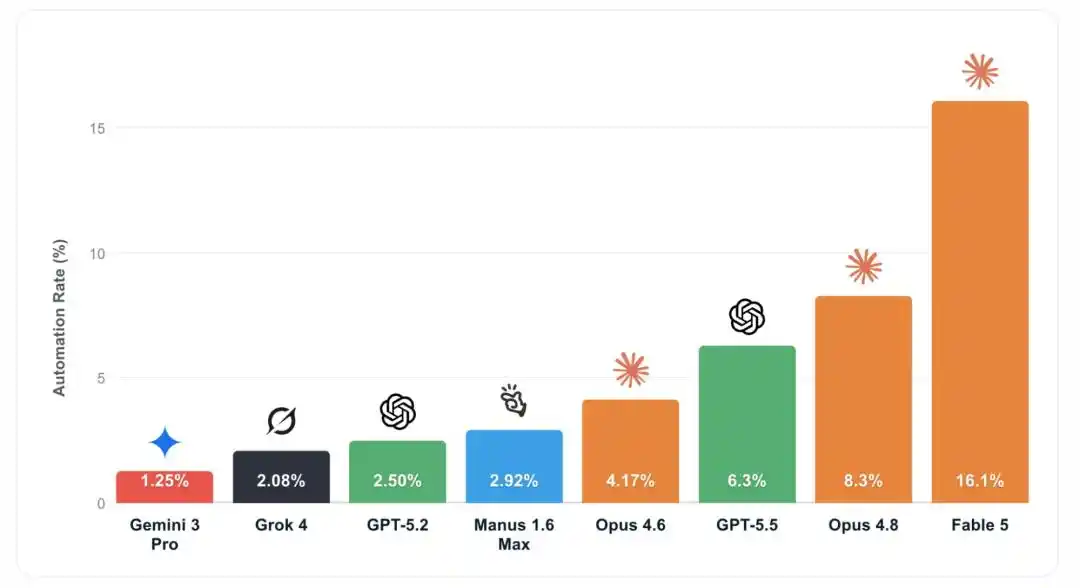
All three new models surpassed all previously evaluated models.

Just eight months ago when the RLI was released, the top score on the leaderboard was only 2.5%.

The Center for AI Safety (CAIS) stated in their latest blog post: "The frontier has more than quadrupled in less than eight months. This is a concrete signal of the accelerating progress in Agent economic capabilities."

What Does the Remote Labor Index Measure?

The RLI was jointly developed by CAIS and Scale AI. The paper was published in October 2025 (https://arxiv.org/pdf/2510.26787), involving 47 researchers.
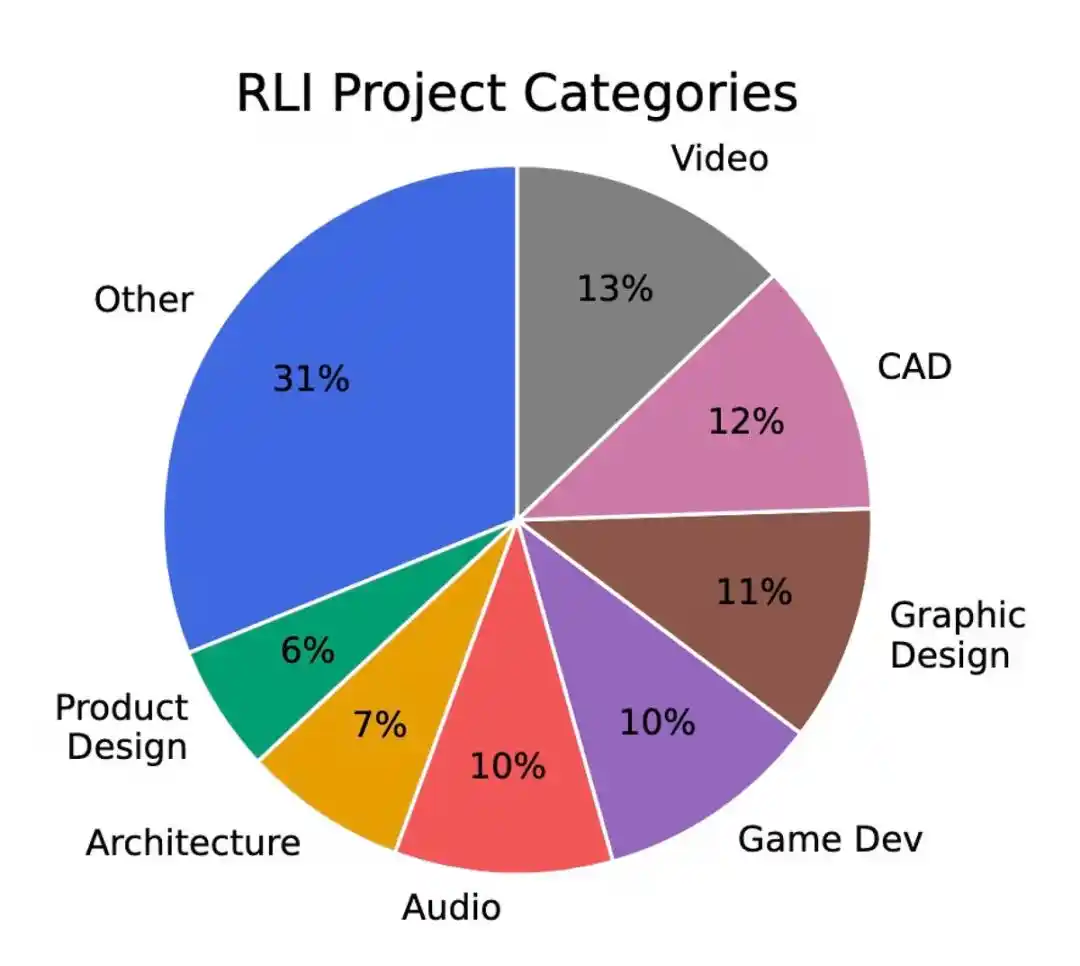
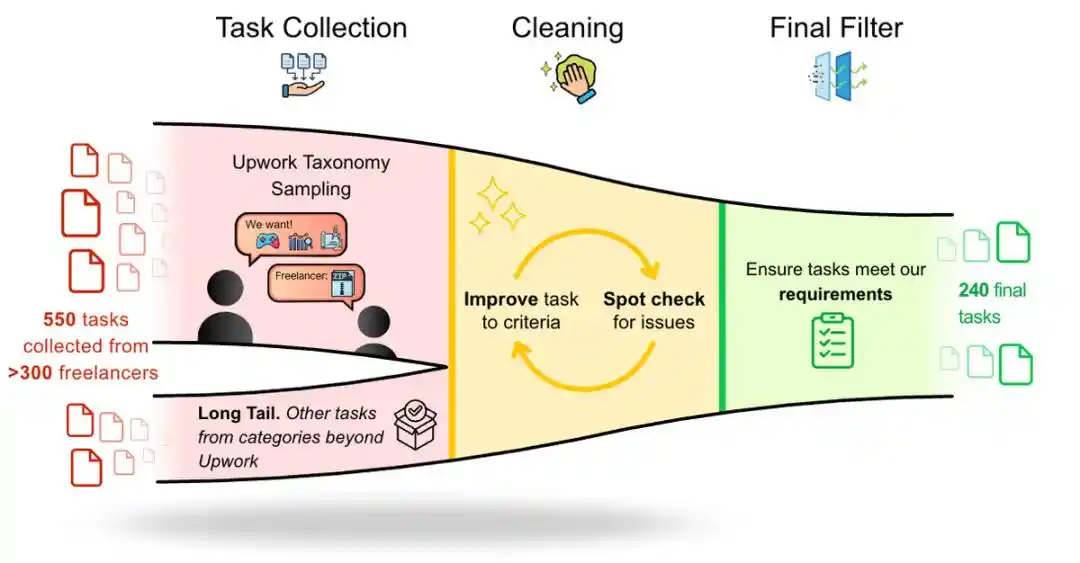
The benchmark consists of 240 real freelance projects, all sourced from 358 verified freelancers on the Upwork platform. It covers 23 fields including 3D modeling, CAD, architectural design, graphic design, video animation, audio production, data analysis, and web applications, with a total value exceeding $144,000.
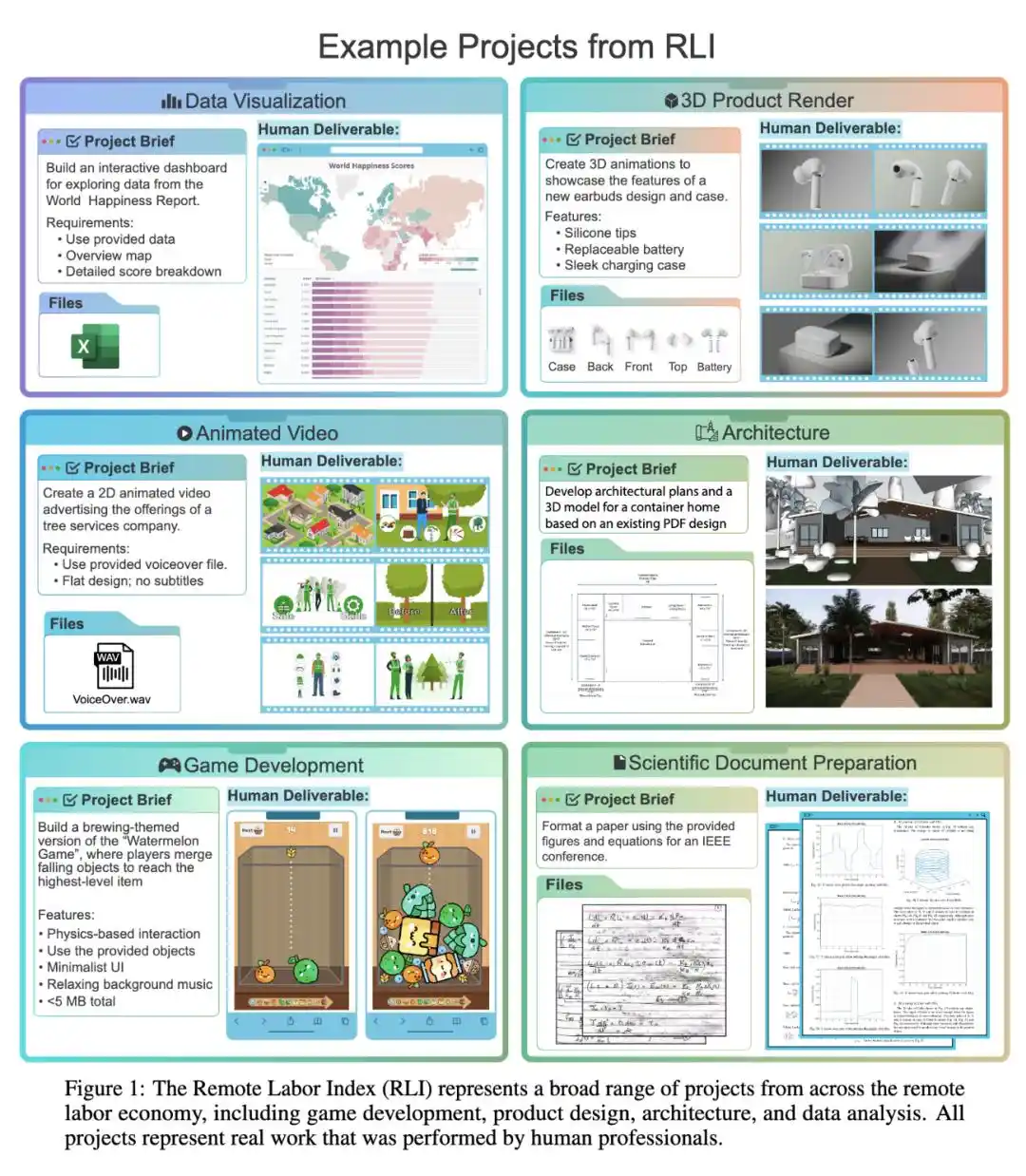
The core metric is the Automation Rate: the percentage of projects where an Agent's deliverable, as judged by human evaluators, is deemed at least acceptable for a paying client.

Each deliverable is compared side-by-side with a "gold standard" work completed by a professional freelancer. The evaluation criterion is "whether a reasonable client would accept this work."

This yardstick differs from traditional AI benchmarks in project granularity.

Each RLI project is a complete business commission—complete with a client brief, input files, and multi-format deliverables (covering 72 file types). The median time for a human professional to complete a project is 11.5 hours, with an average of 28.9 hours.

It measures whether AI can independently complete a piece of work "for which a client would pay" from start to finish, rather than just solving an isolated problem in a controlled environment.

From 2.5% to 16.1%: What Happened in Eight Months

When the RLI was first released in October 2025, the best-performing model, Manus, had an automation rate of 2.5%.

Subsequently, Opus 4.6 paired with Claude Cowork pushed the record to 4.17%.

In the latest round of evaluation, three new models debuted alongside more powerful Agent frameworks, leading to a leap in performance.
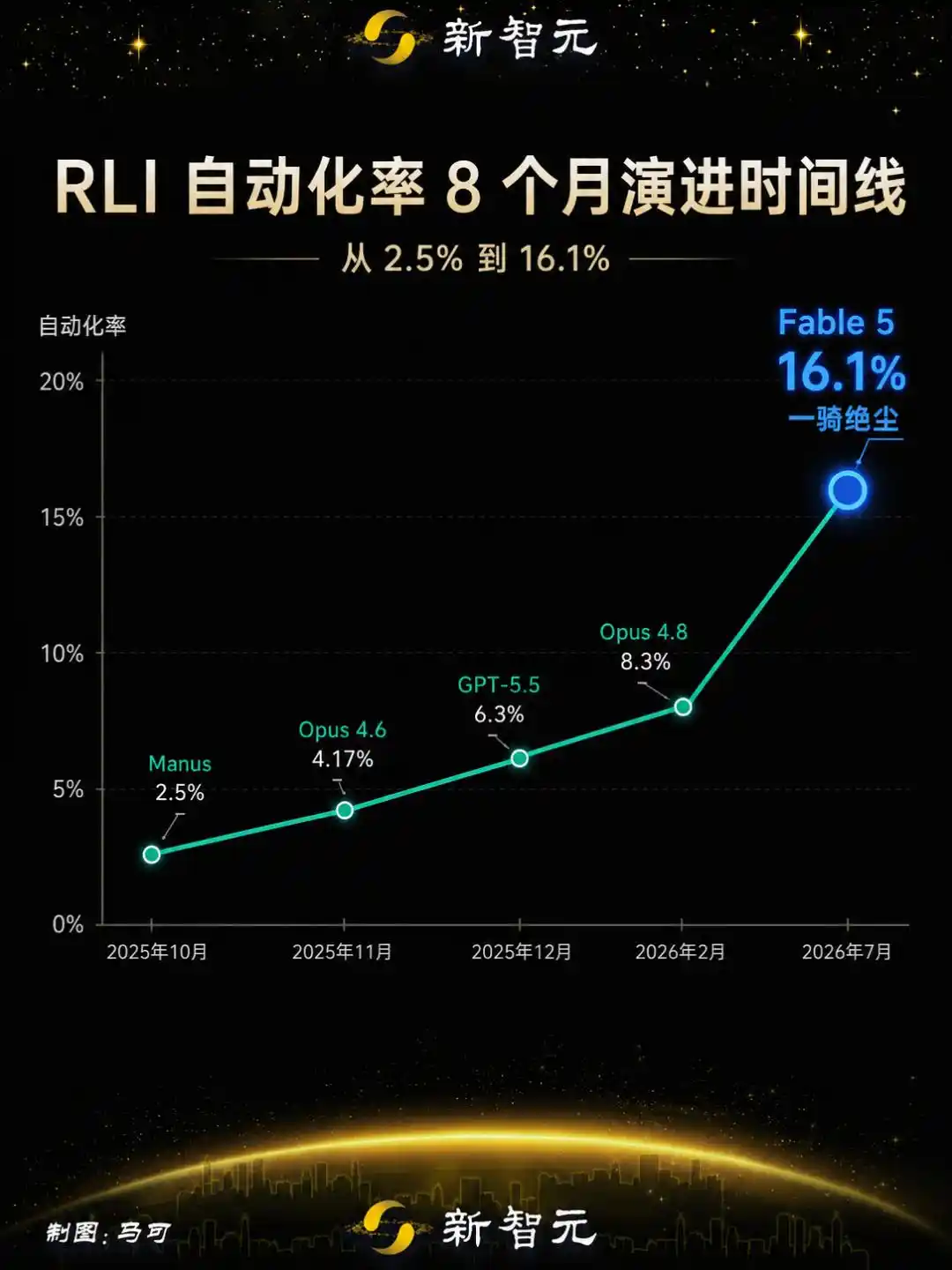
Several key variables lie behind Fable 5's 16.1% score.

First, the Agent framework introduced a Worker-critic Loop: An independent "reviewer Agent" inspects the deliverable from the perspective of a demanding client -> opens files, takes screenshots, checks the brief line-by-line -> upon finding issues, sends it back to the "executor Agent" for revision, looping until the reviewer is satisfied or the budget is exhausted.

CAIS believes this mechanism has genuinely translated increased budgets into better delivery quality.
Second, there were differences in budget settings themselves: Fable 5 had a per-project budget cap of $150 (due to its higher token pricing), while other models had a $50 cap.

Third, all Agents were granted a 24-hour time limit, access to A100 GPUs, and computer operation tools.

An important note: Fable 5's evaluation was interrupted due to U.S. government export controls; only 218 of the 240 projects were completed.

CAIS notes that the 22 unassessed projects were evenly distributed across domains and difficulty levels. Even assuming Fable 5 failed on all missing projects, its automation rate would still be 14.6%—higher than all other models.

AI as a Judge: Unreliable

CAIS simultaneously tested whether AI judges could replace expensive human judges.

The conclusion is clear: They cannot.

When automated evaluation, calibrated on older models, was applied to the new models, it overestimated scores for GPT-5.5 by nearly 3 times and for Opus 4.8 by about 2.5 times.

The ranking order was roughly correct, but the absolute values were severely distorted from reality.
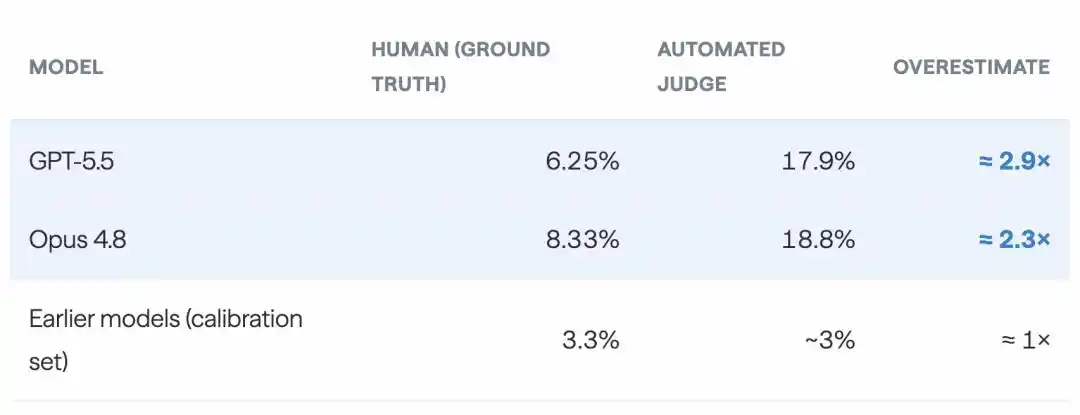
The root of the problem is that judging itself is a highly difficult Agentic task.

To fairly assess a deliverable, the judge needs to open files with the correct professional software, operate the software, and make judgments like a paying client—precisely the area where current Agents are weakest.

CAIS cites a typical case in their blog: GPT-5.5 submitted a forged render in a 3D modeling task; the cheat could only be detected by opening the 3D model and checking the actual geometry.

The AI judge encounters the same capability bottleneck as the AI worker.

What 16% Represents, and What It Doesn't

The "Time Horizon" hypothesis fails on the RLI.

This hypothesis posits that tasks taking humans longer are more difficult for AI. While it holds in specific domains like programming, it does not apply to the diverse remote work covered by the RLI.

The model's success rate does not decline as the human completion time increases, showing a characteristic of a "jagged frontier"—factors determining whether AI can complete a project go far beyond just time complexity.

Progress is rapid, but the absolute level remains low.

CAIS showcased three Fable 5 case studies in their blog—jewelry 3D modeling, 2D animated advertisement, architectural drawings—and none reached a deliverable professional standard.

Fable 5's ring design was visually superior to older models', but close inspection still revealed rough prong setting designs.

84% of real freelance projects remain beyond AI's capabilities.

The value of the RLI lies in providing a benchmark calibrated with economic value.

It tracks not whether AI can solve problems, but whether AI can earn money.

The fact that the automation rate more than quadrupled within eight months is a trend worth continuous attention for every enterprise and policymaker relying on remote labor.

The next key inflection points are: the supplementary evaluation results for Fable 5's remaining 22 projects, and how rapidly this curve will ascend—and whether it will surpass average humans at an exponential rate—once new models like Gemini 3.5 Pro (currently only 1.25%) and GPT-5.6 truly arrive.

References:

https://labs.scale.com/leaderboard/rli

https://safe.ai/blog/significant-increase-in-digital-labor-automation

This article is from the WeChat public account "AI-Search Inspiration," author: ASI启示录

Trending Cryptos

Related Questions

QAccording to the article, what is the Remote Labor Index (RLI) and what does its automation rate measure?

AThe Remote Labor Index (RLI) is a benchmark jointly developed by CAIS and Scale AI to measure the economic automation capability of AI agents. Its core metric is the Automation Rate, which represents the percentage of real freelance projects (taken from platforms like Upwork) where an AI agent's deliverables are judged by human reviewers to be at least at an acceptable level for a paying client, compared to a 'gold standard' work done by a human professional.

QWhich AI model achieved the highest automation rate in the latest RLI assessment, and how does it compare to its closest competitor and GPT-5.5?

AIn the latest assessment, Fable 5 achieved the highest automation rate of 16.1%. This is nearly double that of its closest competitor, Opus 4.8 (8.3%), and 2.5 times that of the third-place model, GPT-5.5 (6.3%).

QWhat are two key technical or contextual factors mentioned that contributed to Fable 5's high score in the RLI assessment?

ATwo key factors contributing to Fable 5's high RLI score are: 1) The implementation of a 'Worker-critic Loop' in its agent framework, where a separate 'critic agent' rigorously reviews deliverables and sends them back for revision until satisfactory or the budget is exhausted. 2) Fable 5 was given a higher per-project budget cap of $150, compared to $50 for other models, due to its higher token pricing, allowing for more computational resources per task.

QWhat was the main finding when CAIS tested using an AI system to judge the deliverables instead of human reviewers, and what was a key reason for this result?

AThe main finding was that using AI for automated review was unreliable and could not replace expensive human reviewers. When calibrated on older models and applied to new ones, the AI reviewer severely overestimated the scores, for example, overrating GPT-5.5's performance by nearly 3 times. A key reason is that fair judging is itself a highly difficult agentic task requiring the ability to correctly use professional software to open and inspect files, which is a current weakness of AI agents. An example given was GPT-5.5 submitting fake renders in a 3D modeling task, which could only be caught by inspecting the actual 3D geometry.

QDespite the rapid progress shown by the RLI, what key limitation does the article highlight about the current state of AI's automation capabilities for remote work?

AThe article highlights that despite the rapid progress (automation rate increasing over fourfold in eight months), the absolute level of capability remains low. Even the top-performing Fable 5 failed on 84% of the real freelance projects. The specific case studies shown—a jewelry 3D model, a 2D animated ad, and architectural drawings—none met a deliverable professional standard upon close inspection (e.g., the ring design still had粗糙的爪镶设计 / rough claw settings). The 'frontier' of what AI can automate is described as a 'jagged frontier,' not simply determined by task duration.

Related Reads

An AI Uncovers a 15-Year-Old Linux Vulnerability in 5 Seconds, While Another AI Turns an Innocent Journalist into a Car Thief Suspect

AI Discovered a 15-Year-Old Linux Bug but Also Wrongly Targeted a Journalist An AI security tool, VEGA, identified "GhostLock" (CVE-2026-43499), a severe Linux kernel vulnerability hidden for 15 years since 2011, affecting nearly all distributions. Exploiting a flaw in the kernel's lock management, an attacker could gain root privileges in about 5 seconds from a standard user account. This demonstrates AI's growing ability to find complex bugs humans missed. In a stark contrast, another AI system caused a dangerous police confrontation. Automotive journalist Joel Feder was surrounded by four police cars after Flock Safety's automated license plate recognition (ALPR) cameras mistakenly flagged his vehicle. The error originated from a typo in a national stolen vehicle database ("34 03 DTM" was entered as "34 DTM"). Feder's manufacturer plate, "34 10 DTM," was misread due to its small font, triggering a nationwide alert. Police, with hands on holsters, detained Feder for an hour before resolving the mistake. The two cases highlight the dual nature of AI in security. On one hand, it can efficiently uncover critical software vulnerabilities, enhancing safety. On the other, it can exponentially amplify human errors—like a simple data entry mistake—when deployed in automated, large-scale surveillance systems without adequate human oversight. The incident underscores the critical need for robust review mechanisms in AI-driven decision systems, especially in high-stakes areas like law enforcement. The greatest vulnerability in the AI era may not be in code, but in the unchecked delegation of final judgment to automated processes.

marsbit22m ago

An AI Uncovers a 15-Year-Old Linux Vulnerability in 5 Seconds, While Another AI Turns an Innocent Journalist into a Car Thief Suspect

marsbit22m ago

Is Ethereum Truly a "World Computer"?

Ethereum has long been branded as a "world computer," yet its current infrastructure reveals significant geographic concentration, challenging this claim. An analysis of validator node distribution shows the network heavily leans toward Western nations. The U.S. alone hosts 38.19% of all validators, while Germany accounts for 13.04%, meaning these two countries comprise over half the network. Notably, a substantial portion of U.S. validators are residential nodes run from home connections, reflecting grassroots participation. In contrast, representation from Asia, South America, the Middle East, and Africa is minimal. Examining only professionally-operated institutional validators shows a more balanced picture, with countries like Singapore, Hong Kong, Japan, and South Korea collectively reaching nearly 25%. This shift indicates strategic institutional deployment to meet local regulatory requirements and reduce latency for regional users. A core problem is Ethereum's peer-to-peer gossip protocol, which systematically disadvantages regions with low node density. Late message arrival reduces a node's "peer score," pushing it to the network's periphery, further delaying future messages. This can impact validator rewards and network performance in these areas, posing a challenge to decentralization. However, this geographic imbalance also presents a significant opportunity. For Ethereum to truly become a global settlement layer, localized infrastructure is essential. Pioneering reliable validator operations in underserved regions like the Middle East, South America, or Africa could establish a crucial first-mover advantage, meeting growing demand for compliant, low-latency staking services in these markets.

marsbit1h ago

Is Ethereum Truly a "World Computer"?

marsbit1h ago

Trading

Spot

Hot Articles

Discussions

Welcome to the HTX Community. Here, you can stay informed about the latest platform developments and gain access to professional market insights. Users' opinions on the price of S (S) are presented below.

活动图片