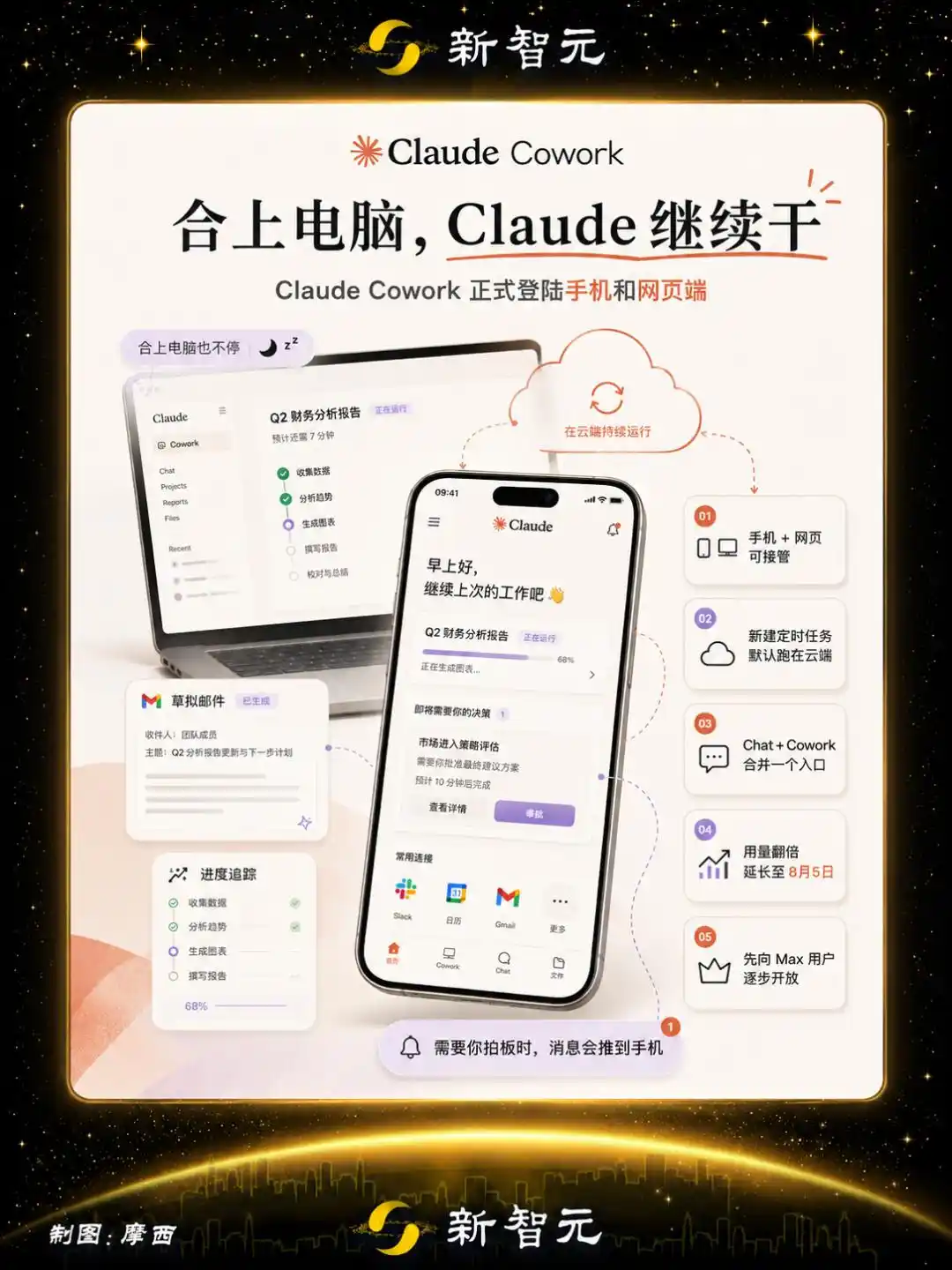
Watching the World Cup, catching a flight—nothing stops AI from working for you. Cowork has completely detached from devices, turning your phone into a command center in seconds, only popping up with a message when a decision needs your approval.
Cowork has received another significant upgrade!
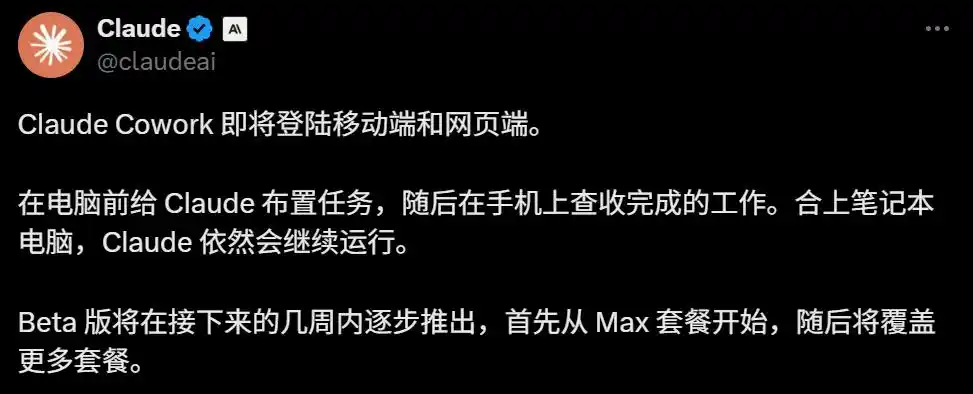
Just now, Anthropic announced: Claude Cowork is officially available on mobile and web.
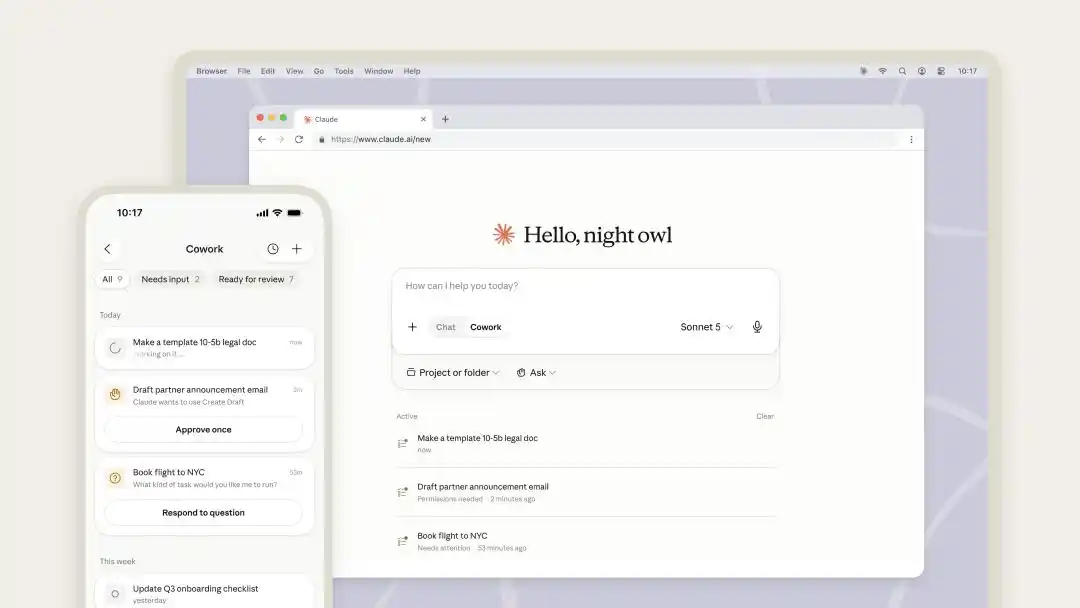
Now, tasks on your desktop can be tracked on your phone for progress, and you can take over operations from any device at any time. Cowork has leaped from 'requiring your presence' straight into 'it works even when you're not there.'
Furthermore, Chat and Cowork have been merged into a single entry point, and the doubled usage quota will be extended directly until August 5th.
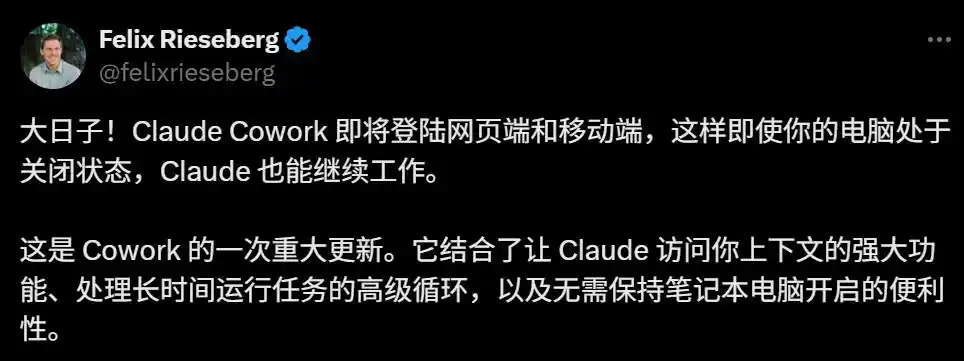
Anthropic engineer Felix Rieseberg stated that this is the first time Cowork has assembled the three key 'puzzle pieces'—
Accurate context acquisition, advanced loops supporting long-duration tasks, and complete freedom from the constraint of requiring a device to be online at all times.
It's worth noting that the first two were each a limiting weakness in the past, and this time, they have finally been seamlessly 'welded' together.
Cloud Takeover: AI Runs All Night After You Close the Laptop
After Cowork lands on mobile, the most immediate sensation is that workers finally don't have to sit in front of their computers.
Now, you just need to throw out all the tasks you need done: pulling data, creating documents, flagging risks, drafting emails without sending, scheduling execution, post-meeting reviews.
Cowork will break them down, prioritize them, and set execution times itself—no need for you to break down steps or write prompt templates.
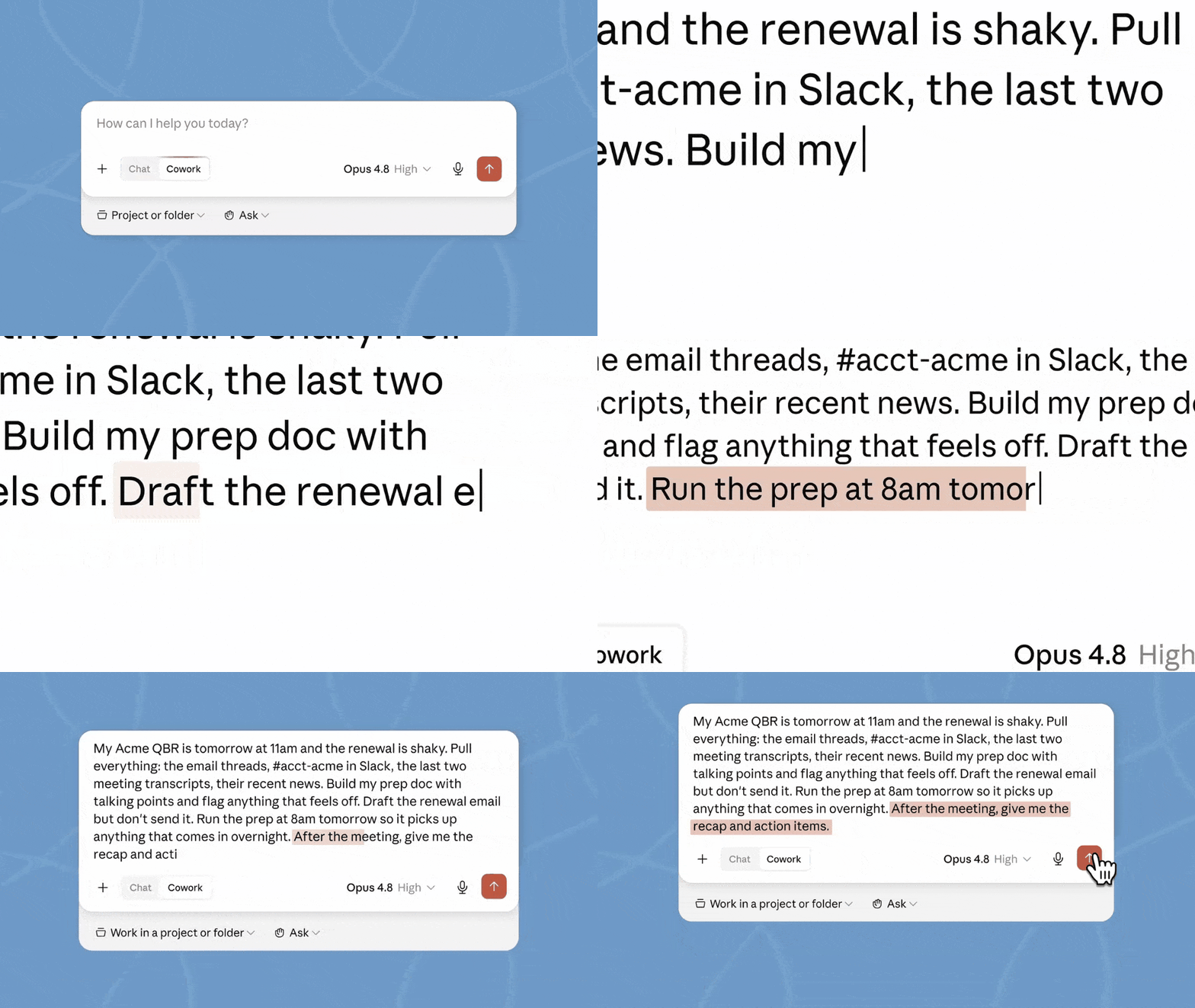
After receiving the tasks, Claude doesn't immediately dive in headfirst.
It first outputs a thought process, reiterating what the user has explained to confirm understanding—when to prepare, keeping emails in the draft folder for someone to send, conducting reviews after the meeting.
Next, Cowork will automatically detect available connectors—Slack, email, calendar—and connect them one by one.
Only after establishing these connections does it truly start sifting through Acme's chat history in Slack, reviewing emails, and compiling scattered information into the preparation document.

Then, the laptop closes, the screen goes black. From this moment, the task is completely decoupled from your device.
Remember, previously, using a phone to assign tasks to AI required the computer to stay on as the host; if the network disconnected, the work stopped. Now it runs on Anthropic's cloud. Whether you're there or not, whether the computer is on or off, doesn't stop it from finishing the job.

Once the preparation document is fully assembled and the follow-up email is drafted, it will pause and push the issue to the phone—a notification pops up, waiting for your tap.

In other words, from start to finish, Cowork has executed a complete work cycle: receiving the brief → autonomous planning → finding tools → pulling data → creating documents → pausing at decisions for human approval → output stopping at draft stage.
Phone Becomes Command Center: Watch the Game, Work Gets Done
Anthropic product manager Robert Bye strongly recommends based on personal experience—
He can now thoroughly enjoy watching the World Cup while calmly 'supervising' his several running agents on his phone.

Ramp's customer success manager Armmand Hosseini also experienced a taste of 'seamless transition.'
He was using Cowork to build a customer tracking dashboard. The work was halfway done when he had to leave to catch a flight. After landing, he pulled out his phone at the baggage carousel and saw the cloud session was still running smoothly.
At that moment, Cowork恰好popped up a decision requiring his personal approval—a light tap to confirm, closing the phone, grabbing the suitcase, and walking away, all in one fluid motion.
Of course, the desktop is still the place for deep work, with full access to local files and browsers; the phone and web are subsets, suitable for follow-up and light interaction.
Giants Enter the Fray, Battling for the Ordinary Person's Desk
Half a year ago, AI agents were still something programmers commanded in terminals. Now, several giants are simultaneously pushing them into ordinary people's phones.
OpenAI's Codex weekly active users have exceeded 5 million, with knowledge workers accounting for about 20%, growing more than three times faster than developers.
Microsoft analyzed 100,000 dialogues from its Copilot: 49% supported cognitive work like analysis, evaluation, and problem-solving, unrelated to coding.
Google's Gemini Agent Mode is also competing for the same space.
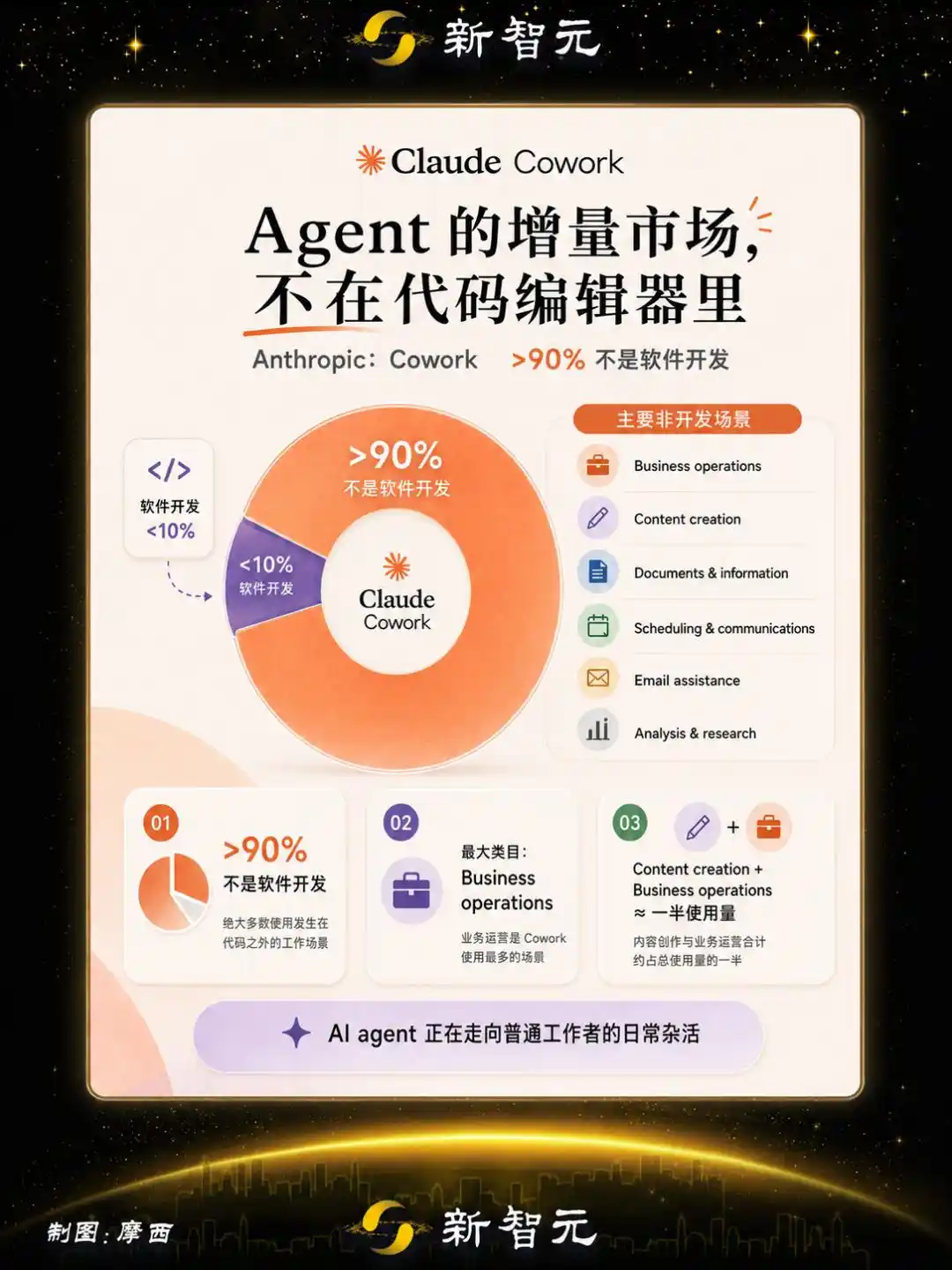
The numbers from these companies point to the same conclusion: the real growth market for agents isn't in code editors, but in the daily chores of ordinary workers.
Looking back at Cowork's expansion path over the past six months, Anthropic is laying out a strategy.
Desktop launch in January, expansion to ordinary office workers in February, followed by Dispatch enabling remote task assignment from phones, and now pushing into mobile and web with scheduled tasks independent of devices.
From desktop to palm to cloud, flags have been planted on all interfaces where work happens.
In the end, this competition might not be about whose agent is smarter, but about who becomes part of ordinary people's daily lives first.
However, for you, it's just one more colleague on your phone—
You assign tasks, it works, pops up a message when a decision needs your approval, you approve it on the subway, and it continues.
It's still there when you're off work. It's still there when you're asleep.
References:
https://claude.com/blog/cowork-web-mobile/
This article is from the WeChat public account "新智元" (XinZhiYuan), author: 新智元, editor: Moshe