IP Token Plunges 98%, Is DATA Rebranding the Last-Ditch Effort? Analyzing Story Protocol's Transformation

Foresight NewsPublished on 2026-07-10Last updated on 2026-07-10

Abstract

IP Token Plummets 98%, Is DATA Rebranding a Last Gamble? Analyzing Story Protocol's Pivot **Summary** Story Protocol, having seen its IP token fall approximately 98% from its all-time high, announced a major pivot on June 25, rebranding as the DATA Foundation. The project will shift its focus from IP to AI training data infrastructure, with a corresponding token change from IP to DATA. While the announcement triggered a brief price bounce, the token soon fell back near its lows. This analysis argues that such a fundamental rebrand is not typically a bullish signal, but rather an admission that the original strategy failed. Historically, rebrands fail when not backed by genuine improvements in product, user adoption, or liquidity, as seen in cases like MultiversX (Elrond) and Golem. Merely chasing a new narrative without execution is insufficient. Conversely, successful pivots are defined by on-chain evidence of growth. The transformation of ETHLend into Aave is the prime example, where a surge in Total Value Locked (TVL) and users preceded and drove long-term value. Projects like Polygon and Kaia, despite price declines, show underlying operational strength. Story’s pivot, announced just two weeks after its token hit a record low, risks being perceived as a last-ditch marketing effort. Leadership changes—with founder Seung Yoon Lee moving to an advisory role—further close the chapter on the original vision. For the DATA rebrand to succeed, it must demonstrably improve th...


Author: Tiger Research

Compilation: AididiaoJP, Foresight News


Key Takeaways


Rebranding is usually not a signal of recovery, but more like an admission of the failure of the original strategy. Past cases show that if products, users, and liquidity don't truly return after a name change, it often ends in failure.


However, judging success or failure solely by price is prone to error. If on-chain execution evidence persists after the rebrand, one shouldn't jump to conclusions of failure too early.


The true test of success lies in the path of ETHLend's transformation into Aave: first comes growth in users and Total Value Locked, and then price follows.


Whether Story Protocol's shift from IP to DATA is a genuine business restructuring or a final marketing attempt will be answered by its future execution.


Market Reaction to Rebranding: Not Necessarily a Good Omen
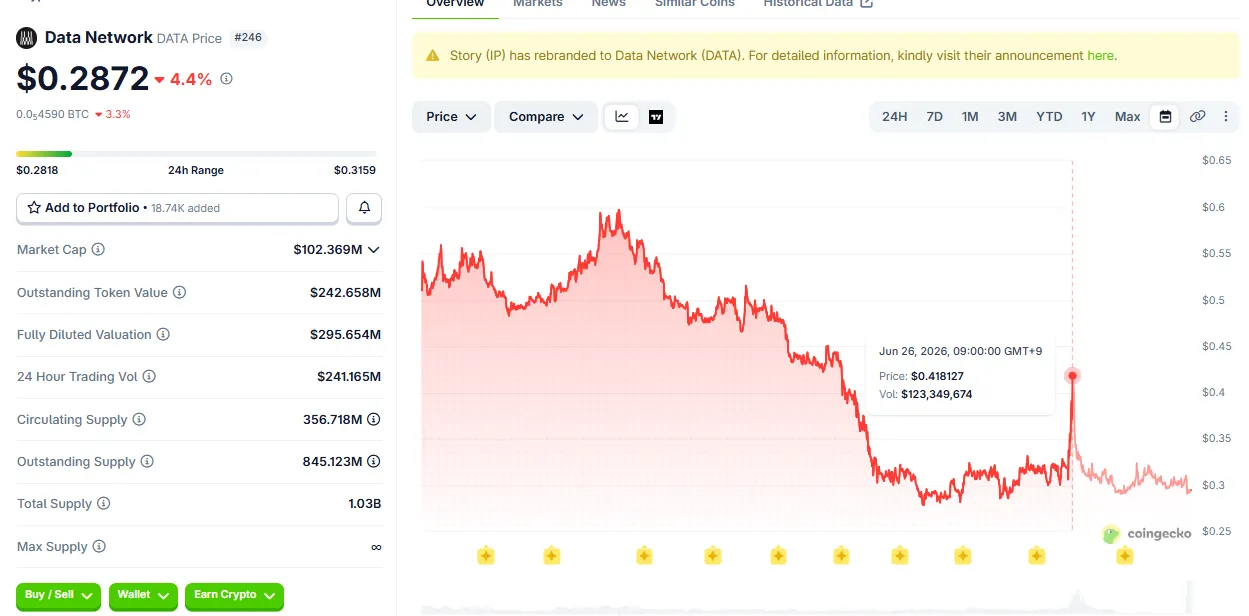


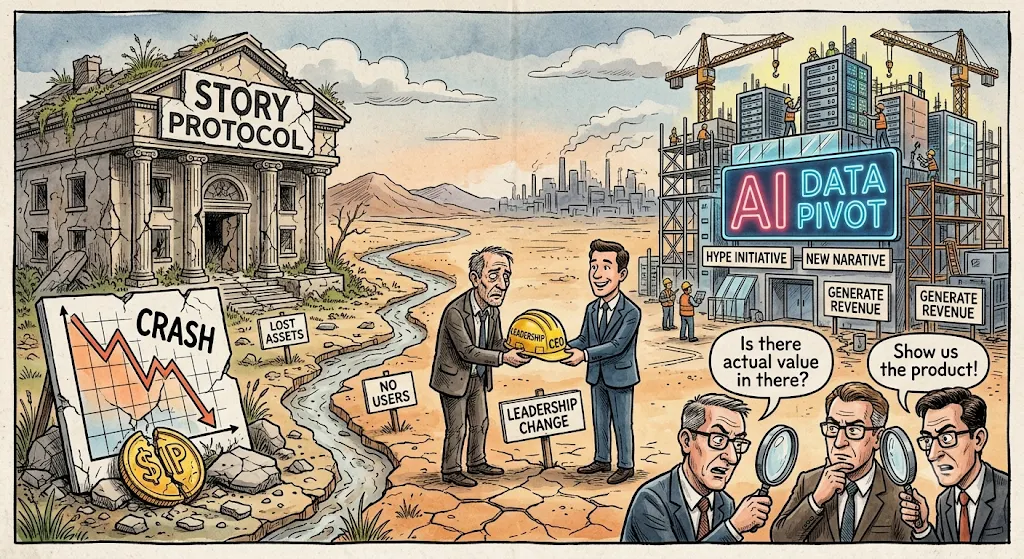
On June 25th, Story Protocol announced its transformation into the DATA Foundation and plans to switch its token from IP to DATA. Although the project had previously secured consecutive funding rounds led by a16z, the IP token struggled to sustain its value during the bear market, falling approximately 98% from its all-time high.


The token subsequently hit new lows. Following the rebranding announcement, the price saw a brief rebound but soon fell back near its lows.


In reality, it's difficult to view this rebranding as a long-term positive for the project. To some extent, it indirectly acknowledges that the project has reached a dead end.


A comprehensive rebrand incurs significant tangible and intangible costs. The time and funds previously invested in brand recognition become sunk costs. Changing the token symbol and project name also carries risks related to internal communication, external coordination, and on-chain asset migration. This means the decision itself carries weight; a rebrand is not superficial but involves a comprehensive adjustment of on-chain and off-chain infrastructure.


Before expecting short-term price rebounds from a token symbol change, a more pertinent question is: what fundamental problem forced the project to abandon the accumulated brand equity and decide to take this path?


Common Traits of Failed Rebranding Cases
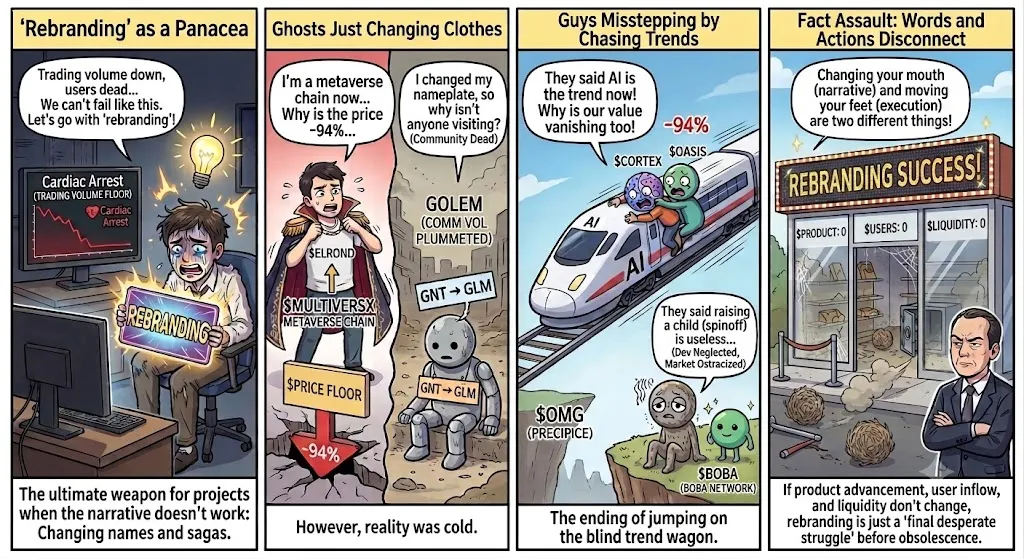


On the surface, rebranding seems like just changing the project name and token symbol, but in essence, it's a shift in product direction and core philosophy. Data from failed rebrands show that most projects that failed to demonstrate genuine improvement in real metrics were eventually eliminated by the market.


  • MultiversX (formerly Elrond): Kept the original EGLD token symbol, pivoted to a metaverse narrative, but the token value has fallen about 94% since the rebrand.
  • Golem (GNT to GLM): Completed token migration, but price is down 92.7% from its peak. Trading volume and development activity have significantly declined, and the project has largely lost relevance.
  • Cortex (CTXC) and Oasis (ROSE): As the AI blockchain narrative faded, Cortex's value nearly zeroed out. Oasis, after pivoting to AI privacy, has also fallen about 94% since its rebrand.
  • OMG Network: After spinning off Boba Network, core network development and ecosystem management were neglected, eventually being left behind by the market.


The common thread among these failed cases is the lack of substantive follow-through in product development, user acquisition, or liquidity provision after the rebrand. Adjusting the narrative and executing the business are two different things.


Judging by Token Price Alone is Far from Enough


Of course, judging a project's success or failure solely by price decline has its limitations, as post-rebrand performance is often intertwined with the overall bear market environment. To avoid mistakenly categorizing projects that still maintain robust on-chain execution data as failures, the following cases are worth referencing.


Ongoing Operational Cases


Kaia (KLAY & FNS merged into KAIA): Post-merger token price fell about 73%, but the project demonstrated strong underlying vitality through initiatives like partnering with South Korea's Kookmin Bank and Busan Bank to issue a Korean won stablecoin, and LINE's mini-program decentralized application. The mini-program attracted 35 million users in its first month, generating 7.3 million new wallets.


Polygon (MATIC to POL): Token fell about 81%, but underlying business continues to advance through the operation of multi-chain settlement infrastructure like AggLayer and the retention of a large ecosystem.


Render (RNDR to RENDER) and ASI: Although market performance has been weak, they possess clear real-world use cases—providing AI computing power and operating core AI products, and their technical execution is validated. Therefore, they are not categorized as failures.


The Benchmark for Successful Rebranding


The case of ETHLend transforming into Aave sets the standard for success.
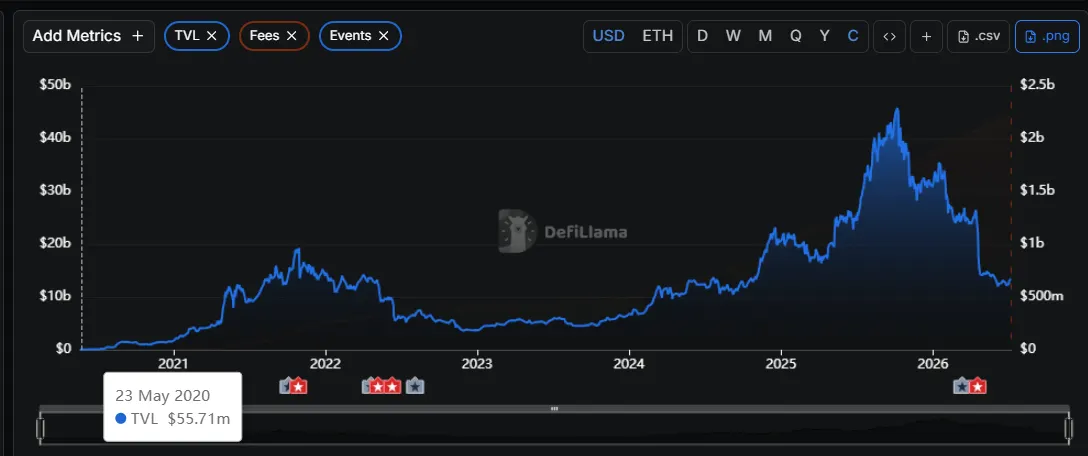


Since its name change in 2020, Aave's Total Value Locked has grown steadily. It has enriched its product line by expanding supported assets, and its user base has significantly expanded. Today, it has become synonymous with the lending protocol sector, a setter of on-chain benchmark interest rates, akin to the "central bank" of decentralized finance. This is a classic example of improving business metrics driving brand value appreciation.


The story of MakerDAO pivoting to Sky is similar: what matters is not the token's roughly 20% decline, but its performance relative to the broader market and its clear execution in running the USDS and sUSDS decentralized stablecoins.


These cases show that the key to judging the success of a rebrand is not short-term price volatility, but whether the project's stated rationale truly materializes and the subsequent tangible results. A rebrand without genuine growth in underlying metrics will eventually be abandoned by the market once the marketing effect wears off.


Story Protocol's Current Rebrand


Story's IP token launched in February 2025, reaching its all-time high of around $14.78 in September of the same year, then entering a period of stagnation.


Notably, consider the timing: the token hit its all-time low of $0.275 on June 10, 2026. Just two weeks later, on June 25, the project announced its pivot to AI training data infrastructure.


Because the rebrand occurred near the all-time low, the market questions whether this is merely the final card played to boost the price.


For Story to justify this rebrand, three key metrics need to be tracked in the future:


  • Whether the token's relative strength compared to the broader market recovers;
  • The trend of on-chain liquidity and trading volume after the token switch;
  • Whether the new AI data narrative genuinely brings on-chain user growth and increased settlement revenue.


Changes in core leadership are also noteworthy. The original narrative leader, Seung Yoon Lee, has stepped back from the foundation's daily operations into an advisory role focusing on strategy. Former Chief Product Officer Andrea Muttoni has taken over as the new CEO of the DATA Foundation.


Seung Yoon Lee remains the CEO of the development company PIP Labs, but his reduced role in the foundation marks the end of a chapter for the original Story (IP) narrative centered around this Korean founder and the three consecutive a16z-led funding rounds.


Based on currently available data, this pivot to DATA looks more like a defensive adjustment than a long-term strategic overhaul. To change this perception, tangible results in liquidity, users, and settlement revenue must be delivered after the token switch. Otherwise, Story will become just another failed rebranding case, with its past brief glory fading into memory.


Trending Cryptos

Related Questions

QWhat is the main concern raised in the article about Story Protocol's rebranding to DATA Foundation?

AThe main concern is that the rebranding might not signal a genuine recovery but rather an admission that the original IP strategy has failed. The timing, occurring after the IP token hit a historical low, leads to skepticism about whether it's a final marketing attempt rather than a substantive business pivot.

QAccording to the article, what is the common factor among failed rebranding cases like MultiversX and Golem?

AThe common factor is that after the rebranding, there was no substantial follow-through in terms of product development, user acquisition, or liquidity provision. The narrative change was not backed by real improvements in fundamental business metrics.

QWhat key example does the article use to illustrate a successful rebranding, and why was it successful?

AThe article uses the example of ETHLend rebranding to Aave. It was successful because the rebranding was followed by significant growth in Total Value Locked (TVL), expansion of supported assets, and a substantial increase in user base, transforming it into a leading lending protocol.

QWhat three key metrics does the article suggest should be tracked to judge the success of Story Protocol's (DATA) rebranding?

AThe three key metrics are: 1) The relative strength of the DATA token compared to the broader market. 2) The trend of on-chain liquidity and trading volume after the token migration. 3) Whether the new AI data narrative actually brings growth in on-chain users and increases settlement revenue.

QWhat leadership change is highlighted in the article regarding Story Protocol's transition to DATA?

AThe article highlights that Seung Yoon Lee, the original narrative driver and founder, has stepped back from the foundation's daily operations to an advisory role focusing on strategy. Andrea Muttoni, the former Chief Product Officer, has taken over as the new CEO of the DATA Foundation.

Related Reads

Does Switching Chains to Re-entrepreneur Really "Change One's Destiny"?

Amid a recent wave of blockchain migrations, several established projects, including Sophon, Moonbeam, and Secret Network, are moving to new ecosystems like Base and Arbitrum. Unlike past migrations driven by hype or security, these moves are often accompanied by strategic pivots, such as shifting focus to consumer applications, AI, or privacy-AI integration, effectively representing a "re-startup" attempt. However, the crypto community has reacted cautiously. Following Secret Network's announcement of its planned migration to Arbitrum, its token price plummeted over 30% in 24 hours. While migrating to more cost-efficient, higher-traffic, or technologically suitable chains can be a pragmatic choice, history shows that such moves rarely guarantee success. Examples like the y00ts NFT project, which moved from Solana to Polygon and then to Ethereum, or Synthetix’s retreat from a multi-chain strategy, illustrate the challenges and often underwhelming results. The current market environment, characterized by greater user rationality and the partial validation of past narratives, makes a successful "pivot via migration" even more difficult. Simultaneously, destination chains themselves face challenges in demonstrating sustainable user adoption beyond merely attracting migrating projects. Ultimately, the competition is shifting from which chain can onboard the most projects to which can genuinely foster real-world application and retain users.

链捕手8m ago

Does Switching Chains to Re-entrepreneur Really "Change One's Destiny"?

链捕手8m ago

June Transaction Volume Doubles: x402 Ecosystem Continues to Expand, Content Monetization Narrative Faces Crucial Test

X402, a protocol for AI and data services, experienced significant growth in June. Its transaction volume doubled compared to May, primarily driven by the AI inference routing service BlockRun. The ecosystem expanded with new integrations: Apify enabled data scraping services, Exa extended its AI search to Solana, and Seal launched 'Hacks', a marketplace for automated AI agents. The protocol itself received crucial upgrades, including 'Builder Codes' for tracking and affiliate systems and 'Batch Settlement' to enable practical micropayments for high-frequency AI tasks. Major external validation came from tech giants. Amazon Web Services (AWS) launched a solution for AI traffic metering at its edge nodes. More significantly, Cloudflare opened its waitlist for a Content Monetization Gateway. This gateway allows websites to charge AI bots and other automated agents for accessing content, using x402 for stablecoin payments. This addresses a core internet monetization problem and represents x402's most promising path to mass adoption, though Cloudflare's CEO noted current blockchain scalability remains a critical hurdle. Current leading use cases are AI inference routing and paid data feeds. However, the large-scale real-world test with Cloudflare's gateway will be decisive in determining if x402 can transition from a useful tool to a fundamental infrastructure component for a new web economy where AI agents pay for the content they consume.

Foresight News33m ago

June Transaction Volume Doubles: x402 Ecosystem Continues to Expand, Content Monetization Narrative Faces Crucial Test

Foresight News33m ago

RWA Weekly: EU Proposes Revision of MiCA to Cover Tokenization and Non-EU Stablecoins; Swift and 17 Banks to Pilot Tokenized Cross-Border Payments

RWA Weekly: EU Proposes MiCA Revision for Tokenization and Non-EU Stablecoins; Swift to Pilot Tokenized Cross-Border Payments with 17 Banks During the statistical period of July 3-10, 2026, the RWA sector showed signs of recovery. The total on-chain market capitalization of RWAs rebounded to $33.12 billion, ending a prolonged decline. The stablecoin market cap also returned above $300 billion, with active addresses and holders increasing, indicating restored market vitality. Key regulatory developments include China promoting the use of digital yuan in consumption vouchers, the EU considering revisions to its MiCA framework to cover tokenization and non-EU stablecoins, and Kazakhstan authorizing stablecoin use for cross-border corporate and government payments. In Hong Kong, HSBC issued its first "digitally native" structured product. Major project updates feature Swift announcing readiness of its blockchain ledger for a 24/7 tokenized cross-border payment pilot involving 17 global banks. Ondo launched a perpetuals platform allowing tokenized stocks as collateral. Sony received conditional U.S. OCC approval to launch a stablecoin-focused trust bank in 2027. Tether plans to natively issue USDT on Bitcoin via the RGB protocol. Significant funding rounds saw Securitize planning to deploy over $400 million for acquisitions to expand its institutional tokenization business, while Tether invested $20 million in Brazil's Mercado Bitcoin to support its growth in on-chain financial services. Analysis highlights that stablecoins are evolving into global financial infrastructure with regional specializations and that institutions should consider international expansion to gain practical experience in the RWA tokenization space amidst evolving regulations.

marsbit1h ago

RWA Weekly: EU Proposes Revision of MiCA to Cover Tokenization and Non-EU Stablecoins; Swift and 17 Banks to Pilot Tokenized Cross-Border Payments

marsbit1h ago

Trading

Spot

Hot Articles

Discussions

Welcome to the HTX Community. Here, you can stay informed about the latest platform developments and gain access to professional market insights. Users' opinions on the price of S (S) are presented below.

活动图片