Huh? Is This a Robot's Hand?

marsbitPublished on 2026-07-10Last updated on 2026-07-10

Abstract

"Surprise? This is a robot's hand?" introduces the groundbreaking robotic hand developed by 1X Technologies for its humanoid robot, NEO. Featuring 25 degrees of freedom, tendon-driven mechanics, and "force transparency," the hand is fully force-controlled, back-drivable, and equipped with fingertip tactile sensing. It achieves a positioning precision of ±0.2mm, withstands 2 million cycles at the wrist, and is IP68 waterproof. The hand can perform a wide array of complex, human-like tasks, from screwing in a lightbulb and sorting grapes to pouring tea, plugging in a USB-C cable, and even using sign language. Its low gear ratio (5:1 to 15:1) enables real-time force feedback and safe physical interaction. Already in mass production with a 2025 target of 10,000 units, this vertically integrated design marks a significant step towards scalable, intelligent embodied agents capable of everyday manual work.

Huh? Is this still a robot's hand? Where on earth did it bring me.
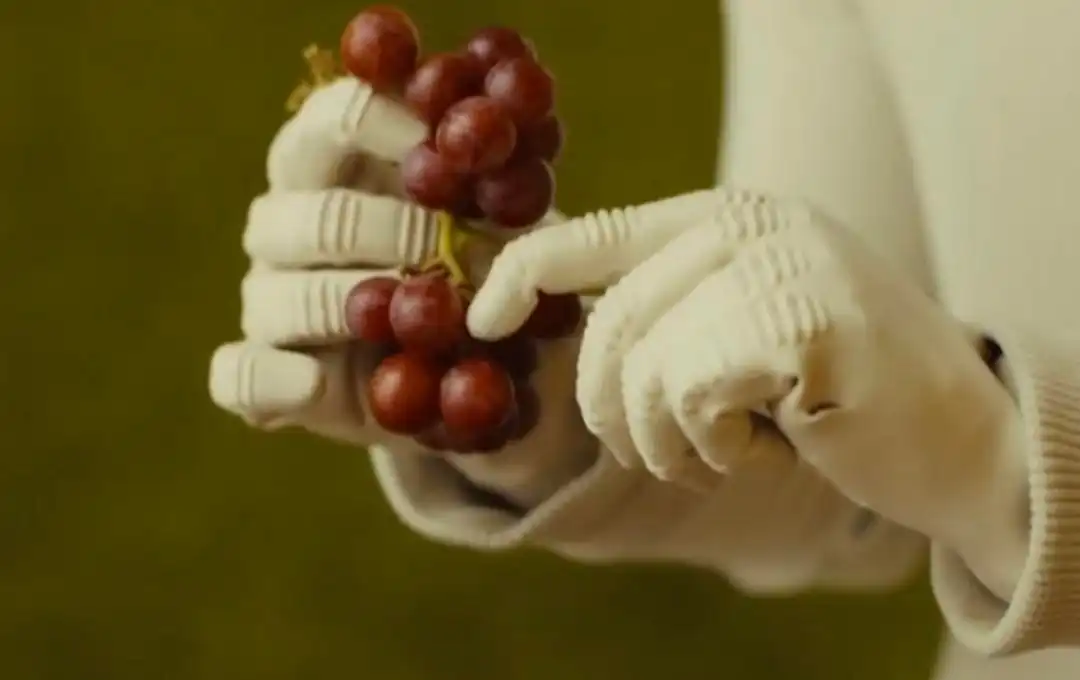
1X Technologies has released its trump card.

A 25-degree-of-freedom, tendon-driven robotic hand, mounted on its humanoid robot NEO, can handle screwing in light bulbs, picking up screws, zipping up zippers, pouring tea, plugging in USB-C cables, and signing in sign language, all with ease.

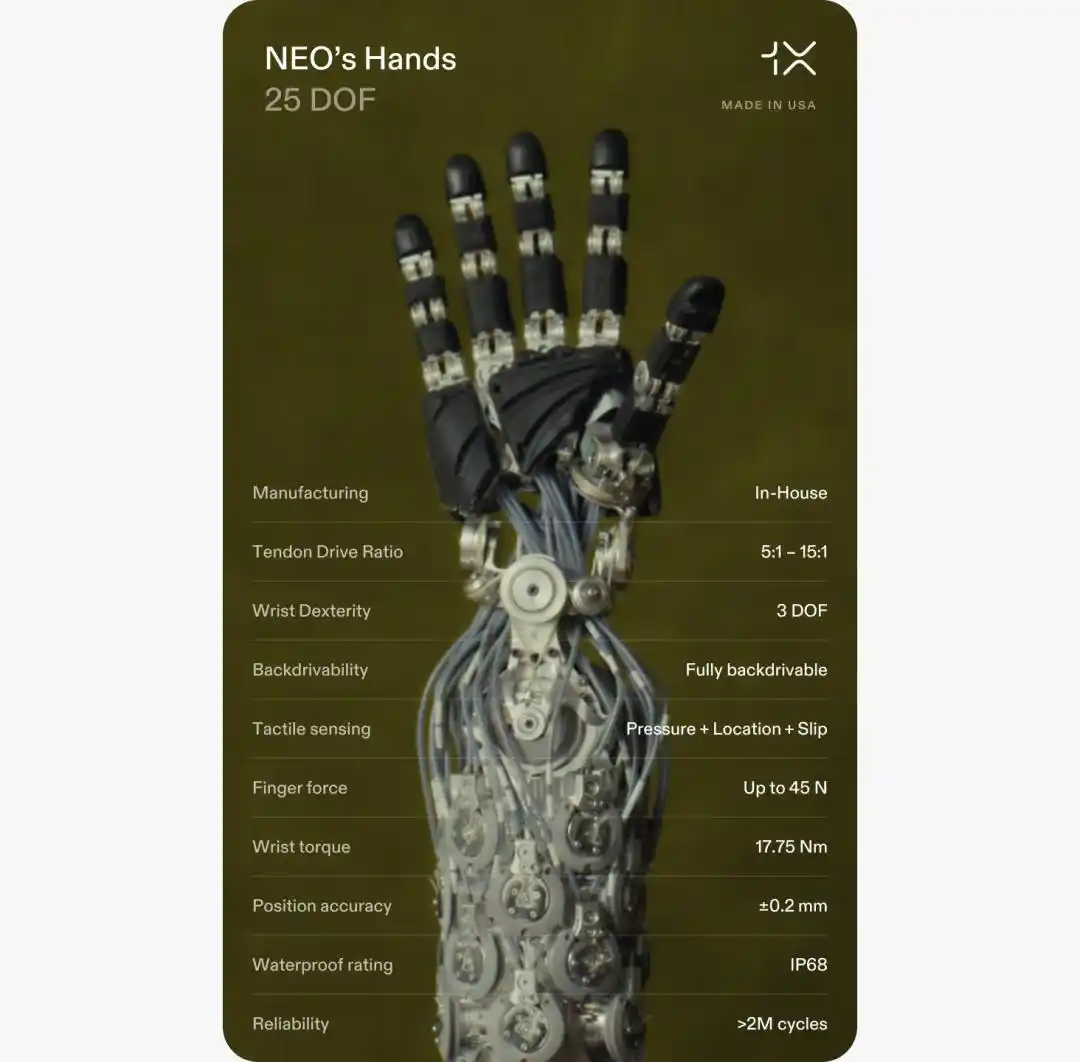
It features force transparency, backdrivability, full fingertip tactile sensing, positioning accuracy of ±0.2mm, a wrist joint that has survived over 2 million cycle tests, IP68 waterproofing, and can even wash itself.
The most crucial part: This year's production capacity is 10,000 units, and they are already running on the production line.

Bernt Børnich, founder and CEO of 1X, said: With these hands, robots can now do the things humans do with their hands every day.

The Joints Themselves Are Sensors

Most robotic hands are "write-only" devices.

Send a position command, the finger moves, but what it touched, how hard it was, whether it's slipping—none of that is known.

The reason lies in the gear ratio:

The industry's common 100:1 or even 200:1 gear reduction ratios swallow contact forces into friction; the signal disappears before it can travel back to the motor.

The result is that the hand itself is numb, forcing engineers to stick cameras on the outside and use vision to guess what's happening at the fingertips.

1X's approach is completely different.

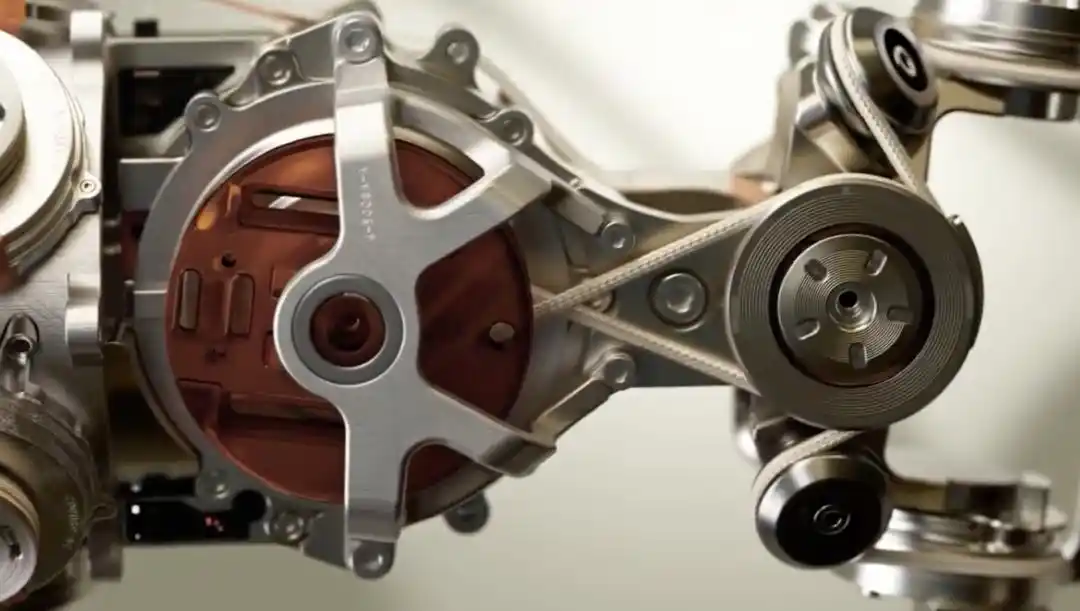
NEO's hand was developed in-house from scratch, using a quasi-direct-drive tendon transmission system, with the transmission ratio compressed to between 5:1 and 15:1.
Of the 25 degrees of freedom, the fingers and palm account for 22 fully actuated DOF, with 3 in the wrist, all natively force-controlled and all backdrivable.

If you push its finger, it will compliantly yield, while precisely reporting the force you applied. Force flows out from the fingertip, and information flows back along the same physical path.
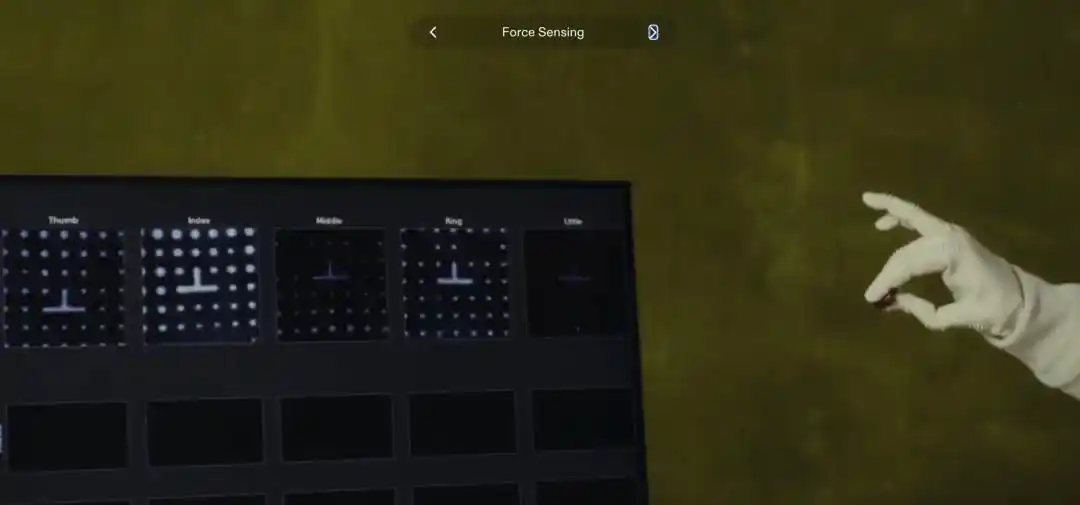
1X calls this "force transparency". It's this characteristic that turns every push, press, and pinch into a measurement.

Beyond force feedback, there is also proprioception because every joint is closed-loop controlled. The hand always knows its configuration without looking, just like a human can touch their two index fingers together with their eyes closed.

What It Can Do: From Picking Up Coins to Signing

What do 25 force-transparent degrees of freedom mean?

It covers a sufficiently rich range of grasping postures and manipulation actions. The distribution of DOF references human hand anatomy, with a key emphasis on strengthening the thumb's opposition ability, which is central to human fine manipulation.
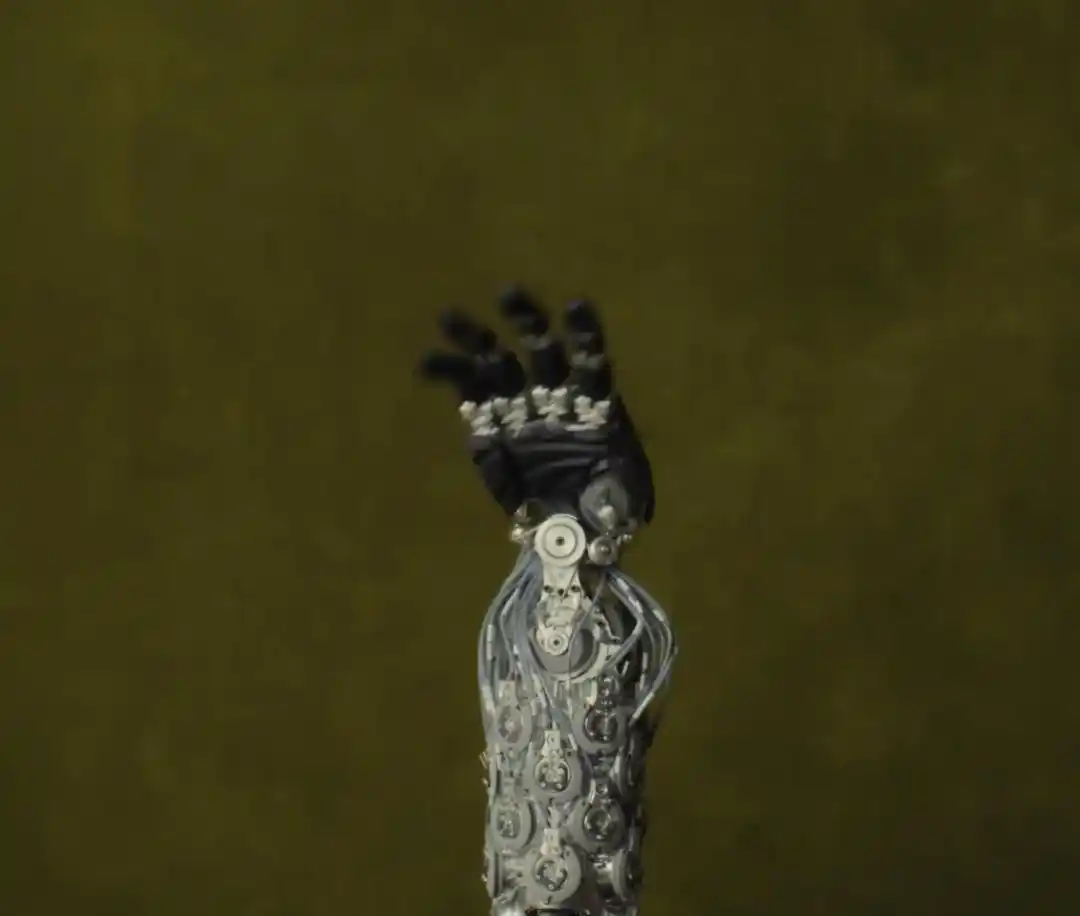
1X states that this configuration represents the optimal balance between operational capability, manufacturability, controllability, and maintainability.

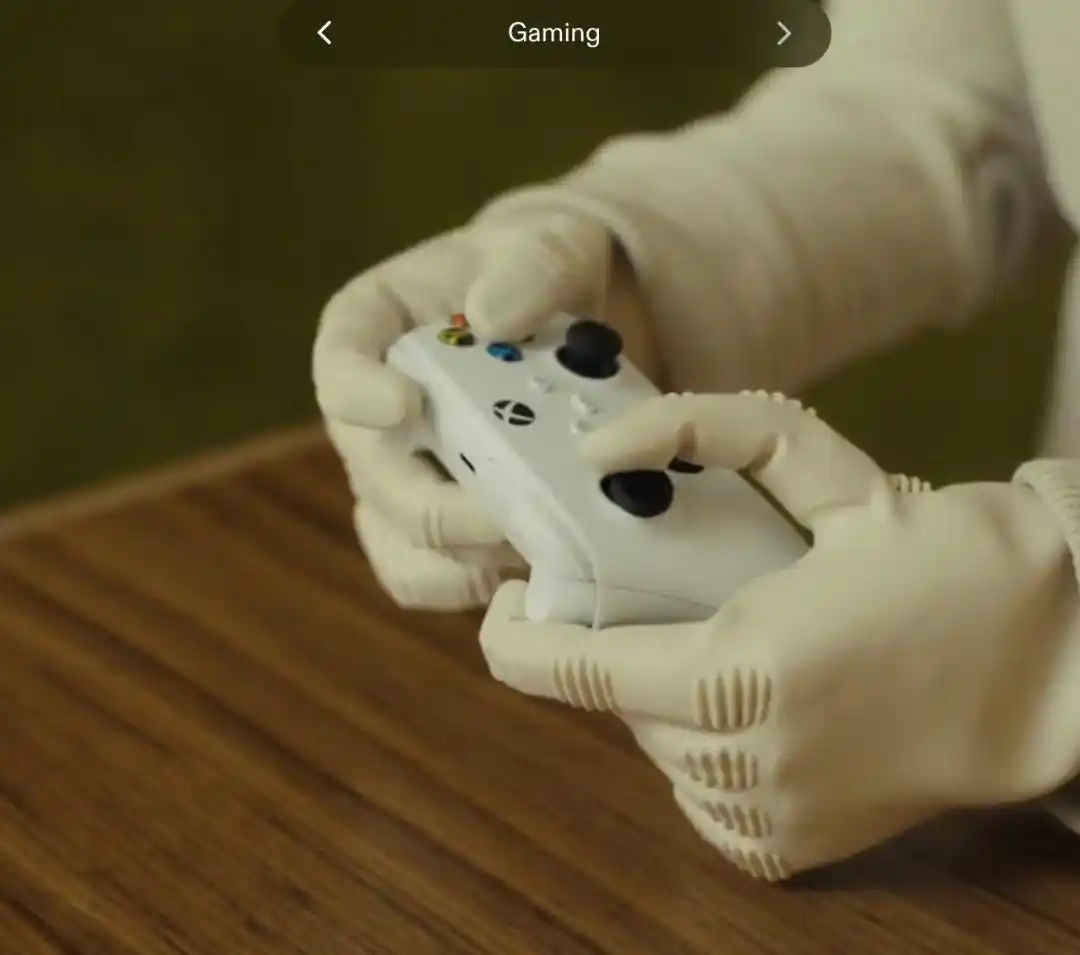
NEO can assemble LEGO bricks, pick out a single coin or screw from a wallet, rotate and install a light bulb, use a screwdriver, rotate objects within the hand, zip up a jacket zipper, sort grapes by color, pour tea from a kettle, catch a soft ball, plug in a USB-C charging cable, pick up a wine glass, wipe a table with a tissue and spray, and sign in sign language.

It's no slouch in strength either. The thumb carpometacarpal joint has a peak torque of 3.5 Nm, the finger metacarpophalangeal joints 2.6 Nm, fingertip flexion force reaches 45N, and wrist torque is 17.75 Nm. Opening doors, pushing loaded carts, lifting heavy objects, and tool operation are all within its capabilities.

Positioning accuracy is ±0.2mm, just covering the most common range for manipulating small objects in daily human labor.
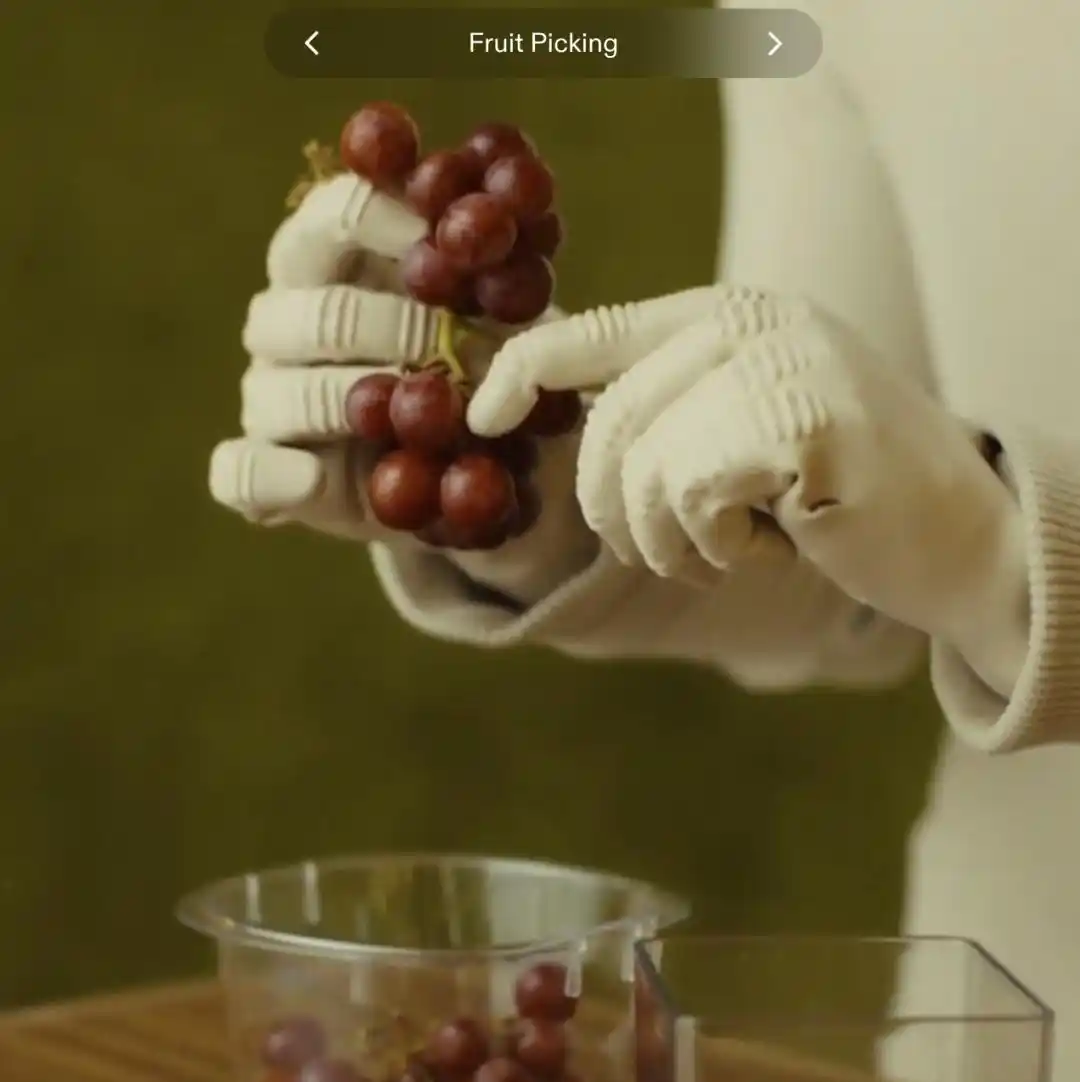
On the tactile level, the fingertips and contact surfaces are covered with high-resolution tactile sensors that can perceive normal force, contact position, and shear force.

When an object begins to slip, the hand can detect it in real-time and re-grasp.
The visualizations released by 1X include contact normal vectors, heat maps of pressure during a handshake, and the process of delicately picking up fragile origami without causing any damage.

This skin is a functional material co-designed with the internal sensors and the underlying tendons. For small, transparent, deformable, or occluded objects, vision alone is simply insufficient.

The Production Line Is Already Running

The hand's motors are hidden in the forearm, similar to the location of human grip muscles, pulling the fingers via proprietary tendons that run through the wrist.

This keeps the hand itself lightweight while allowing it to maintain high output during continuous operation without overheating.

The entire hand is deeply vertically integrated: in-house motors, custom electronics, embedded sensors, proprietary tendon system, compact transmission mechanisms, hand-specific firmware—all designed and manufactured in-house. From tendon material to the outermost soft polymer and tactile sensing layer, everything is done end-to-end internally.
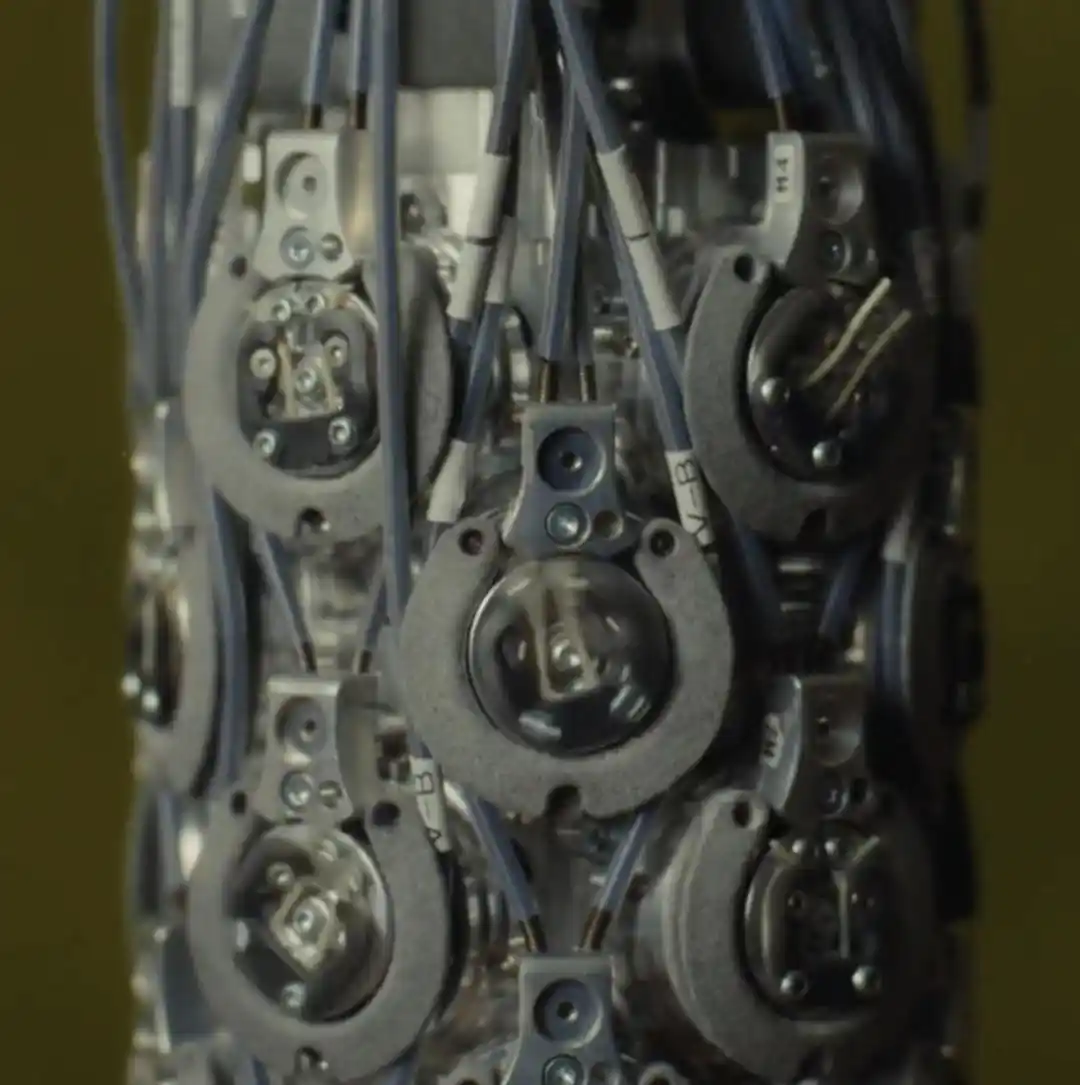
In terms of durability, components and complete finger assemblies have undergone millions of cycle tests, drive units have been validated under extreme temperatures, and the wrist joint passed over 2 million cycles under high load. Protection rating is IP68, materials are food-safe grade, allowing it to work by the sink and wash itself when dirty.
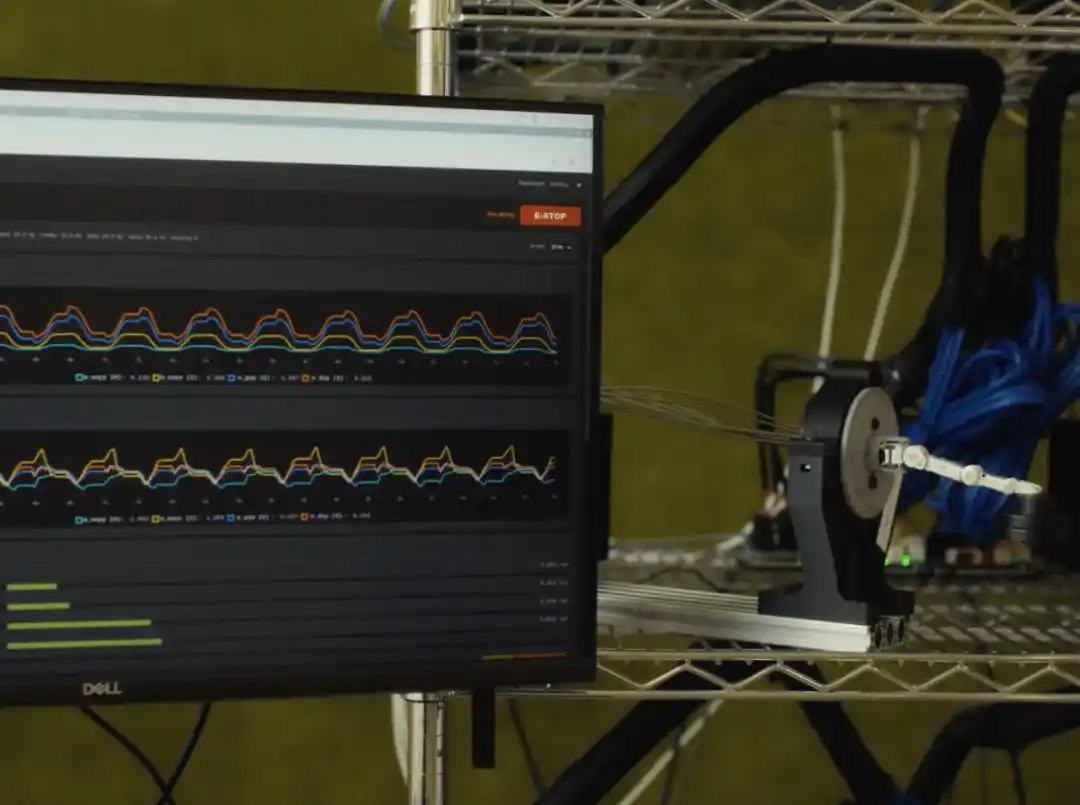
Safety is ensured by the mechanics themselves: the extremely low gear ratio combined with tendon drive and low distal inertia allows external impacts to safely backdrive the fingers.

In slow-motion footage released by 1X, the hand is shown being slapped, hammered, caught in a drawer, and smashed into foam, compliantly yielding without damage.

This hand has already been mass-produced in the hundreds on a scalable production line. The production target for this year is 10,000 units, each undergoing complete end-of-line testing.

A hand that can't be manufactured at scale can't generate data at scale, and without data at scale, there can be no embodied intelligence.

Reference link:[1]https://www.1x.tech/discover/neos-hands

This article is from the WeChat public account "QbitAI", author: Meng Chen

Trending Cryptos

Related Questions

QWhat is the key innovative feature of 1X Technologies' new robot hand that enables its delicate manipulation capabilities?

AIts key innovation is the 'force transparency' enabled by a low gear ratio (5:1 to 15:1) tendon-driven system. This allows the hand to be backdrivable and provides native force sensing, meaning the hand can precisely feel forces at the fingertips and adjust its grip accordingly, similar to a human hand.

QHow many degrees of freedom does the NEO robot's hand have, and how are they distributed?

AThe NEO robot hand has 25 degrees of freedom in total. Twenty-two fully actuated degrees of freedom are in the fingers and palm, enabling intricate finger movements. The remaining three degrees of freedom are in the wrist.

QWhat are some specific tasks demonstrated by the NEO robot using its new hands?

ADemonstrated tasks include assembling Lego bricks, picking a single coin or screw from a wallet, screwing in a light bulb, using a screwdriver, rotating objects within the hand, zipping up a jacket, sorting grapes by color, pouring tea, inserting a USB-C cable, holding a wine glass, wiping a table, and performing sign language.

QWhat manufacturing milestone has 1X Technologies achieved with this robot hand?

A1X Technologies has already manufactured hundreds of these hands on a scalable production line, with an annual production capacity target of 10,000 units this year.

QHow does the robot hand design address safety concerns for human-robot interaction?

ASafety is primarily ensured through its mechanical design. The low gear ratio, tendon-driven mechanism, and low inertia at the fingertips make the hand naturally backdrivable and compliant. It can safely yield to external impacts, like being tapped, hit with a hammer, or pinched in a drawer, without breaking.

Related Reads

June Transaction Volume Doubles: x402 Ecosystem Continues to Expand, Content Monetization Narrative Faces Crucial Test

X402, a protocol for AI and data services, experienced significant growth in June. Its transaction volume doubled compared to May, primarily driven by the AI inference routing service BlockRun. The ecosystem expanded with new integrations: Apify enabled data scraping services, Exa extended its AI search to Solana, and Seal launched 'Hacks', a marketplace for automated AI agents. The protocol itself received crucial upgrades, including 'Builder Codes' for tracking and affiliate systems and 'Batch Settlement' to enable practical micropayments for high-frequency AI tasks. Major external validation came from tech giants. Amazon Web Services (AWS) launched a solution for AI traffic metering at its edge nodes. More significantly, Cloudflare opened its waitlist for a Content Monetization Gateway. This gateway allows websites to charge AI bots and other automated agents for accessing content, using x402 for stablecoin payments. This addresses a core internet monetization problem and represents x402's most promising path to mass adoption, though Cloudflare's CEO noted current blockchain scalability remains a critical hurdle. Current leading use cases are AI inference routing and paid data feeds. However, the large-scale real-world test with Cloudflare's gateway will be decisive in determining if x402 can transition from a useful tool to a fundamental infrastructure component for a new web economy where AI agents pay for the content they consume.

Foresight News10m ago

June Transaction Volume Doubles: x402 Ecosystem Continues to Expand, Content Monetization Narrative Faces Crucial Test

Foresight News10m ago

RWA Weekly: EU Proposes Revision of MiCA to Cover Tokenization and Non-EU Stablecoins; Swift and 17 Banks to Pilot Tokenized Cross-Border Payments

RWA Weekly: EU Proposes MiCA Revision for Tokenization and Non-EU Stablecoins; Swift to Pilot Tokenized Cross-Border Payments with 17 Banks During the statistical period of July 3-10, 2026, the RWA sector showed signs of recovery. The total on-chain market capitalization of RWAs rebounded to $33.12 billion, ending a prolonged decline. The stablecoin market cap also returned above $300 billion, with active addresses and holders increasing, indicating restored market vitality. Key regulatory developments include China promoting the use of digital yuan in consumption vouchers, the EU considering revisions to its MiCA framework to cover tokenization and non-EU stablecoins, and Kazakhstan authorizing stablecoin use for cross-border corporate and government payments. In Hong Kong, HSBC issued its first "digitally native" structured product. Major project updates feature Swift announcing readiness of its blockchain ledger for a 24/7 tokenized cross-border payment pilot involving 17 global banks. Ondo launched a perpetuals platform allowing tokenized stocks as collateral. Sony received conditional U.S. OCC approval to launch a stablecoin-focused trust bank in 2027. Tether plans to natively issue USDT on Bitcoin via the RGB protocol. Significant funding rounds saw Securitize planning to deploy over $400 million for acquisitions to expand its institutional tokenization business, while Tether invested $20 million in Brazil's Mercado Bitcoin to support its growth in on-chain financial services. Analysis highlights that stablecoins are evolving into global financial infrastructure with regional specializations and that institutions should consider international expansion to gain practical experience in the RWA tokenization space amidst evolving regulations.

marsbit44m ago

RWA Weekly: EU Proposes Revision of MiCA to Cover Tokenization and Non-EU Stablecoins; Swift and 17 Banks to Pilot Tokenized Cross-Border Payments

marsbit44m ago

The first to catch the wave of the Robinhood Chain hype is Arbitrum, up nearly 20%

"ARB, the native token of Arbitrum, surged nearly 20% recently, emerging as a top-performing L2 token. This rally is attributed to the launch of 'Robinhood Chain,' a Real-World Asset (RWA) Layer 2 built using Arbitrum's technology. The launch has brought renewed attention to the 'Arbitrum Expansion Plan' (AEP), a year-and-a-half-old program. AEP allows external projects to build their own chains using Arbitrum's Orbit technology. In return, these 'tenant' chains that do not settle on Arbitrum's main networks must share 10% of their net protocol revenue with the Arbitrum ecosystem—8% to the DAO treasury and 2% to the developer guild. While smaller chains like Degen Chain previously triggered AEP, Robinhood Chain is the first major, high-profile tenant, making the revenue-sharing model economically significant for the first time. Initial data from Robinhood Chain is impressive, with over 35 million transactions, 350,000 addresses, $2.5 billion in TVL, and over $1 billion in DEX volume shortly after launch. However, its current protocol revenue, at roughly $146,000 net, translates to only a minimal payout to Arbitrum DAO. The ARB price surge thus reflects the market's anticipation of future revenue as Robinhood's vast $324 billion platform assets potentially migrate on-chain. This 'landlord' model mirrors Optimism's approach with its OP Stack and Superchain. However, Optimism's model faces pressure as its largest tenant, Base, announced plans to depart, causing a significant drop in OP's price. Similarly, analysts question Robinhood Chain's long-term dependence on Arbitrum, noting its daily sequencer revenue already nears three times that of Arbitrum itself. There is speculation that, like Base, it may eventually seek independence, with ETH potentially being its primary economic token rather than ARB."

Foresight News1h ago

The first to catch the wave of the Robinhood Chain hype is Arbitrum, up nearly 20%

Foresight News1h ago

The Ethereum Foundation is Dead, The Era of Ethereum's Pluralistic Organizations Has Dawned

The Ethereum Foundation (EF) has announced the dissolution of its Protocol Support Team, marking a significant organizational shift. This move, described as the largest layoff in EF's history with a 20% staff reduction, follows a major internal restructuring announced in late June. The restructuring, which EF framed as necessary to streamline for future challenges, has drawn criticism for its perceived cold execution. Concurrently, several new independent non-profit organizations have emerged, founded by former EF members. These include Ethlabs, a research and development lab, and Ethereum Institutional, which focuses on promoting institutional adoption of Ethereum. Their rise is seen as both filling roles vacated by EF's downsizing and signaling a fragmentation of the Ethereum ecosystem's leadership. Amidst these changes, EF is also integrating advanced AI tools into its security operations. The security team has begun using AI agents to conduct red-team testing, which has already uncovered vulnerabilities in Ethereum's code. While EF states that AI complements rather than replaces human researchers, this technological shift hints at potential future reductions in human-centric roles within the organization. The article posits that these developments—massive layoffs, the exodus of key personnel like former Executive Director Xiaowei Wang, the rise of rival organizations, and AI integration—collectively point to a decline in EF's central authority. Once the undisputed leader of the Ethereum ecosystem, EF now faces questions about its future role, with speculation that it may evolve into more of a symbolic "ecosystem mascot" rather than a driving force for growth and adoption. This organizational turmoil unfolds against a backdrop of ongoing market pressure and community debate over Ethereum's value proposition.

marsbit1h ago

The Ethereum Foundation is Dead, The Era of Ethereum's Pluralistic Organizations Has Dawned

marsbit1h ago

Trading

Spot

Hot Articles

Discussions

Welcome to the HTX Community. Here, you can stay informed about the latest platform developments and gain access to professional market insights. Users' opinions on the price of S (S) are presented below.

活动图片