Channel Dividends Are Dwindling, What Can DeFi Protocols Rely on to Resist Giants' Harvesting?

Foresight NewsPublished on 2026-06-22Last updated on 2026-06-22

Abstract

As the era of channel-driven growth ends, major tech giants like Coinbase, Stripe, and Kraken are vertically integrating by acquiring or building core infrastructure, capturing profits from underlying protocols. For instance, Coinbase leverages its Base blockchain to earn sequencing fees from protocols like Morpho, while Stripe acquired Bridge to internalize stablecoin yields, and Kraken bought NinjaTrader for derivatives licenses. This trend creates a power imbalance: entities controlling distribution channels can extract value from open-source DeFi protocols. However, protocols are developing a defense through multi-chain expansion. Examples like Morpho (with significant TVL on Ethereum and Base) and Uniswap (dominant across many chains) show that by deploying across multiple blockchains, protocols reduce dependency on any single chain operator, making them costly and risky to replace. The article argues that the future landscape will be shaped by the race between institutional vertical integration and protocol horizontal, multi-chain scaling. Protocols that embed themselves deeply across ecosystems and become indispensable due to high switching costs are most likely to survive and thrive amidst this consolidation.


Author: Thejaswini M A

Compiled by: Saoirse, Foresight News


In Goodfellas, Ray Liotta has a line: 'Fuck you, pay me.' This line shreds the romanticized filter of mafia honor found in works like The Godfather, starkly revealing the cold, parasitic, and purely profit-driven essence of organized crime. Following a similar logic, let's talk about big tech companies.


You control value by controlling profits. To achieve this, you don't even need to build a public blockchain protocol or a project. It's a profit grab with no rules. But we can't blame Coinbase, Stripe, or Kraken for making such choices.


From the most fundamental business logic, their maneuvers are akin to a shrewd real estate play: be the first to secure the traffic distribution channels. Now holding the power of these channels, they look down and ask: 'Who exactly holds the bargaining power?'


Coinbase built its own blockchain; Stripe spent $1.1 billion acquiring infrastructure it could have rented; Kraken spent $1.5 billion acquiring a derivatives trading platform; Apple built the App Store. The logic of this playbook is: let others develop the market and bear the early risks, then acquire the underlying infrastructure when the profit potential in the sector becomes sufficiently attractive. The core question this article explores: Where will the industry head when traffic distribution channels are no longer the core value?


Coinbase has 110 million verified users. For years, its lending products for users were built on top of the open-source protocol Morpho, with all protocol fees going to Morpho. Later, Coinbase launched its own L2 blockchain, Base. Morpho chose to deploy on Base because Coinbase's massive user base could bring transaction volume. Now, the sequencer fee generated by every transaction on Base flows entirely into Coinbase's pockets, not Morpho's.


Base generated $76 million in net sequencer fee revenue in 2024 and $74 million in 2025. Until February 2026, per the licensing agreement, Coinbase had to share a portion of the revenue with Optimism. But eventually, Coinbase severed the partnership, switched to a self-developed underlying architecture, and now keeps the entire $64 million revenue. Meanwhile, Morpho remains rooted on Base, developing robustly with a Total Value Locked (TVL) of $2.5 billion. However, every transaction processed by Morpho now has to share profits with Coinbase.
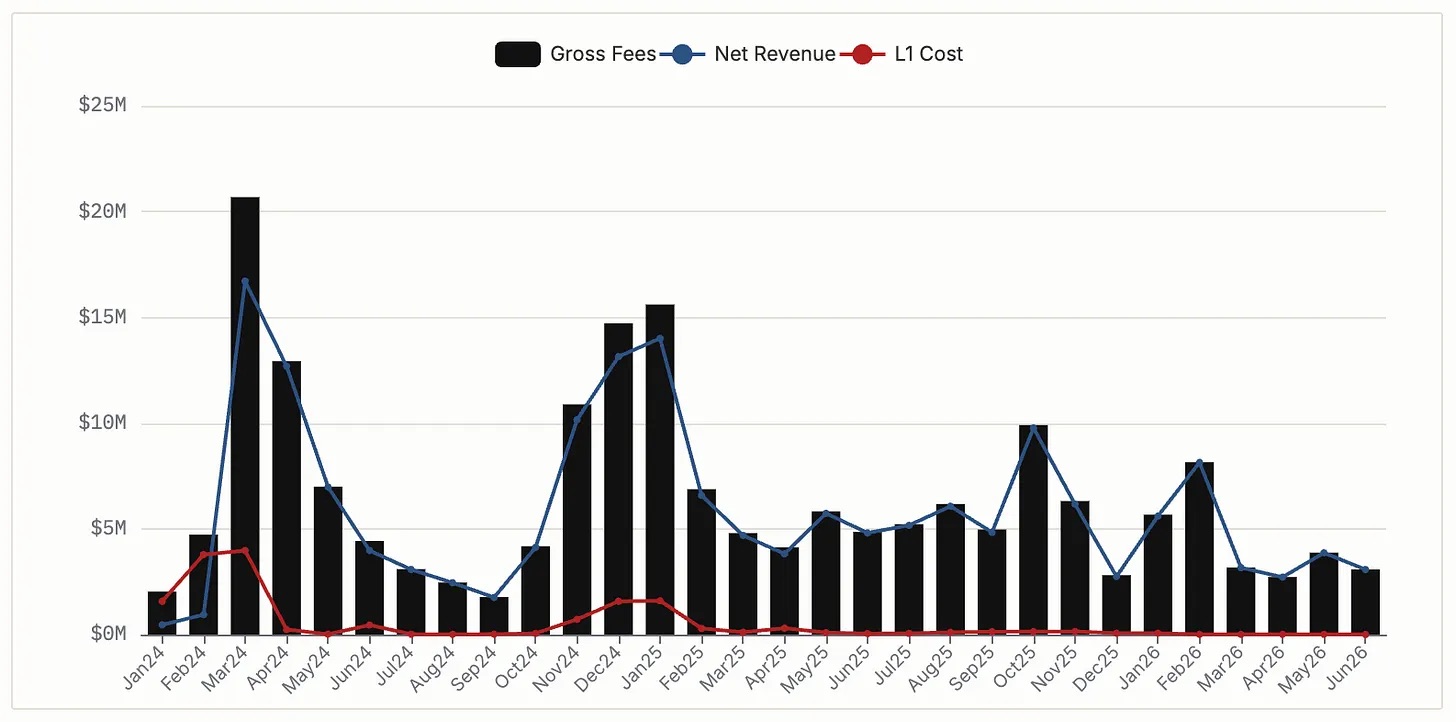

Base Monthly Sequencer Fee Revenue, source: DeFiLlama


Coinbase launched a $300 million Bitcoin-collateralized lending product, relying on Morpho's underlying architecture. Its wrapped Bitcoin, cbBTC, is the largest collateral asset within Morpho, accounting for 38% of the protocol's total TVL. This creates a mutually restraining dynamic: Morpho holds the core underlying capability for Coinbase's credit product, while Coinbase can extract a revenue share from all of Morpho's business, making it difficult for either to easily sever the partnership.


Look at Stripe's case: In early 2025, it spent $1.1 billion to acquire Bridge. Before this, Stripe's stablecoin business relied on Circle's infrastructure. Circle held the stablecoin issuance rights and earned the floating interest generated by the reserve collateral assets. At that time, all revenue from Stripe's trillion-level stablecoin transactions flowed to Circle. Acquiring Bridge completely reversed this situation. Bridge issues its own stablecoin, USDB, collateralized by a BlackRock money market fund. After switching to USDB, the massive interest income from these reserves stays entirely within the Stripe ecosystem. With annual payment processing volume of $1.4 trillion, Stripe was losing hundreds of millions in profit annually by long-term renting its competitor's profit-generating infrastructure.


Patrick Collison once called stablecoins 'the room-temperature superconductors of finance.' Spending $1.1 billion to own this underlying tool outright is far more economical than continuously paying tolls to a competitor.


A pure spot exchange has a natural growth ceiling, with users trading only hundreds of tokens. But Kraken wanted to attract institutional investors and professional retail traders, groups that primarily engage in trading via futures and clearing derivatives. Operating a derivatives business requires registration with the CFTC, NFA membership, and broker-dealer licenses—a compliance system that takes years to build. Even if built from scratch, regulators could reject the application for various uncontrollable reasons.


This is why Kraken set its sights on NinjaTrader. The $1.5 billion acquisition in January 2025 brought not just 1.7 million funded trading accounts, but more crucially, the full suite of broker-dealer licenses that Kraken would have found difficult to quickly develop and obtain on its own.


By acquiring ready-made compliant qualifications, Kraken completely shed its dependence on external partners. It now wholly owns the entire technology stack and licenses, needing neither to rely on others nor spend years waiting for regulatory approval.


Some might say: Large enterprises swallowing small protocols, isn't that just business as usual? What's new here?


Morpho's total TVL is $6.4 billion, with $3.308 billion deployed on Ethereum and $2.488 billion on Base. If Coinbase decided to delist Morpho and switch to a self-developed lending protocol, Morpho would immediately lose 39% of its TVL. However, it would still retain 52% on Ethereum, while continuously expanding to multiple chains like Hyperliquid L1, Monad, and Arbitrum, allowing its overall business to continue operating stably.
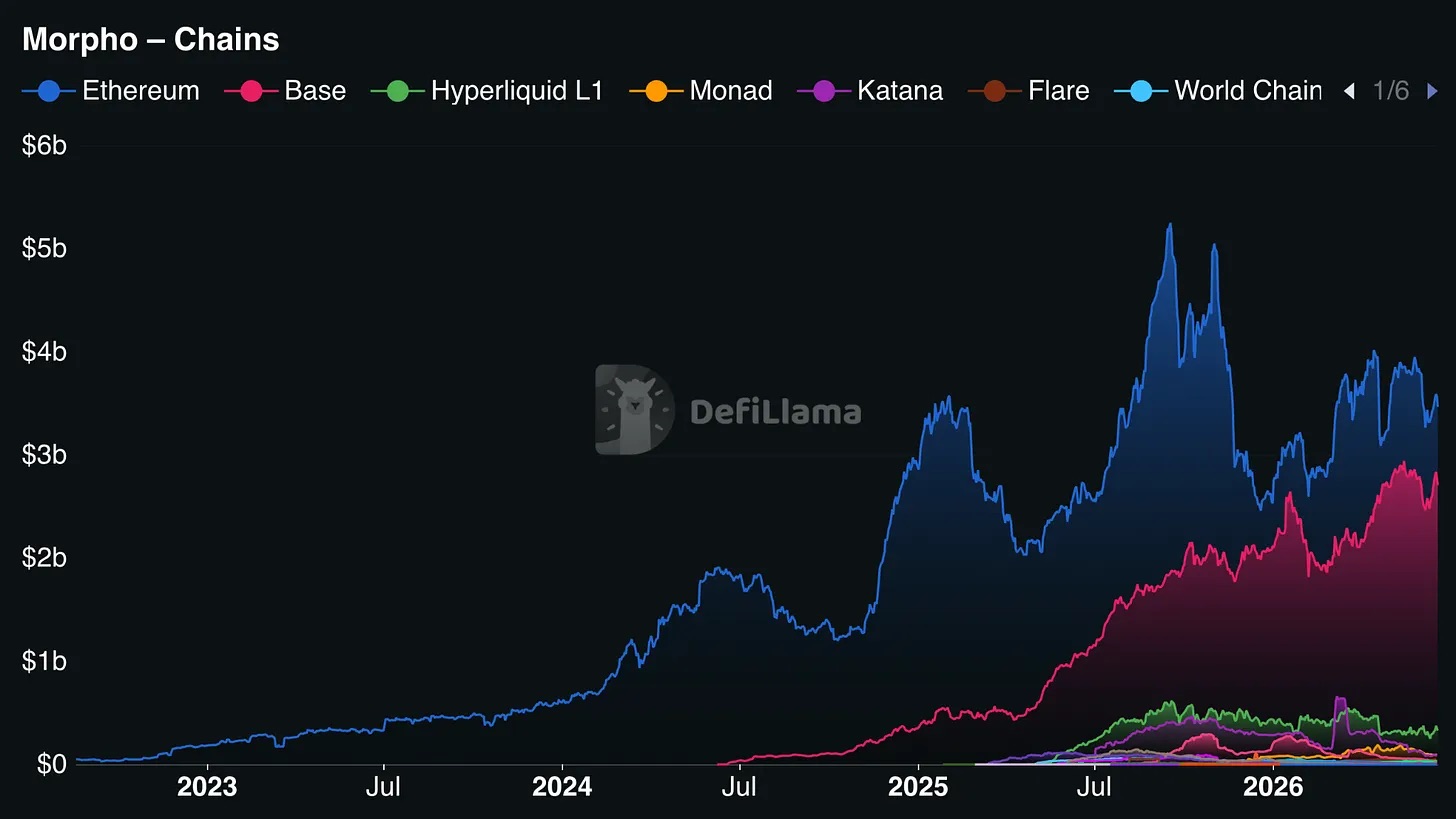

Morpho TVL Distribution Across Chains, source: DeFiLlama


The case of Aerodrome on the Base blockchain vividly demonstrates the impact when a chain operator promotes its own competitor. Aerodrome is Base's native decentralized exchange, optimized for Base's architecture. Coinbase Ventures holds approximately $20 million worth of AERO tokens, its largest liquidity token investment. Meanwhile, the project guides liquidity towards Coinbase's products, including the cbBTC pool, through AERO token lock-up voting. Aerodrome handles about 51% of Base's DEX volume, peaking at 77% in September 2024. Uniswap, deployed across 44 chains, is Base's second-largest DEX, holding 30% volume. Even after losing its leading position on a single chain, Uniswap hasn't perished: in 2025 it processed $212 billion in volume on Base, with estimated cross-chain monthly volume around $73 billion.
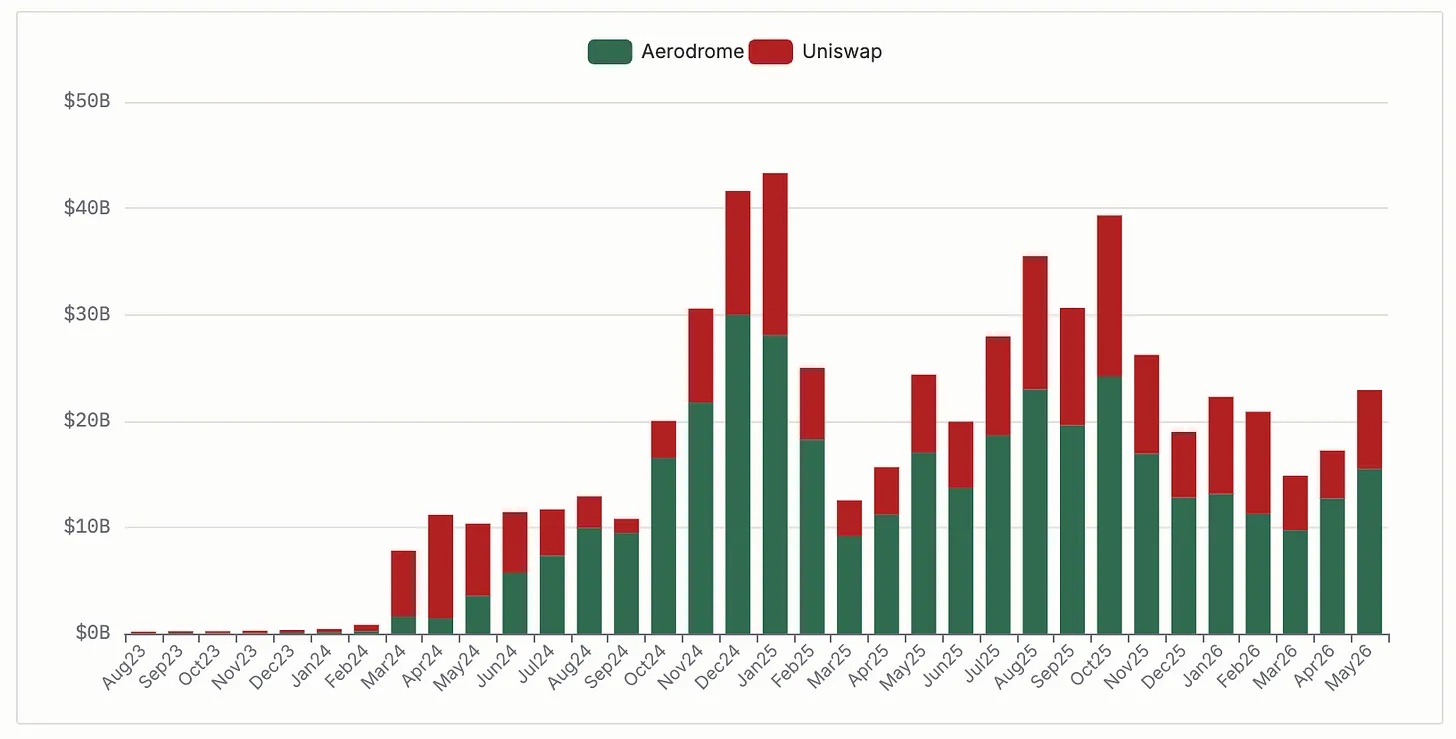

Base DEX Volume Share, source: DeFiLlama


This case confirms: Multi-chain deployment is a protocol's natural moat. A project deployed on a single chain is entirely at the mercy of the chain operator—they can always promote a competitor to squeeze your survival space. Conversely, a multi-chain protocol can continue normal operations in other sectors even after losing a particular chain's market. After witnessing Uniswap's traffic being diverted by Aerodrome on Base, Morpho rapidly expanded its multi-chain deployment. Large traffic platforms can vertically integrate into the underlying layer, while open-source protocols can horizontally expand across multiple chains to diversify risk.


If you rely on underlying infrastructure you don't own, you don't truly control your business. The party controlling the underlying layer holds overwhelming bargaining power over you, can define your product experience, and ultimately influence your operational stability. For enterprises of this scale, this dependency relationship translates into tangible profit losses every single day. This business logic isn't unique to crypto: Amazon built its moat relying on AWS; Apple, constrained by Intel's chip roadmap for years, spent many years developing custom chips to break free.


Everyone can check in real-time how much revenue Coinbase earns from Base sequencer fees, and clearly see Morpho's TVL across various chains. This value extraction process is fully transparent—something internal infrastructure profits at companies like Amazon, in the traditional internet space, cannot achieve.


There is a potential direction for the industry: the future market could be entirely controlled by giants like Coinbase, Stripe, Kraken, and a few banks. They control the entire industry chain from underlying protocols to payment cards, with open-source protocols only used to fill niche gaps the giants haven't yet covered. This is a fully plausible development path for fintech. Open-source technology would no longer be a free and vast fertile ground for innovation, but merely become patches of adhesive tape for the tiny crevices giant corporations haven't yet figured out how to monetize. Like a quip: 'Look at this high-quality little open-source protocol. Let's just build a commercial system on top of it to harvest the traffic.'


However, I lean towards an optimistic assessment: Considering the current wave of acquisitions, the probability of such a complete monopoly isn't as high as it seems. Underlying protocols are difficult to be monopolized by giants in the same way traffic channels can be. Morpho can deploy on a new chain in just weeks; replacing a battle-tested lending protocol deeply embedded in institutional operations carries an extremely high cost, not easily perceivable by outsiders. Coinbase's $300 million Bitcoin lending product still relies on Morpho because replicating Morpho's security system from scratch would take years and introduce security risks Coinbase is unwilling to bear.


Protocols that can survive this wave of giant consolidation all meet one core condition: they completed full multi-chain deployment before the traffic giants built their own ecosystems, deeply embedding themselves into the backend systems of major enterprises, making the economic cost of replacing them prohibitively high. Even Robinhood, a traffic giant with a massive user base, chose to integrate Lighter, a third-party zk-proof perpetuals exchange, as its trading backend. Robinhood Ventures participated in Lighter's $68 million funding round, and founder Vlad Tenev maintains close communication with the project.


If only traffic channels could build moats, Robinhood could have built its own underlying tech like Coinbase did. But it didn't: achieving a system that combines CEX-like trading speed with verifiable zk-proof matching logic is an extremely difficult, niche technical problem; the Lighter team spent over a year cracking it. After calculation, Robinhood concluded that purchasing the right to use mature technology is far more economical than building from scratch.


Currently, Morpho occupies this advantageous position of mutual restraint, while Uniswap was the pioneer of this path. The speed of institutional expansion and the speed of open-source protocol horizontal multi-chain expansion are in a game of chess; the final outcome will determine the direction of the industry landscape.


The underlying businesses of giants like Stripe and Coinbase still rely on open-source technology at this stage. In the short term, open-source protocols can still stand firm. We'll re-examine the industry landscape in two years.


Trending Cryptos

Related Questions

QWhat is the main business strategy employed by large tech companies like Coinbase and Stripe in the crypto industry according to the article?

AThe article describes a strategy where large tech companies like Coinbase, Stripe, and Kraken act as distribution channels, capturing and controlling user traffic. They let smaller protocols bear the early risk and development costs, and then acquire or build competing infrastructure once the market becomes profitable. This allows them to capture the value and profits generated by the underlying protocols, exemplified by Coinbase capturing sequencer fees from protocols like Morpho on Base.

QHow does the acquisition of Bridge by Stripe change its business model in the stablecoin sector?

APrior to acquiring Bridge for $1.1 billion, Stripe's stablecoin business relied on Circle's infrastructure, meaning all interest from the reserve assets backing the stablecoins flowed to Circle. By acquiring Bridge, which issues its own stablecoin USDB backed by BlackRock money market funds, Stripe now keeps the substantial interest revenue generated by the massive reserves within its own ecosystem, rather than paying it to a competitor.

QWhy does the article argue that multi-chain deployment is a crucial defense for DeFi protocols against large platforms?

AMulti-chain deployment acts as a natural moat for protocols. If a protocol is only deployed on a single chain, its fate is tied to that chain's operator, who could favor or build a competing protocol. A multi-chain protocol, like Uniswap or Morpho, can survive the loss of dominance on one chain because its business on other chains continues to operate. This diversification reduces dependency and risk from any single entity.

QWhat example does the article use to show that even large platforms sometimes choose to rely on third-party protocols instead of building everything in-house?

AThe article cites Robinhood as an example. Instead of building its own perpetual futures exchange from scratch like Coinbase did with Base, Robinhood integrated with Lighter, a third-party zero-knowledge proof perpetual exchange. Robinhood determined that licensing this specialized, proven technology was more economical and efficient than developing it internally, despite having a massive user base.

QWhat is the "two-way checkmate" position that Morpho currently holds in its relationship with Coinbase, according to the article?

AMorpho is in a "two-way checkmate" with Coinbase. On one hand, Coinbase's $300 million Bitcoin-backed lending product is built on Morpho's infrastructure, making Morpho's security and technology core to that offering. Replacing it would be risky and costly for Coinbase. On the other hand, Morpho's significant deployment on Coinbase's Base chain means a large portion of its activity generates sequencer fees for Coinbase. This mutual dependency makes it difficult for either party to easily sever the relationship.

Related Reads

During the World Cup, USDT becomes the preferred chip for illegal gambling? Beware of three typical scams

During the 2026 FIFA World Cup, USDT has become the preferred payment method for illegal online gambling due to its price stability, anonymity, and fast cross-border transfers. This article analyzes how USDT facilitates this activity and outlines three major scams targeting users. **Why USDT is the "Chip of Choice"**: It solves bettors' anxiety over crypto volatility, enables instant cross-border transfers without traditional banking, and shows significant abnormal transaction spikes during major events. **The Fund Flow**: Gambling platforms use a complex laundering chain involving multi-layer address hopping, cross-chain transfers (e.g., Polygon to Tron), mixers like Tornado Cash, and final cash-out via exchanges. **Three Typical Scams**: 1. **"USDT Betting Evades Regulation"**: Fake platforms promising anonymous, high-odds betting but manipulating outcomes. 2. **Fake Sportsbooks**: High-quality replica sites that allow small initial withdrawals to build trust before freezing accounts with larger funds. 3. **"Insider Tips / Guaranteed Wins"**: Schemes selling fabricated "AI predictions" or "fixed match" models to exploit information anxiety. **Identifying Suspicious Addresses**: Key chain-based indicators include a "fast-in, fast-out" transaction pattern, clustered addresses with consistent behavior, uniform Gas fee patterns, and frequent cross-chain jumps. **User Protection Advice**: * Avoid any project promoting "USDT betting," "Web3 predictions," or "anonymous high returns." * Be skeptical of promises like "guaranteed wins" or "insider models." * Do not trust platforms just because they allow small withdrawals—this is a common trust-building tactic. * If scammed, preserve all evidence: transaction hashes, wallet addresses, chat logs, and platform URLs. **Conclusion**: USDT provides unprecedented liquidity for illicit activities. The most effective protection for users is complete non-participation in any form of online crypto gambling.

marsbit23m ago

During the World Cup, USDT becomes the preferred chip for illegal gambling? Beware of three typical scams

marsbit23m ago

Zoomex X Space Recap With Djibril Cissé and the World Cup Trading Panel

Zoomex hosted a World Cup-themed X Space with Champions League winner Djibril Cissé and four crypto traders, discussing pressure management, analysis, and philosophy, and launching a charity pledge. Cissé emphasized embracing pressure in critical moments, drawing from his experience taking a penalty in a Champions League final. The traders agreed that managing stress comes from systematic preparation and clear risk parameters before executing a trade. The conversation explored parallels between football and trading. Cissé highlighted pace as his key weapon, but stressed that output (goals) matters more than tools. The traders debated timing versus speed of execution, concluding that timing is paramount and relative to one's timeframe. Discussing resilience, Cissé shared his mindset after major injuries: focusing on recovery and finding the positive. Similarly, traders emphasized learning from losses rather than avoiding them. Cissé declined to speculate on alternate histories, like France's 2006 World Cup run without his injury, stating one must work only with reality—a principle directly applicable to trading. In a lighter segment, traders mapped cryptocurrencies to national teams (e.g., Bitcoin to Brazil/France). The core lesson was that high performers, in both fields, thrive on uncertainty by relying on tested systems and focusing solely on actionable information. The session was part of Zoomex's World Cup Impact Pledge, which includes charity donations tied to guest predictions.

TheNewsCrypto30m ago

Zoomex X Space Recap With Djibril Cissé and the World Cup Trading Panel

TheNewsCrypto30m ago

Fed Turns Hawkish, Wall Street Capitulates, Citi Stands as 'Last Holdout': Insists on Resuming Rate Cuts in October

Amid a surprisingly hawkish shift from the Fed and most of Wall Street capitulating on rate cut expectations, Citigroup stands as a notable outlier, holding firm to its forecast for monetary easing to restart this October. Following the June FOMC meeting, where the "dovish bias" was removed and the dot plot shifted dramatically, markets priced in nearly 37bps of tightening for 2026. Major banks like Deutsche Bank and Goldman Sachs revised their calls, predicting rate hikes as soon as September. Citigroup, however, maintains a baseline scenario for a 25bps rate cut in October, followed by two more cuts in December and January 2027. Its counter-consensus view rests on three key arguments: 1) Plunging oil prices are eliminating a major inflation upside risk. 2) Rising initial jobless claims are mirroring seasonal weakening patterns seen in 2024-2025, signaling a labor market cool-down. 3) The strong core PCE is an "outlier," heavily influenced by AI-related prices and equity market gains rather than broad consumer price pressures, with other inflation metrics showing more moderation. While Wall Street largely "surrenders" to the hawkish Fed narrative, with Deutsche Bank forecasting two hikes and Goldman Sachs warning of potential back-to-back moves, Citigroup remains the "last holdout," betting that disinflationary forces will pave the way for cuts before year-end.

marsbit32m ago

Fed Turns Hawkish, Wall Street Capitulates, Citi Stands as 'Last Holdout': Insists on Resuming Rate Cuts in October

marsbit32m ago

Open Systems Will Ultimately Prevail: Why Ethereum Is the Next Linux?

The article "Open Systems Will Ultimately Prevail: Why Ethereum Is the Next Linux?" argues that Ethereum, like Linux before it, will triumph over closed, proprietary systems in finance due to its open, permissionless, and credibly neutral nature. It draws a historical parallel: just as the open internet defeated corporate private networks and Linux outcompeted proprietary Unix systems, open financial infrastructure like Ethereum will surpass private blockchains. The core advantage lies in the "bazaar" development model (as described in Eric Raymond's "The Cathedral and the Bazaar"), where decentralized, permissionless innovation by a global community of developers outpaces the controlled "cathedral" approach of centralized entities. This model fosters rapid innovation, as seen with Ethereum standards like ERC-20 and applications like Uniswap, which were built without needing permission. Ethereum's key, irreplicable strength is its credible neutrality: transparent, equally applicable, immutable rules that allow anyone to participate. This ensures sovereign independence, meaning no single entity (company, government) can control or change its core rules—a critical feature for global financial infrastructure. In contrast, private blockchains and consortium chains (like SWIFT or various bank-led projects) suffer from platform risk, central control, and an inability to attract broad developer ecosystems, leading to frequent failures. The article notes that major institutions (e.g., BlackRock, JPMorgan, Coinbase, Robinhood) are already building on Ethereum or its Layer 2 networks, recognizing its security, developer ecosystem, and network effects. While critics argue finance requires accountable, controlled systems, the response is that compliance (KYC, regulations) can be built at the application layer on top of a neutral settlement layer like Ethereum, just as secure commerce was built on the open internet via HTTPS. Ultimately, the thesis is that attempting to build walled-garden, proprietary financial networks is a flawed strategy that stifles innovation. The winning approach is to build applications on top of open, credibly neutral infrastructure like Ethereum, which is poised to become the foundational settlement layer for global finance.

Foresight News43m ago

Open Systems Will Ultimately Prevail: Why Ethereum Is the Next Linux?

Foresight News43m ago

Trading

Spot
Futures

Hot Articles

What is DOGE M

Doge Matrix ($doge m): The New Breed of Community-Driven Cryptocurrency Introduction In the ever-evolving landscape of cryptocurrency, new projects constantly emerge, each aiming to capture the interest of investors and enthusiasts alike. One of the latest entrants to this domain is Doge Matrix, represented by the ticker symbol $doge m. This project has attracted attention thanks to its roots in the popular meme culture surrounding Dogecoin, establishing its place within the web3 space. This article aims to provide a comprehensive analysis of Doge Matrix, covering its overview, creator, investors, functionality, timeline, and notable aspects. What is Doge Matrix ($doge m)? Doge Matrix is a community-driven cryptocurrency project that seemingly builds upon the widespread appeal of Dogecoin, a digital currency known for its Shiba Inu mascot and its meme origins. While the overarching objectives of Doge Matrix are not extensively defined, it is characterized by a commitment to harnessing community involvement and support. Unlike traditional cryptocurrencies that often emphasize utility or intrinsic value through underlying technologies, Doge Matrix positions itself within a space that embraces the cultural phenomenon of cryptocurrencies, particularly appealing to those who resonate with the ethos of meme-based assets. Drawing on the strengths of the Dogecoin community, Doge Matrix operates as part of a broader ecosystem, inviting participation and engagement from users who share an interest in cryptocurrency and the digital landscape. Who is the Creator of Doge Matrix ($doge m)? The identity of the creator of Doge Matrix remains unknown. This lack of transparency is not an uncommon occurrence in the cryptocurrency space, where some projects are launched without revealing the identities of their founders. The absence of information regarding the founding team can raise questions among potential investors about the project’s accountability and direction. Who are the Investors of Doge Matrix ($doge m)? As it stands, there is no publicly available information detailing the investors or investment foundations that back Doge Matrix. The project appears to rely primarily on community support rather than institutional investment. This model aligns with the community-driven nature of the initiative, fostering an environment where the direction of the project is shaped by its participants rather than being dictated by a select few financial backers. How Does Doge Matrix ($doge m) Work? The specifics regarding the operational mechanisms of Doge Matrix are somewhat vague, reflecting a broader trend of projects in the meme coin space where innovative functionalities are not always clearly articulated. Nonetheless, Doge Matrix seems designed to tap into the existing cryptocurrency ecosystem by encouraging user participation while tapping into the familiar cultural references associated with Dogecoin. Its potentially unique characteristics derive from community interactions rather than technological advancements, emphasizing shared experiences and collaboration among token holders. While the exact innovations have not been explicitly outlined, the project appears to create a space where community members can engage, share ideas, and propel the project's potential forward. Timeline of Doge Matrix ($doge m) Reflecting on the project’s timeline reveals notable events that have defined its journey thus far: November 25, 2024: Doge Matrix reached its all-time high value, marking a significant milestone in its early history. January 1, 2025: Conversely, Doge Matrix hit its all-time low value, illustrating the volatility often associated with cryptocurrencies, especially in the early stages of a project's lifecycle. Ongoing: The project continues to be actively traded and supported by its community, although specific future milestones or objectives have yet to be disclosed. Key Points About Doge Matrix ($doge m) Community Focus At the heart of Doge Matrix is a commitment to community engagement. The project thrives on the premise of collaboration and shared objectives among its members, emphasizing the importance of collective effort. Unlike centralized projects that often have a defined leadership structure, Doge Matrix at present showcases a more fluid approach to governance, where every community member's voice matters. Volatility The cryptocurrency market is notorious for its volatility, and Doge Matrix is no exception. Its price history reflects significant fluctuations between high and low values, which is typical of many new cryptocurrencies but underscores the risks associated with investment in emerging tokens. Lack of Detailed Information One of the most striking features about Doge Matrix is the scarcity of detailed information regarding its technological underpinnings and operational mechanisms. This ambiguity necessitates that potential investors conduct thorough due diligence before engaging with the project. Conclusion In summary, Doge Matrix ($doge m) illustrates a new wave of cryptocurrency projects that lean heavily on community engagement and cultural relevance. While lacking in certain specifics—such as clear leadership, defined objectives, and detailed functionality—the project has managed to generate interest within the crypto community, leveraging the established appeal of meme culture. As with any investment in the cryptocurrency space, understanding the inherent risks and conducting comprehensive research is essential for potential participants. Doge Matrix stands as a reminder of the dynamic, sometimes unpredictable nature of the crypto industry, marked by constant evolution and enthusiasm for community-driven initiatives.

3.8k Total ViewsPublished 2025.02.03Updated 2025.02.03

What is DOGE M

What is $M

Understanding Mantis ($M): A New Era in Cross-Chain Interoperability In the continually evolving landscape of Web3 and cryptocurrency, new projects strive to offer innovative solutions aimed at enhancing the user experience and expanding functional possibilities within the decentralized financial ecosystem. One such project garnering attention is Mantis ($M), a pioneering protocol founded on the principles of cross-chain interoperability and intent-based settlements. This article delves into the essential aspects of Mantis, including its core functionality, creators, investment backing, innovative features, and critical milestones. What is Mantis ($M)? Mantis is described as a multi-domain intent settlement protocol that simplifies cross-chain interactions, enabling users to execute complex financial transactions across various blockchain platforms seamlessly. The protocol operates through three primary layers: Intent Expression: Users can articulate their transaction goals using natural language facilitated by the DISE LLM, an advanced AI language model. For instance, a user might express a desire to swap Ethereum (ETH) for Solana (SOL) with a specific slippage tolerance of 1%. Execution: This layer employs a network of solvers that compete to fulfill user intents. Transactions are executed using mechanisms such as Coincidence of Wants (CoWs) and Order Flow Auctions (OFAs), which ensure that user demands are met optimally. Settlement: Leveraging the Inter-Blockchain Communication (IBC) protocol, Mantis enables atomic cross-chain transactions, allowing users to operate across various supported chains, including Ethereum, Solana, and Cosmos. Mantis is engineered to introduce native yield generation for idle assets, employing cryptographic proofs to maintain the integrity of transactions throughout the entire process. Creators & Development Team Mantis was conceived by the Composable Foundation, a research-driven organization notable for its emphasis on blockchain interoperability solutions. This foundation collaborates with esteemed academic institutions, including Harvard University and the University of Lisbon, contributing to extensive research and development efforts that inform Mantis's architecture and functionality. The Composable Foundation’s commitment to fostering innovation in the blockchain space positions Mantis as a robust solution for the growing demand for interoperability among multiple blockchain networks. Investors & Backing While specific details about individual investors have not been publicly disclosed, Mantis enjoys substantial backing from various entities, including: Ecosystem grants from IBC-enabled chains, which support the protocol's growth and integration within decentralized finance ecosystems. Strategic partnerships with infrastructure providers that enhance Mantis's network capabilities and deployment strategies. Funding through the Composable Foundation's treasury, ensuring sustained financial support for ongoing development and operational costs. These collaborative efforts reflect a consensus among stakeholders about the importance of enhancing cross-chain functionality and the potential utility of Mantis's infrastructural innovations. Key Innovations Mantis sets itself apart through several pioneering innovations that enhance its functionality and utility: Chain-Agnostic Intents: Users can initiate transactions from any supported chain while settling on another. This flexibility empowers users, driving increased interaction among different platforms. AI-Powered Interface: The integration of DISE LLM allows users to conduct complex DeFi operations using natural language, thereby simplifying interactions and making blockchain technology accessible to a broader audience. Cross-Domain MEV Capture: Mantis creates an internal market for maximal extractable value (MEV) through competitions among solvers. This innovative approach allows for greater efficiency and value extraction in complex transactions. Modular Settlement Layer: The protocol supports various verification methods, including zero-knowledge proofs and optimistic rollups, providing a versatile framework that can adapt to emerging blockchain technologies. Historical Timeline Mantis's development is marked by several critical milestones that chart its trajectory and growth: | Year | Milestone | |————|————————————————————————-| | 2022 | Initial concept development within the Composable Foundation's research division. | | Q3 2024 | Launch of the testnet with bridging capabilities between Solana and Ethereum. | | Q1 2025 | Anticipated Token Generation Event (TGE) alongside the mainnet launch. | | Q2 2025 | Expected integration of DISE LLM and expansion of cross-chain capabilities. | | 2025 H2 | Planned support for over 15 chains through further IBC upgrades. | This timeline outlines Mantis's evolution, from conceptual discussions to active implementation and future growth phases. Ecosystem Growth Strategy Mantis's strategy for ecosystem growth includes several initiatives designed to encourage user participation and developer engagement: Credits System: Users can earn protocol credits by providing liquidity and engaging in referral programs. These credits are redeemable for incentives in the future, fostering a robust user community. Modular Software Development Kit (SDK): This toolkit empowers developers to create applications based on intent-driven models utilizing Mantis's infrastructure, thus promoting innovation within its ecosystem. Governance Model: As the protocol matures, $M token holders will have a voice in protocol governance, allowing them to vote on proposed upgrades and changes, thereby enhancing community engagement and decentralization. Mantis represents a significant advancement in the realm of cross-chain architecture. By seamlessly integrating advanced AI algorithms with a robust settlement framework, Mantis seeks to tackle the problems of fragmentation within multi-chain ecosystems. Its innovative approach prioritizes improved user experiences while adhering to the foundational principles of decentralization and security, setting a new standard for the future interoperability of blockchain technologies. As Mantis continues its journey of growth and implementation, it promises to be a project to watch closely in the competitive landscape of Web3 and decentralized finance. With its focus on crossing boundaries and elevating user engagement, Mantis is poised to be an integral part of the future developments in the cryptocurrency space.

276 Total ViewsPublished 2025.03.18Updated 2025.03.18

What is $M

How to Buy M

Welcome to HTX.com! We've made purchasing MemeCore (M) simple and convenient. Follow our step-by-step guide to embark on your crypto journey.Step 1: Create Your HTX AccountUse your email or phone number to sign up for a free account on HTX. Experience a hassle-free registration journey and unlock all features.Get My AccountStep 2: Go to Buy Crypto and Choose Your Payment MethodCredit/Debit Card: Use your Visa or Mastercard to buy MemeCore (M) instantly.Balance: Use funds from your HTX account balance to trade seamlessly.Third Parties: We've added popular payment methods such as Google Pay and Apple Pay to enhance convenience.P2P: Trade directly with other users on HTX.Over-the-Counter (OTC): We offer tailor-made services and competitive exchange rates for traders.Step 3: Store Your MemeCore (M)After purchasing your MemeCore (M), store it in your HTX account. Alternatively, you can send it elsewhere via blockchain transfer or use it to trade other cryptocurrencies.Step 4: Trade MemeCore (M)Easily trade MemeCore (M) on HTX's spot market. Simply access your account, select your trading pair, execute your trades, and monitor in real-time. We offer a user-friendly experience for both beginners and seasoned traders.

7.4k Total ViewsPublished 2025.07.02Updated 2026.06.02

How to Buy M

Discussions

Welcome to the HTX Community. Here, you can stay informed about the latest platform developments and gain access to professional market insights. Users' opinions on the price of M (M) are presented below.

活动图片