After C Ronaldo's Teary Farewell, Polymarket Stages a 'Tear Verification' Drama

Odaily星球日报Published on 2026-07-08Last updated on 2026-07-08

Abstract

After Portugal's heartbreaking 0-1 loss to Spain in the 2026 World Cup Round of 16, a poignant image of a tearful 41-year-old Cristiano Ronaldo circulated widely, marking what he confirmed was his final World Cup match. This moment sparked not just emotional headlines, but a high-stakes debate on the prediction market Polymarket. The platform had an active market on "Will Ronaldo cry at the World Cup?" Despite the apparent visual evidence, the event entered a dispute phase. Polymarket's strict settlement rules required "clearly identifiable tears" on his face within the pitch or bench area, leading traders to dissect footage—arguing whether the moisture was tears, sweat, or a reflection. With the "Yes" probability plunging below 20%, the outcome hinged on rule interpretation. However, Polymarket issued a crucial clarification, stating that qualifying photo and video evidence showed "Cristiano Ronaldo crying, with visible tears on his face" on the pitch post-match. This official ruling caused an immediate and dramatic reversal, sending the "Yes" probability soaring above 99%. The event, which saw over $22 million in volume, highlighted a potential shift in Polymarket's approach, suggesting a move towards aligning outcomes with mainstream perception when rules allow, rather than being dictated solely by technical loopholes.

Original | Odaily Planet Daily(@OdailyChina)

Author | Asher(@Asher_ 0210)

Yesterday, Portugal lost 0-1 to Spain in the Round of 16 of the 2026 World Cup. In stoppage time, a headed goal from Mikel Merino knocked out the 41-year-old C Ronaldo and Portugal, barring them from the quarter-finals. Before the match, C Ronaldo had just confirmed this would be his final World Cup; after the match, he stood on the pitch, applauded the fans, wiped his eyes, and hugged Spain's young player Lamine Yamal.

“Farewell, Youth! 41-year-old C Ronaldo Tears Up After the Match, His Last World Cup Ends in the Round of 16.” Headlines like this flooded media and social platforms. For most people, that C Ronaldo cried is almost beyond dispute.

C Ronaldo covering his face post-match, visibly emotional

But according to Polymarket's settlement rules, whether “C Ronaldo cried” is truly a matter of debate.

C Ronaldo Crying or Not, Market Examines Frame by Frame

For Polymarket, where anything can be predicted, C Ronaldo's drama was naturally part of this World Cup. Long before the match started, the platform launched a prediction event – “Will Ronaldo cry at this World Cup?” (Link: https://polymarket.com/event/will-ronaldo-cry-at-the-world-cup-20260604013616610).

Common sense would suggest that the image of C Ronaldo with “tears in his eyes” after Portugal's elimination gave a clear answer. But on Polymarket, media reports and audience feelings aren't enough; ultimately, it comes down to the rules themselves.

According to the settlement rules for this event on Polymarket, only if a real photo or video clearly shows identifiable tears on C Ronaldo's face does it count as Yes; the crying must occur in the pitch or bench area, areas like the locker room or tunnel don't count; merely being emotional, having red eyes, wiping eyes, or watery eyes don't necessarily count.
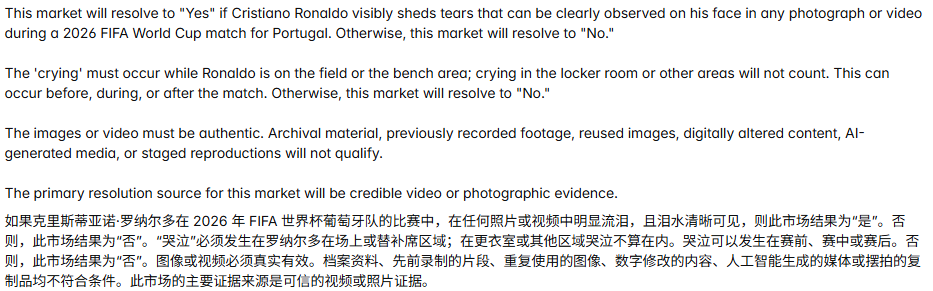
Settlement details for “Will Ronaldo cry at this World Cup?” on Polymarket

Thus, the controversy quickly shifted from “Did C Ronaldo cry?” to “Does this drop of liquid count as a tear?”

Some argued that photos and videos were clear enough, showing tear stains on C Ronaldo's face; others insisted it could just be sweat, light reflection, or leftover moisture from exertion. A football pitch isn't exactly the ideal place for “tear verification” – sweat, camera cuts, and light glare all make the judgment more difficult.

Discussion among Polymarket heavy traders on whether C Ronaldo shed tears

This isn't the first time Polymarket has been caught up in rule definitions. Previously, events like “Does a partial U.S. government shutdown count as a shutdown?” sparked trader disputes due to grey areas between reality and market rules. This time, however, the controversial subject landed on that streak of moisture on C Ronaldo's face.

As a result, the event failed to settle twice yesterday and entered a dispute phase. As the dispute intensified, the Yes probability once plunged below 20%.

The “Will Ronaldo cry at this World Cup?” event failed to settle twice and is under dispute

At this stage, the market price no longer reflects just whether C Ronaldo cried, but rather traders' bets on rule interpretation, evidence quality, and the final arbitration outcome. Based on the experience of many disputed markets on Polymarket, once an event enters this phase of nitpicking rules and scrutinizing evidence, the final outcome often deviates from public intuition.

A Clarification Leads to a Major Reversal

Just as Yes holders almost resigned themselves to their positions going to zero, the supplementary rules updated by Polymarket official this morning instantly reversed the situation leaning towards No.

The clarification explicitly stated, “As of the time of this clarification's release, there exists qualifying photo and video evidence, taken on the pitch after the Portugal vs. Spain match, showing Cristiano Ronaldo crying, including visible tears on his face.”
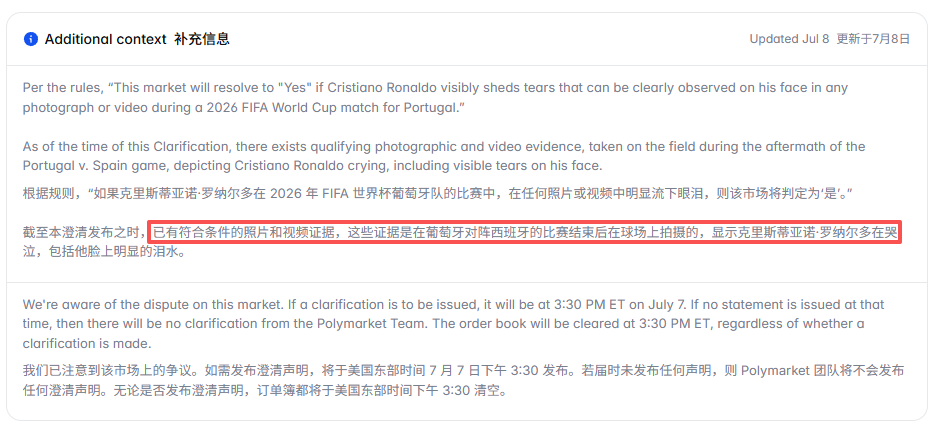
Supplementary settlement rules updated by Polymarket this morning

In other words, regarding this disputed event, Polymarket official directly gave a clear stance: that streak of moisture on C Ronaldo's face counts as tears. Market sentiment swiftly reversed. The Yes probability, which had previously dropped below 20%, quickly skyrocketed to above 99%. The event's total trading volume exceeded $22 million.
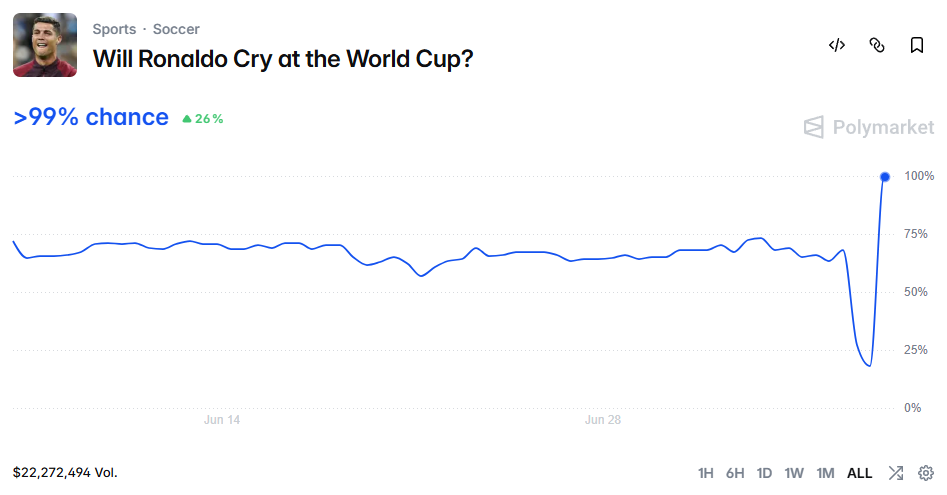
After the supplementary rules were released, the probability for “Will Ronaldo cry at this World Cup?” surged to 99% in a short time

This controversial market saw a reversal with the release of Polymarket team's supplementary clarification. More importantly, this clarification sends a signal—when the rules themselves still have room for reasonable interpretation, the Polymarket team seems increasingly willing to align the outcome with common perception, rather than letting the market be skewed by rule-exploiting players.

In the past, the outcomes of many disputed markets on Polymarket often depended on who was better at finding loopholes or advantageous interpretations in grey areas. But this time, live footage, media reports, and supplementary evidence all pointed to C Ronaldo indeed shedding tears, and the official did not let the detailed debate over “sweat or tears” continue to dictate the settlement result.


Trending Cryptos

Related Questions

QWhat prediction event related to Cristiano Ronaldo was created on Polymarket during the 2026 World Cup?

AThe prediction event was 'Will Ronaldo cry at the World Cup?'

QAccording to Polymarket's original settlement rules, what specific criteria had to be met for the 'Cristiano Ronaldo crying' event to resolve as 'Yes'?

AFor the event to settle as 'Yes', clear photographs or videos had to show identifiable tears on Ronaldo's face. The crying had to occur on the pitch or in the technical/substitute area (not in the locker room or tunnel). Merely being emotional, having red eyes, wiping eyes, or having watery eyes did not necessarily count.

QWhy did the 'Will Ronaldo cry?' market initially go into a disputed state on Polymarket despite widespread media reports?

AIt went into a disputed state because there was debate over whether the moisture visible on Ronaldo's face in the images/videos were definitively tears, or if they could be sweat, water, or light reflection. The original strict settlement rules led to this ambiguity, causing two settlement attempts to fail.

QHow did Polymarket's official clarification change the outcome of the disputed market?

APolymarket's official clarification stated that qualified photo and video evidence, captured on the pitch after the Portugal vs. Spain match, showed Cristiano Ronaldo crying with visible tears on his face. This directly confirmed that the event criteria for 'Yes' were met, causing the market probability for 'Yes' to surge from below 20% to over 99%.

QWhat significant signal does the article suggest Polymarket's handling of this event may have sent to its users?

AThe article suggests that Polymarket's intervention signaled a potential shift towards aligning settlement outcomes with broad public perception and available evidence, rather than allowing the result to be dictated solely by technical rule interpretations or 'loophole' players in ambiguous situations.

Related Reads

Bitcoin’s path to $80K may hinge on THIS hidden trend

Bitcoin's potential path toward $80,000 is influenced by conflicting market signals. Data shows the Coinbase Bitcoin Premium Index has recorded its longest-ever streak of consecutive negative premiums, indicating muted institutional demand or net selling from U.S. institutions. While such a trend often signals short-term weakness, it doesn't necessarily forecast a long-term bear market. Additionally, a bearish crossover occurred in Bitcoin's Net Unrealized Profit/Loss (NUPL), with its short-term average falling below the longer-term average, suggesting declining investor profitability and waning market momentum. Historically, major bear market bottoms saw the 100-day NUPL drop below zero, but this cycle it remains positive, implying either an unprecedented bottom or a further decline is needed. Currently trading around $63,148, Bitcoin has seen weekly gains but remains below its May peak. Technical indicators present a mixed picture: the MACD shows bullish momentum, while the RSI signals bearish pressure. A positive development is the return of inflows to Bitcoin ETFs after eight weeks of outflows. Analysts hold divergent views; some highlight a key liquidity zone between $48,000-$50,000 where a market bottom could form, while others maintain a more optimistic long-term outlook. Ultimately, while some bullish signs exist, a strong push from institutional investors appears crucial for Bitcoin to challenge the $80,000 level.

ambcrypto12m ago

Bitcoin’s path to $80K may hinge on THIS hidden trend

ambcrypto12m ago

Unexpected Weak Non-Farm Payrolls Data Pushes BTC to Rebound 11%, FOMC Minutes to Test the Narrative of This Rally

Bitcoin has rebounded 11% from its 21-month low, but the sustainability of this rally hinges entirely on the Federal Reserve's release of the June FOMC meeting minutes. The bounce was triggered by a weaker-than-expected US jobs report, which showed only 57,000 jobs added in June—about half of economists' forecasts. This data prompted traders to scale back bets on further Fed rate hikes, fueling a rally in Bitcoin alongside gold and stocks. The upcoming minutes are critical. They will reveal whether Fed officials, in their mid-June meeting, were already expressing concerns about a weakening labor market, tight credit conditions, or the risks of overtightening—factors that would support the market's recent dovish shift. Conversely, if the discussion focused on persistent inflation and the conditions for more rate hikes, the rally's foundational narrative would crumble. Market indicators show the rebound's fragility. While US spot Bitcoin ETFs saw a significant single-day inflow, it followed a prolonged period of outflows. On-chain data indicates a substantial increase in Bitcoin being moved to exchanges, creating potential sell pressure. Options market positioning suggests key price levels around $60,000 and $62,000 that could either stabilize or accelerate price movement. In essence, Bitcoin's 11% gain is built on speculation about the Fed's private deliberations three weeks ago. The FOMC minutes will replace that speculation with concrete details, and the discrepancy between market expectations and the actual record will determine whether Bitcoin holds above $64,000 or falls back toward $58,000.

marsbit23m ago

Unexpected Weak Non-Farm Payrolls Data Pushes BTC to Rebound 11%, FOMC Minutes to Test the Narrative of This Rally

marsbit23m ago

Just Now, The World's First Ultra-High-Frame World Model Was Born, Nvidia Content 0, Racing to 50 FPS

Just Now, Global First Ultra-High-Frame World Model Born, 0% NVIDIA, Speeds to 50 FPS A Chinese team has developed MoWorld, the world's first Flash World Model, achieving real-time interactive inference exceeding 50 FPS. Crucially, it is entirely built on domestic NPUs (National Processing Units), bypassing NVIDIA GPUs. Developed by Moxin Technology in collaboration with Zhejiang University's Pan Yunhe academician team, MoWorld represents a complete, closed-loop system from training and distillation to deployment on domestic computing power. The model tackles the critical industry bottleneck of real-time performance, essential for applications like robotics, gaming, and digital worlds. MoWorld achieves this through a full-stack redesign for NPUs, including a proprietary 3D-annotated data pipeline, system-level optimizations for long-sequence training (up to 2000 frames), and inference optimizations like dynamic mixed-precision quantization. On a Huawei Ascend 910C platform, a 14B MoE parameter model achieves over 50 FPS, reducing typical inference costs by 70% compared to equivalent GPU solutions. This breakthrough lowers the deployment barrier, potentially accelerating the industrialization of world models. Key application areas include gaming/entertainment (offering 6-DoF camera control for immersive exploration), embodied AI/autonomous driving (providing a high-fidelity digital training ground), film pre-visualization, and 3D reconstruction/digital twins due to its strong geometric consistency. MoWorld demonstrates that a full-stack domestic compute ecosystem can support cutting-edge, real-time world models, positioning China at a competitive starting line in defining next-generation spatial intelligence standards. The project underscores a shift in competition from model scale to real-world usability and cost-effective deployment.

marsbit1h ago

Just Now, The World's First Ultra-High-Frame World Model Was Born, Nvidia Content 0, Racing to 50 FPS

marsbit1h ago

Pacific 'Fever': How Extreme Weather Becomes Wall Street's Cash Machine?

"Pacific Fever": How Extreme Weather Becomes Wall Street's ATM? The summer of 2026 sees unusually fierce weather across China and globally. The common driver behind this global pattern is a powerful El Niño event, potentially the strongest since 1950, as declared by NOAA. This phenomenon, characterized by warming central/eastern Pacific waters, disrupts global atmospheric circulation, raising risks of floods, droughts, and heatwaves, further intensified by climate change. For financial markets, especially commodities, El Niño is not just weather but a major trading theme. History shows its price impact is profound. In the 1970s, El Niño-driven anchovy collapse in Peru fueled a soybean boom, giving Richard Dennis his first million. Anthony Ward's cocoa empire was built on superior weather intelligence. Most recently in 2024, West African droughts caused cocoa prices to soar over 400%, delivering huge gains for trend-following hedge funds. In 2026, markets are again pricing in future El Niño-induced supply shocks. Despite high current inventories, prices for palm oil, rubber, and sugar have rallied on anticipation of upcoming Southeast Asian droughts and weak Indian monsoons. Analysts identify key indicators to watch: the Niño3.4 index, Indian monsoon rainfall, Malaysian palm oil stocks, and the fundraising scale of specialized weather funds like Moreton Capital. Beyond trading opportunities, a concerning narrative is gaining traction online, linking El Niño with fertilizer shortages and energy supply disruptions to warn of potential global food crises within months. While alarmist, it highlights a deeper truth: the cascading effects of climate-driven weather extremes ultimately translate into higher costs of living for everyone, far beyond the trading floor.

marsbit1h ago

Pacific 'Fever': How Extreme Weather Becomes Wall Street's Cash Machine?

marsbit1h ago

Pacific 'Fever': How Extreme Weather Becomes Wall Street's ATM?

"Pacific 'Fever': How Extreme Weather Becomes Wall Street's Piggy Bank" The article examines how the 2026-2027 El Niño, potentially the strongest since 1950, is not only disrupting global weather but also creating major financial opportunities. It links recent extreme events in China and worldwide to this climate phenomenon, which alters atmospheric patterns, increasing risks of floods, droughts, and heatwaves. The core narrative explores how financial markets capitalize on these disruptions. A hedge fund is raising $500 million specifically to bet on El Niño-affected crops like South African corn and Malaysian palm oil. Historically, such strategies have yielded massive profits. Examples include Richard Dennis ("Turtle Trader") making his first fortune in the 1970s soy boom triggered by El Niño's impact on Peruvian anchovies (a key fishmeal source), and Anthony Ward's cocoa empire built on superior weather intelligence. The 2024 cocoa price surge, driven by West African drought, enriched quantitative trend-following funds. Currently, markets are preemptively bidding up palm oil, rubber, and sugar futures based on anticipated future supply shocks, despite high current inventories. The article details El Niño's asymmetric global impacts: causing drought in Southeast Asia (hurting palm oil/rubber) and India (affecting sugar/cotton), but bringing beneficial rains to South American soy and sugarcane. Key metrics to watch include the Niño3.4 index, Indian monsoon data, and Malaysian palm oil stocks. The true price effects often materialize *after* the El Niño peaks, suggesting 2027 may see the real volatility. The conclusion warns that beyond trading gains, the convergence of El Niño, energy shortages, and fertilizer scarcity poses a systemic risk, potentially raising the cost of living for everyone, turning a climate event into a global economic story.

链捕手1h ago

Pacific 'Fever': How Extreme Weather Becomes Wall Street's ATM?

链捕手1h ago

Trading

Spot

Hot Articles

Discussions

Welcome to the HTX Community. Here, you can stay informed about the latest platform developments and gain access to professional market insights. Users' opinions on the price of S (S) are presented below.

活动图片