Pudgy Penguins: Why PENGU’s retail push isn’t winning over bears yet

ambcryptoPublished on 2026-07-20Last updated on 2026-07-20

Abstract

Pudgy Penguins (PENGU) has expanded into retail with the launch of PENGU plushies, aiming to reach millions of new users and increase utility for its native token. The news prompted a slight price increase to $0.0062, driven by spot buyers, with exchange outflows indicating accumulation. However, the broader market structure remains bearish. Derivatives data shows aggressive selling, with negative volume deltas in perps and futures outflows. Technical indicators like the RSI at 45 confirm seller control. While the retail push could support the price at $0.006 and target $0.0068 with sustained demand, prevailing bearish momentum risks a pullback to $0.0058 if selling pressure continues.

Pudgy Penguins [PENGU] made a major step towards fulfilling its goal to expand its reach beyond the internet.

Following its successful TCG drop in June, Pudgy Penguins has now launched PENGU plushies for retail purchase. The new plushie line marks the NFT project’s biggest push yet into retail. Even more importantly, with this move, Pudgy Penguins extends its reach to millions more users.

In fact, Pudgy Penguins noted this milestone, adding that,

Pengu has been introduced to millions of new people in retail

An expanded user base is good news for the network and the native token, PENGU, as it increases use cases for the token. Furthermore, more traders will discover the token via QR codes on plushies, thus potentially driving demand for PENGU.

How did Pudgy Penguins’ market react?

With the news, the PENGU price made a slight move higher, hiking to $0.0062 before slightly pulling back to $0.0061 at press time. These slight gains were mostly driven by spot buyers who rushed to accumulate.

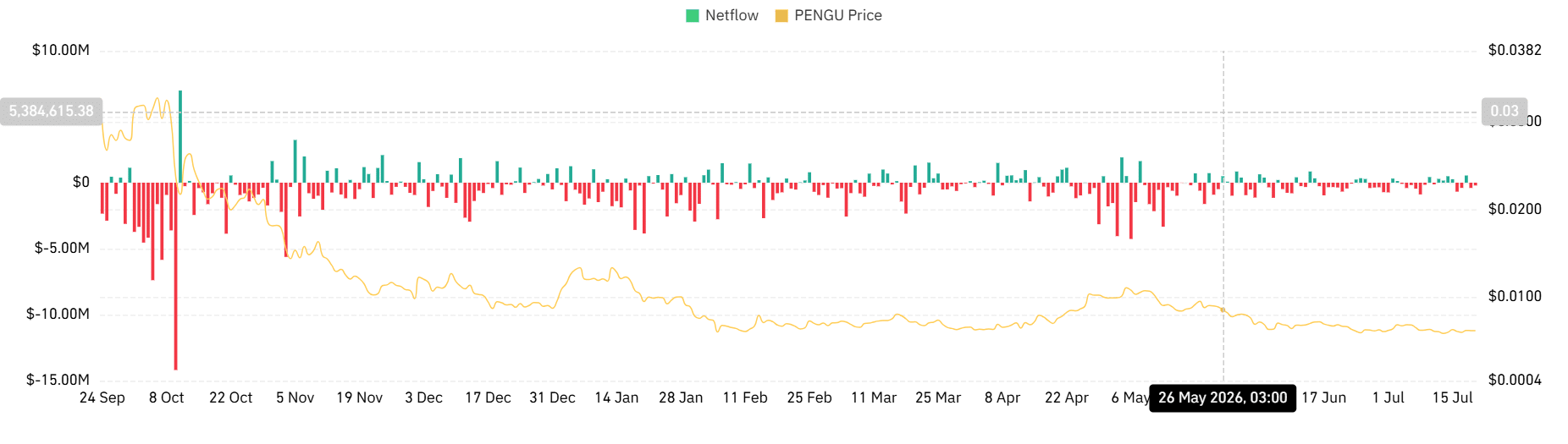
According to CoinGlass data, the exchange outflows outpaced inflows significantly over the past day. As a result, the Spot Netflow remained negative.
Source: CoinGlass

At press time, the Spot Netflow was -$139k, indicating that more PENGU flowed out of exchanges. Often, reduced supply on exchanges has preceded better price performances.

Bears still dominate perps, risking another pullback

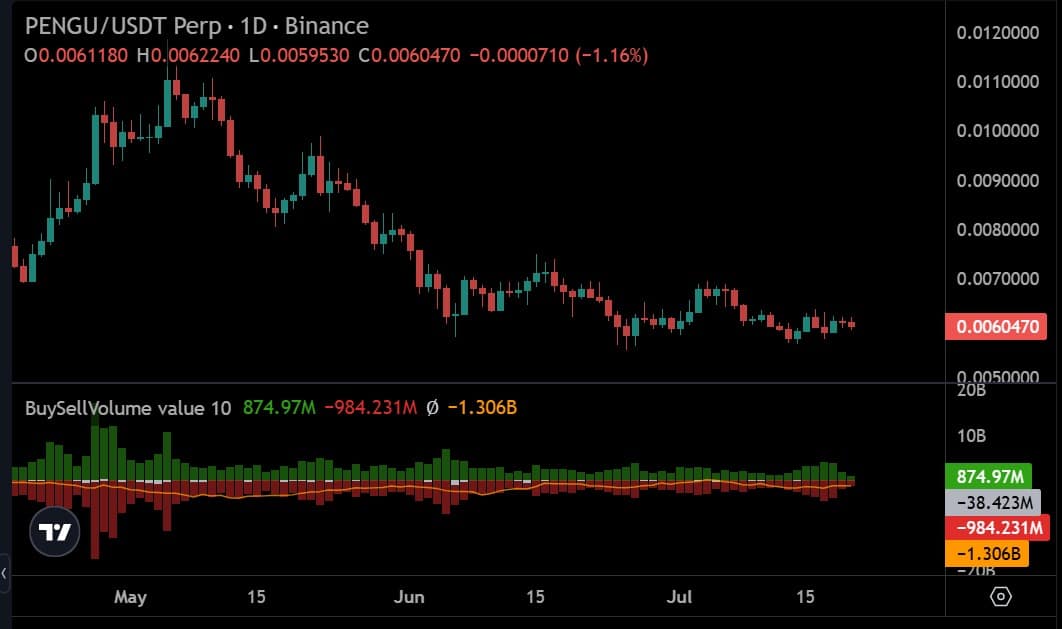
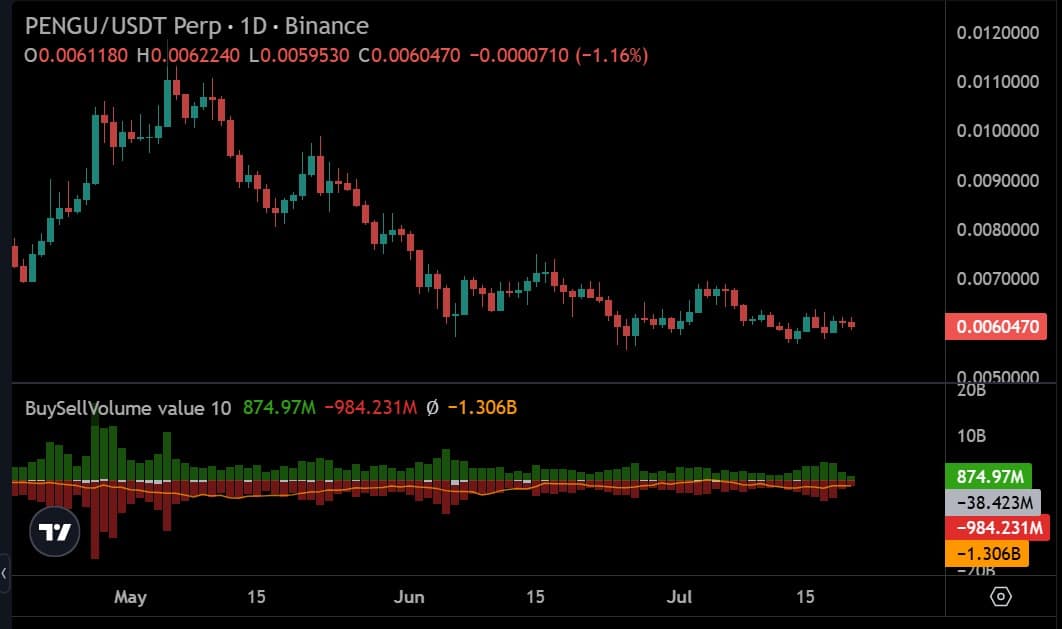
While buyers rushed into the spot on the good news, traders on the derivatives aggressively cashed out on these gains.
Source: Coinalyze

For starters, on the perpetual side, the Perps Sell Volume rose to 984.2 million, compared to 874.9 million in Buy Volume.

As a result, the perps recorded a negative delta of -109.3 million, a clear sign of aggressive selling. The same market behavior was observed on the futures side.

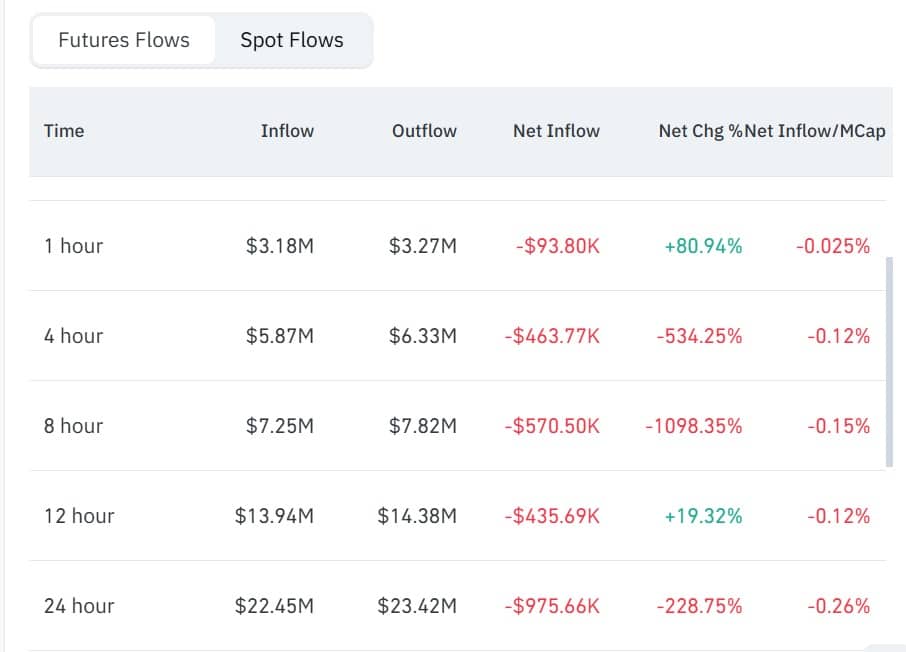
According to CoinGlass data, Futures Outflow rose to $23.4 million while Inflow fell to $22.4 million. For that reason, Futures Netflow dropped 228% to -$975k.
Source: CoinGlass

A negative Futures Netflow suggests that more traders closed their positions, reflecting increased bearishness.

What’s next for the memecoin?

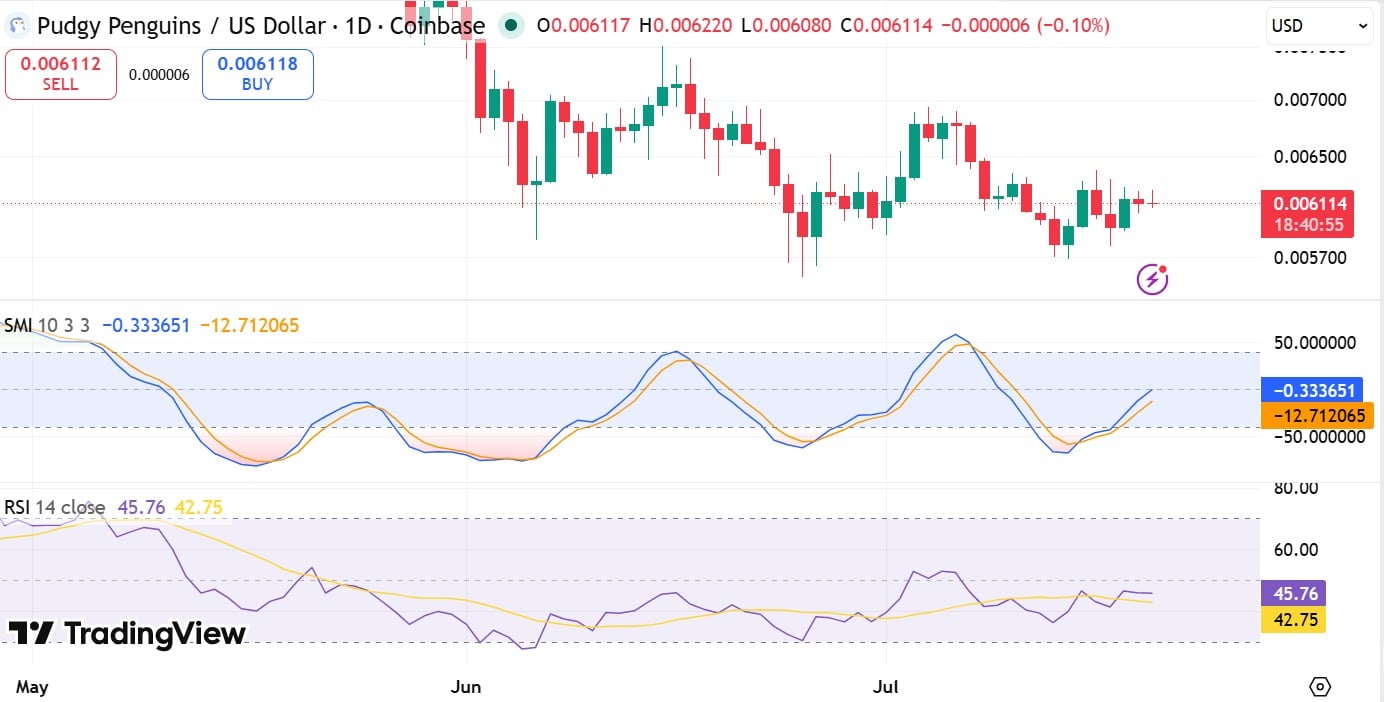
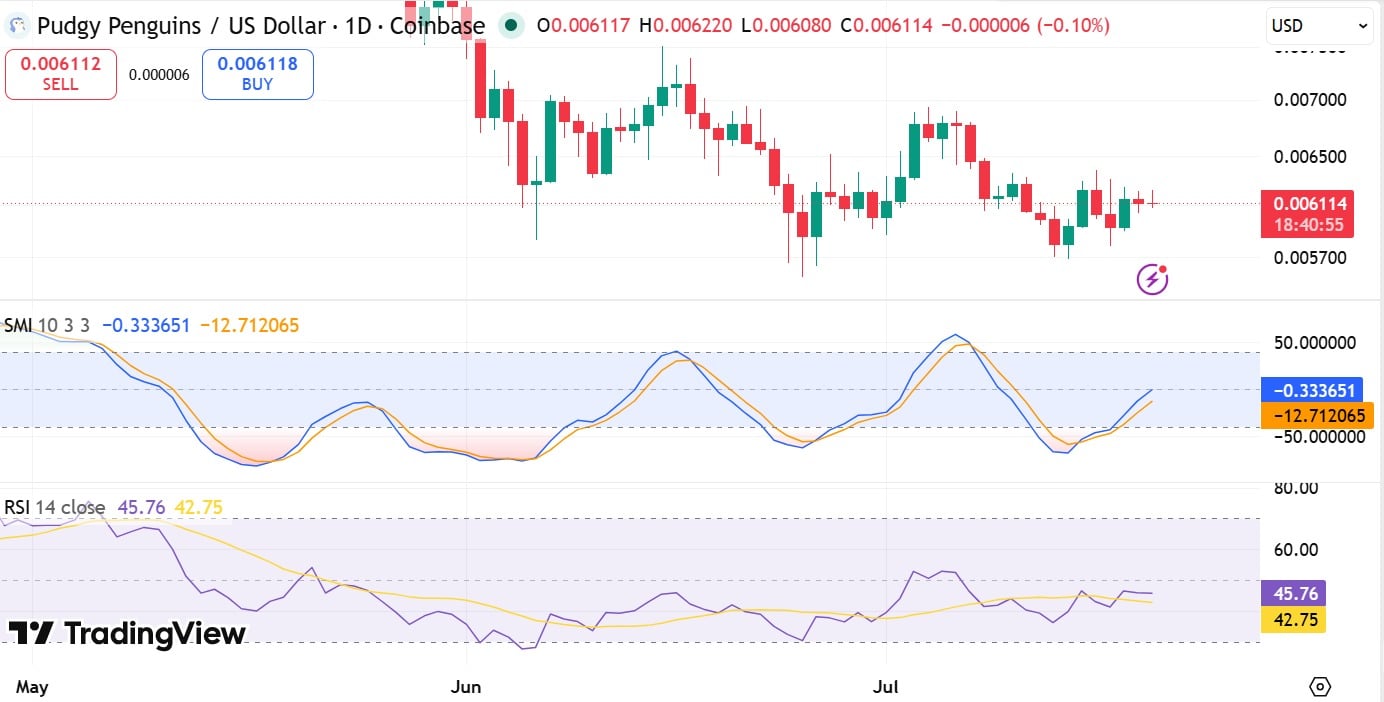
Despite PENGU’s extended reach, the market structure remains strongly bearish. At press time, the Relative Strength Index remained within the bearish zone at 45.
Source: TradingView

This implies sellers are still controlling the market. The Stochastic Momentum Index also confirmed this view, as it remains negative.

Although SMI has been on an upward trajectory, the indicator holds deeply within the bearish zone. Combined, these two indicate that the momentum leans to the downside and is likely to remain so.

Thus, if the slight demand driven by the news fades, exacerbated by derivatives pressure, PENGU will drop to $0.0058. If the plushies help boost demand, however, with the extended base, PENGU could hold $0.006 and target $0.0068.


Final Summary

  • Pudgy Penguins announced the launch of PENGU plushies on all Target shelves across the United States.
  • PENGU market remains structurally bearish, driven by intense selling pressure on thderivativeses market.


Trending Cryptos

Related Reads

The Encryption Bill Clarity's Challenge: A Thorny Path of Bipartisan Compromise in the U.S.

U.S. lawmakers are attempting to advance the Clarity Act, a significant crypto market structure bill, but its path is fraught with partisan hurdles. The process has been rocky since January, when a prior bipartisan deal in the Senate Banking Committee was upended. A key compromise in May on "yield" issues allowed the bill to move forward in committee, but only with the conditional support of two Democratic senators, Angela Alsobrooks and Ruben Gallego. They emphasized that their final vote depends on reaching an agreement on ethics provisions for elected officials. Ultimately, the Senate Agriculture Committee passed its version along party lines without Democratic support. As Republicans push for a full Senate vote in July, the demand for strong ethics language has expanded beyond Democrats. Additional controversies surround provisions related to yields (aligning some Republicans with large banks) and developer protections (opposed by enforcement agencies). Core concerns about illicit finance and consumer protection remain central to the debate. Despite consensus on the need for legislation, achieving the necessary bipartisan compromise is proving difficult. While momentum exists—including recent meetings between senators and White House officials—a reconciled bill text faces skepticism. Senator Gallego has stated that without ethics terms acceptable to Democrats, they will not provide the needed votes. The immediate goals for the crypto community in Congress are unclear: a symbolic Senate vote before the August recess, eventual passage into law by 2026, or forging a final compromise framework. The arduous, vote-by-vote effort to build bipartisan support continues, mirroring the traditional legislative grind the industry must now navigate.

Foresight News51m ago

The Encryption Bill Clarity's Challenge: A Thorny Path of Bipartisan Compromise in the U.S.

Foresight News51m ago

Kalshi and Polymarket Founders at Odds? This Business War Is Far More Brutal Than You Imagine

The New York Times details the fierce, personal rivalry between Kalshi CEO Tarek Mansour and Polymarket founder Shayne Coplan, which has escalated beyond typical business competition into a conflict marked by legal complaints, regulatory battles, and public hostilities. The feud intensified in late 2024 when FBI agents raided Coplan's New York apartment. While Coplan publicly blamed political motives, sources indicate his team privately suspected Mansour, noting that Kalshi's lawyers had previously reported Polymarket's operational model to federal prosecutors, highlighting that U.S. users could still access its offshore platform despite a ban. The animosity extends through their companies' operations. Kalshi positions itself as a compliance-focused, fully licensed U.S. operator, while Polymarket has historically operated its core platform offshore without a U.S. license, offering more anonymity and controversial betting markets. Mansour has publicly called Polymarket's model "illegal and immoral," while Coplan privately dismisses Kalshi as a copycat. Their competition has played out in Washington lobbying, attempts to sabotage each other's major deals (such as Kalshi's efforts to dissuade Intercontinental Exchange from investing in Polymarket), competing sponsorships, and poaching staff. The rivalry continues as both platforms experience massive growth, with Kalshi currently holding a valuation and trading volume edge, but facing ongoing regulatory scrutiny alongside Polymarket.

Foresight News1h ago

Kalshi and Polymarket Founders at Odds? This Business War Is Far More Brutal Than You Imagine

Foresight News1h ago

Trading

Spot

Hot Articles

Discussions

Welcome to the HTX Community. Here, you can stay informed about the latest platform developments and gain access to professional market insights. Users' opinions on the price of S (S) are presented below.

活动图片