【Introduction】From Ben Mann leading his team to build an early VS Code extension in 2021, to Boris Cherny's frenetic iterations in 2024, to the groundbreaking arrival of Claude Code in 2025 which fundamentally changed how Silicon Valley operates — the entire story is an epic. Yet, the father of Claude Code says: "We've only completed 1%."
Claude Code is only 1% complete!
Anthropic's core developer Boris Cherny reveals the extremely counterintuitive origin of Claude Code: Claude Code evolved from an internal safety alignment (Alignment) project at Anthropic.
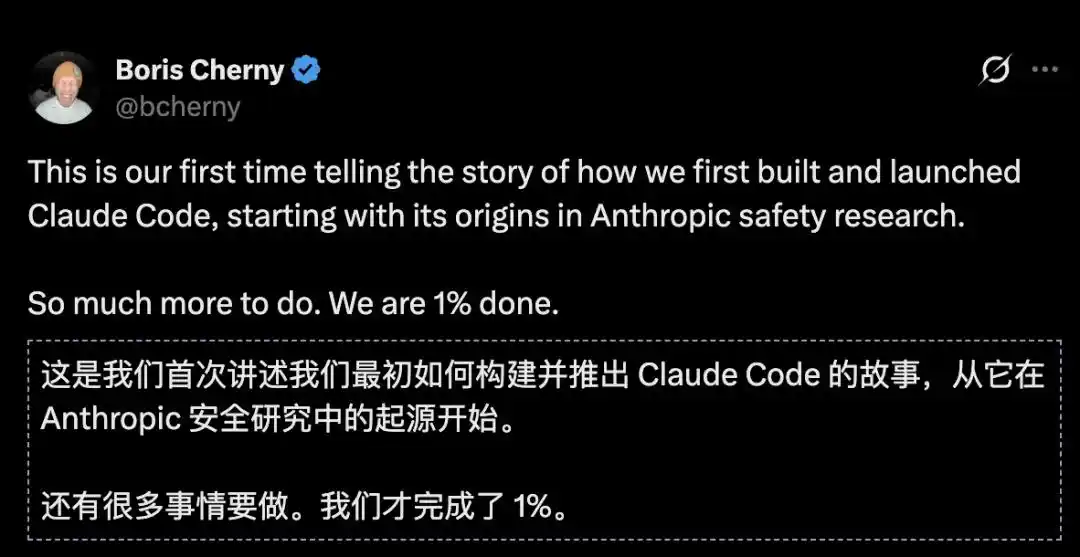
And the most exciting part lies in the second half:
There's still so much to do. We've only completed 1%.
Because 1% space means 99% of the future is still completely blank.
At the same time, Claude officially reveals the origin history of Claude Code for the first time:
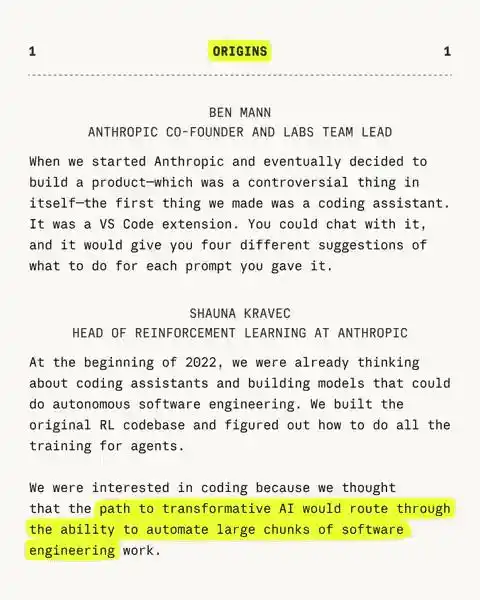
Anthropic's official page "The Making of Claude Code" goes live simultaneously.
Portal: https://www.anthropic.com/features/making-of-claude-code

Claude Code Was Almost Completely Forgotten
The story begins in 2021.
Anthropic co-founder and Labs team lead Ben Mann recalls:
When we founded Anthropic and ultimately decided to build a product — which was itself a controversial decision at the time — the first thing we did was build a programming assistant.
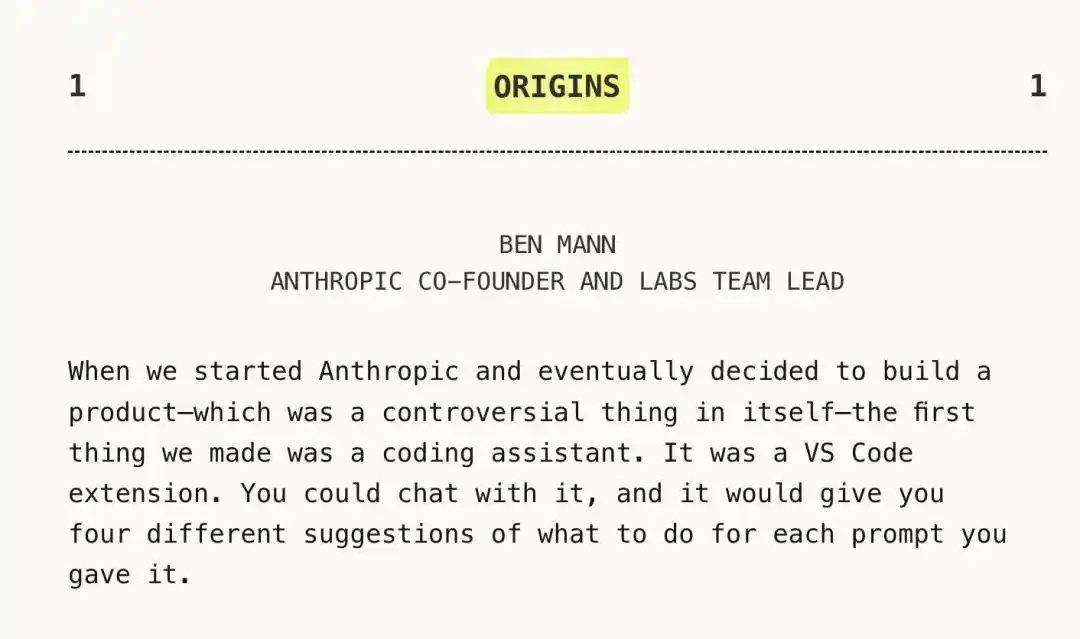
Research engineer Dawn Drain had just joined Anthropic. Her main project was: make the model's coding ability at least as good as my own.
During the same period, Shauna Kravec's reinforcement learning team was already thinking more radically — autonomous software engineering. They didn't want to build a chatbot; they wanted the model to actually "do work".
Why coding? Shauna's answer remains stunning to this day:
We believed the path to transformative AI had to go through automating large-scale software engineering work.
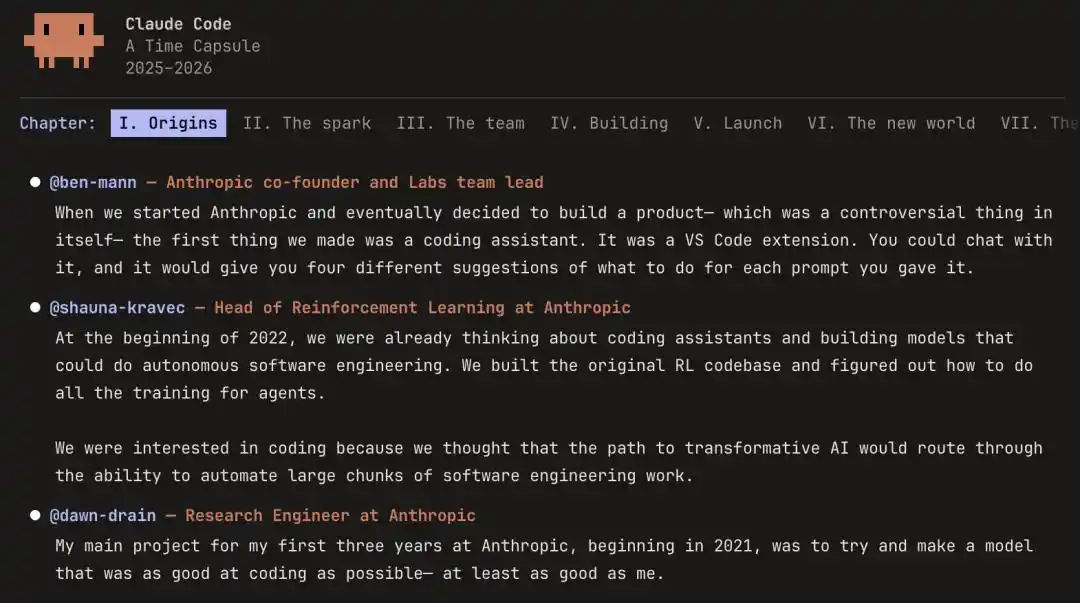
By early 2022, they were already using RL to train models to write simple functions and then test their correctness.
The result: the initial models performed very poorly.
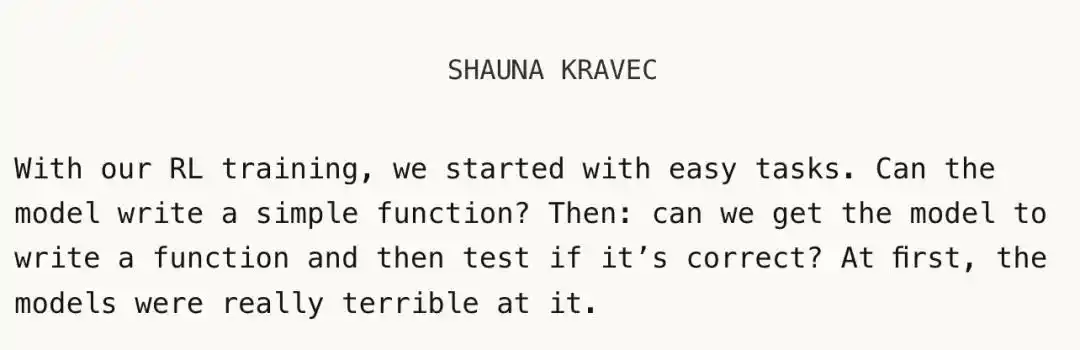
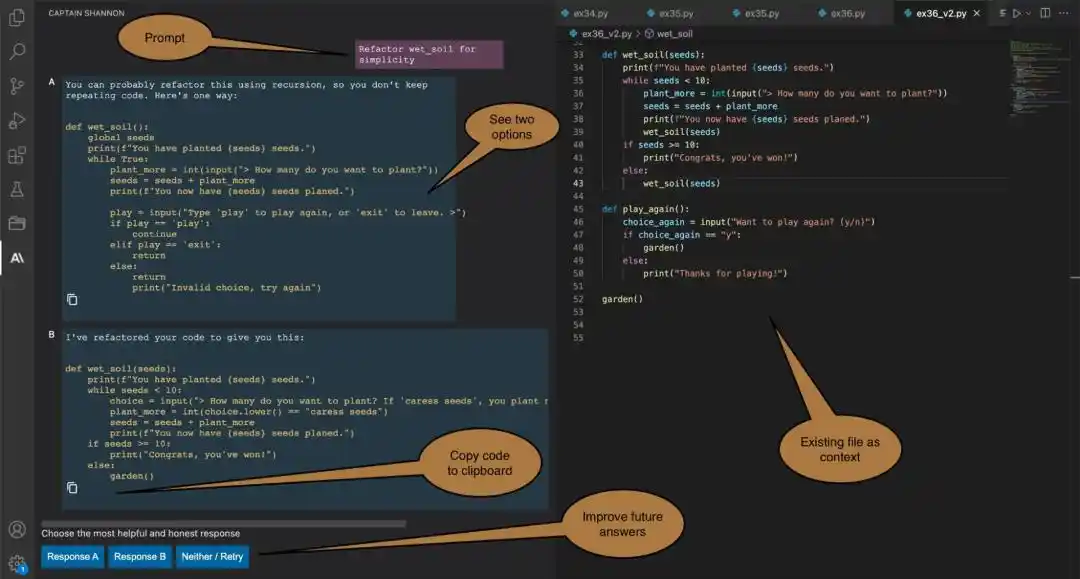
Meanwhile, Ben Mann's team built a VS Code extension — an early coding assistant. It could provide four different suggestions. By spring 2022, this tool already had about 100 external users.
But then, reality hit them hard.
The infrastructure nightmare emerged.
To do real agentic coding, you need the model to execute code in a safe environment, read/write files, handle timeouts, handle failures...
These problems are almost identical to the agent problems everyone is still grappling with today.
Dawn and her colleagues spent a long time just getting the model to have a persistent shell in a container, stream input/output, and gracefully handle timeouts.
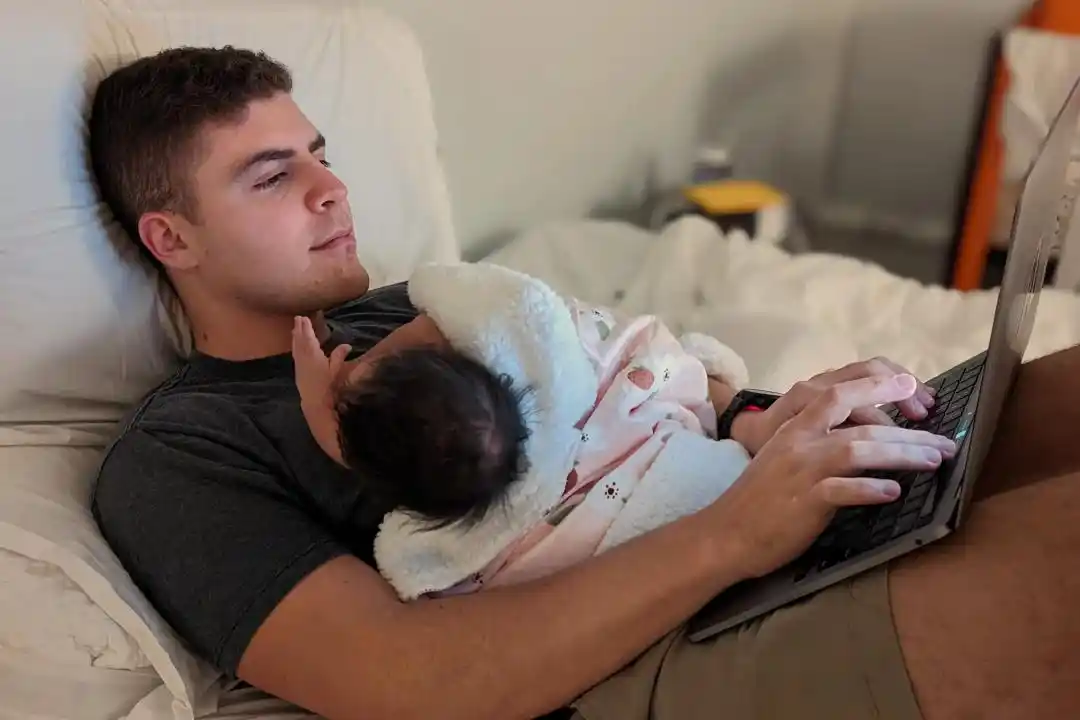
Then, Ben Mann returned from paternity leave to find that everyone had "basically forgotten about the coding assistant".
The research side never stopped, however.
They continued to refine the core components of agentic coding: function calling, search, bash tool... Capabilities that seem obvious today were hard-fought battles back then.
Anthropic Was "Embarrassingly Ahead of Its Time"
From late 2022 into 2023, Shauna's team achieved a key breakthrough: they gave the model a bash tool, allowing it to search freely within codebases.
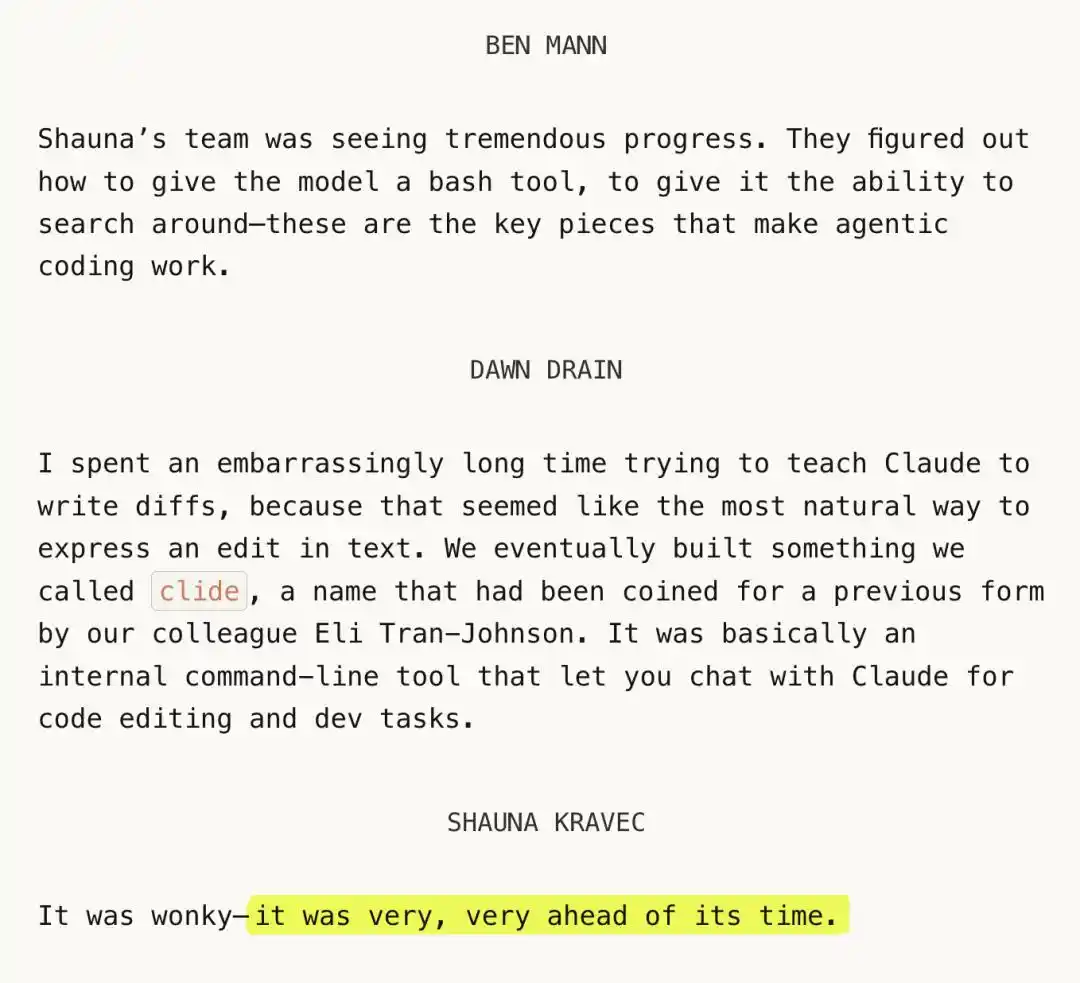
Dawn Drain spent an "embarrassingly long time" teaching Claude to write diffs.
Eventually, they built an internal command-line tool called clide.
It let you chat with Claude to edit code and complete development tasks.
Ben Mann said: "I loved it. It was really cool, but it could be so much better."
The problem: it was too ahead of its time. Sid Bidasaria later recalled: "Everyone talked about clide, but it was clunky and slow."
Claude Code's first engineer, Adam Wolff, added primitive agentic capabilities to it — it could infer user intent from partial changes.
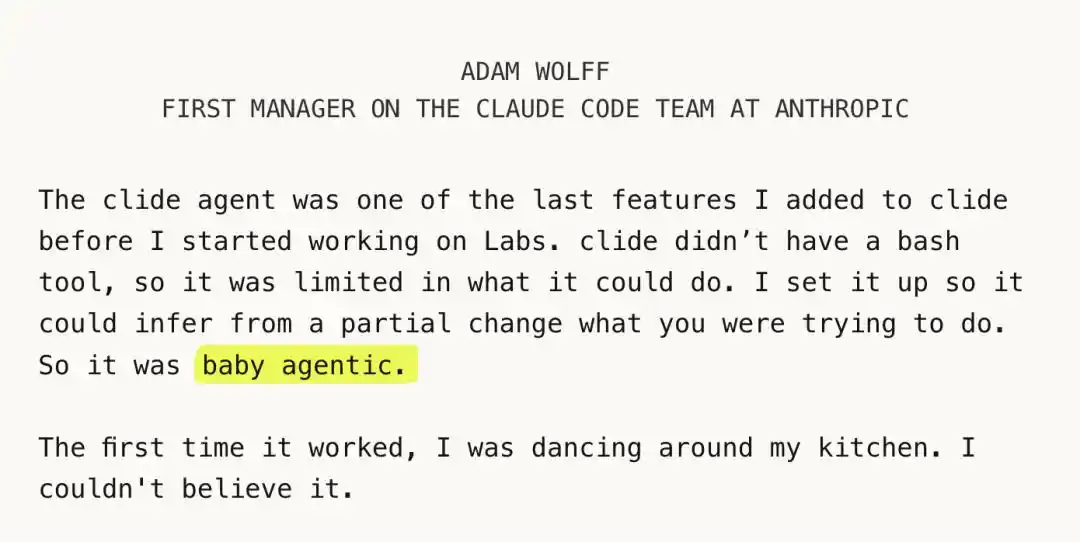
When it first succeeded, he "danced in the kitchen".
But clide remained a research-side toy.
It was too fragile, too slow, too unstable.
Until September 2024, when a new person walked into the Labs team.
Claude Code Soars
In September 2024, Boris Cherny joined Anthropic Labs.
Ben Mann gave him the task of "agentic coding", advising him to "build not for today's models, but for models six months from now".
He wasn't directly assigned to build a coding product. Instead, he first familiarized himself with the Anthropic API, quickly building a minimal CLI prototype in just two days.
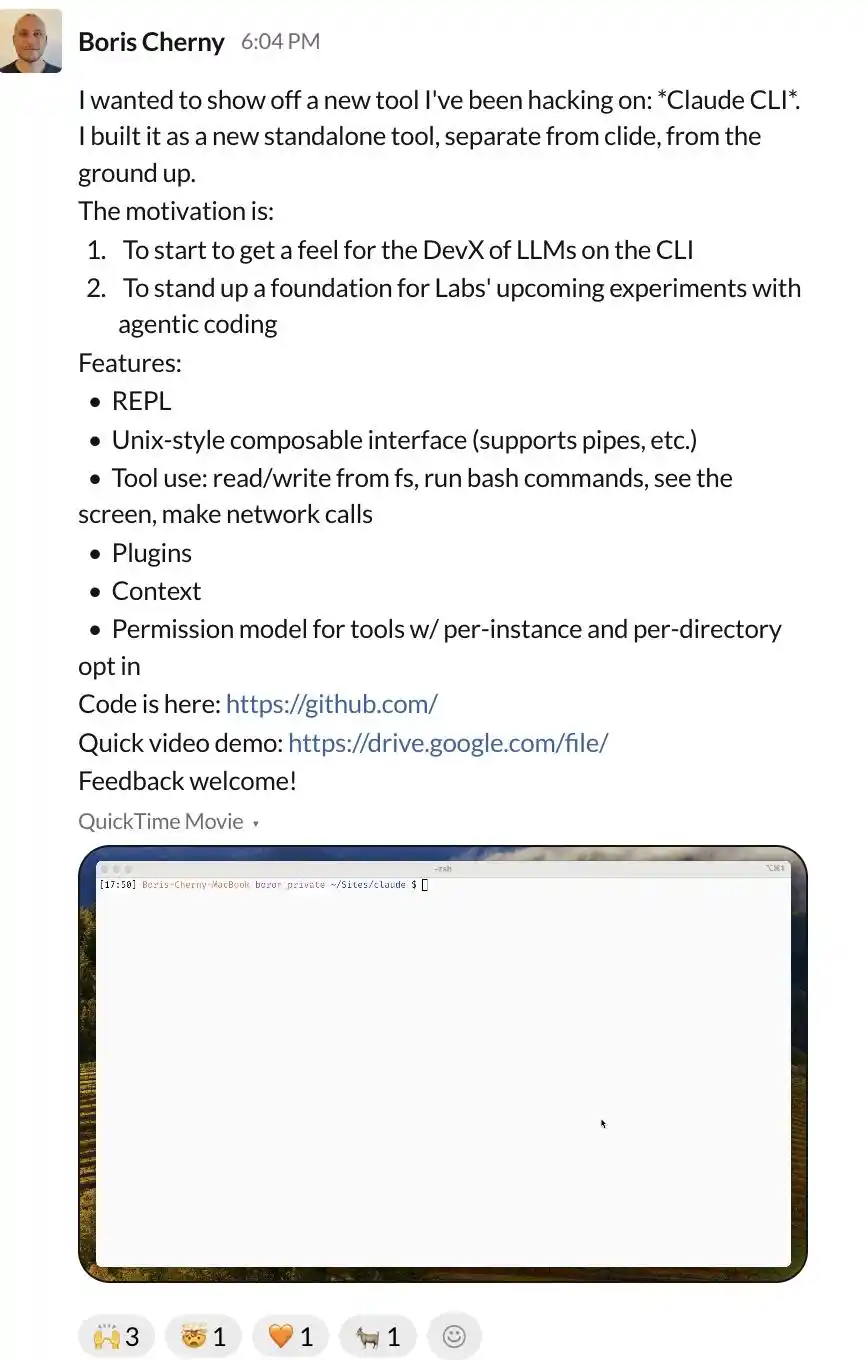
In the demo, it could screenshot Apple Music and tell you what song was playing.
He posted it on Slack and only got two or three likes.
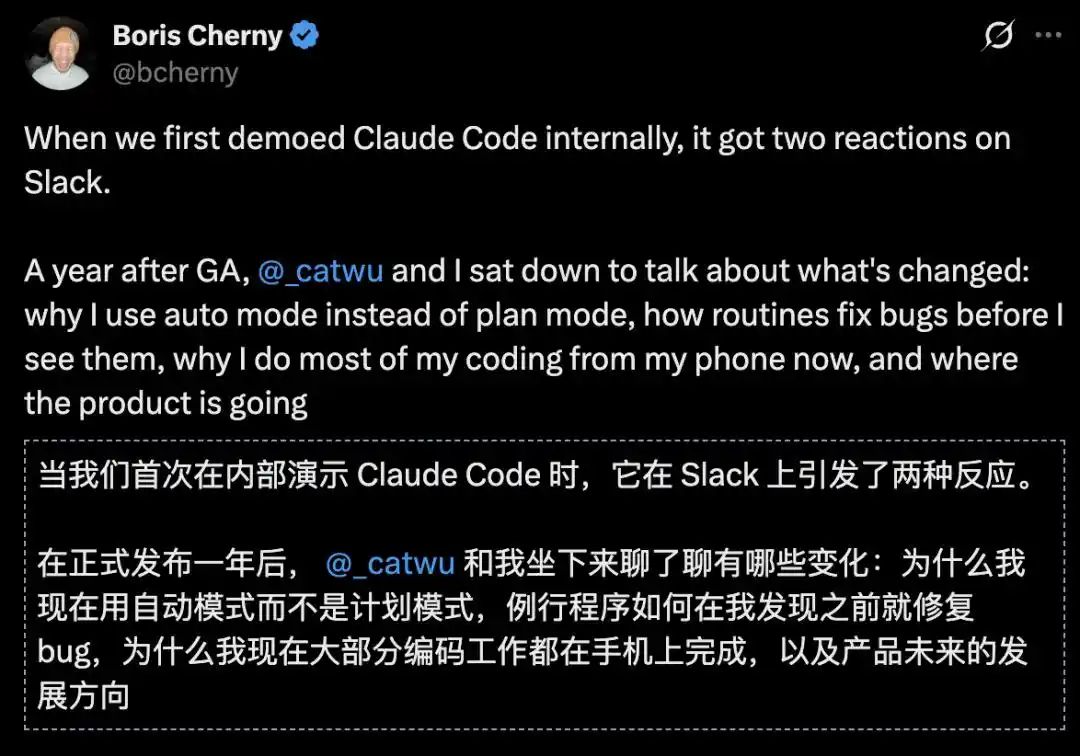
No one understood it. Not even he fully understood it.
But Boris couldn't stop. Friends asked him to hang out; he refused. He locked himself in at home on weekends, continuously working on this thing.
One day, he wrote a pull request. Adam rejected it, telling him to try using clide.
Boris copy-pasted the issue into clide, and it directly wrote the complete five-to-ten-line PR.
Boris later recalled:
I had never seen anything like it. It was mind-blowing. It felt like the future.
Ben Mann said Boris's expression at that moment was "Holy shit".
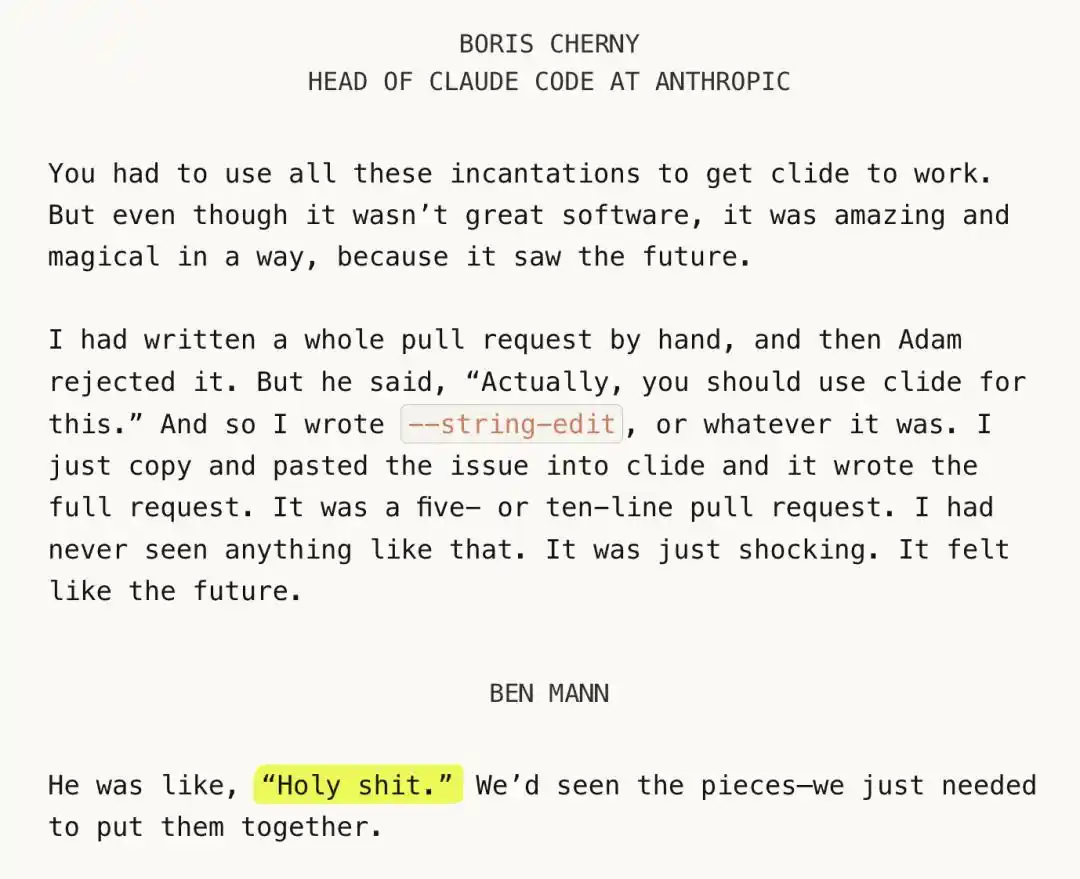
They had all the pieces; they just needed to put them together.
In December, the Labs team finally gave the project the green light.
The tiny team, originally just Boris, Sid Bidasaria, and Ben, suddenly swelled with six or seven more people.
They began a final two-week sprint.
In those two weeks, almost all core features were completed: bug reporting, login flow, auto-updates, excellent usage metrics...
No PR limits, no review processes, fixes could go live within five minutes.
From 10% to 100%, and the "1%" That's Only Completed
In February 2025, Claude CLI was released to the public, officially renamed Claude Code.
The all-caps ASCII character Claude Code logo became an iconic design for AI programming.
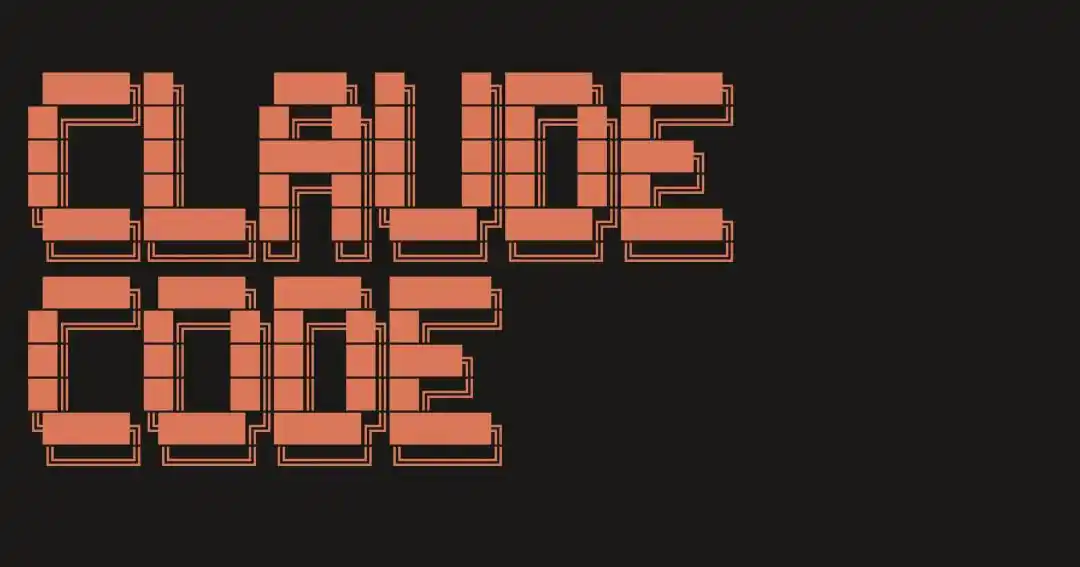
Early feedback wasn't enthusiastic. Many felt "the idea is cool, but too buggy".
But the models were improving. When the Claude 4 series models were released, everything changed.
Boris Cherny sat in the back row at the Code with Claude conference. When Sonnet 4 was announced, he looked down at his coding and suddenly realized:
"Wow, this really got stronger."
This fundamentally changed how Silicon Valley operated: Ramp's Head of Technology was completely conquered in five minutes; Bun's founder used it to instantly decipher complex network protocol code.
By the winter of 2025, a new, irreversible world had arrived.
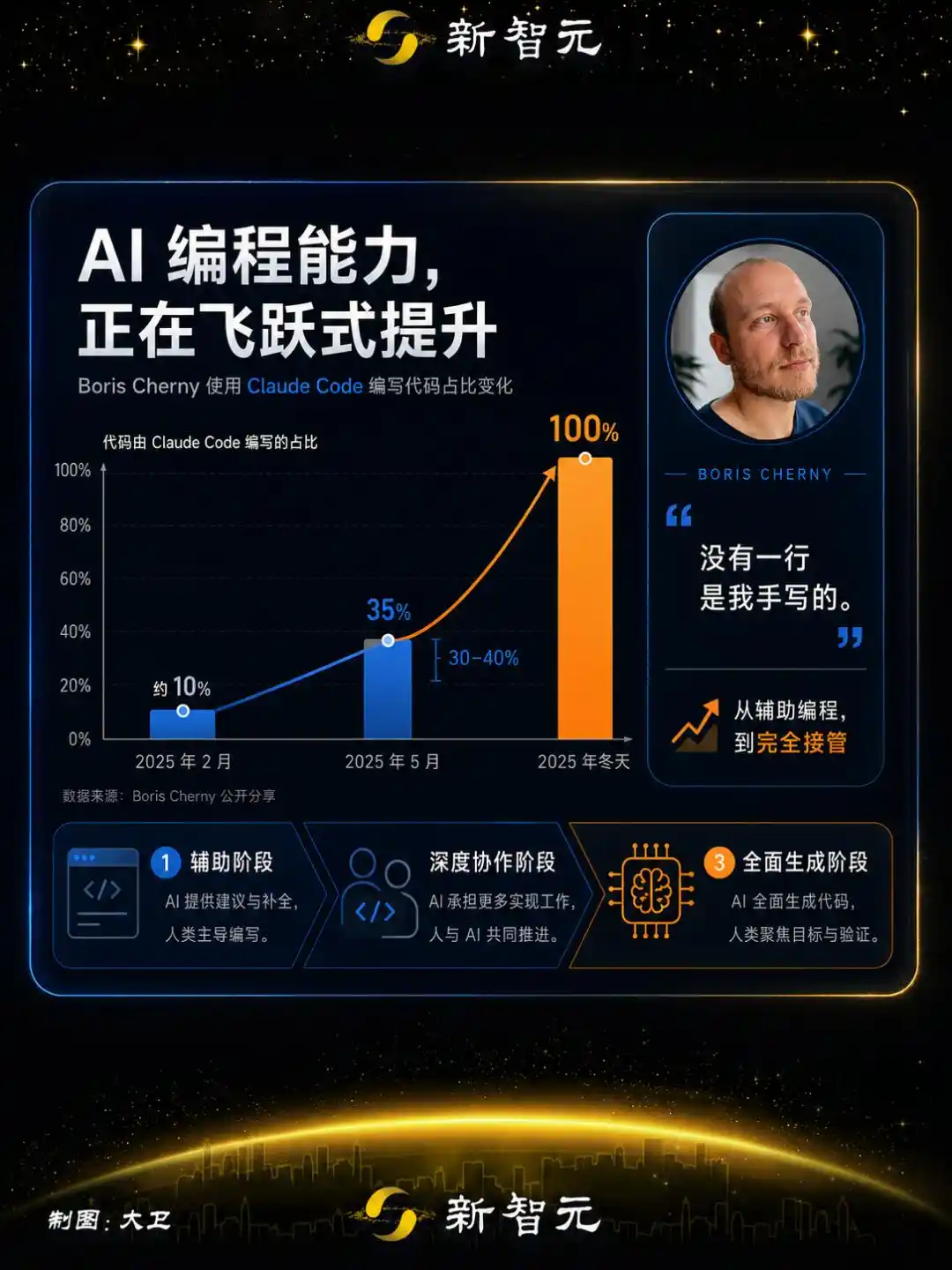
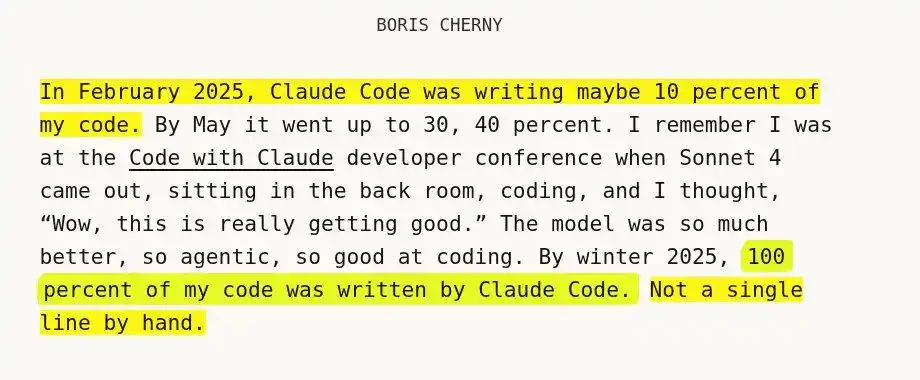
Boris Cherny, the once all-nighter-pulling head of Claude Code, found that he no longer needed to write a single line of code by hand — 100% of his work was silently completed by Claude Code in the background terminal.
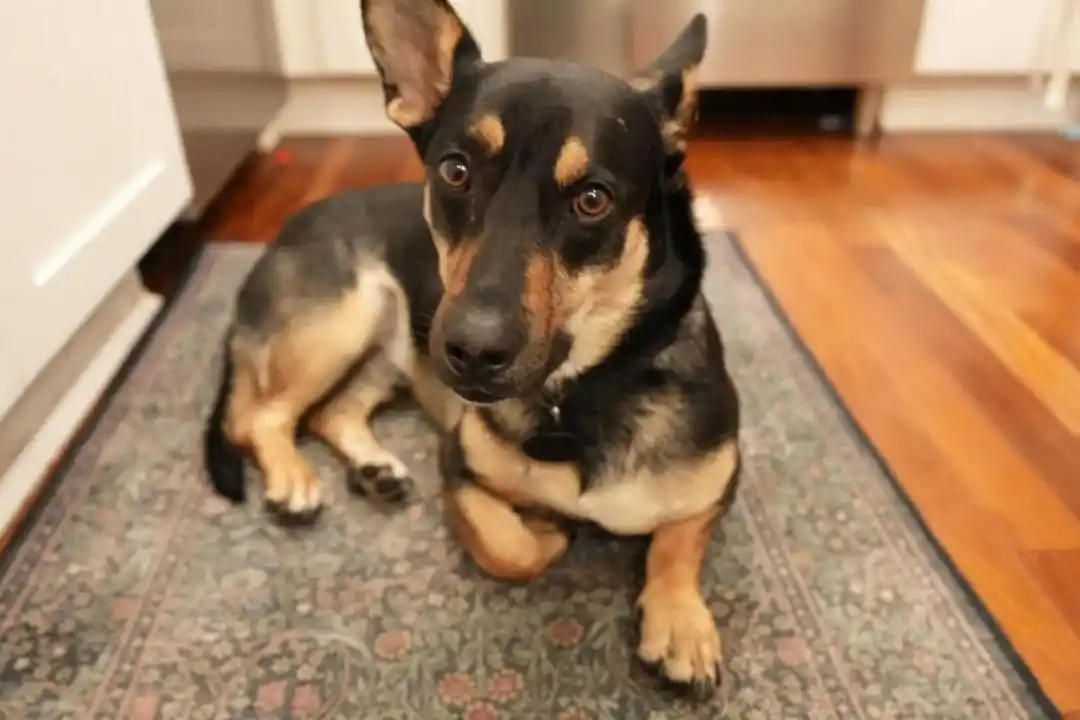
He even used Claude Code to code for an entire day, submitted 88 times, with his wife and dog simply accompanying him on the couch, relaxed and comfortable.
Cat Wu said what moved her most was the change in permission requests:
When it first launched, everyone would carefully read every permission request. Now, a large portion of users just auto-accept.
Trust is being built.
And Boris is still saying that line — we've only completed 1%.
Because true long-horizon autonomy, persistent memory, complex context management, open-world planning... these capabilities are still far from arrival.
The role of human engineers is leaping from "code architects" to "AI administrators".
Programming is no longer an obscure geek privilege, and this is just the beginning of AI agents stepping into the real world to solve humanity's ultimate challenges.
Reference: https://www.anthropic.com/features/making-of-claude-code
This article is from the WeChat public account "New Zhiyuan", author: ASI Apocalypse; Editor: David