Can MemeCore clear $1.28 resistance? THIS setup hints at…

ambcryptoPublished on 2026-07-07Last updated on 2026-07-07

Abstract

MemeCore's token M faced an 11% daily decline, erasing a portion of its recent 111% weekly gains. Underlying data shows increased selling pressure, particularly in the perpetual derivatives market where selling volume outpaces buying. The price is testing key resistance at $1.28 within a symmetrical triangle pattern, with a breakout direction pending. Spot market activity shows a slight net inflow and ongoing accumulation, while whale wallets have begun accumulating as retail participation weakens. This mixed picture suggests the near-term trend hinges on whether whale support and spot demand can overcome the heavy selling pressure in leveraged markets.

MemeCore’s native token M has extended its decline over the past 24 hours, losing roughly 11% even as the memecoin-focused blockchain retained a 111% gain over the past seven days.

On the surface, that pullback erases only about a tenth of M’s accumulated gains and reads as a routine corrective phase.

The underlying data tells a different story, with sellers gaining ground across the market in a way that could drag the asset lower from current levels.

Is selling pressure getting stronger?

Capital is contracting across MemeCore’s markets, with the gap between spot and perpetual traders narrowing as fresh flows move into the derivatives side.

Spot Netflow data showed buyers absorbed roughly $790,000 worth of M, while sellers offloaded about $743,000, leaving a slim net inflow of around $56,000.

That balance tilts toward buyers, yet the edge is too thin to spark a decisive rally, and the imbalance sharpens in the perpetual market, where rising inflows are colliding with heavy selling volume.
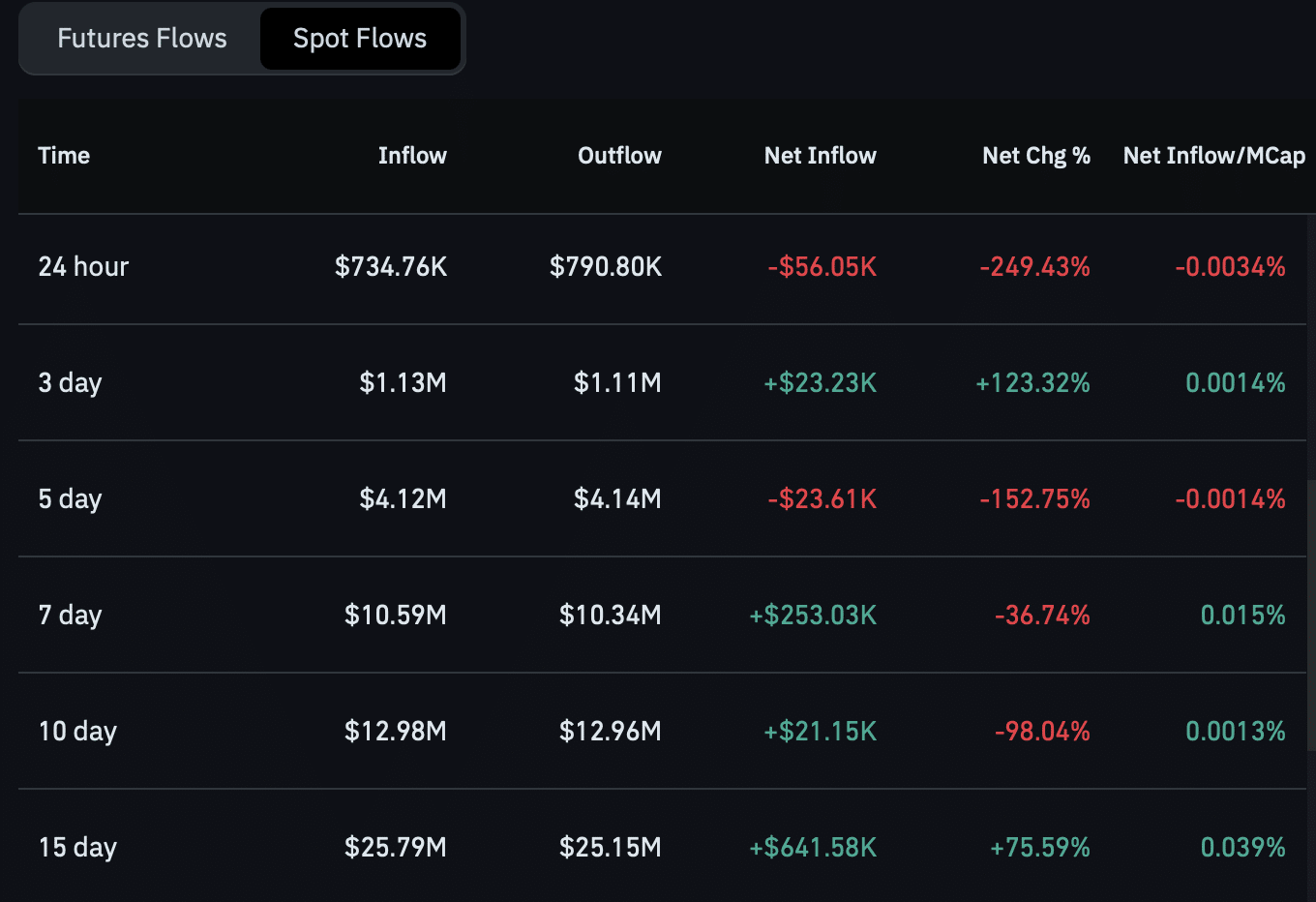
Source: CoinGlass

MemeCore’s perpetual contracts drew a netflow of roughly $668,200, pointing to more capital channeled into leveraged positions on M. That inflow skews toward sellers, though, the Taker Buy Sell Ratio has slid to 0.823 in the latest CoinGlass reading, meaning market sells are outpacing market buys.

Mounting sell pressure in the perpetual market, set against shrinking spot capital, leaves M in a tight spot as it tries to rebuild momentum for a near-term move higher.

MemeCore [M] tests a major level

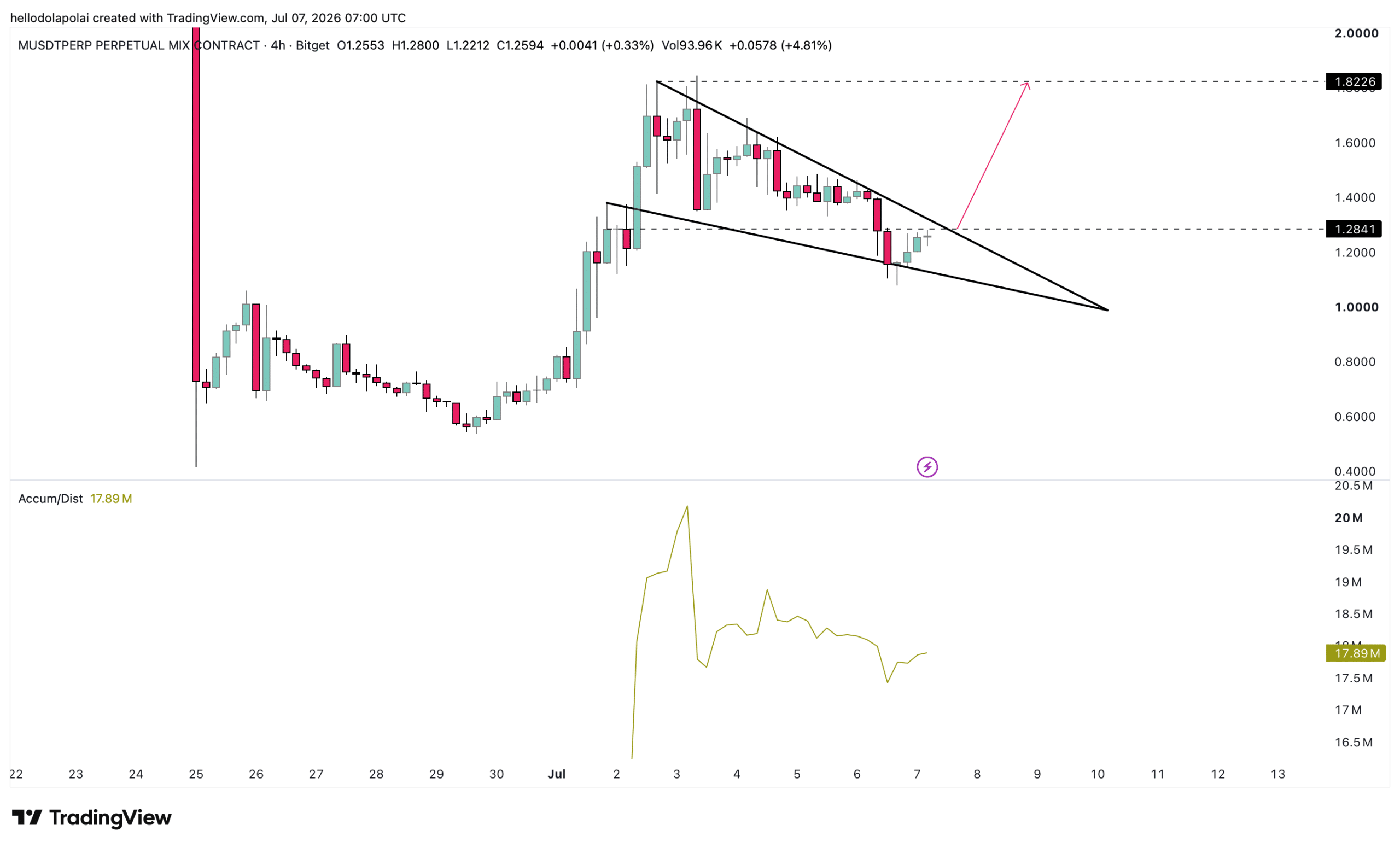
MemeCore traded inside a symmetrical triangle pattern.

The formation typically develops after a sharp price advance as the price consolidates between converging support and resistance lines. The pattern often precedes a breakout.

M now needed to clear horizontal resistance at $1.28.

A break above that level would still leave the price facing the pattern’s descending resistance. Clearing both barriers could confirm a stronger bullish move, while another rejection would likely extend consolidation.
Source: TradingView

Reinforcing the setup, the Accumulation/Distribution (A/D) indicator is climbing, a sign that buying has outweighed selling across the broader market.

A sustained rise in the indicator would show accumulation building beneath the price, a dynamic that tends to support M over time.

Whales accumulate as retail steps back

The Whale-to-Retail Delta recently flipped positive, though only marginally, at 0.01, a slim edge for large holders over retail participants.

That shift points to whales stepping in while retail investors are exiting.

Whales hold deep capital that frequently steers market direction, and their positioning could prove decisive in whether M resumes its slide or turns higher.
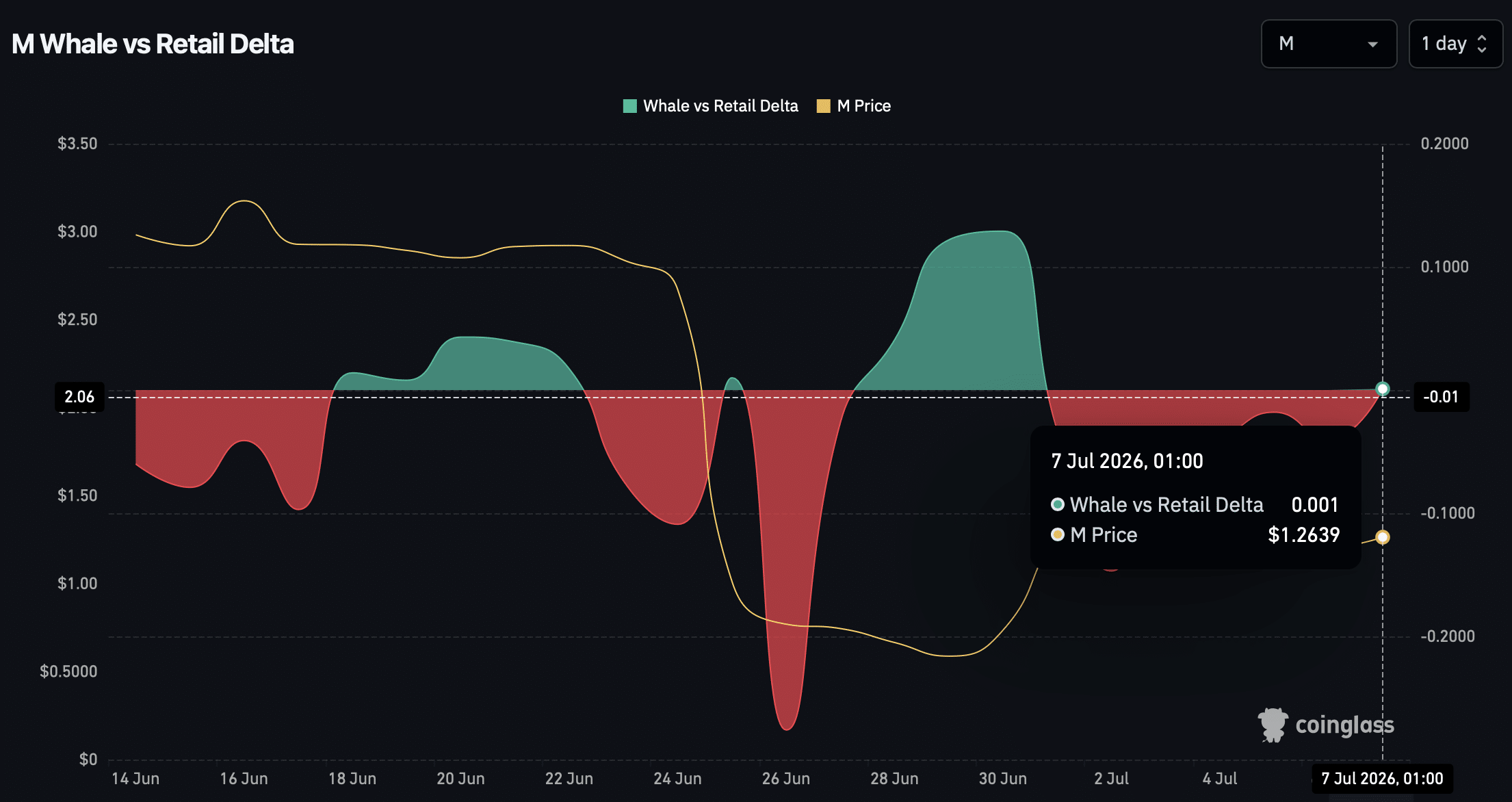
Source: CoinGlass

Even so, Spot buying continued outweighing selling, while most bearish pressure originated from the perpetual market. The A/D indicator also continued pointing toward accumulation.

If whale accumulation continues supporting Spot demand, M could strengthen its rebound and build on the gains recorded over recent weeks.


Final Summary

  • MemeCore’s 11% decline coincided with growing selling pressure in perpetual markets despite positive Spot Netflow.
  • Whales accumulated while retail activity weakened, offering early signs of underlying confidence.


Trending Cryptos

Related Questions

QAccording to the article, what are the key indicators showing that selling pressure is increasing in the MemeCore (M) market?

AThe key indicators showing increasing selling pressure include: 1) A narrowing gap between spot and perpetual markets as capital flows into derivatives. 2) A Taker Buy Sell Ratio in perpetual contracts sliding to 0.823, indicating market sells are outpacing market buys. 3) Perpetual market netflows of $668.2k skewing towards sellers, contrasting with shrinking spot capital.

QWhat price level must MemeCore's token M clear, and what technical pattern is it currently trading within?

AThe token M must clear the horizontal resistance level at $1.28. It is currently trading within a symmetrical triangle pattern, which developed after a sharp price advance and represents a period of consolidation.

QWhat does the positive Whale-to-Retail Delta value of 0.01 signify for the M token market?

AA Whale-to-Retail Delta value of 0.01, while marginal, signifies that large holders (whales) have begun accumulating the token while retail investors are stepping back or exiting their positions.

QWhat is the significance of the rising Accumulation/Distribution (A/D) indicator mentioned in the analysis?

AA rising Accumulation/Distribution (A/D) indicator signifies that buying pressure has outweighed selling pressure across the broader market. It suggests accumulation is building beneath the current price, which is a dynamic that tends to support the asset's price over time.

QWhat two conditions, according to the final summary, coincided with MemeCore's 11% price decline?

AAccording to the final summary, the 11% price decline coincided with: 1) Growing selling pressure in perpetual markets. 2) Despite this, a positive Spot Netflow (indicating more spot buying than selling).

Related Reads

Altcoin Hacked, Leading to Sharp Price Drop! Also Listed on Major Exchanges!

The price of the NES token plummeted significantly following suspicious activity and large sell-offs detected on the network. Blockchain observers suggested that one wallet minted approximately $55 million worth of NES tokens and began selling them on decentralized exchanges. This selling pressure caused the price of NES to drop by up to 40%. According to the data, the address in question still holds around $18 million worth of NES, indicating that market sell-off pressure may continue. Prior to the incident, it was reported that about $12.35 million worth (62.9 million NES tokens) were transferred to the Ethereum mainnet in the morning (Turkish time), with claims that liquidity was withdrawn and tokens were sold on the market later that evening. However, data regarding the $55 million token mint and the transfer of 62.9 million NES tokens has not been independently confirmed. The NESA team confirmed in a statement that they detected malicious activity exploiting a vulnerability in their Layer 1 network originating from Cosmos EVM. They stated they are working to contain the impact, responded promptly, and will restore services after implementing a software patch and additional measures to ensure secure network operation. Nesa also notified all cryptocurrency exchanges and stated deposit operations will resume after necessary work is completed. The article includes a chart showing the NES price decline following the exploit and concludes with a standard disclaimer that this is not investment advice.

cryptonews.ru1h ago

Altcoin Hacked, Leading to Sharp Price Drop! Also Listed on Major Exchanges!

cryptonews.ru1h ago

PeaqOS and World ID Integrate ZK Proofs into Autonomous Robots

The integration of PeaqOS and World ID now allows autonomous machines to verify they are interacting with real, unique individuals without collecting names, photos, or other personal data. This update, available via robotic.sh, enables connected devices to directly request and verify World ID proofs. The system leverages zero-knowledge technology, letting a person prove they are human while maintaining the privacy of their identity. This addresses a key challenge for operators of delivery robots, shared machines, and autonomous systems: how to authenticate a user as genuine without relying on insecure PINs, pickup codes, or traditional identity checks that require personal data collection. Instead of obtaining identifying information, a device receives a cryptographic proof that the user is a real person. PeaqOS acts as a coordination layer, allowing devices to utilize World ID via decentralized identifiers and a device marketplace. A robot can request verification, receive a zero-knowledge proof, and register an auditable record of the interaction—all without exposing underlying personal data. The system also supports uniqueness verification, enabling machines to enforce rules like "one item per person" without maintaining user identity databases. A demonstrated use case involves autonomous medicine delivery: a patient verifies via the World App when placing an order, a pharmacist verifies before loading the medication, and the patient verifies again upon delivery so the robot can confirm the recipient is linked to the order before unlocking the compartment. Similarly, promotional robots could ensure one item per person, and shared vending machines could grant access to verified individuals without requiring accounts or personal data. This integration for PeaqOS-powered robots and devices minimizes the identity information collected or stored while allowing autonomous systems to confirm they are interacting with real humans.

cryptonews.ru3h ago

PeaqOS and World ID Integrate ZK Proofs into Autonomous Robots

cryptonews.ru3h ago

Trading

Spot

Hot Articles

Discussions

Welcome to the HTX Community. Here, you can stay informed about the latest platform developments and gain access to professional market insights. Users' opinions on the price of S (S) are presented below.

活动图片