PA Graphic | One Picture to Understand Major Web3 Events Worth Watching in June

marsbitPublished on 2026-06-01Last updated on 2026-06-01

Abstract

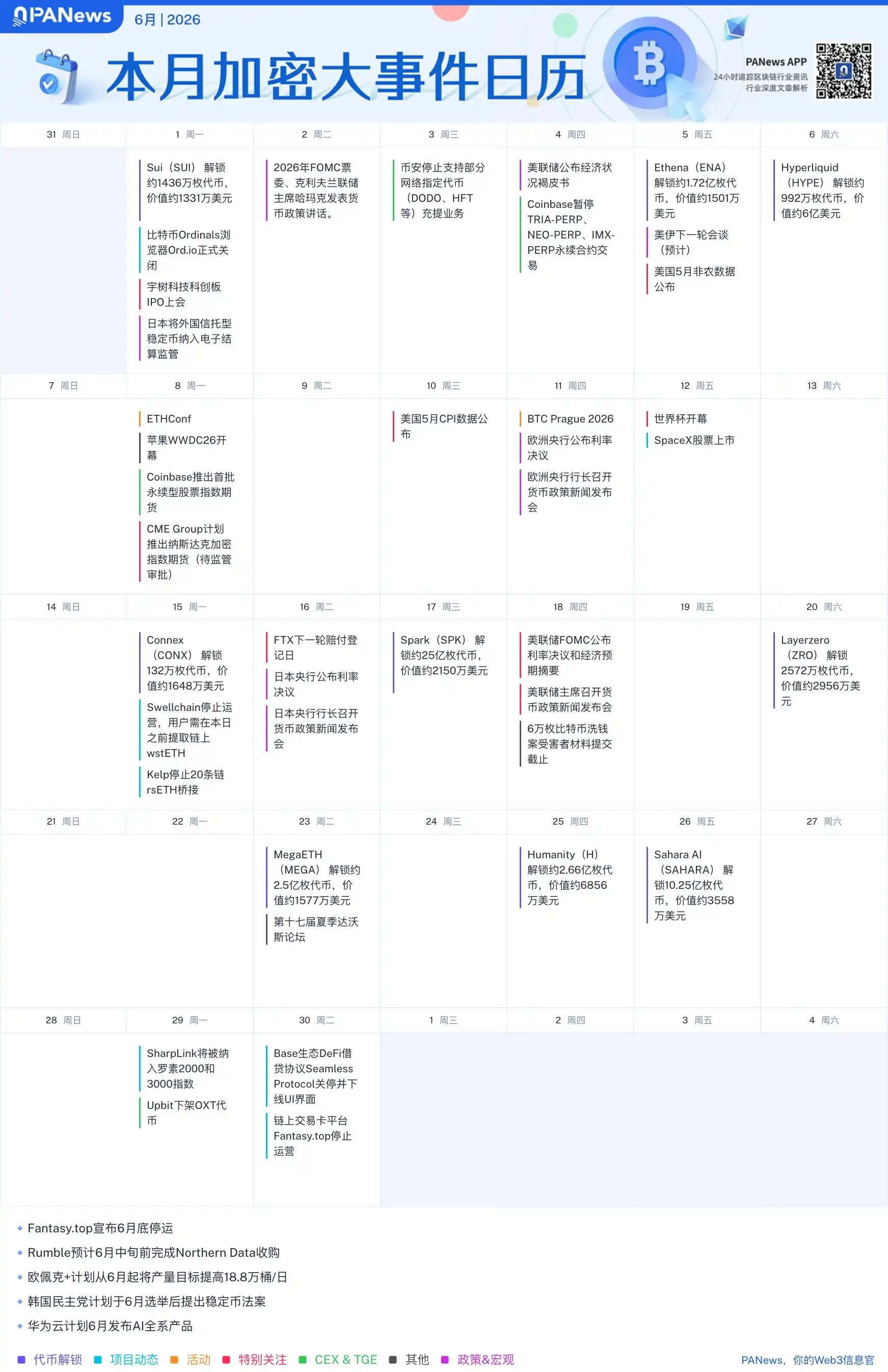
June's crypto market is dominated by key macro events, token unlocks, and project developments. The major focus is on US economic data releases, including May's Nonfarm Payrolls and CPI figures, alongside the Federal Reserve's policy meeting and press conference. These will heavily influence market risk appetite. The European Central Bank and Bank of Japan will also announce interest rate decisions, keeping global liquidity and rate paths in focus. Significant token unlocks are scheduled for assets like SUI and ENA, posing potential market risks. Notable project updates include Coinbase launching its first perpetual stock index futures and CME Group planning a Nasdaq Crypto Index. SharpLink will be added to Russell indexes. Conversely, project consolidation continues, with services like the Bitcoin Ordinals browser Ord.io shutting down, requiring users to manage asset transfers. Other key events span technology and sports, such as the start of the World Cup, Apple's WWDC26, SpaceX's stock market debut, and Yushu Technology's IPO review. Overall, June's market direction will be shaped by evolving liquidity expectations, regulatory shifts, and ecosystem rotation amidst these converging events.

More comprehensive coverage, flexible filtering, and convenient export. Welcome to experience the new PANews crypto calendar👇

Click to View Calendar

In June, the crypto market sees a dense mix of macro interest rate decisions, key economic data, token unlocks, and traditional tech events. The core highlights are:

📌 The US releases May Non-Farm Payrolls and CPI data; the Fed publishes the Beige Book and holds a monetary policy press conference, as market risk appetite continues to be influenced by macro expectations.

🏦 The European Central Bank and the Bank of Japan will announce interest rate decisions, with global liquidity and interest rate paths remaining one of the main market themes for June.

🪙 Tokens such as SUI and ENA will undergo unlocks; be mindful of the risks.

🚀 Project Updates: Coinbase will launch its first perpetual stock index futures; CME Group plans to launch Nasdaq crypto index futures; SharpLink will be included in the Russell 2000 and 3000 indices.

⚠️ Project Shutdowns Continue: Services like the Bitcoin Ordinals browser Ord.io are gradually ceasing operations; attention should be paid to asset withdrawal and migration arrangements.

🌐 Other Key Events: World Cup opening, Apple WWDC26 opening, SpaceX stock listing, Unitree Robotics' IPO hearing on the STAR Market, etc.

Macro factors, unlocks, regulation, project shutdowns, and tech events are advancing simultaneously. The market in June may continue to seek new directions amid liquidity expectations, policy shifts, and ecosystem rotations.

Global focal events converge. Lock onto the core threads of Web3 in June 2026 with just this one graphic!
Related Questions

QWhat are the key categories of events to watch in the Web3 space for June according to the article?

AThe key categories are macro events (like US non-farm payrolls, CPI data, and Fed meetings), central bank interest rate decisions (from the ECB and Bank of Japan), token unlocks (for projects like SUI and ENA), major project dynamics (e.g., new futures products from Coinbase and CME), project shutdowns, and other significant tech/global events.

QWhich two major central banks are expected to announce interest rate decisions in June?

AThe European Central Bank (ECB) and the Bank of Japan are expected to announce their interest rate decisions in June.

QWhat specific risks related to project tokens are mentioned for June?

AThe article warns of risks associated with token unlocks for projects like SUI and ENA in June.

QName two traditional financial institutions planning to launch new crypto-related products in June.

ACoinbase is planning to launch its first perpetual stock index futures, and CME Group plans to launch Nasdaq crypto index futures.

QWhat is one example given of a project or service that is shutting down in June?

AThe Bitcoin Ordinals browser Ord.io is mentioned as one of the projects whose services are being discontinued in June.

Related Reads

A 134% Surge, 75 P/E Ratio: Why Is the Market Paying Up for Murata's 'Zero Growth'?

Murata Manufacturing, the world's largest passive components maker, saw its stock price surge 134% over the past year and hit a record high on May 28th, despite reporting nearly zero growth in operating profit for its latest fiscal year. This has pushed its valuation to a P/E ratio of approximately 75x. The disconnect is driven by a fundamental market re-rating. The catalyst was a late-May meeting where management upgraded the AI investment cycle outlook to "lasting until around 2030" and noted that demand for its components is roughly double its supply capacity, with customers prioritizing securing volume over price. While Murata's revenue grew only 5.0% and operating profit stagnated at ¥281.8 billion for the fiscal year ending March 2026, its guidance for the current fiscal year projects a 34.8% jump in operating profit to ¥380 billion. This sharp growth is underpinned by expectations that its AI/data center-related revenue will nearly double from ¥170 billion to ¥325 billion, becoming a key pillar of its business. Analysts highlight that this growth stems not from broad price hikes but from a shift towards higher-value, cutting-edge MLCCs for AI servers, where Murata holds over 70% market share. The market is now pricing Murata not as a cyclical component maker but as a critical "AI pick-and-shovel" supplier with structural pricing power. However, the high valuation also carries risk if future AI demand or quarterly guidance falls short of the elevated expectations.

marsbit18m ago

A 134% Surge, 75 P/E Ratio: Why Is the Market Paying Up for Murata's 'Zero Growth'?

marsbit18m ago

a16z: Why Do Prediction Markets Matter?

Prediction markets, which allow users to trade on the outcome of future events, have gained significant traction, especially in the U.S. At their core, these markets function like any other market by aggregating information from all participants and translating it into a price signal—in this case, the perceived probability of a specific event occurring. Unlike polls or surveys that offer static snapshots, prediction markets provide dynamic, quantifiable probability estimates that update in real-time as new information and participants enter. A key advantage is the incentive structure: participants risk their own capital, which encourages serious research and trading based on genuine knowledge. This can surface information that traditional methods might miss. Furthermore, prediction markets can be created for a vast array of specialized questions—from geopolitical events to AI model performance—that aren't covered by traditional financial markets. However, several challenges remain. Infrastructure issues include reliably determining event outcomes and resolving disputes. Market design must ensure participation from well-informed individuals while preventing manipulation, such as insider trading or attempts to sway public perception by artificially moving prices. Addressing these concerns around rules, participation, and contract design is crucial. If these hurdles are overcome, prediction markets could evolve into a powerful, widely-used tool for forecasting and navigating uncertainty.

marsbit28m ago

a16z: Why Do Prediction Markets Matter?

marsbit28m ago

Interview with 7 Ordinary Professionals: After AI Arrived, How Are You Doing?

This article interviews seven professionals from diverse fields like Web3, bulk chemical trading, digital agriculture, and traditional wholesale to examine the impact of AI on their work. Key themes emerge from the discussions. AI has become integral to their workflows, primarily for increasing efficiency in tasks such as coding, content creation, research, and data analysis. Individuals across roles, from developers to managers, report that AI tools like ChatGPT and Claude have significantly reduced workloads and accelerated learning, creating opportunities for "super individuals" or one-person teams. However, this efficiency comes with a double-edged sword. It intensifies competition, pushing professionals to constantly learn new tools and adapt, leading to widespread anxiety about job security and a heightened pressure to keep pace. Interviewees anticipate significant job reductions in roles like administrative support, finance, HR, customer service, and some creative fields. A recurring view is that AI acts as a "great equalizer," amplifying the capabilities of those who use it effectively while leaving others behind, potentially deepening polarization. Despite AI's capabilities, interviewees identify enduring human strengths. AI struggles with tasks requiring deep contextual understanding, complex judgment in areas like risk assessment and system stability (especially in finance/Web3), nuanced human communication, and handling exceptions in logistics and manufacturing. These areas remain firmly in the human domain. Consequently, many professionals are refocusing their career strategies. They plan to evolve from task executors into "complex system owners," "super coordinators" managing AI agents, or specialists in high-level areas like business context, risk control, product design, and personal branding. In summary, the article portrays AI not as an optional tool but as a transformative force reshaping job demands. While it automates routine work, it also creates new forms of pressure and competition. The future, as seen by these professionals, belongs to those who can strategically integrate AI to augment uniquely human skills like judgment, responsibility, and strategic oversight.

marsbit44m ago

Interview with 7 Ordinary Professionals: After AI Arrived, How Are You Doing?

marsbit44m ago

Satoshi Nakamoto Sued? $83.7 Billion Worth of BTC Up for 'Legal Claim'

An anonymous individual known as Noah Doe, along with two Wyoming LLCs, has filed a lawsuit in the New York Supreme Court. They are attempting to use New York's "lost and found" laws to claim legal ownership of approximately 837 billion USD worth of Bitcoin held in 39,069 dormant addresses. Crucially, this list includes addresses believed to belong to Bitcoin's creator, Satoshi Nakamoto (holding around 837 billion USD), alongside other long-inactive addresses from Mt. Gox and early Bitcoin holders. The plaintiff's legal strategy hinges on classifying these public Bitcoin addresses as "lost property." They submitted a USB drive containing only the public addresses to the New York Police Department, sent OP_RETURN notifications on the Bitcoin blockchain, and issued press releases. Their argument is that after these efforts and a waiting period, they should be granted ownership. A key, and highly controversial, claim is an unnamed "independent expert" valuing each address at under 10 USD, allowing for a faster legal process. Analysts from Galaxy point out major flaws in the case. The plaintiff never physically possessed the Bitcoin or private keys. The "under 10 USD" valuation is considered unrealistic, and allowing anonymous companies to claim such vast assets is highly unusual. Even if the plaintiff wins, they would only receive a court declaration of ownership, not the actual private keys to move the Bitcoin. The real danger lies in this court document acting as a "cloud on title." If any of these Bitcoins are later transferred to a regulated exchange or custodian, the plaintiff could present the judgment to freeze the assets, forcing the true owner into lengthy and de-anonymizing litigation to prove ownership. The outcome is uncertain, but the case highlights potential legal risks for dormant cryptocurrency holdings.

marsbit49m ago

Satoshi Nakamoto Sued? $83.7 Billion Worth of BTC Up for 'Legal Claim'

marsbit49m ago

Trading

Spot
Futures

Hot Articles

How to Buy ONE

Welcome to HTX.com! We've made purchasing Harmony (ONE) simple and convenient. Follow our step-by-step guide to embark on your crypto journey.Step 1: Create Your HTX AccountUse your email or phone number to sign up for a free account on HTX. Experience a hassle-free registration journey and unlock all features.Get My AccountStep 2: Go to Buy Crypto and Choose Your Payment MethodCredit/Debit Card: Use your Visa or Mastercard to buy Harmony (ONE) instantly.Balance: Use funds from your HTX account balance to trade seamlessly.Third Parties: We've added popular payment methods such as Google Pay and Apple Pay to enhance convenience.P2P: Trade directly with other users on HTX.Over-the-Counter (OTC): We offer tailor-made services and competitive exchange rates for traders.Step 3: Store Your Harmony (ONE)After purchasing your Harmony (ONE), store it in your HTX account. Alternatively, you can send it elsewhere via blockchain transfer or use it to trade other cryptocurrencies.Step 4: Trade Harmony (ONE)Easily trade Harmony (ONE) on HTX's spot market. Simply access your account, select your trading pair, execute your trades, and monitor in real-time. We offer a user-friendly experience for both beginners and seasoned traders.

3.7k Total ViewsPublished 2024.03.29Updated 2025.06.04

How to Buy ONE

Discussions

Welcome to the HTX Community. Here, you can stay informed about the latest platform developments and gain access to professional market insights. Users' opinions on the price of ONE (ONE) are presented below.

活动图片