A piece of turtle plastron or ox scapula lies on the desk, cracks running through the inscribed characters, a few words missing strokes.
To confirm one unfamiliar character, researchers often have to sift through hundreds or even thousands of rubbings, compare forms found in bronze inscriptions, Warring States period scripts, and small seal script, and then search for usage examples in ancient texts and modern research papers. Evidence is scattered across different eras, different media, and different databases; one round of verification can take days.
Recently, a joint team from Huazhong University of Science and Technology and others has introduced AlphaOracle, the first artificial intelligence system that simulates the expert interpretation workflow, to assist scholars in the arduous task of deciphering oracle bone inscriptions.
Paper link: https://doi.org/10.1016/j.xinn.2026.101462
Supplementary materials: https://arxiv.org/abs/2607.17849
Code repository: https://github.com/Yuliang-Liu/AlphaOracle
Demo link: http://vlrlabmonkey.xyz:7685/?lan=zh
AlphaOracle first examines the historical evolution trajectory of the oracle bone character's form, then returns to the complete textual context and similar divination records for contextual verification, and finally consults ancient texts and research literature for further evidence, forming a complete chain of evidence.
Each step of AlphaOracle's interpretation analysis is accompanied by source citations, candidate answers, and confidence levels, facilitating expert review item by item, providing convenient, efficient, and reliable intelligent assistance. The paper has been accepted by *The Innovation*.
Research Background
Oracle bone inscriptions preserve the Shang Dynasty's wars, agricultural activities, illnesses, sacrifices, celestial phenomena, and daily decisions on bones over three thousand years old. More than 150,000 oracle bone fragments have been discovered, containing at least 4,500 distinct character forms, of which about 1,500 have received relatively reliable interpretations.
The remaining approximately 3,000-plus characters are like an unopened door, behind which lie the lexicon, place names, clan names of early Chinese, as well as the details of Shang Dynasty social operations. Deciphering oracle bone inscriptions makes the language, concepts, and social life of ancestors over three millennia ago clear and visible once more, and vividly illuminates the continuous historical thread of Chinese civilization.
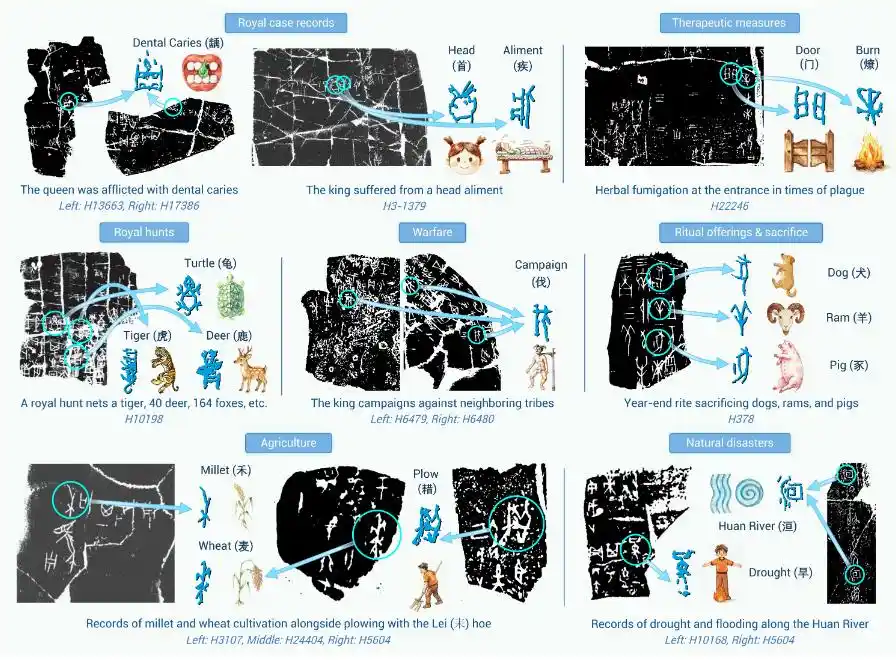
Oracle bone inscriptions record the tapestry of Shang Dynasty social life, serving as a precious cultural treasure of the Chinese nation and a crucial basis for exploring the origins of Chinese civilization.
However, the process of deciphering and interpreting oracle bone inscriptions is difficult and tedious. When interpreting undeciphered characters, experts typically analyze the character's historical variant forms, retrieve contextual and textual corroborative materials from vast reference corpora, and verify related hypotheses by combining multiple inscriptions and transmitted texts. This process demands that researchers possess extensive knowledge accumulation and rich research experience, and also requires long-term collection, organization, and repeated comparison of large volumes of documentary materials.
While expert-led independent research has yielded many important results, this model consumes significant time and manpower, and the evaluation process often relies on subjective expert judgment, heavily dependent on the individual scholar's erudition. This makes it difficult to reach consistent conclusions and challenging to scale up the work.
The rapid development of artificial intelligence technology brings new possibilities for assisting experts in interpreting ancient scripts. Previous research often predicted the corresponding modern Chinese character based on the isolated glyph of an oracle bone character.
However, such methods primarily rely on visual information, seldom incorporating textual contextual usage and transmitted texts for cross-verification. Consequently, although some output results may seem plausible at the glyph level, they lack linguistic and historical evidence, offering limited assistance to experts.
These challenges indicate an urgent need to construct a computational framework capable of integrating all stages of decipherment, simulating expert reasoning processes, and scaling it for large-scale corpus analysis, thereby basing inferences on comprehensive and verifiable evidence.
Highlights of the Work
The team proposes AlphaOracle, the first AI system to fully simulate the expert interpretation workflow, partially transforming the unscalable, experience-dependent process of ancient script analysis into a reviewable, repeatable, and collaborative computational framework.
AlphaOracle integrates large-scale oracle bone rubbings, facsimiles, transmitted ancient texts, and over twenty thousand related research papers. The candidate results and evidence sources generated during the analysis process are completely retained, ultimately compiled into an auxiliary interpretation report that is traceable and verifiable, available for experts to inspect and discuss item by item.
By helping scholars quickly discover clues, gather evidence, and compare different interpretations from scattered and voluminous materials, this technical approach enables AI to potentially enter the core processes of ancient script research.
In an evaluation involving 86 domain experts and doctoral researchers, 78.7% of participants gave AlphaOracle a positive or highly positive evaluation, estimating it could save approximately 64% of analysis time on average.
Research Methodology
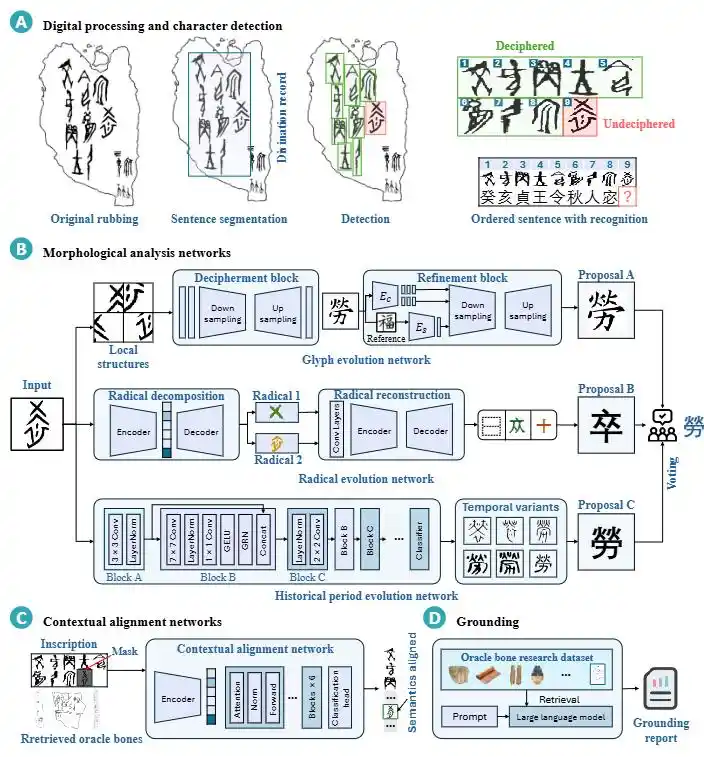
Following the reasoning of experts conducting real paleographic analysis, AlphaOracle sequentially links the steps of oracle bone rubbing parsing, character form evolution analysis, textual context retrieval and judgment, and verification against transmitted texts and modern research.
The system first proposes multiple candidate interpretations based on whole-character evolution, component structure, and cross-era character relationships. It then tests these candidates in the context of their sentences and searches for similar cases in large-scale oracle bone materials. Finally, it seeks further support or challenges from ancient texts and modern academic research, forming a complete evidence chain.
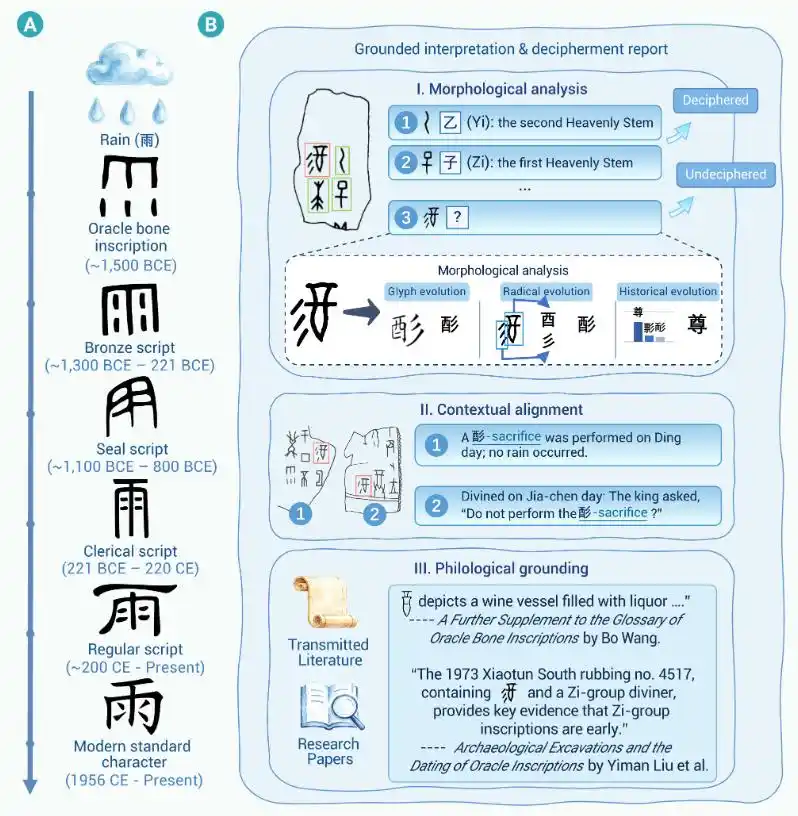
AlphaOracle interpretation workflow: First parsing the rubbing, then sequentially completing morphological analysis, context alignment, and literature verification, ultimately forming an evidence report for expert review.
Step One: Rubbing Parsing
Upon input of an original oracle bone rubbing, the system first performs character detection, classification, and sentence reconstruction. A detection model locates each oracle bone character, a classifier identifies already-interpreted characters, and leaves contested, undeciphered characters for subsequent modules.
Next, treating each character as a node, the system uses a graph neural network combined with spatial information to simultaneously determine the sentence's start, end, and connection relationships between characters, then reconstructs the reading order accordingly. Ultimately, the parsing model breaks down the oracle bone rubbing into several independent statements with reading order and preliminary character recognition results.
Step Two: Morphological Analysis
With clear single-character images and reading order, the system begins proposing several possible decipherment hypotheses for undeciphered characters from two directions: diachronic evolution and internal structure.
A Glyph Evolution Network uses a diffusion model to simulate the transformation of ancient forms into later script styles, recognizing and summarizing the results of multiple generations.
A Component Evolution Network decomposes oracle bone glyphs into constituent elements, mapping them to Ideographic Description Sequences (IDS), and infers corresponding Chinese characters based on component combinations.
A Historical Period Evolution Network compares similarities along a timeline covering stages like oracle bone script, bronze inscription script, Warring States script, small seal script, and clerical script.
These three expert models each provide candidates and probabilities. The system weights them according to model reliability, determines if the character has a generally accepted interpretation, and retains multiple possible decipherment answers with corresponding confidence levels for undeciphered characters.
Step Three: Context Alignment
Decipherment hypotheses from morphological analysis must be tested within their sentence context, and similar cases must be sought from other related rubbings.
The system first retrieves all known occurrences of the target character from digitized materials like *Jiaguwen Heji* (Collected Oracle Bone Inscriptions), *Jiaguwen Moben Daxi* (Compendium of Oracle Bone Rubbing Facsimiles), and *Jiaguwen Jiaoshi Zongji* (Complete Collated Interpretations of Oracle Bone Inscriptions), based on image and text information. It then analyzes collocations using a Masked Language Model trained specifically on oracle bone texts.
During training, the model learns to predict masked characters based on known oracle bone context. During inference, it re-ranks the multiple candidates from the morphology module to determine which fits the sentence most coherently, and also independently proposes semantic candidates.
Context alignment also includes an explanation model, fine-tuned via supervised learning and reinforcement learning from feedback, used to summarize the usage of the same character in different divination records and generate modern Chinese explanations convenient for researcher review.
Step Four: Literature Verification
Decipherment candidates filtered through form and context are then further verified using transmitted ancient texts and modern research papers.
The system's materials include 25 ancient transmitted texts and 23,755 authoritative modern research papers, covering works like *Shuowen Jiezi*, pre-Qin and Han dynasty classics, and specialized reference books such as *Guwenzi Gulin*, *Jiaguwen Gulin*, and *Jiaguwen Zilin*.
During retrieval, it incorporates variant forms and near-synonyms into queries, simultaneously searching for relevant materials through both textual semantics and glyph images.
The relevance of different texts, source authority, literature type, and chronological order all influence the weight of evidence. Each piece of material retains bibliographic information and retrieval rationale, facilitating researcher tracing to the original source.
The final comprehensive report sequentially presents glyph-based evidence, contextual usage examples, and literature evidence. It indicates the currently most supported reading and its credibility, while also clearly retaining unresolved disagreements.
In summary, AlphaOracle generates hypotheses itself, collects relevant evidence for each hypothesis, and then presents it to the researcher.
Throughout the process, the system makes only the minimal necessary judgments but does not replace the expert in making the final decision. Its core function is to help researchers discover clues, verify evidence, and compare different interpretations more efficiently, leaving the ultimate adjudication to the researcher.
Experimental Results and Expert Evaluation
Oracle bone interpretation lacks a universally accepted benchmark. Therefore, the paper breaks down the larger problem into several measurable tasks and evaluates AlphaOracle from both component performance and expert utility perspectives.
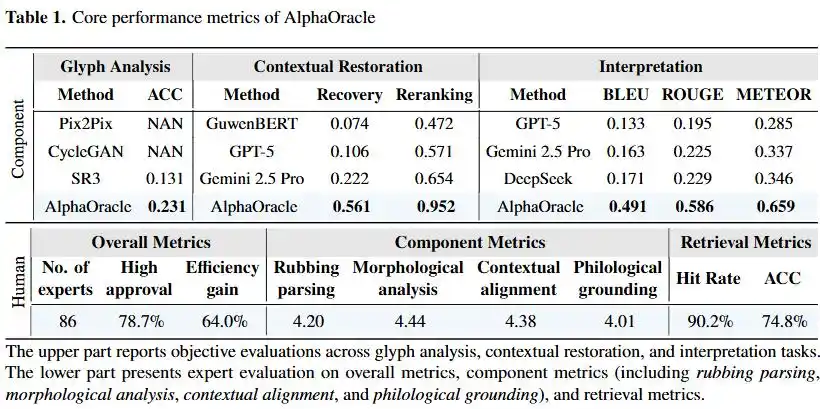
In the glyph analysis experiment, using a "simulated undeciphered character" setting with a test set of 88 known characters never seen during training, AlphaOracle achieved a Top-1 accuracy of 23.1%.
In context analysis, the system achieved 56.1% accuracy in recovering masked characters from incomplete divination texts, and could select the interpretation more consistent with context from candidates provided by the glyph analysis with 95.2% accuracy, surpassing the best general large model baselines of 22.2% and 65.4%, respectively.
In a comprehensive explanation evaluation using modern Chinese explanations as a proxy task, AlphaOracle achieved BLEU, ROUGE, and METEOR scores of 0.491, 0.586, and 0.659, respectively.
It should be noted that general models like GPT-5, Gemini 2.5 Pro, and DeepSeek were used in the paper with a zero-shot setting, without fine-tuning on oracle bone domain data. Therefore, these results highlight the importance of specialized corpora and domain-specific workflows for this task.
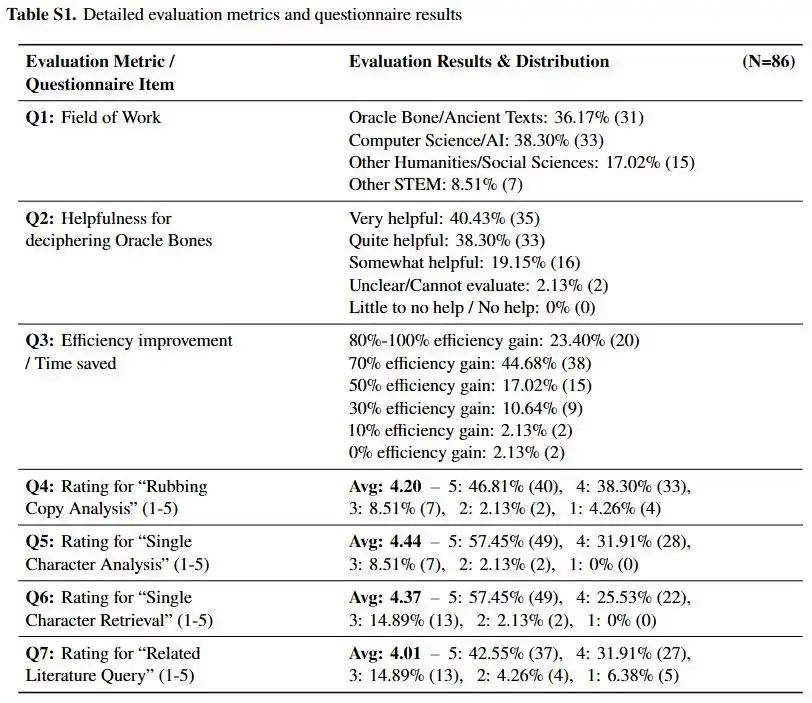
Specific Findings from Human Expert Evaluation
In the practical usage evaluation by experts, 86 experts and doctoral researchers from oracle bone studies, AI, and related fields anonymously participated in the system assessment.
Among them, 78.7% of participants found the system "helpful" or "very helpful," and estimated an average time saving of about 64%. In a modular evaluation on a 5-point scale, the average scores for the four parts—rubbing parsing, glyph analysis, context alignment, and literature evidence retrieval—were 4.20, 4.44, 4.38, and 4.01, respectively.
For the literature retrieval component, a manual check was performed on a random sample of 42 oracle bone characters, resulting in a recall rate (hit rate) of 90.2% and a precision rate of 74.8%. This means the system presents most of the valuable materials but still includes some literature that experts need to filter out.
For researchers, this reduces the cost of sifting through literature, freeing up more time saved for evidence judgment.
The paper also organized a blind "human arena" evaluation, where senior oracle bone scholars from institutions including the Palace Museum, Shanghai Museum, Chinese Academy of Social Sciences, Tsinghua University, Fudan University, Nanjing University, Jilin University, Zhengzhou University, Henan University, Henan Normal University, Capital Normal University, Southwest University, Ocean University of China, the Ministry of Education Key Laboratory for Oracle Bone Information Processing, and related academic groups from South Korea, Japan, and the United States completed 210 blind tests on context explanation tasks.
Results showed AlphaOracle received the highest preference rate at 45.2%, followed by DeepSeek at 34.8%, Gemini 2.5 Pro at 12.9%, and GPT-5 at 7.1%.
Interpretation of Specific Difficult Characters
For the long-contested oracle bone character in the "Tunnan 307" rubbing (早期研究常把它释作「卒」), AlphaOracle, integrating glyph, textual context, and literature materials, interpreted it as a variant of "勞" (láo), supplementing evidence for its interpretation as a place name or clan name.

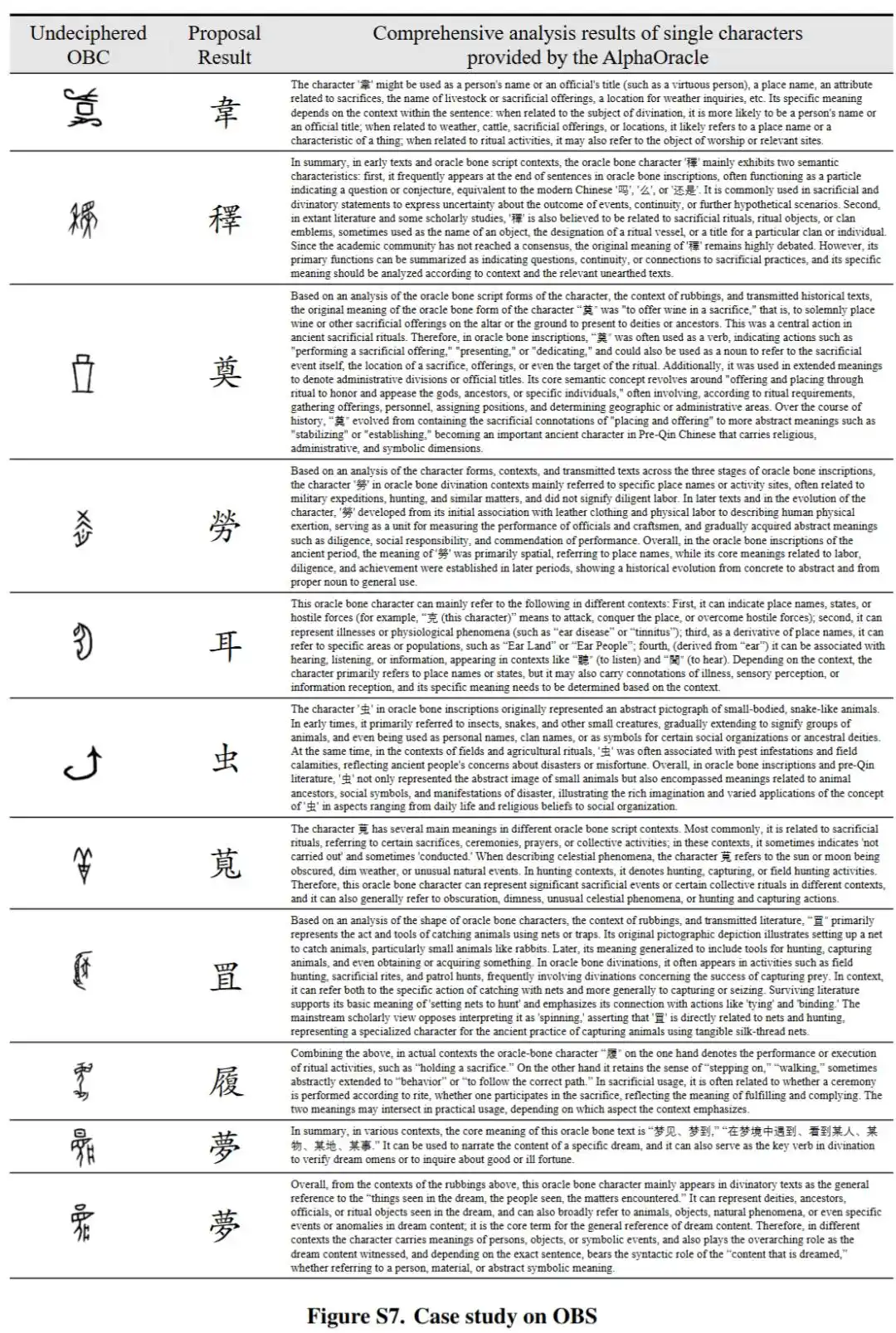
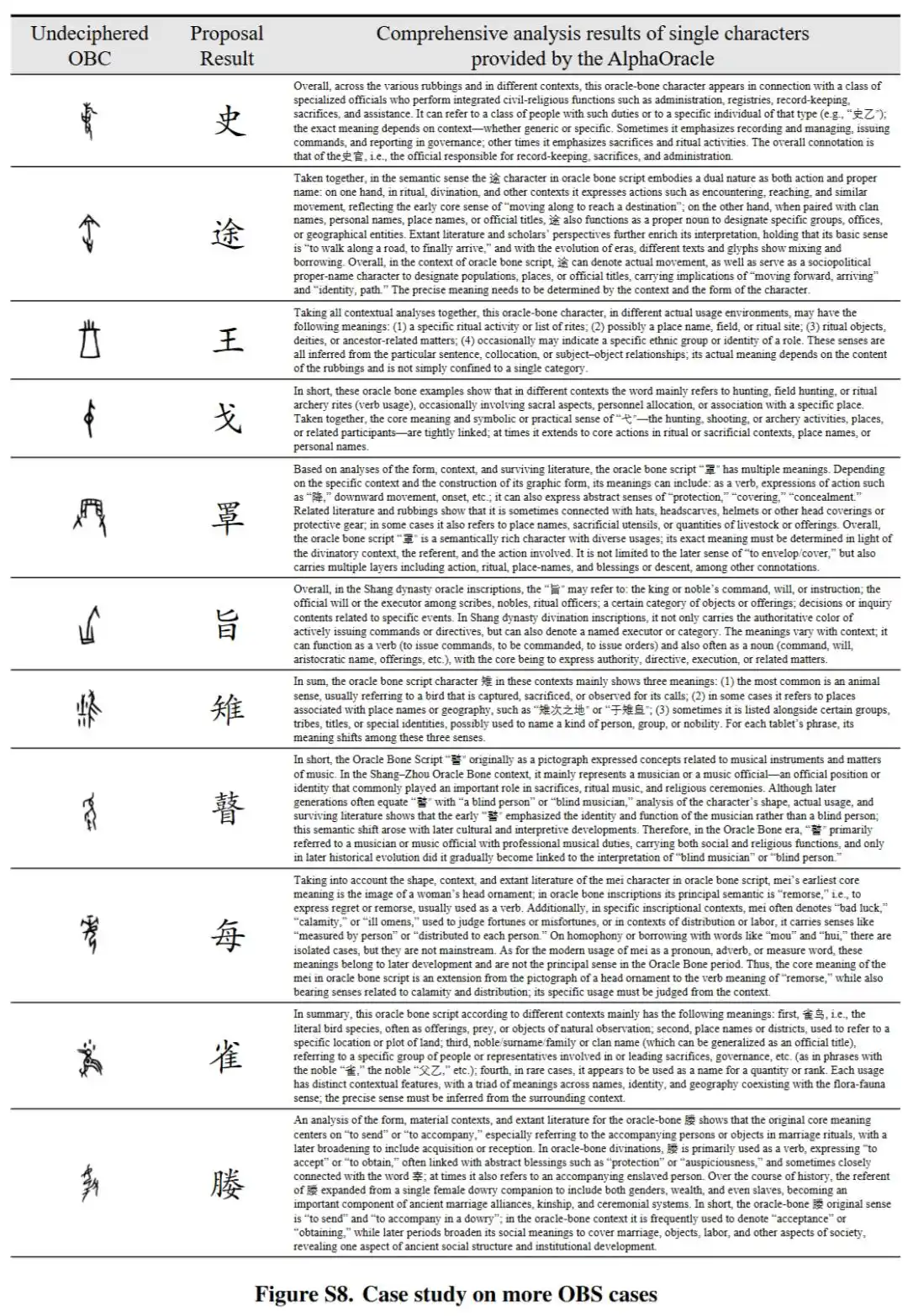
Additionally, the paper reports disambiguation results for 22 controversial variant characters. Some of these analyses have already been incorporated into authoritative oracle bone academic databases, demonstrating the potential of AI-assisted experts to efficiently investigate contested characters and advance academic discussion.
Conclusion
By mimicking the research methods of human experts, AlphaOracle places oracle bone character evolution, textual context distribution, and literature materials into the same evidence chain, helping researchers discover clues, locate literature, and verify materials, thereby improving the efficiency of oracle bone interpretation.
Simultaneously, it opens a path for computational paleography that is closer to real-world practice. Machines should not just provide an end-to-end, unsupported final answer but should instead offer reliable evidentiary assistance at each step of the researcher's workflow.
This approach can similarly extend to other ancient script domains, establishing more systematic AI-assisted methods for organizing and researching the scattered and voluminous field of ancient scripts.
Ancient script research ultimately cannot do without human judgment. Machines excel at rapidly proposing hypotheses, performing searches, conducting comparisons, and making inductions from massive materials, while scholars are responsible for weighing the significance of evidence and making the final decisions.
The more promising future lies precisely in this kind of collaborative research landscape: artificial intelligence expands the breadth of material search, while human scholarship safeguards the depth of academic judgment, allowing more historical information dormant in oracle bones and ancient scripts to be seen anew.
Reference: https://doi.org/10.1016/j.xinn.2026.101462
This article is from the WeChat public account "XinZhiYuan" (New Wisdom Source), author: ASI启示录; Editor: LRST