Tokenized markets reach $2.3B – Why utility matters more than TVL

ambcryptoPublished on 2026-07-19Last updated on 2026-07-19

Abstract

Tokenized financial markets have reached a $2.3 billion market capitalization, driven by growing institutional adoption of on-chain funds and equities. While Ethereum leads in custody value, holding 34% of the total, Solana processes the vast majority (95-97%) of tokenized equity trading. This highlights a key industry shift where execution and utility—measured by trading volume, transaction activity, and settlement efficiency—are becoming more critical than Total Value Locked (TVL) alone. Platforms like Arbitrum and Solana lead in holder growth, supported by established issuers such as Ondo Finance, underscoring that issuer reputation and robust liquidity channels are central to attracting institutional capital. The evolving landscape suggests blockchain networks will compete increasingly on real economic activity and capital efficiency.

Tokenized U.S. funds continue drawing institutional capital as regulated on-chain finance expands beyond early adoption. That pattern emerges because institutions still favor issuers with established liquidity and distribution channels.

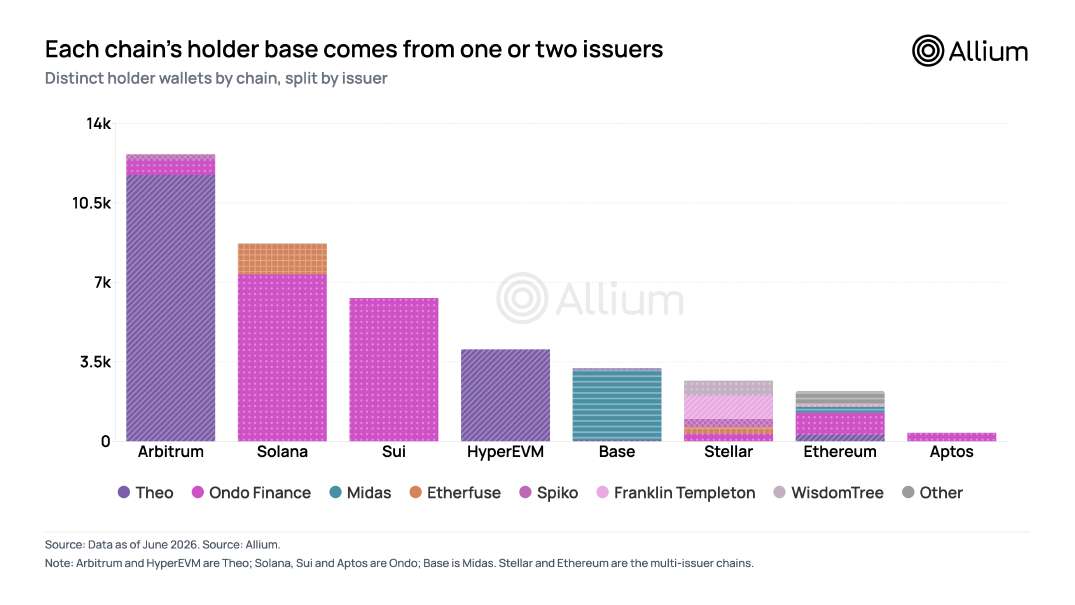
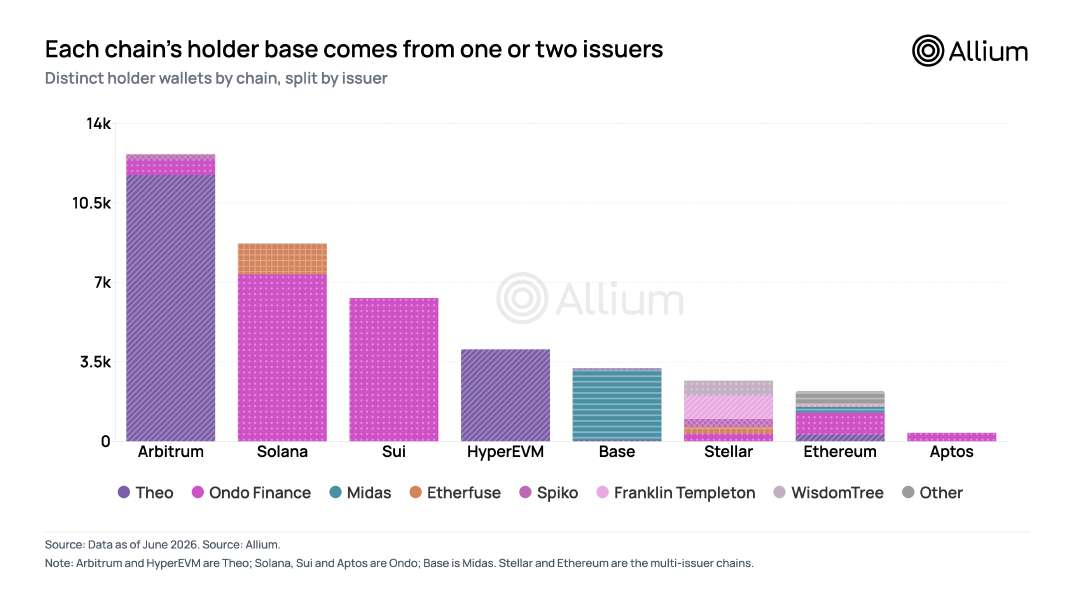
As a result of this preference, Arbitrum [ARB] leads with roughly 12,500 distinct holder wallets, largely through Theo. Solana [SOL] follows with about 8,200 wallets, supported mainly by Ondo Finance [ONDO] and Etherfuse.
Source: Allium

Meanwhile, Sui [SUI] approaches 6,000 holders, reinforcing Ondo’s growing cross-chain footprint. In addition, HyperEVM and Base add nearly 4,000 and 3,200 holders, further extending institutional reach.

Yet Ethereum [ETH] hosts only around 2,000 holders despite supporting several issuers. This suggests issuer reputation, rather than chain availability alone, is the key driver of liquidity, user growth, and future competition across tokenized fund markets.

Tokenized stocks redefine blockchain utility

Institutional momentum is no longer limited to tokenized funds. Market participants are also investing in equities, which have expanded their presence on various blockchain platforms.

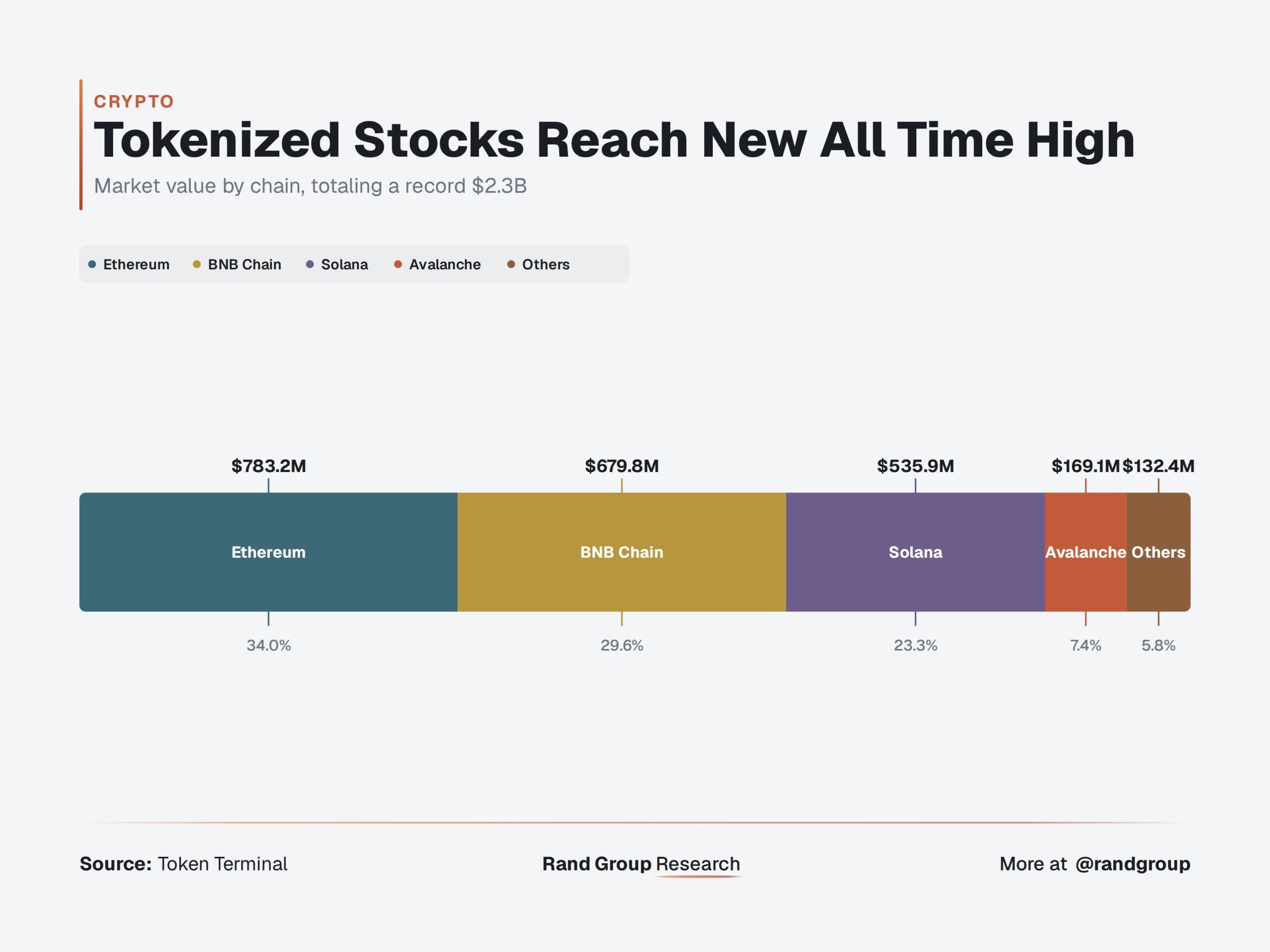
The industry has reached an all-time high of $2.3 billion in market capitalization, demonstrating increasing interest in on-chain financial products.

Ethereum leads with $783.2 million. This translates into 34% of total value, reflecting its role as the primary custody layer. BNB Chain follows with $679.8 million, while Solana holds $535.9 million. However, market value tells only part of the story.
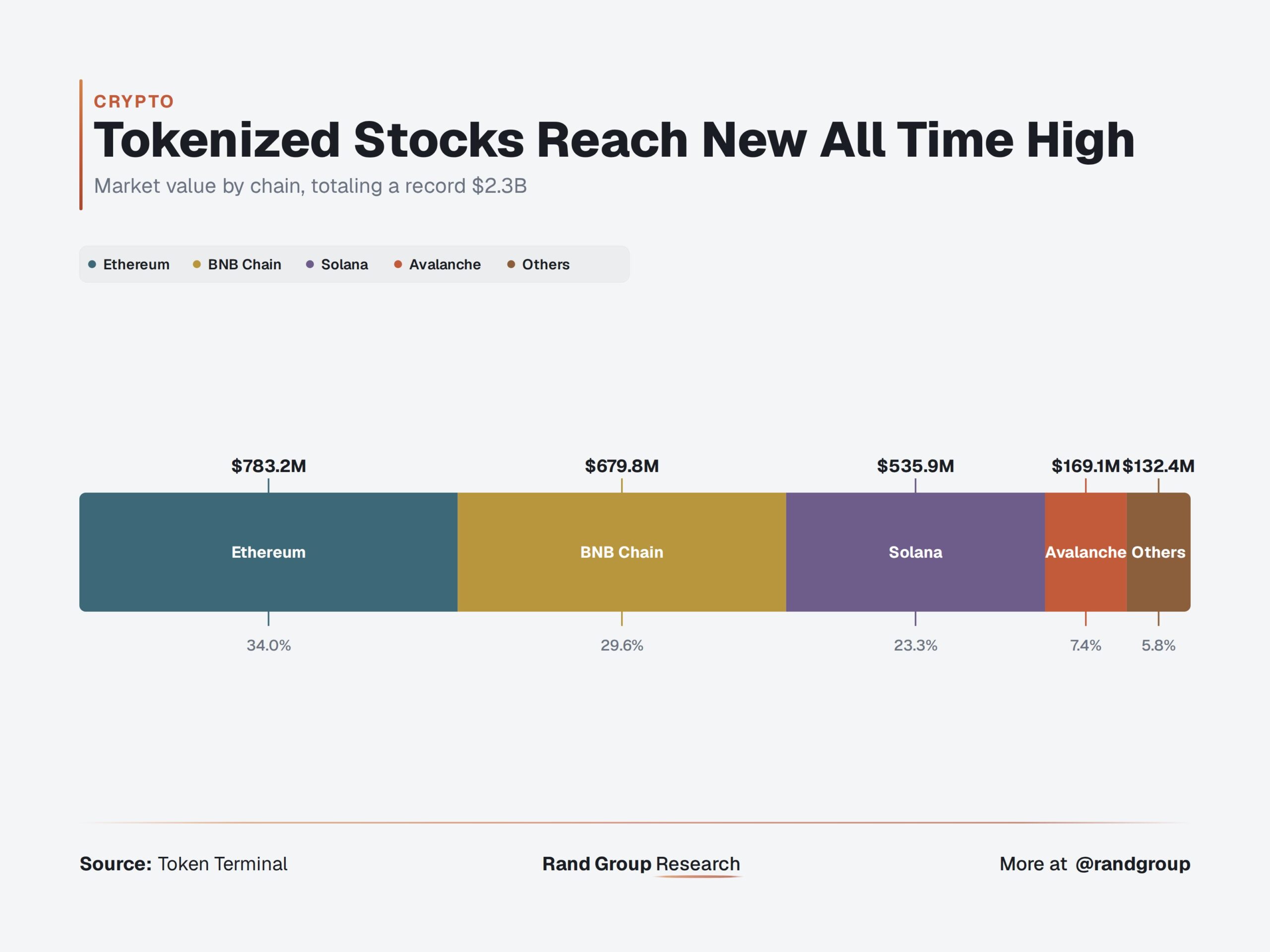
Source: X

Moreover, Solana processes roughly 95%–97% of tokenized equity trading. This indicates that execution is increasingly shifting away from where assets are stored.

This divergence implies that institutions are beginning to separate custody and trade functions, potentially redefining blockchain leadership by emphasizing liquidity, settlement efficiency, and user activity rather than value locked alone.

Utility emerges as blockchain’s competitive edge

That shift reflects an industry-wide change in how blockchain competitors attract institutional investment capital. Investors increasingly evaluate execution quality and real economic activity rather than prioritizing TVL alone.

DEX volume, transaction activity, and fee generation have now become the key measures of network utility, replacing passive liquidity as the primary benchmark. Institutional investors continue to favor platforms that deliver rapid settlement at low cost while maintaining regulatory‐compliant token architectures.

As tokenization expands, networks delivering stronger capital efficiency and operational resilience will likely attract greater liquidity, reinforcing utility as blockchain’s primary competitive advantage.


Final Summary

  • Tokenized U.S. funds and tokenized stocks are expanding, signaling stronger institutional adoption of on-chain financial assets.
  • Blockchain competitiveness is increasingly defined by execution quality, liquidity, and utility rather than TVL alone.


Related Questions

QWhat is the main reason cited in the article for why Arbitrum leads in holder wallets for tokenized funds?

AArbitrum leads because institutions favor issuers with established liquidity and distribution channels, with Theo being a major driver on the network.

QWhy does the article suggest Ethereum has a relatively low number of tokenized fund holders compared to other chains?

AIt suggests that issuer reputation, rather than chain availability alone, is the key driver. Despite supporting several issuers, Ethereum's lower holder count indicates reputation is more important for attracting users.

QAccording to the article, what portion of tokenized equity trading does Solana process, and what does this indicate?

ASolana processes roughly 95%–97% of tokenized equity trading. This indicates that execution is increasingly shifting away from where assets are stored, and institutions are beginning to separate custody and trade functions.

QWhat metrics have become the key measures of network utility, replacing passive liquidity (TVL)?

ADEX volume, transaction activity, and fee generation have become the key measures of network utility, replacing passive liquidity (TVL) as the primary benchmark.

QWhat does the article identify as blockchain's primary competitive advantage as tokenization expands?

AThe article identifies utility, driven by factors like capital efficiency and operational resilience, as blockchain's primary competitive advantage.

Related Reads

Who Decides Bitcoin's Rules? BIP-110 Ignites Governance Debate

Title: Who Decides Bitcoin's Rules? BIP-110 Ignites Governance Debate A new technical proposal, BIP-110 (Reduced Data Temporary Softfork), has sparked a fundamental governance debate within the Bitcoin community. It aims to impose new consensus rules for one year to limit non-financial data (like inscriptions and Runes) on-chain, moving beyond simple node and miner policy filters to invalidate currently valid transactions. Supporters argue that default policies have failed due to workarounds, necessitating consensus-layer changes to protect Bitcoin's core monetary function from data spam. Critics, including Michael Saylor and Adam Back, contend this dangerously centralizes judgment, undermines permissionlessness, and sets a risky governance precedent. They advocate for market-based solutions like fees or Layer 2s instead. The debate exposes deeper tensions: miners are divided on activation; node operators assert their sovereignty; Bitcoin Core developers influence defaults without direct accountability; and large corporate holders like MicroStrategy now wield narrative influence. Technically, BIP-110 may not fully block data and carries a disclosed consensus bug risk. Ultimately, BIP-110 acts as a stress test, forcing the community to confront the unresolved question: who legitimately decides what Bitcoin is and how it evolves, amidst competing claims from miners, nodes, developers, and capital holders.

链捕手5m ago

Who Decides Bitcoin's Rules? BIP-110 Ignites Governance Debate

链捕手5m ago

Zcash's New Node Zakura Goes Live: Privacy Payments Can Reach 50,000 TPS, Aiming to Rival Visa and Mastercard

Zcash, a privacy-focused cryptocurrency, has launched a new full node software called Zakura version 1.0.0. Developed by Zcash co-founder Sean Bowe and Dev Ojha, with private ZEC donations, its goal is to enable Zcash to process over 50,000 transactions per second (TPS)—matching the scale of Visa and Mastercard—while maintaining full transaction privacy and verifiability. This addresses a key bottleneck, as Zcash currently handles only about 1 private transaction per second. Zakura is a fork of the Zcash Foundation's Zebra node. It features chain pruning and snapshots, reducing disk usage and allowing new nodes to sync in under two minutes. It also offers compatibility with the legacy `zcashd` client interface. The scalability challenge stems from the large data size of privacy proofs. Bowe's Tachyon project aims to use recursive proofs to reduce consensus-layer data needs from ~500 MB/s to ~100 MB/s. For wallet scalability, Valar Group is researching Private Information Retrieval (PIR) tech to allow wallets to fetch their data privately. Zakura supports fast block propagation and the upcoming "Ironwood" network upgrade (NU6.3), scheduled for activation around July 28th. Ironwood was created to contain a critical inflation bug discovered in the Orchard shielded pool in May 2024. The fix uses "turnstiles" to trap any counterfeit ZEC created during the vulnerability period within the shielded pool, preventing it from entering circulation and restoring supply integrity.

marsbit20m ago

Zcash's New Node Zakura Goes Live: Privacy Payments Can Reach 50,000 TPS, Aiming to Rival Visa and Mastercard

marsbit20m ago

Replicating the "DeepSeek Moment"? Wall Street Unanimously Says: Kimi K3 Instead Strengthens Computing Power Demand

Title: Wall Street Sees Kimi K3 as a Catalyst for Compute Demand, Not a "DeepSeek Moment 2.0" Summary: Following the release of Moonshot AI's powerful open-source model Kimi K3, initial market reaction mirrored the "DeepSeek moment" that sparked a sell-off in compute stocks earlier in 2025, fearing reduced demand for AI infrastructure. However, major Wall Street banks including UBS, Nomura, BofA, and Citi argue the opposite: K3 will accelerate, not weaken, demand for compute, memory, storage, and networking. Their analysis centers on K3's specifications—2.8 trillion parameters, 1M token context, and MoE architecture—which represent a "scale" story rather than a pure "efficiency" one like DeepSeek R1. These features increase pressure on inference, memory (especially KV cache), and storage. Analysts invoke Jevons Paradox: as high-quality models become more affordable (K3 is cheaper than top closed models but not the cheapest), usage and token volumes expand, ultimately increasing total compute consumption. The reports highlight that competition will force leading US AI labs (OpenAI, Anthropic, Google) to invest more in training and iteration to maintain their edge. Furthermore, the rise of capable open-source models like K3 is expanding the global AI developer ecosystem, with Chinese models now accounting for over 45% of developer traffic. Key beneficiaries identified across the AI infrastructure chain include memory/storage players (e.g., Micron, Samsung), compute leaders (Nvidia, TSMC), networking suppliers (due to "super-node" cluster needs for deploying K3), and cloud platforms (e.g., Alibaba) that host diverse model ecosystems. The consensus is that stronger open-source models are an entry point for the next wave of infrastructure demand diffusion, provided workload growth outpaces efficiency gains.

链捕手23m ago

Replicating the "DeepSeek Moment"? Wall Street Unanimously Says: Kimi K3 Instead Strengthens Computing Power Demand

链捕手23m ago

Prediction Markets Witness $200 Million in Suspicious Insider Trading Over Six Months, Who's Reaping the Profits?

Prediction markets are booming, with monthly trading volume exceeding $210 billion as of 2026. However, a Bloomberg investigation analyzing data from August 2025 to June 2026 reveals a parallel surge in suspicious trading, totaling roughly $200 million in the first half of 2026 on Polymarket alone. These potentially illicit trades are concentrated in geopolitical and military events, with 57% of the highest-earning wallets created less than 24 hours before trading. The analysis, using AI-driven platform Polysights, found profits are highly concentrated: the top 1% of wallets captured over half the gains. A significant portion (71%) of funds for marked trades originated from U.S.-regulated crypto exchanges, despite Polymarket's ban on U.S. users. Traders are increasingly using coordinated clusters of wallets and focusing on smaller markets to avoid detection. Two major criminal cases highlight the risks: a U.S. Army sergeant was charged for using classified information on a Venezuela operation to profit nearly $410,000, and an Israeli reservist allegedly leaked details of an Iran strike for a $128,400 gain. Regulatory scrutiny is intensifying. The CFTC is investigating Polymarket, congressional bills aim to ban insiders from trading, and major firms like Goldman Sachs have restricted employee participation. In response, Polymarket has updated its rules against insider trading and provided wallet data to authorities. The core challenge remains distinguishing between skilled research and trading on non-public information in a market designed to price such knowledge.

Foresight News33m ago

Prediction Markets Witness $200 Million in Suspicious Insider Trading Over Six Months, Who's Reaping the Profits?

Foresight News33m ago

Trading

Spot
活动图片