Written by: ChandlerZ, Foresight News
The scale of prediction markets is rapidly expanding. According to data from TRM Labs, monthly trading volume in prediction markets surpassed $21 billion in 2026. Within Polymarket's geopolitical category alone, cumulative trading volume exceeded $5 billion from the beginning of the year to mid-June, with contracts related to Iran accounting for over $2 billion.
However, growing in tandem with the scale is the phenomenon of profiting by betting using non-public information. On July 21st, Bloomberg Businessweek published an extensive data investigation, analyzing approximately 34,000 suspicious transactions flagged by the on-chain monitoring platform Polysights between August 2025 and June 2026. The core finding is that in the first half of 2026, the total value of transactions flagged as suspicious on Polymarket was around $200 million.
Furthermore, the analysis reveals that profits from transactions flagged as potential insider trading on the Polymarket platform are highly concentrated. The top 1% of profitable wallets captured over half of the total profits. Notably, 57% of these highly profitable wallets were created less than 24 hours before the flagged transaction occurred. Recently, one account, using a wallet created just two hours before its first trade, placed a bet on the market option "Will a permanent U.S.-Iran peace agreement be reached by June 15?" at odds as low as 6%, profiting $370,000.
What Did Bloomberg's Investigation Find
Bloomberg was able to conduct this analysis because all of Polymarket's transactions run on the Polygon blockchain, making every bet, odds movement, and wallet fund flow publicly traceable. In contrast, Kalshi, as a CFTC-regulated centralized platform, does not make its transaction data public. This makes Polymarket an ideal sample for studying insider trading in prediction markets.
The data provider, Polysights, is an AI-driven on-chain analysis platform that has received investment support from Polymarket, Predict.fun, and Underdog Fantasy, completing a $1.5 million funding round in June. The platform calculates an eight-dimensional score for each transaction, including: bet size, time between account creation and event occurrence, odds level at entry, concentration of trading volume in specific markets, profit rate, etc. Transactions with a composite score exceeding a threshold are flagged as suspicious.
Based on Polysights' data, Bloomberg conducted further cross-analysis, revealing several key patterns.
Suspicious trading is concentrated in geopolitical and military categories. Markets related to Iranian airstrikes and ceasefires contributed approximately $45 million in suspicious trading volume, the highest among all categories. Iranian-related betting peaked in late February (around the time of the U.S.-Israel joint airstrike on Iran). The single contract "When will the US strike Iran?" alone attracted over $529 million in trading volume.
Profits are highly concentrated among a tiny fraction of wallets. Among flagged suspicious transactions, the top 1% of profitable wallets captured over half of the profits. Among these highly profitable wallets, 57% were created within 24 hours of the transaction, pointing to a typical "use-and-discard" pattern: create a new wallet, place bets, profit, disappear.
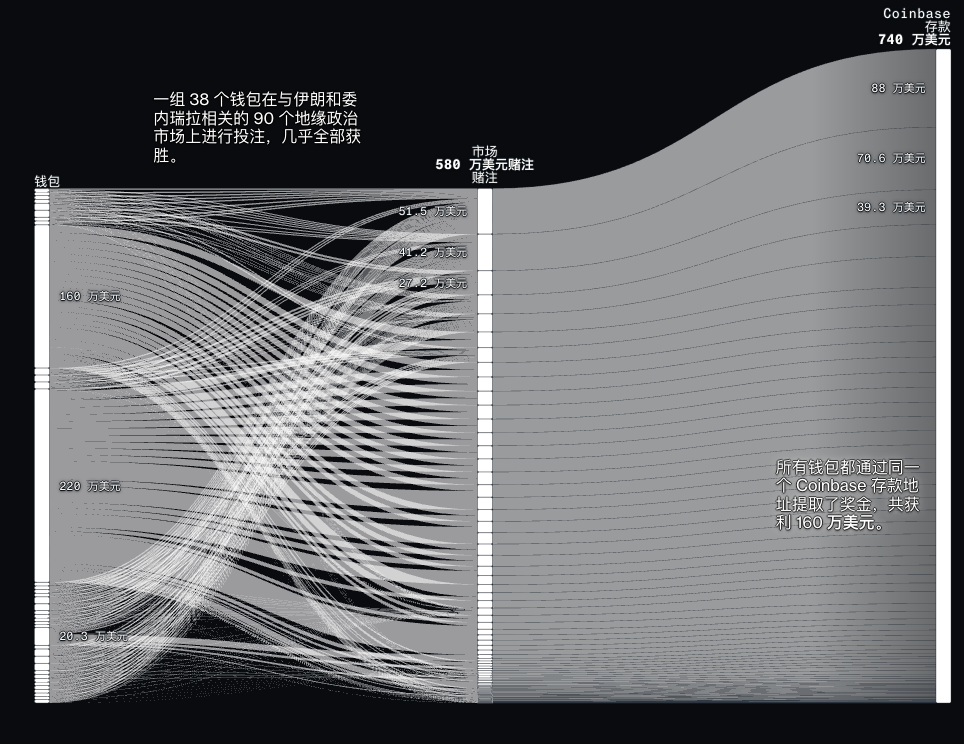
Fund sources point to the United States. Among flagged transactions, a high proportion of 71% were funded via U.S.-regulated crypto exchanges. This proportion reached 70% in Iran-related geopolitical markets, nearly three times higher than in non-flagged transactions. Polymarket nominally prohibits U.S. users, but individuals can circumvent restrictions using VPNs. Since January 2021, roughly half of Polymarket's approximately $21 billion in traceable trading volume originated from wallets funded by U.S.-regulated exchanges.
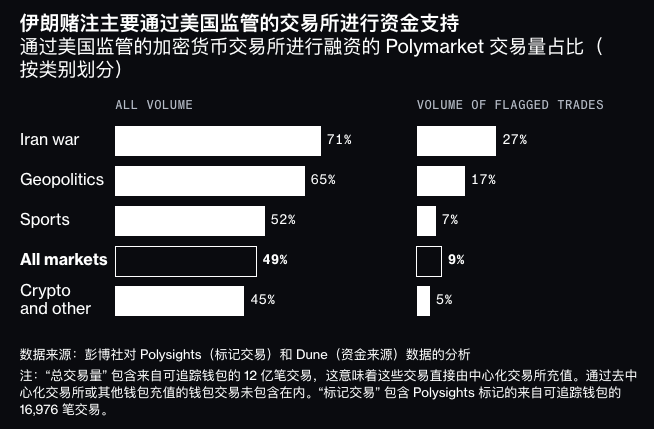
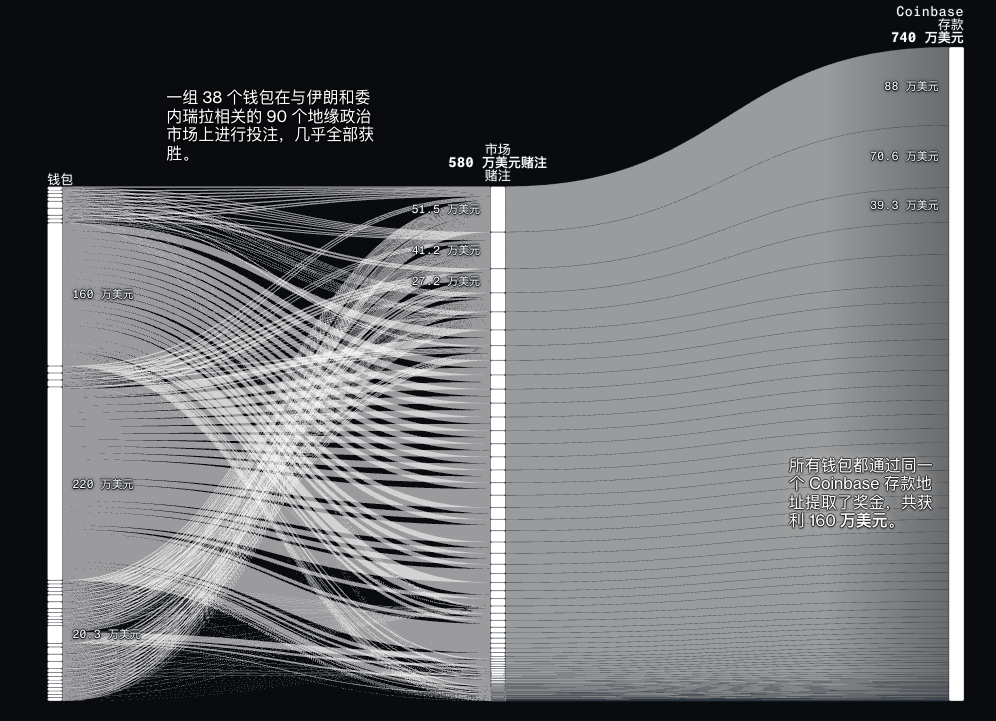
The report noted that some large trades that appear to be from insiders are easily detected by firms and other entities tracking suspicious activity, but their trading strategies often involve making numerous small bets. They increasingly use coordinated wallet clusters, focusing on markets with lower trading and capital volume. In these markets, their trades can still be profitable but are less likely to attract attention. For example, 38 linked addresses bet on Trump's actions regarding Iran and Venezuela with a win rate as high as 98%, ultimately profiting $1.6 million. All addresses withdrew funds through the same Coinbase deposit account.
Following the publication of the Bloomberg report, Car, a well-known analyst within the Polymarket community, wrote a rebuttal. He pointed out that Polysights flagged over 34,000 wallets as "possible insider traders," including ordinary users who bet on Argentina winning the World Cup. Car tracked one wallet prominently mentioned in the Bloomberg report and found its actual profit to be in the hundreds of thousands of dollars, lower than the $1.5 million claimed by Bloomberg. He argued that the wallet's trading history—consistently placing large bets in election and sports markets over time—aligns more with the profile of an experienced high-frequency trader rather than an insider trader.
This controversy highlights the core difficulty of detecting insider trading in prediction markets: in a market that incentivizes pricing information advantages, how does one distinguish between good research and knowing the answer in advance? Polysights' algorithm cannot answer this question; it can only flag statistical outliers, leaving the final judgment to human discretion.
Dozens of Interconnected Wallets Profit $1.6 Million on U.S. Military Bets
Bloomberg's report stated that some large trades that appear to be from insiders are easily detected by firms and other entities tracking suspicious activity, but their trading strategies often involve making numerous small bets. They increasingly use coordinated wallet clusters, focusing on markets with lower trading and capital volume. In these markets, their trades can still be profitable but are less likely to attract attention. For example, 38 linked addresses bet on Trump's actions regarding Iran and Venezuela with a win rate as high as 98%, ultimately profiting $1.6 million. All addresses withdrew funds through the same Coinbase deposit account.
So far in 2026, the prediction market sector has produced the first two criminal insider trading charges in U.S. history.
The first case involved a U.S. military special forces soldier betting on Venezuela operations. On April 23rd, the U.S. Department of Justice and the CFTC filed criminal charges against U.S. Army Special Forces Sergeant Major Gannon Ken Van Dyke. Van Dyke participated in the planning and execution of Operation Absolute Resolve, the operation to arrest former Venezuelan President Nicolás Maduro on January 3rd. He used confidential information obtained during the operation to place approximately $34,000 in bets on Polymarket, ultimately profiting about $409,900. Afterwards, Van Dyke requested Polymarket to delete his account and changed the registered email for his crypto exchange to hide his identity. He faces multiple charges, including illegal use of confidential government information for profit, theft of non-public government information, commodities fraud, and wire fraud.
The second case involved an Israeli reservist officer leaking information to bet on Iran operations. Israeli authorities arrested two individuals: 30-year-old iGaming industry professional Omer Ziv, and an Israeli Air Force reservist major whose name was not disclosed for national security reasons. The indictment alleges that after learning about the impending Operation Rising Lion against Iranian nuclear facilities, the major informed Omer Ziv of the intelligence via WhatsApp. Omer Ziv then built positions on Polymarket, ultimately profiting approximately $128,400, and shared the profits in cryptocurrency with the officer. Both have been detained since late January, with Omer Ziv's identity made public in March.
The common feature of these two cases is that the individuals involved had access to confidential information about imminent military operations, and prediction markets provided a direct avenue to monetize that information.
A broader quantitative analysis was provided in a March paper titled "From Iran to Taylor Swift: Informed Trading in Prediction Markets" by Columbia Law School professor Joshua Mitts and University of Haifa professor Moran Ofir. The research identified over 210,000 suspicious transactions that have generated approximately $143 million in abnormal profits for "informed traders" since 2024.
The study employed a five-dimensional composite scoring system: cross-market bet size, single-trader bet size, profit rate, pre-event time window, and directional concentration. Traders flagged by this system achieved a win rate of 69.9%, deviating from random probability by over 60 standard deviations.
Prior to the U.S. and Israeli airstrike on Iran on February 28th, six newly created wallets collectively earned about $1.2 million on Polymarket. One of these wallets executed its first trade 71 minutes before the news became public, with that single wallet profiting approximately $553,000.
Regulatory and Industry Reactions
Regulatory responses to insider trading in prediction markets are advancing on multiple fronts simultaneously.
At the federal enforcement level, the CFTC has launched a broad investigation into Polymarket. In January, Representative Ritchie Torres introduced the Public Integrity Financial Prediction Markets Act, which would prohibit anyone with access to significant non-public government information from trading on prediction markets. The bill has garnered co-sponsorship from over 40 Democratic lawmakers. In late April, the Senate unanimously passed a resolution banning senators and congressional staff from participating in prediction markets. In May, House Oversight Committee Chairman James Comer initiated a congressional investigation specifically targeting insider trading in prediction markets.
At the financial institution level, Goldman Sachs updated its internal trading policy in July, prohibiting employees from participating in prediction market contracts related to politics and finance, while retaining exemptions only for sports and entertainment contracts.
At the state government level, pressure is also mounting on Kalshi. A Washington state judge issued a preliminary injunction against Kalshi, ruling that it constitutes illegal gambling. Prosecutors in Arizona have also filed criminal charges against Kalshi, accusing it of operating a gambling service without a license.
At the platform level, Polymarket updated its Market Integrity Rules in March, explicitly prohibiting trading based on confidential information obtained in breach of a fiduciary duty, acting on tips from insiders, and betting on events where one has the ability to influence the outcome. The platform stated it has provided leads on nearly 100 wallets to law enforcement agencies, with some leads directly contributing to the prosecution of the two aforementioned criminal cases.