Original author: Jia Liu
Could copper become another kind of gold in this era?
In the past two years, the market understood AI infrastructure as a story about chips. NVIDIA's GPUs, TSMC's capacity, HBM's yield, CoWoS packaging bottlenecks—almost all discussions revolved around silicon. But an AI data center isn't something you can just run by plugging in a GPU after buying it. It also requires grid connection, transformers, busways, cables, liquid cooling systems, fiber optic interconnects, and a lot of metal.
In the previous article 'The Moment of 'Great Famine' for Fiber Optics and Copper in the AI Era', we briefly discussed one thing: AI demand is trickling down from chips to fiber optics and copper.
This article will delve deeper into the evolving narrative around copper this year. Why is the market starting to see copper more like gold? Why are macro funds starting to buy copper? Why are mining companies and commodity traders all saying 'there isn't enough copper'? Why is it no longer just that industrial metal used to gauge economic cycles?
Dr. Copper is No Longer Just a Reflection of the Manufacturing Cycle
In the English financial markets, there's an old saying called 'Dr. Copper', sometimes translated as 'Copper Doctor' in Chinese financial media. The name means that copper prices act like an economic doctor, able to diagnose the health of the global economy in advance.
Because copper prices are inseparable from manufacturing. When Chinese real estate starts new projects, manufacturing replenishes inventories, and demand for appliances, cars, cables, and pipes picks up, copper prices rise. When the cycle turns down, copper follows. Essentially, copper prices are a reflection of the cycles in Chinese real estate, global manufacturing, and trade.
But now copper demand has new influencing variables: AI data centers, grid expansion, new energy vehicles, energy storage, military-industrial sectors, and reindustrialization are all adding to the structural demand for copper.
Wherever electricity is used, you can't do without copper.
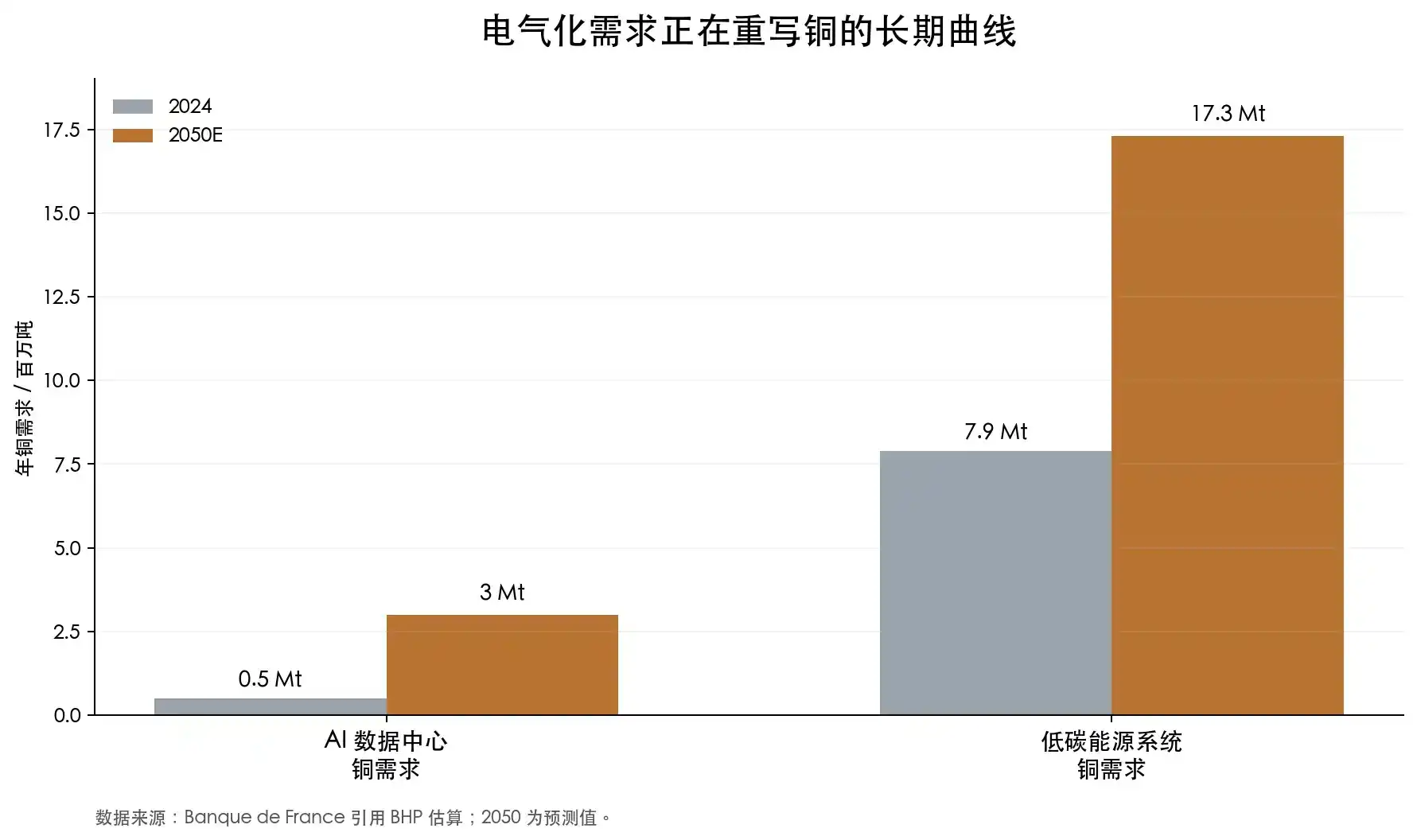
In an analysis of AI data centers and the copper market, the French central bank, Banque de France, cited BHP estimates: Copper demand from AI data centers could grow from about 500,000 tonnes in 2024 to about 3 million tonnes by 2050. Over the same period, copper demand for low-carbon energy systems could rise from 7.9 million tonnes to 17.3 million tonnes. The article also cited a specific case: the construction of Microsoft's Chicago data center consumed 2,177 tonnes of copper.
Looking at this number alone, it's not particularly large in the global copper market. But the point is not how much copper one data center uses, but that behind AI data centers lies not just point demand, but a complete set of power infrastructure needs. The denser the GPUs and the higher the power per rack, the more a data center resembles a high-energy-consumption factory. Factories need electricity, and using electricity requires power grids, transformers, cables, busways, switchgear, and cooling systems.
Of course, not all of copper's story can be simplistically attributed to AI.
Richard Holtum, CEO of the global commodity trading giant Trafigura, reminded everyone at LME Week in 2025 that while data centers and defense are indeed hot topics, the bulk of copper demand over the next decade will still come from traditional infrastructure, construction, urbanization, and consumer goods. He also mentioned that copper use in air conditioning units still exceeds that in data centers.
This perspective gives us a new angle: the increase in copper demand is not solely supported by AI; its demand growth lies in the simultaneous expansion of almost all electricity-using scenarios.
Copper's Biggest Bullish Logic: It Can't Be Mined Fast Enough
Many people's first impression of copper is as an 'industrial metal', always thinking that once the price rises, mines will dig more, and supply will naturally increase. But the reality is not like that.
Large copper mines typically take over a decade from discovery, exploration, resource confirmation, feasibility study, financing, permitting, construction to production. A report by the IEA shows that new copper projects take an average of about 17 years from discovery to production. This means that if the market suddenly realizes in 2026 that there isn't enough copper, truly large-scale new supply might not appear in 2028 or 2029; much of it will have to wait until the 2030s.
Robert Friedland, founder and executive co-chairman of the Canadian mining company Ivanhoe Mines, repeatedly emphasizes this problem. He is one of the most famous copper bulls in the global mining circle, owning the world-class Kamoa-Kakula copper project in the Democratic Republic of Congo. His expressions are always very aggressive: the world hasn't yet realized how much copper it actually needs. Over the past decade or more, the world hasn't prepared enough new copper mines for the electrification era.
This is not just his judgment. IEA data also supports this direction.
The average grade of global copper mines has fallen by about 40% since 1991. A decline in grade means that more ore must be mined, consuming more electricity, more water, and processing more waste rock to obtain the same tonne of copper as before. The IEA also mentioned that among the copper deposits discovered in the past 35 years, only 5% have been found in the last decade. Few new discoveries, declining grades in old mines, lengthening project construction periods, and rising capital expenditures. The IEA estimates that based on the current project pipeline, the copper market could face a supply gap of 30% by 2035.
So, copper is not an asset like those in ordinary commodity cycles where 'supply immediately appears after price increases'. Copper mining projects are increasingly resembling large-scale infrastructure projects: finding the ore, obtaining permits, handling community relations, solving water resource issues, facing environmental reviews, and withstanding changes in tax policies in resource-rich countries.
Chile, Peru, the Democratic Republic of Congo, Zambia, Indonesia, Mongolia—these places all have important copper resources, and they all have different forms of political, tax, community, or operational risks. The more strategic copper becomes, the more motivated resource-rich countries are to increase their share; the higher the copper price, the more likely mining companies are to face tax increases and renegotiations.
Tension is also emerging on the smelting side.
After copper concentrate enters a smelter, it is processed into refined copper. The processing and refining fees that smelters charge mines are called TC/RC in the industry—treatment charge and refining charge. Normally, when concentrate supply is ample, smelters have stronger bargaining power and TC/RC is higher; when concentrate is tight and smelters compete for raw materials, TC/RC falls.
A rather anomalous point in 2026 is that while copper prices hit new highs, smelting processing fees have fallen to historical lows. The IEA stated that the 2026 annual TC/RC benchmark fell to $0 per tonne, and spot TC/RC has been negative since 2024.
This is more critical than simply looking at exchange inventories. Because the bottleneck for copper is not only in refined copper products but also in mines and concentrate. If upstream raw materials are tight, having more smelters is useless. China has significantly expanded its copper smelting capacity over the past two decades. The IEA notes that China accounted for over 90% of global copper smelting production growth since 2005 and will account for about half of global copper smelting production by 2025. Strong midstream capacity coupled with tight upstream mines amplifies the vulnerability of the supply chain.
Gold's scarcity comes from reserves, mining costs, and monetary attributes. Copper is, of course, not gold. But as its new supply becomes increasingly slow, resources become more concentrated, and its strategic attributes strengthen, it is also beginning to possess a kind of scarcity sensation similar to gold's.
Why Macro Funds Are Starting to Like Copper
Copper used to belong mainly to commodity traders and mining analysts. Now, it is increasingly attracting macro funds.
Take Stanley Druckenmiller, for example. He is one of the most well-known macro investors in the US, having co-managed the Quantum Fund with George Soros and later founding Duquesne Family Office. His characteristic is betting on major cycles with large positions in high-conviction trades, so the market pays close attention to his views on AI, the US dollar, bonds, and commodities.
Recently, in an interview with Morgan Stanley, he mentioned that his portfolio had been primarily driven by AI over the past few years but has now shifted to a more macro and geopolitical positioning. He mentioned holding copper, being bearish on the US dollar, and holding gold as a geopolitical hedge.
His logic is: If the US dollar weakens, dollar-denominated commodities will benefit. Expanding fiscal deficits, continued government spending, rising geopolitical risks drive buying in gold; in the same environment, grid expansion, military-industrial sectors, AI data centers, energy systems, and manufacturing reshoring will also create demand for physical assets, and copper sits at the intersection of these trends.
Druckenmiller represents the perspective of macro funds. There are even more aggressive expressions within the commodity trading circle.
Pierre Andurand is one of the most typical examples. He is a well-known European commodity hedge fund manager, starting in energy trading, co-founding BlueGold Capital, and later founding Andurand Capital. In an interview with the Financial Times, he gave a very aggressive prediction: Copper prices could surge to $40,000 per tonne in the coming years.
Jeff Currie's views are also worth mentioning. Jeff Currie, the long-time head of Goldman Sachs' commodity research who later joined Carlyle, is one of the most influential figures in Wall Street commodity research. He proposed the saying 'copper is the new oil' long ago, meaning that in the energy transition era, copper might play the foundational resource role that oil did in the old energy era. In 2024, he again called copper one of his highest-conviction trades.
Data also shows that money is flowing in.
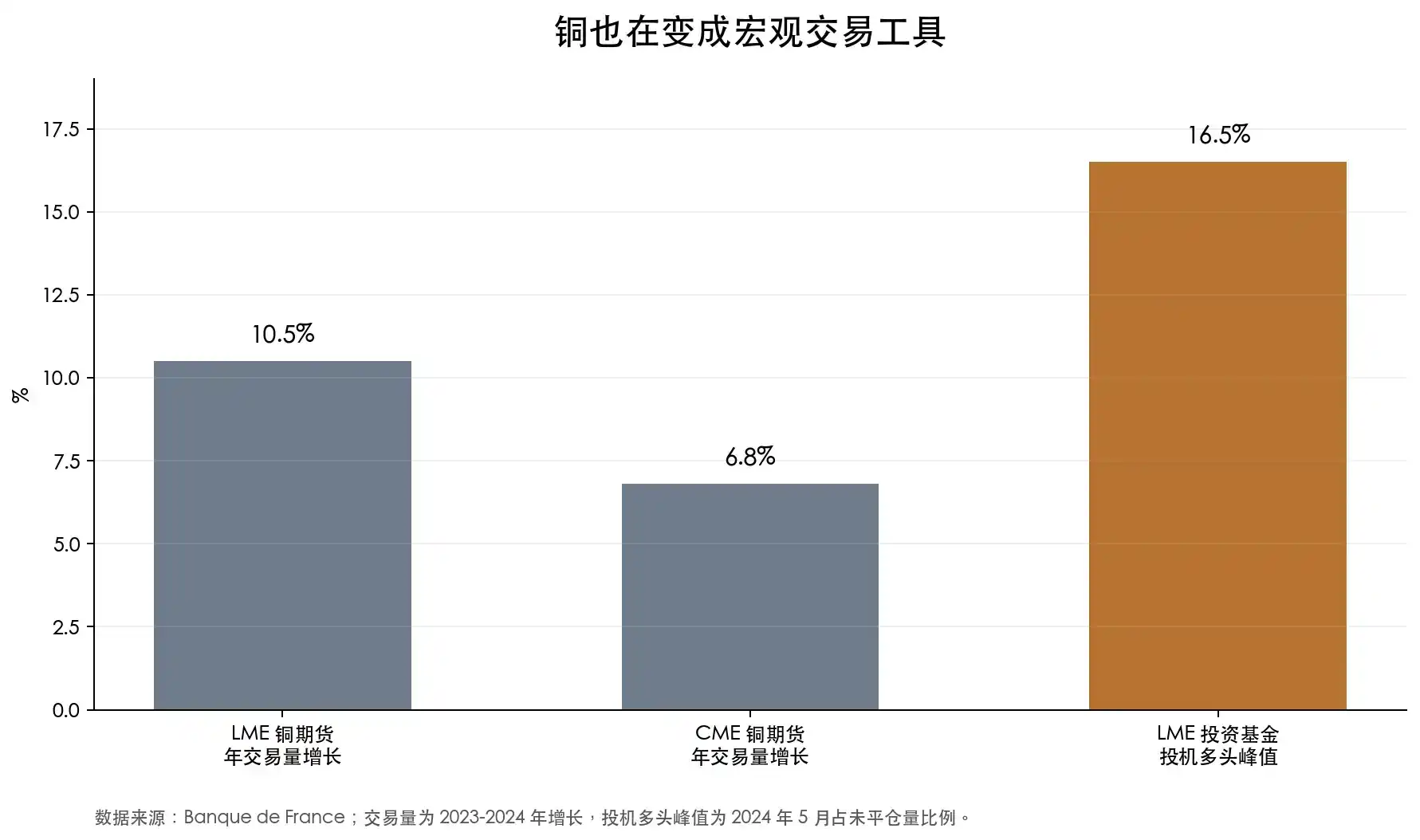
Banque de France mentioned that from 2023 to 2024, LME copper futures annual trading volume grew by 10.5%, and CME copper futures annual trading volume grew by 6.8%; among LME copper futures, speculative net long positions held by investment funds reached 16.5% of open interest in May 2024. This isn't simple physical restocking; it's financial capital treating copper as a macro trading tool.
Copper Mining Stocks: The Leverage of Copper
In a gold bull market, gold stocks typically amplify gold price fluctuations. In a copper bull market, copper mining stocks also have similar amplifier properties.
A rise in copper prices creates cost pressure for end-users, but for mining companies with existing capacity, it can mean margin expansion. For example, if copper rises from $9,000 to $12,000 per tonne, and the miner's cash costs haven't risen proportionally, a large part of that additional $3,000 flows directly into the profit statement. Precisely because of this, copper mining stocks inherently carry operating leverage. A certain copper price increase can lead to a larger profit increase for miners; when copper prices fall, profits contract faster.
The market has already been trading this leverage over the past two years.
Taking A-shares as an example, from June 2024 to June 2026, China Molybdenum (洛阳钼业) is the most typical high-beta sample. Its core appeal lies in its copper-cobalt assets in the Democratic Republic of Congo, especially Tenke Fungurume and KFM. Calculating roughly based on adjusted closing prices, China Molybdenum's price rose about 129% over this two-year period, with peak gains nearing 260%. This isn't the performance of an ordinary cyclical stock; it's the market repricing overseas copper resources.
Companies like Jiangxi Copper (江西铜业), Tongling Nonferrous Metals (铜陵有色), and Yunnan Copper (云南铜业) better reflect the combined volatility of copper prices and smelting attributes. Jiangxi Copper's price rose about 82% over the period, with peak gains exceeding 200%; Tongling Nonferrous Metals rose about 77%, with peak gains around 159%; Yunnan Copper's price rose only about 29%, but peak gains also exceeded 130%.
These stocks all demonstrate another aspect of copper mining stocks: when the rally comes, the elasticity is great; when the tide recedes, the drawdown is also severe.
Looking at drawdowns from peaks makes the volatility more intuitive. Yunnan Copper drew down about 45% from its period high, Jiangxi Copper drew down about 41%, and China Molybdenum, Northern Copper (北方铜业), and Zijin Mining (紫金矿业) also experienced drawdowns exceeding 30%. Copper mining stocks are not the copper price itself; they are the result of the combined effects of copper prices, costs, inventory, TC/RC, project progress, resource country risks, and equity market sentiment.
In US stocks, the most typical copper mining stock representative is Freeport-McMoRan, ticker FCX. It is one of the core US copper producers, with assets including Morenci in the US, Cerro Verde in Peru, and Grasberg in Indonesia. For global capital, FCX is almost one of the most commonly used US stock tools to gain copper price exposure. MarketWatch data shows FCX touched a 52-week high of $72.09 on June 2, 2026, but fell 9.07% on June 5 alone, pulling back over 12% from the high within days.
Southern Copper, ticker SCCO, is another high-quality copper mining stock representative. Its assets are primarily in Peru and Mexico, with high copper exposure and strong profitability. IBD mentioned earlier this year that SCCO was once up 55% year-to-date and hit a record high. Compared to FCX, SCCO resembles a purer, higher-quality copper mining asset, but it similarly cannot escape copper price and resource country risks.
If investors don't want to bet on a single company, they can also look at copper mining ETFs. For example, the Global X Copper Miners ETF, which tracks global copper mining companies.
However, copper mining stocks are much more complex than copper.
A mining company's value depends not only on the copper price but also on ore grade, cash costs, reserve life, capital expenditures, host country, tax policies, labor relations, environmental permits, transportation conditions, and management execution. Copper prices can lift the valuation of the entire sector, but ultimately, there will be significant divergence between companies.
Resource country risk is particularly important. Many high-quality copper mines are located in Chile, Peru, the Democratic Republic of Congo, Zambia, Mongolia, and Indonesia. Good resource endowment does not guarantee stable shareholder returns. The more valuable copper becomes, the more likely governments are to recalculate their share; the larger the project, the more difficult issues like community relations, environmental protection, water use, and infrastructure become to handle.
Cost inflation can also eat into profits. When copper prices rise, energy, equipment, labor, steel, and financing costs often rise together. A development project that looks beautiful on paper might end up leaving little profit for shareholders due to capital expenditure overruns, production delays, permit obstacles, etc.
Early-stage copper mining companies carry higher risk. Their story is about future reserves and future production, but each step from resource to proven reserves, from feasibility study to financing, from permits to construction, can fail. The long-term logic for copper being valid does not mean every copper mining stock will deliver.
Therefore, copper mining stocks are better understood as a leveraged expression of the copper price thesis, rather than a simple substitute for the copper price itself. They can provide higher elasticity but also bring greater drawdowns. What's truly worth studying are companies with low costs, long mine life, clear expansion paths, robust balance sheets, and controllable political risks.
This is also part of copper's 'goldification': the scarcity logic of copper isn't confined to spot and futures markets; it's being repackaged by stock markets, ETFs, and speculative capital. Rising copper prices represent one layer of the trade; rising copper mining stocks represent another layer. The former reflects the commodity itself, while the latter reflects how much imagination the market is willing to pay for this long-term shortage.
The 'Goldification' of Copper Has Only Just Begun
This world needs more electricity, and more electricity means more copper.
Of course, copper won't actually turn into gold. It doesn't have the pure monetary attributes of gold, nor will it shake off economic cycles. A global economic slowdown, weakening manufacturing, or a cooling of risk assets will all suppress copper prices. Copper will still fluctuate, possibly even violently.
But the change lies in the underlying logic, which is different from the past.
In the past, major copper price declines often occurred when demand weakened combined with oversupply. Today's supply side isn't that loose. Aging mines, declining grades, lengthening permitting cycles, smelters scrambling for raw materials, resource countries redistributing benefits—these factors make copper increasingly difficult to be simply treated as an ordinary cyclical commodity.
It may still be an industrial metal, but it is no longer just a reflection of the industrial cycle.
The 'goldification' of copper has only just begun.