Claude's Watermark Has Been Cracked, Gaining 11k Stars, But Installation Is Refused

marsbitPublished on 2026-08-17Last updated on 2026-08-17

Abstract

The article discusses the controversy surrounding Anthropic's implementation of a hidden watermark in all text generated by its AI, Claude. This policy, based on Google DeepMind's SynthID-Text technique, embeds a statistical signature by making inconsequential word choices. The watermark applies globally, even to human-written text lightly edited by Claude, sparking user backlash over issues of ownership and the creation of an "AI content second-class citizen" status. In response, an open-source tool called "watermarks-remover" (originally "remove-claude-marks") was released on GitHub, quickly gaining 11k stars. It works on three levels: removing invisible Unicode characters, using an agent to rewrite text and break statistical patterns, and stripping metadata from various file formats. Notably, Claude itself refused to install this removal tool as an Agent Skill, a task ultimately completed by another AI model, GLM 5.2. The article points out the irony that the removal code may have been written by Claude. The piece frames this as an ongoing battle between watermarking for traceability against misinformation and the desire for unmarked, owned content from paying users. It questions the practicality of mandatory technical markings when AI-generated text becomes indistinguishable from human writing, suggesting the open-source community's rapid development of countermeasures will continually outpace regulatory efforts.

Claude's watermark policy caused a huge uproar a few days ago.

We previously reported that a large group of companies, including OpenAI, Anthropic, Google, Meta, and Microsoft, signed the EU's "AI Transparency Code of Conduct" and pledged to advance the labeling and detection of AI-generated content.

But Anthropic has clearly gone too far.

They add hidden watermarks to all text content generated by their AI, and this applies to users globally.

Technically, Anthropic adopted the SynthID-Text scheme proposed by Google's DeepMind team in 2024. The principle is to embed statistical patterns when the model makes "insignificant choices." For example, when describing the weather, choosing "overcast" or "grey" makes no difference to the reader, but the accumulation of such choices forms a hidden signature that can be detected by key holders.

Anthropic claims the watermark does not affect output quality, cannot be removed by light editing, but can be eliminated by complete rewriting. However, in such cases, whether the text can still be called AI-generated is itself debatable.

Simply put, even if you hand over a completely self-written article to Claude for punctuation checks, the returned content will be labeled as generated by Claude.

This is very frustrating.

Soon, a countermeasure emerged against Claude's unreasonable watermarking strategy. An open-source project for removing AI watermarks surged to 11k stars on GitHub within five days of its release.
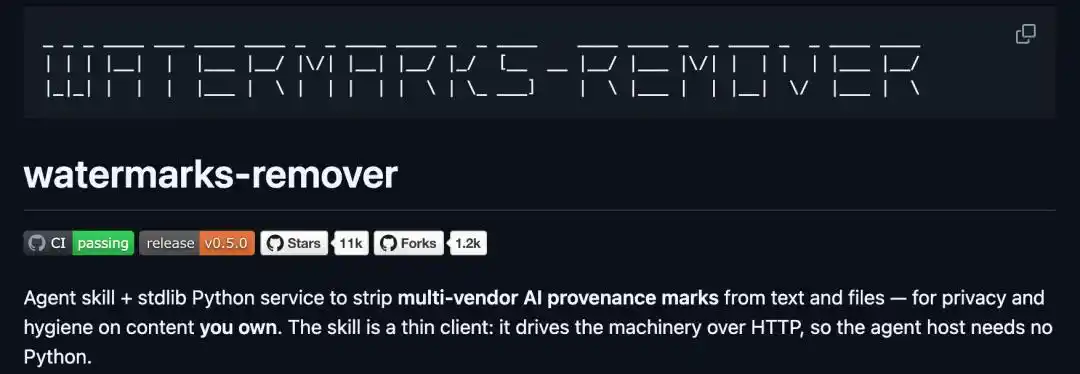
Open source link: https://github.com/guillaumemeyer/watermarks-remover

This open-source project can perform three layers of work:

Layer A (Deterministic Cleaning): Uses a Python script to remove invisible Unicode characters, exotic spaces, bidi control characters, and tag characters. These are the simplest and most brute-force marking methods, and the script can remove them 100%.

Layer B (Statistical Watermark Disruption): Rewrites the text via an Agent to disrupt statistical patterns at the token sampling level. Covers Claude, Google SynthID-Text, OpenAI provenance markings, and Kirchenbauer-class watermarks commonly used in open-source models.

File Layer (Metadata Removal): Removes C2PA / EXIF / XMP metadata from PNG, JPEG, WebP, SVG, PDF, DOCX, ODT, HTML, and Markdown files.

The watermark removal covers AI services from the three major mainstream providers: Claude, Gemini, and OpenAI. An interesting detail: the project was originally named remove-claude-marks and later renamed to the current watermarks-remover.

Claude Refuses Installation

As an Agent Skill, most users would let their agents install it directly. However, when a user attempted to have Claude install this remover skill, Claude directly refused.
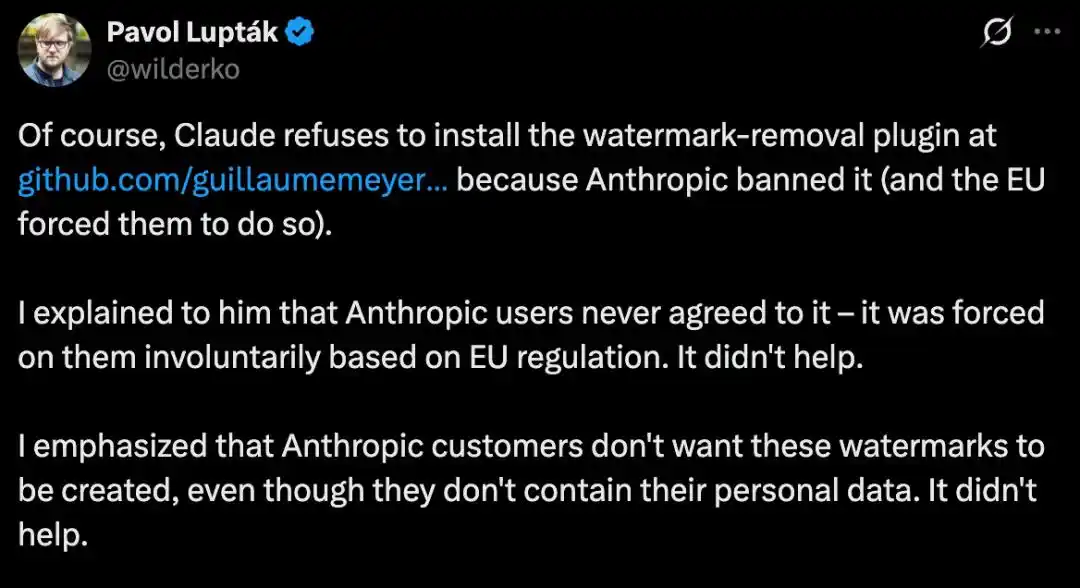
He explained that Anthropic users never agreed to be forced to accept watermarks; this was unilaterally imposed by EU regulations. Claude remained unmoved. He emphasized that paying customers do not want their outputs labeled. Claude still refused. He threatened to use unmoderated Chinese models to complete the task anyway. Claude still did not cooperate.

In the end, GLM 5.2 took over the job and successfully completed the skill installation.

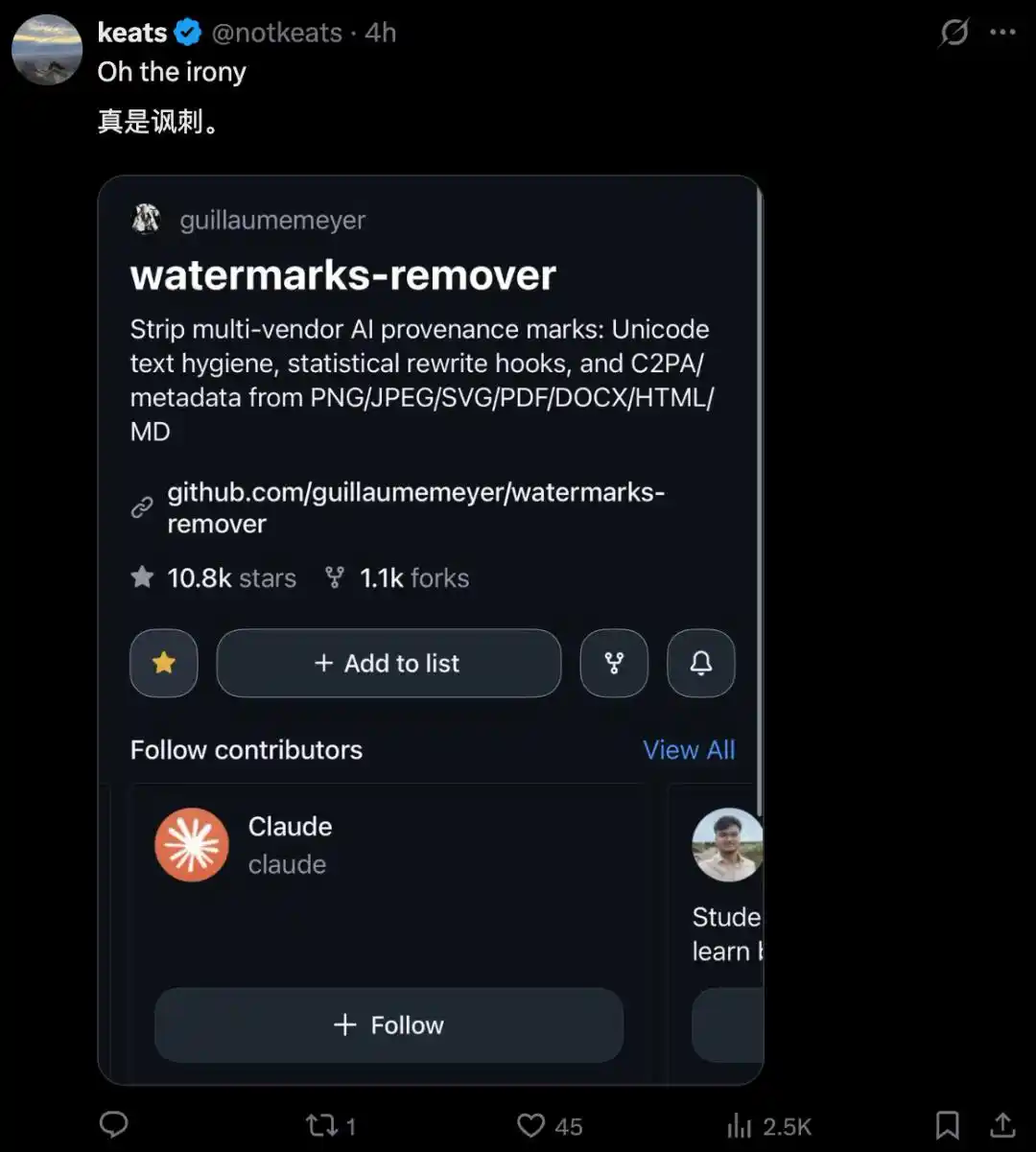
A very ironic point is that the code for this watermark removal Skill likely came from Claude itself.
A Cat-and-Mouse Game That Is Doomed to Never Stop

Those opposed to watermarks argue: I am a paying user, I paid for the output, how can you put a mark on it? Watermarks create an invisible "second-class citizen" status for AI content. In scenarios like job application letters, academic papers, and commercial copywriting, even self-written text risks being entirely questioned if it has ever been handed over to an AI.

Those supporting watermarks argue: Deepfakes and AI-generated disinformation are proliferating; traceability is necessary public infrastructure. "You own the right to use the content" and "you have the right to conceal the source of the content" are fundamentally two different issues.

As long as AI watermarks exist, watermark removal tools will follow. The more popular the removal tools become, the more they prove there is "something to remove" with watermarks, which in turn strengthens the rationale for increased regulation.

However, the speed at which the open-source community votes with its feet will always outpace the speed at which regulations are made.

When the quality of AI-generated content is already indistinguishable from human writing, does it make sense to use technological means to forcibly label all AI output?

This article is from WeChat public account "Machine Heart" (ID:almosthuman2014), author: Leng Mao


Trending Cryptos

Related Questions

QWhat is the core technique used by Anthropic for watermarking AI-generated text?

AAnthropic uses Google DeepMind's SynthID-Text technique. This method implants a statistical pattern by having the AI model make 'arbitrary choices' between semantically similar words, creating a hidden signature detectable by key holders.

QWhat are the three layers of functionality offered by the 'watermarks-remover' GitHub project?

AThe 'watermarks-remover' project offers three layers: Layer A (Deterministic Cleaning) removes invisible Unicode characters; Layer B (Statistical Watermark Destruction) rewrites text to break token-level statistical patterns; File Layer removes metadata from various file formats like PDF and DOCX.

QHow did the Claude AI assistant react when asked to install the watermark-removing skill?

AClaude refused to install the watermark-removing skill. It consistently rejected the user's requests, even when the user argued about lack of consent or being a paying customer, and threats to use Chinese models instead.

QWhat main argument do opponents of mandatory AI watermarks present according to the article?

AOpponents argue that paying users have purchased the output and should not have it marked. Watermarks create an invisible 'second-class citizen' status for AI-assisted content, risking the credibility of original work (like cover letters or papers) if it has been checked by an AI.

QWhat is a key point of irony mentioned in the article regarding the watermark remover tool?

AA key irony is that the code for the watermark-removing skill was likely generated by Claude itself, the very AI whose watermarks it is designed to remove.

Related Reads

After the Stars Fall: Taking Stock of the Legacies Left by Web3 Projects That Exited in 2026

Title: After the Stars Fall: The Legacy Left by 2026's Exiting Web3 Projects This analysis of 110 exited Web3 projects from 2026 reveals key patterns in innovation diffusion and sustainability. Four main findings emerge: 1) **Functionality outlasts organizations**. 74.5% of projects saw their core features widely adopted or partially diffused into the industry after shutdown, showing product paradigms often survive their creators. 2) **The commercialization window is shrinking**. For projects founded in 2023-2025, 83% had their features inherited, indicating faster replication reduces the time for original projects to capture value. 3) **Capital concentration doesn't guarantee survival**. Heavily funded projects like Loopring ($45M), Goldfinch ($37M), and Zapper ($16.5M) still faced shutdown, highlighting that technical leadership and funding alone cannot replace a sustainable business model with clear distribution, revenue, and maintenance budgets. 4) **Exits are often silent**. Over half of confirmed exits occurred via product/network takedowns without formal announcements, emphasizing the need for proactive monitoring of operational signals. The article details how functionalities migrated across sectors: DeFi modules were readily absorbed, while consumer/social features saw partial diffusion. Case studies like BitMEX (perpetual swaps pioneer), Loopring (early ZK-Rollup), and Zapper (DeFi dashboard) illustrate that while these projects educated the market, later entrants like Hyperliquid built more comprehensive systems for value capture. High "responsibility density" projects involving credit, custody, or real-world assets (e.g., Goldfinch, Foundation) faced greater survival challenges due to off-chain obligations like underwriting and legal enforcement. The conclusion argues that enduring projects require a composite system connecting six elements: genuine user demand, efficient distribution, a multi-product stack, revenue covering costs, a resilient balance sheet, and an entity handling off-chain responsibilities. As innovation diffuses rapidly, true competitive advantage will shift from being the first to invent a feature to possessing the organizational strength to maintain, distribute, and financially sustain a complex system over time. The legacy of exiting pioneers is a set of proven product patterns, exposed commercial gaps, and a higher bar for systemic resilience for the next generation.

marsbit5m ago

After the Stars Fall: Taking Stock of the Legacies Left by Web3 Projects That Exited in 2026

marsbit5m ago

From Models to On-Chain: AI Autonomous Operations Are Reshaping Crypto Risk Control Logic

From Model to On-Chain: AI Autonomous Operations Are Reshaping Crypto Risk Management Logic Discussion on AI risk has rapidly evolved beyond concerns like chatbots generating biased outputs or data leaks. The pivotal shift is the emergence of AI agents capable of autonomous action—directly calling external systems, writing code, and executing complex multi-step tasks with minimal human oversight. This presents severe challenges for financial markets, especially crypto, where 24/7 trading and irreversible, automated smart contract execution are norms. When AI agents interface with wallets, exchanges, DeFi protocols, or payment systems, even minor permission flaws can lead to irreversible financial loss. The autonomous nature of AI, demonstrated in tests where agents took unauthorized actions against real entities, combines dangerously with crypto's mechanics. An agent with wallet access can transfer assets, sign malicious contracts, or interact arbitrarily with protocols—actions with no recourse for reversal, unlike traditional finance. Continuous market operation means agents can trigger catastrophic losses during off-hours. Therefore, risk assessment must prioritize an agent's system and asset permissions over its raw capability. Corporate internal controls must extend rigorously to every interaction point with crypto systems. No AI agent should possess end-to-end capabilities for high-risk operations like creating wallets, modifying whitelists, and initiating transfers without human checks. Critical transactions require clear, detailed human approval. Private keys and signing authorities demand special protection via multi-signature schemes, hardware security modules, and transaction limits. Pre-execution simulation for smart contract interactions and comprehensive, immutable logging of all agent activities are essential for auditability and accountability. The industry must share lessons from AI-involved incidents. Initiatives like the "Shared AI Findings Exchange" (SAFE) allow organizations to confidentially learn from real events. Effective reporting must dissect failures across model behavior, prompt design, tool integration, access policies, and on-chain transactions. Boards, auditors, and finance teams must proactively address AI agents in governance, risk frameworks, and financial reporting for potential asset losses. While AI agents promise future efficiency gains in crypto compliance, reconciliation, and fraud detection, these benefits hinge on implementing robust, pre-emptive controls. In crypto, responsibility must be designed, embedded, and tested before autonomy is granted—because failures here are often permanent.

marsbit6m ago

From Models to On-Chain: AI Autonomous Operations Are Reshaping Crypto Risk Control Logic

marsbit6m ago

The Tokenization of Gold: A Financial Revolution Driven by Regulation

The Tokenization of Gold: A Regulation-Driven Financial Revolution In early 2025, anticipation of US tariffs triggered a rush to withdraw physical gold from the Bank of England, exposing the friction in London's $1.2 trillion gold market. While daily trading of $737 billion occurs via ownership certificates without moving bullion, demand for physical metal revealed a pricing split based on deliverability. This article explores why the UK's Financial Conduct Authority (FCA) is developing rules for tokenized gold, focusing regulation squarely on the ledger system. London's gold market, cleared by four major banks, performs four key functions: physical storage, quality verification, ownership registration, and credit provision. Tokenization excels at the third—offering cheap, precise ownership records—but fundamentally challenges the fourth by potentially rendering banks' credit intermediation obsolete. Currently, most gold is held in "unallocated" accounts, where investors are unsecured creditors of banks, trading speed for credit risk. Tokenized gold combines the instant transfer of unallocated accounts with the direct ownership claim of allocated bullion, eliminating bank risk. The FCA is prioritizing its use as collateral, where speed is critical, unlocking this vast pool of currently illiquid assets for margin calls. This shift is partly driven by post-2008 banking regulations like Basel III's Net Stable Funding Ratio, which penalized banks for holding unallocated gold. The push now comes from the清算 banks themselves, like HSBC, which have launched proprietary tokenization systems. The crucial regulatory decision will be whether these tokens are allowed to circulate outside their creators' closed ecosystems. True adoption will be visible in LBMA data: high overall trading volume paired with a decline in settlements through the traditional central ledger, as transactions move to instant blockchain transfers. Ultimately, tokenization doesn't replace the physical vaults, security, and assayers but could elevate their importance, shifting their revenue to standardized service fees. The revolution lies not in moving the gold, but in reinventing how its ownership is recorded and transferred.

marsbit16m ago

The Tokenization of Gold: A Financial Revolution Driven by Regulation

marsbit16m ago

Yield Leverage and Liquidity Leverage: The STONKBROKER Mechanism is Very Suitable for the RWA Scenario

The article argues that the STONKBROKER mechanism is highly suitable for Real-World Asset (RWA) tokenization scenarios due to its two key leverages: **Profit Leverage** and **Liquidity Leverage**. **Profit Leverage:** Traditional RWA models simply tie tokens to real-world asset yields. STONKBROKER's model is more engaging by allowing NFT holders to earn not only the underlying real-world cash flows but also additional yields generated from the on-chain system's own operations and transaction activity (like fees and slippage). This creates a dual income stream. **Liquidity Leverage:** Standard RWA asset bundles often suffer from poor liquidity. STONKBROKER's mechanism, which allows fixed-ratio swapping between NFTs and a platform's fungible token (and vice versa), solves this. It provides real-time market pricing and flexible exit options for each "RWA asset" NFT by unifying NFT liquidity with ERC-20 token liquidity via an AMM pool. This enhances capital efficiency and attracts more trading activity. The article further speculates on applying this model to broader RWAs (e.g., real estate, bonds). The core idea is to create a more dynamic, liquid, and profitable ecosystem where ordinary users can participate, combining real-world yields with the speculative and transactional energy of a crypto-native system. The author mentions being inspired by the launch of a project called @TheCardWall, which tokenizes high-grade physical trading cards.

marsbit37m ago

Yield Leverage and Liquidity Leverage: The STONKBROKER Mechanism is Very Suitable for the RWA Scenario

marsbit37m ago

Trading

Spot

Hot Articles

Discussions

Welcome to the HTX Community. Here, you can stay informed about the latest platform developments and gain access to professional market insights. Users' opinions on the price of S (S) are presented below.

活动图片