Ansem: Why I Believe Token Buybacks Don't Solve Anything?

marsbitPublished on 2026-07-17Last updated on 2026-07-17

Abstract

Crypto trader Ansem argues that token buybacks alone do not create value. Instead, a project's valuation multiple is driven by "trust premium" built between the team and its community. He compares two high-revenue Solana protocols: Hyperliquid (estimated $800M annualized revenue, ~$650B FDV) and pump.fun (estimated $440M annualized revenue, ~$14B FDV). Both aggressively use most protocol revenue for buybacks, yet their valuation multiples differ by nearly 50x. Ansem attributes Hyperliquid's high valuation to the trust earned by its founder Jeff and team through consistent execution, transparent community rewards, and a dedicated user base. In contrast, he criticizes pump.fun for failing to fulfill a promised airdrop of 24% of its token supply for over a year since its July 2025 ICO, despite generating over $1B in revenue and raising $1B in the ICO. He suggests that honoring its commitments could significantly boost its token price and platform metrics. The core thesis is that trust, not just financial mechanics, is the key driver of crypto asset valuations.

Author: Claude, Deep Tide TechFlow

Deep Tide Introduction: Famous Solana trader Ansem posted that the buyback mechanism itself does not create value, and what determines the token valuation multiple is the "trust premium" between the team and the community. Using Hyperliquid (annualized revenue approx. $8 billion, FDV approx. $65 billion) and pump.fun (annualized revenue approx. $440 million, FDV only approx. $1.4 billion) as a comparison, he pointed out that both are conducting large-scale buybacks, but their valuation multiples differ by nearly 50 times.
One of the most enduring narratives in the crypto market is being challenged: dumping protocol revenue into buybacks will make the token price rise.

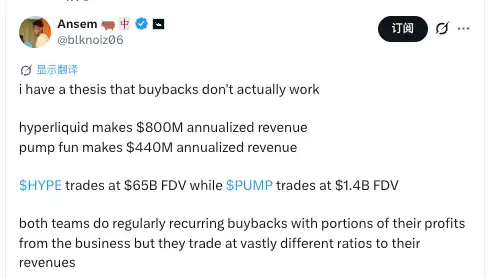
On July 16, famous Solana trader Ansem (@blknoiz06) posted a long thread on platform X, proposing a counterintuitive argument: the buyback mechanism itself does not create value; what truly determines the token trading multiple is the "trust premium" between the team and the community. This post quickly gained over 469,000 views, 3,240 likes, and 509 reposts.

Ansem selected two of the crypto industry's highest-earning protocols for comparison. Hyperliquid's annualized revenue is approximately $8 billion, HYPE's FDV is approximately $65 billion; pump.fun's annualized revenue is approximately $440 million, PUMP's FDV is only about $1.4 billion. Both teams are using the vast majority of their revenue for buybacks, but their valuation multiples differ by nearly 50 times.

Ansem's conclusion is: the gap is not in the scale of revenue, but in the trust accumulated through the team's actions.

Both Spending Heavily on Buybacks, Why Do Hyperliquid and pump.fun Have Such Widely Different Valuations?

Ansem deconstructed the buyback strategies of the two platforms in his post.

Hyperliquid directs 97% to 99% of protocol fees directly into HYPE buyback and burn. According to CryptoNews data, as of June 30, Hyperliquid's cumulative protocol revenue had exceeded $1 billion, with an annualized run rate close to $840 million. The platform has burned over 41 million HYPE tokens, worth over $1 billion, reducing the circulating supply by approximately 4.2%. At the time of writing, HYPE is quoted around $60 to $67, with an FDV of approximately $57 to $62 billion.

pump.fun is similarly aggressive. In 2025, the platform's total revenue was approximately $970 million, and it invested close to 100% of revenue into PUMP buybacks, accumulating about $213 million in buybacks. In April 2026, the team executed a one-time burn of PUMP tokens worth $370 million (about 36% of the circulating supply) and locked 50% of subsequent revenue for continuous burns. However, PUMP is currently quoted around $0.0016, with an FDV of approximately $1.4 to $1.7 billion.

pump.fun's annualized revenue is a bit more than half of Hyperliquid's, but its FDV is less than 3% of Hyperliquid's. If the buyback mechanism were the core driver of valuation, this multiple gap would be unexplainable.

Ansem's Explanation: Trust Premium is the Core of Pricing

Ansem believes the high valuation the market gives Hyperliquid stems from the trust established by Jeff (Hyperliquid founder) and his team.

He listed several points in his post: Hyperliquid has never overpromised; the team focuses solely on shipping products; user rewards are strictly distributed based on pre-determined on-chain metrics without opaque operations; the core user base has an extremely high trust rating for Jeff and the team. Ansem's original words stated that this trust premium "is one of the main reasons the token is trading so well."

Hyperliquid's historical actions support this judgment. The project did not accept VC investment, allocating 70% of the total supply to the community; the massive airdrop at launch in November 2024 fulfilled early promises; the platform showed resilience during the market sell-off in February 2026, indicating its user base includes many serious traders who rely on the platform for daily trading.

The pump.fun Problem: $1 Billion in Revenue, Promised Airdrop Unfulfilled for a Year

Ansem's criticism of pump.fun is more direct.

He pointed out that pump.fun has accumulated over $1 billion in revenue, raised another $1 billion in its ICO, but the airdrop promised to users has never been delivered. According to a Protos report, pump.fun clearly stated "airdrop coming soon" when announcing the PUMP token ICO on July 9, 2025, promising to allocate 24% of the supply to the community. By mid-July 2026, this promise has been outstanding for a full year, with no airdrop in sight.

Ansem had previously criticized this on June 25: "pump.fun is the only application in crypto that has sustained attention for several years, not even OpenSea achieved that. But people are angry because they promised a 24% airdrop and never delivered, just sitting on the cash now."

The $370 million token burn in April 2026 was intended to repair trust, but the community reaction backfired. Some users believed the burned tokens should have been used for the airdrop allocation, and burning them directly eliminated the community's deserved share. According to a Cryptopolitan report, the widespread community interpretation of this move was that it "deepened distrust."

In his latest post, Ansem made a hypothetical scenario: if pump.fun seriously fulfilled its airdrop promise and addressed the concerns of its core users, the token price could potentially increase 10 to 15 times, while trading volume, attention, and platform revenue would also see substantial growth.


Trending Cryptos

Related Questions

QWhat is the core argument presented by Ansem regarding token buybacks?

AAnsem argues that token buyback mechanisms themselves do not create value. He believes the key driver of a token's valuation multiple is the 'trust premium' established between the project team and its community.

QAccording to the article, what is the significant valuation difference between Hyperliquid and pump.fun despite both engaging in buybacks?

ADespite both platforms aggressively using protocol revenue for buybacks, Hyperliquid's FDV is approximately $650 billion while pump.fun's FDV is only about $14 billion, representing a nearly 50x difference in valuation multiples.

QWhat reasons does Ansem give for the high 'trust premium' enjoyed by Hyperliquid?

AAnsem attributes Hyperliquid's trust premium to the team's focus on product delivery without overpromising, transparent and rule-based user reward distribution, and a core user base with high trust in founder Jeff and the team's execution.

QWhat is the specific criticism Ansem levels against pump.fun regarding community commitments?

AAnsem criticizes pump.fun for failing to fulfill its promise of a community airdrop allocating 24% of the token supply, a commitment made during its July 2025 ICO announcement that remained unfulfilled a year later.

QWhat was the community's reaction to pump.fun's $370 million token burn in April 2026, and why?

AThe community reaction was largely negative and deepened distrust. Many users perceived that the burned tokens should have been allocated for the promised airdrop, viewing the burn as destroying the community's rightful share.

Related Reads

CLARITY Act Delays Have Become a Compliance Crisis, Not Just a Political Stalemate

The article discusses the ongoing delay in the US Senate regarding the CLARITY Act, a bill intended to clarify the regulatory status of digital assets as either securities under the SEC or commodities under the CFTC. A year after the House passed it, this inaction is creating a concrete governance, risk, and compliance crisis for businesses, moving beyond mere political gridlock. While related bills for stablecoins and CBDC prohibitions have become law, the comprehensive CLARITY Act remains stalled. The delay creates profound uncertainty for companies on fundamental rules for exchanges, custodians, and all market participants. Without clear congressional action, regulatory classification depends on shifting enforcement actions and presidential administrations, making stable compliance impossible. The Senate's window for action is narrowing, with key votes needed before the August recess. Several major issues are blocking passage, including ethical concerns over crypto holdings by officials, law enforcement opposition to certain provisions, perceived loopholes for stablecoin rewards, and regulatory agency vacancies at the SEC and CFTC. Bipartisan support is fragile. Further delay risks postponing the legislation until 2030, perpetuating a costly "regulation by enforcement" environment. In contrast, passage would provide a durable regulatory framework. Regardless of the outcome, compliance leaders are urged to immediately map their digital asset exposures, prepare governance materials for both scenarios, and stress-test their arrangements. The article concludes that while the Senate's action is uncertain, corporate preparedness is not.

Foresight News30m ago

CLARITY Act Delays Have Become a Compliance Crisis, Not Just a Political Stalemate

Foresight News30m ago

The 'Big Short' Burry: Now is an Excellent Time to Bottom-Fish in Hong Kong Stocks

The article discusses growing optimism towards Hong Kong stocks, led by prominent investor Michael Burry of "The Big Short" fame. Burry recently stated it is an "excellent time" to find cheap stocks in the Hong Kong market. His bullish view is based on the prediction that as the global AI chip stock frenzy cools, capital will flow out of markets like South Korea and Japan and seek undervalued opportunities, positioning Hong Kong as a potential beneficiary. Supporting this view, Goldman Sachs' Asia equity capital markets head, Wang Yajun, argues the Hong Kong market has already entered the AI era, but major indices have not yet reflected this reality. He points to active AI-related IPOs and transactions as evidence of underlying market vitality, contrasting with the weak performance of key indices like the Hang Seng. Data highlights Hong Kong's underperformance: the Hang Seng Index is down about 7% year-to-date, while markets in South Korea and Japan and semiconductor ETFs have seen significant gains. This disparity is seen by Burry and others as creating a valuation gap and a potential buying opportunity. The article notes Burry has acted on his view by increasing holdings in Chinese e-commerce firm JD.com. Morgan Stanley has also recently advocated buying Hong Kong stocks, citing positive corporate earnings expectations. However, challenges remain, including persistent concerns over Chinese consumer spending and e-commerce profitability, which continue to weigh on the market. The divergence between weak index performance and strong activity in specific sectors like AI presents both opportunity and complexity for investors looking to capitalize on Hong Kong's potential turnaround.

marsbit59m ago

The 'Big Short' Burry: Now is an Excellent Time to Bottom-Fish in Hong Kong Stocks

marsbit59m ago

The Big Short's Burry: Now is the Perfect Time to Bottom-Fish in Hong Kong Stocks

Michael Burry, the investor famous for predicting the 2008 financial crisis, recently stated on X that now is an "excellent time" to look for cheap stocks in the Hong Kong market. His bullish view is based on the expectation that the global AI chip stock frenzy will cool, leading funds to flow out of Korea, Japan, and semiconductor ETFs and into undervalued areas like Hong Kong. He has already acted by increasing his stake in JD.com. Hong Kong stocks have significantly underperformed global peers this year, with the Hang Seng Index down about 7% and the Hang Seng Tech Index falling over 15%. This contrasts sharply with major gains in Korean, Japanese, and semiconductor markets. Burry sees this disparity as creating a bargain-hunting opportunity. Adding another perspective, Goldman Sachs' Asia equity capital markets head, Wang Yajun, argues that while the Hong Kong market has already entered the AI era with active related IPOs and trading, its major indices have not yet reflected this reality due to structural lag. He expects record equity fundraising this year, driven by more AI company listings. Morgan Stanley has also recently advocated buying Hong Kong stocks, citing optimistic corporate earnings prospects. However, challenges remain, including concerns over China's consumer recovery and e-commerce profitability. The key for investors is navigating the overall index pressure while identifying specific structural opportunities highlighted by these bullish narratives.

链捕手1h ago

The Big Short's Burry: Now is the Perfect Time to Bottom-Fish in Hong Kong Stocks

链捕手1h ago

Xi Jinping Attends Opening Ceremony of World Artificial Intelligence Conference 2026 and High-Level Meeting on Global AI Governance, Delivers Keynote Speech

On July 17, 2026, Chinese President Xi Jinping delivered a keynote speech titled "Working Together to Build a Fair and Equitable Global Governance System on Artificial Intelligence" at the opening ceremony of the 2026 World Artificial Intelligence Conference and High-level Conference on Global AI Governance in Shanghai. President Xi pointed out that the rapid development of AI, alongside the accelerated global changes, presents both significant opportunities and governance challenges. He raised critical questions for humanity regarding human-machine coexistence, safety, ethics, and bridging divides. China advocates for a people-oriented, benevolent approach to AI, making it a force for common prosperity and security, and jointly building a fair and reasonable global AI governance system. Xi Jinping put forward a four-point proposal: 1. **Uphold Openness for Win-Win Cooperation and Drive Innovation:** Seize the historic opportunity by encouraging open-source collaboration and sharing to foster AI innovation, industry growth, and application, empowering all sectors. 2. **Enhance Risk Awareness and Ensure Security and Controllability:** Attach great importance to AI's inherent and derivative risks. Build systems for laws, technical monitoring, risk warning, and emergency response to safeguard security, prevent misuse, and ensure human control. Oppose the practice of politicizing national security in AI. 3. **Encourage Inclusiveness and Promote Cultural Exchange:** Shape AI's values with humanity's common values. Use AI to enhance understanding and tolerance between civilizations, fostering a garden of diverse cultures. 4. **Advocate Solidarity and Improve Global Governance:** Practice true multilateralism, leverage the UN's role, and strengthen coordination on AI development strategies, governance rules, and technical standards to form a widely accepted global governance framework. Assist Global South countries in capacity building to bridge the digital divide and avoid new historical inequities. Xi highlighted that as a responsible major country, China, in its 15th Five-Year Plan period, is committed to being a provider of international public goods in AI, contributing Chinese solutions. China has promoted an "AI Plus" initiative, with its core intelligent economy exceeding RMB 10 trillion. To support global AI development, China will provide 5,000 AI training opportunities for developing countries, establish international AI application cooperation centers with regional organizations, and deploy its "Mazu" meteorological AI warning system in 30 countries. The establishment of the World Artificial Intelligence Cooperation Organization in Shanghai marks a significant milestone. Leaders from Kazakhstan, Cambodia, Thailand, and the UN Secretary-General delivered speeches, commending China's contributions to global AI governance and echoing President Xi's proposals. They agreed that AI's opportunities and challenges are borderless, requiring cooperative, inclusive, and equitable international efforts to ensure a secure, prosperous future that leaves no country behind. The conference issued a Chair's Statement. President Xi and his wife hosted a welcome banquet for international dignitaries on July 16. Senior Chinese officials attended the events.

链捕手1h ago

Xi Jinping Attends Opening Ceremony of World Artificial Intelligence Conference 2026 and High-Level Meeting on Global AI Governance, Delivers Keynote Speech

链捕手1h ago

Trading

Spot

Hot Articles

How to Buy ANSEM

Welcome to HTX.com! We've made purchasing The Black Bull (ANSEM) simple and convenient. Follow our step-by-step guide to embark on your crypto journey.Step 1: Create Your HTX AccountUse your email or phone number to sign up for a free account on HTX. Experience a hassle-free registration journey and unlock all features.Get My AccountStep 2: Go to Buy Crypto and Choose Your Payment MethodCredit/Debit Card: Use your Visa or Mastercard to buy The Black Bull (ANSEM) instantly.Balance: Use funds from your HTX account balance to trade seamlessly.Third Parties: We've added popular payment methods such as Google Pay and Apple Pay to enhance convenience.P2P: Trade directly with other users on HTX.Over-the-Counter (OTC): We offer tailor-made services and competitive exchange rates for traders.Step 3: Store Your The Black Bull (ANSEM)After purchasing your The Black Bull (ANSEM), store it in your HTX account. Alternatively, you can send it elsewhere via blockchain transfer or use it to trade other cryptocurrencies.Step 4: Trade The Black Bull (ANSEM)Easily trade The Black Bull (ANSEM) on HTX's spot market. Simply access your account, select your trading pair, execute your trades, and monitor in real-time. We offer a user-friendly experience for both beginners and seasoned traders.

572 Total ViewsPublished 2026.07.01Updated 2026.07.01

How to Buy ANSEM

Discussions

Welcome to the HTX Community. Here, you can stay informed about the latest platform developments and gain access to professional market insights. Users' opinions on the price of ANSEM (ANSEM) are presented below.

活动图片