Ethereum price prediction – Can ETH reclaim $2K as ETF inflows return?

ambcryptoPublished on 2026-07-20Last updated on 2026-07-20

Abstract

Ethereum (ETH) is consolidating around $1,865, showing a recovery from June lows with a pattern of higher highs and higher lows in July. A key factor is the return of institutional demand, with U.S. spot Ethereum ETFs posting a second consecutive week of net inflows ($105.44M for the week ending July 17), bringing total assets near $10 billion. BlackRock's fund (ETHA) led the inflows. Technically, while the weekly RSI remains around 40, the daily RSI near 58 indicates strengthening buying momentum. The immediate resistance is at $1,900. A break above could open a path toward the key $2,000 level, with $1,800 now acting as important support. The return of ETF inflows and improving technicals suggest the recovery is gaining traction, though a sustained push above $1,900 is needed to challenge $2,000.

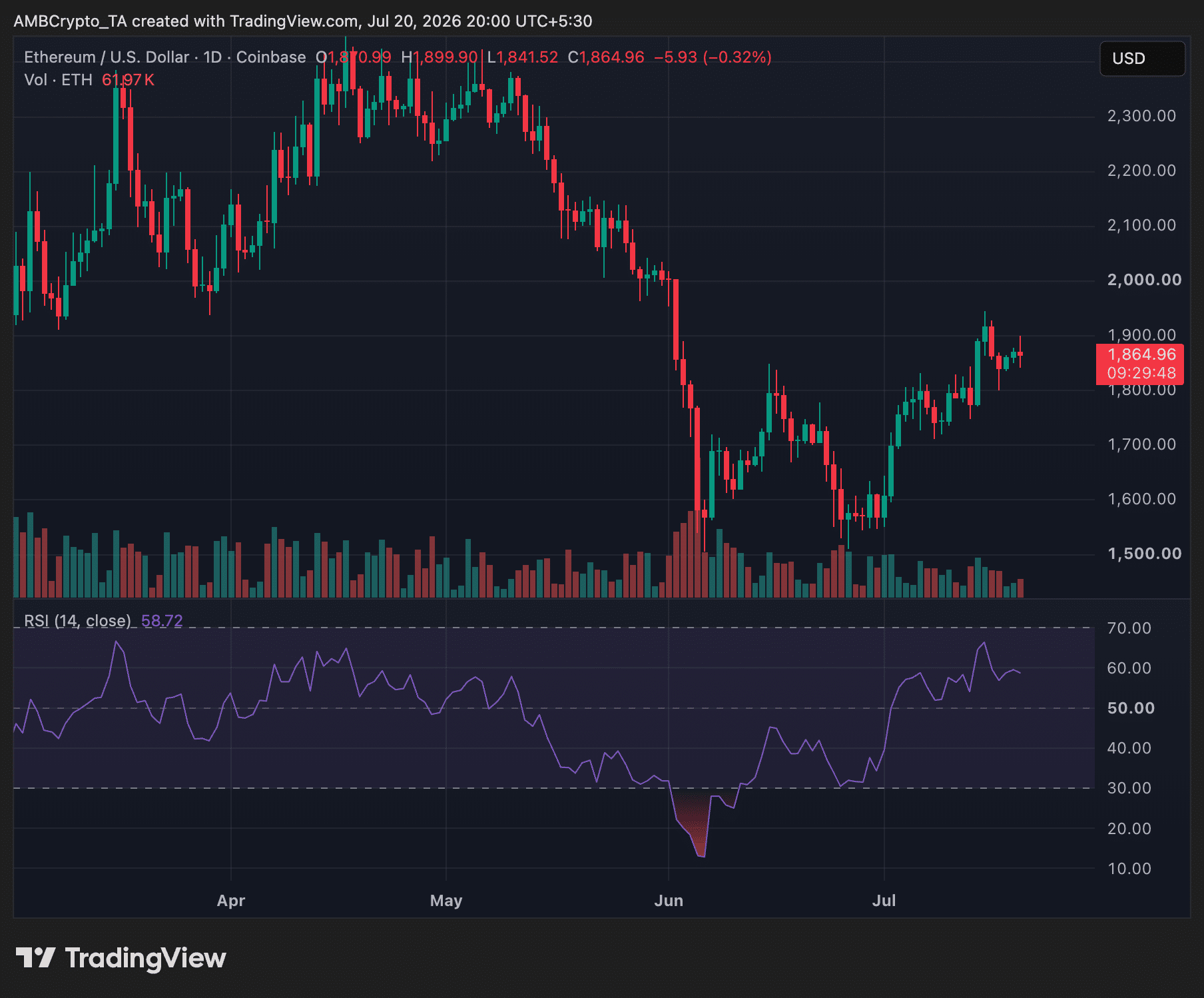
Ethereum [ETH] traded around $1,865 at press time, consolidating after recovering sharply from its June lows. The asset has continued to build higher highs and higher lows throughout July, keeping traders focused on whether it can reclaim the key $2,000 level.

Supporting that recovery, U.S. spot Ethereum ETFs posted a second consecutive week of net inflows, signaling renewed institutional demand after several weeks of persistent outflows.

Ethereum ETFs record second straight week of inflows

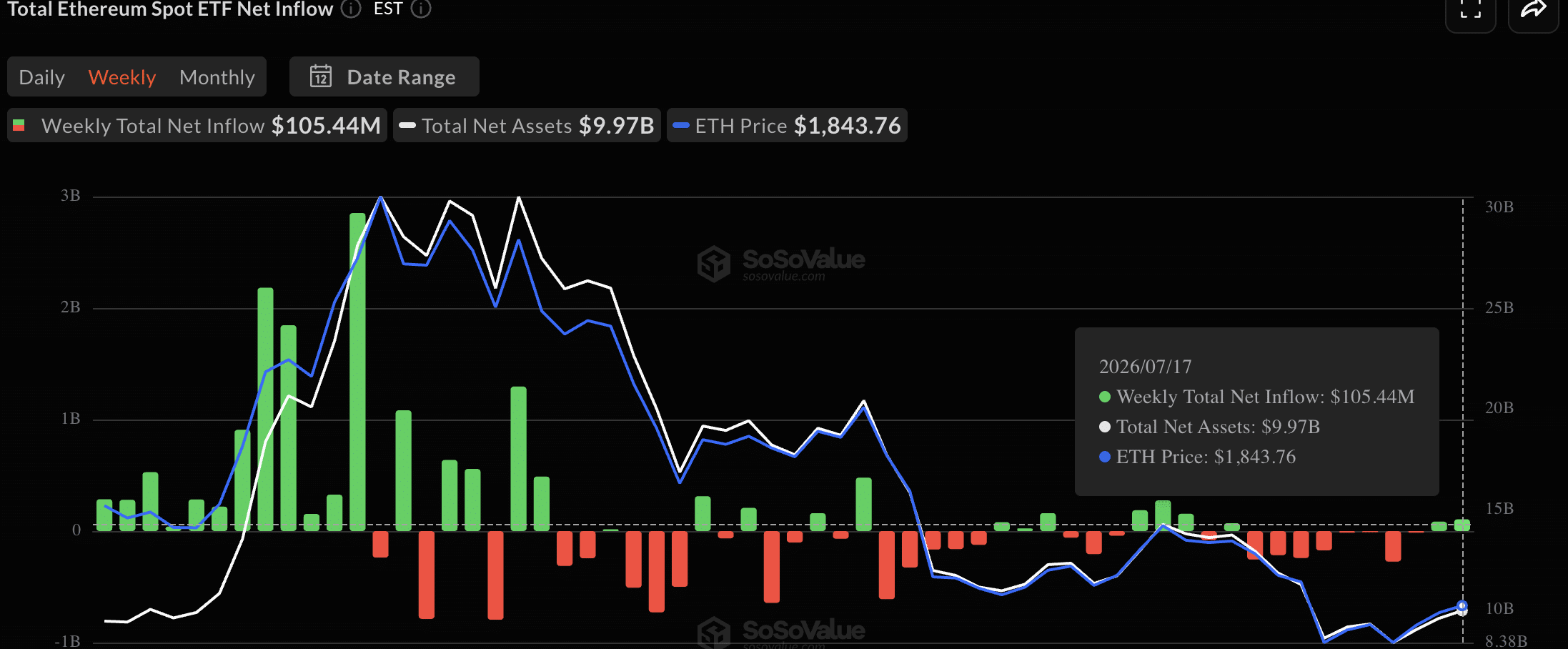
Spot Ethereum ETFs attracted $105.44 million in net inflows during the week ending July 17, following $84.42 million the previous week.

The back-to-back inflows marked a notable shift after five consecutive weeks of net outflows between mid-May and late June.

Meanwhile, cumulative net inflows climbed to $11.08 billion, while total ETF assets reached $9.97 billion, leaving the sector just shy of the $10 billion milestone.
Source: SosoValue

BlackRock’s ETHA remained the largest contributor to institutional demand. The fund recorded $31.68 million in daily inflows on July 17 and managed $5.22 billion in net assets, accounting for more than half of the U.S. spot Ethereum ETF market.

Fidelity’s FETH added another $5.05 million, while the remaining funds recorded little or no net flow during the session.

ETH builds momentum, but $2K remains the hurdle

The weekly chart showed Ethereum continuing to recover from its June decline, with buyers successfully reclaiming the $1,800 region.

However, the broader trend has yet to fully turn bullish. Weekly RSI remained around 40, indicating momentum has improved from oversold conditions but is still below the neutral 50 level.

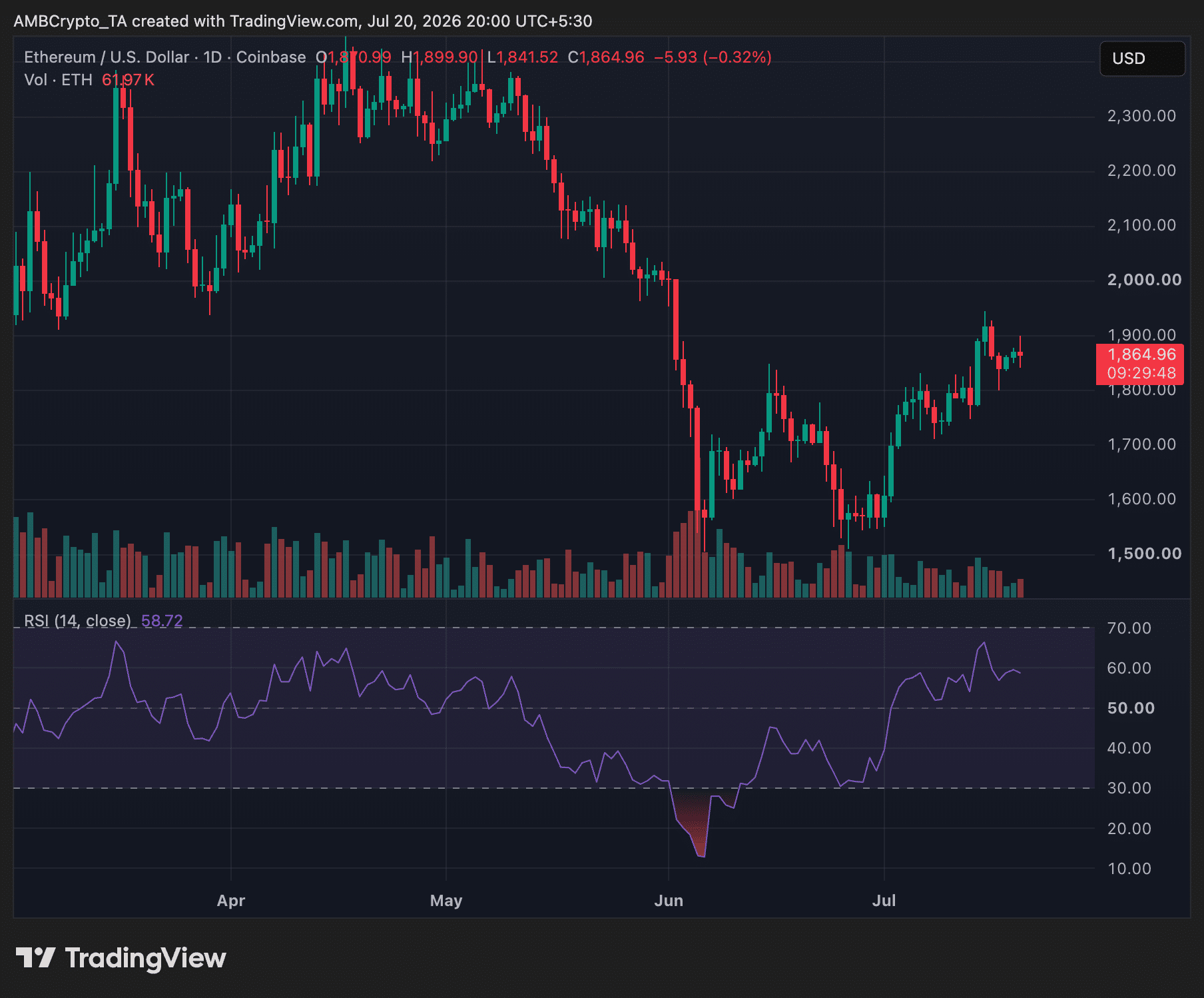
On the daily timeframe, the picture appeared more constructive.
Source: TradingView

ETH’s RSI climbed to around 58, reflecting strengthening buying momentum without entering overbought territory.

Price action also continued forming higher highs and higher lows throughout July, suggesting buyers have gradually regained control following June’s sell-off.

Can Ethereum reclaim $2,000?

The immediate challenge remains the $1,900 resistance zone.

A decisive break above that level could open the path toward the psychological $2,000 mark, which also represents a major area of previous supply.

On the downside, the reclaimed $1,800 level now serves as the first important support. Holding above it would reinforce Ethereum’s improving short-term structure.

At the same time, a rejection below $1,900 could trigger another period of consolidation before buyers attempt another breakout.

With institutional inflows returning and technical momentum strengthening, Ethereum’s recovery appears to be gaining traction. Whether that translates into a move above $2,000 will likely depend on buyers maintaining pressure over the coming sessions.


Final Summary

  • Ethereum ETFs recorded a second consecutive week of net inflows, adding $105.44 million as total ETF assets approached the $10 billion mark.
  • ETH continues to build a constructive technical structure above $1,800, but a sustained move above $1,900 remains necessary before bulls can target $2,000.


Trending Cryptos

Related Questions

QWhat was Ethereum's price at press time and what key level is it attempting to reclaim?

AEthereum was trading around $1,865 at press time, and it is attempting to reclaim the key $2,000 level.

QWhat recent trend did U.S. spot Ethereum ETFs show, and what was the net inflow for the week ending July 17?

AU.S. spot Ethereum ETFs recorded a second consecutive week of net inflows. For the week ending July 17, they attracted $105.44 million in net inflows.

QWhich fund is the largest contributor to the U.S. spot Ethereum ETF market, and what were its daily inflows on July 17?

ABlackRock's ETHA is the largest contributor. It recorded $31.68 million in daily inflows on July 17 and manages over half of the U.S. spot Ethereum ETF market with $5.22 billion in net assets.

QWhat does the daily RSI reading suggest about Ethereum's current buying momentum?

AThe daily RSI climbed to around 58, reflecting strengthening buying momentum without entering overbought territory.

QWhat are the immediate resistance and support levels for Ethereum mentioned in the article?

AThe immediate resistance level is $1,900. The first important support level is the reclaimed $1,800 level.

Related Reads

L2 'Recalibration': When L1 Becomes Its Own Rollup, What Is Ethereum's Endgame?

The article discusses the evolving relationship between Ethereum's Layer 1 (L1) and Layer 2 (L2) solutions, moving beyond the initial "L2 for scaling" model. As Ethereum L1 itself scales (increasing Gas Limit, statelessness, zkEVM), the unique value proposition of L2s shifts from merely providing cheap execution to offering differentiated features like application-specific optimization, privacy, and flexible governance. The piece explores three key themes: 1. **L2's New Role:** L2s are transitioning from a pure scaling technology to a spectrum of execution environments with varying degrees of security inheritance from Ethereum L1. 2. **Interoperability as State Trust:** Solving L2 fragmentation is less about cross-chain bridges and more about enabling faster, trust-minimized state verification between environments. This involves initiatives like faster L1 finality, intent-based architectures (Open Intents Framework), and native account abstraction. 3. **Blurring Layers:** With the potential integration of zk-proofs into L1 validation (making L1 akin to its own "Rollup") and the concept of "Native Rollups," the rigid boundary between L1 and L2 may fade. The future could be a unified system with multiple execution domains (for DeFi, gaming, privacy, etc.) sharing a common security, settlement, and state framework. In conclusion, Ethereum's goal is not to abandon L2s or re-centralize everything on L1, but to re-integrate the fragmented user experience—liquidity, accounts, applications—while preserving the scaling benefits of a multi-environment ecosystem. The endgame is a cohesive "one chain" feeling for users, powered by diverse but securely interconnected execution layers.

marsbit8m ago

L2 'Recalibration': When L1 Becomes Its Own Rollup, What Is Ethereum's Endgame?

marsbit8m ago

The Encryption Bill Clarity's Challenge: A Thorny Path of Bipartisan Compromise in the U.S.

U.S. lawmakers are attempting to advance the Clarity Act, a significant crypto market structure bill, but its path is fraught with partisan hurdles. The process has been rocky since January, when a prior bipartisan deal in the Senate Banking Committee was upended. A key compromise in May on "yield" issues allowed the bill to move forward in committee, but only with the conditional support of two Democratic senators, Angela Alsobrooks and Ruben Gallego. They emphasized that their final vote depends on reaching an agreement on ethics provisions for elected officials. Ultimately, the Senate Agriculture Committee passed its version along party lines without Democratic support. As Republicans push for a full Senate vote in July, the demand for strong ethics language has expanded beyond Democrats. Additional controversies surround provisions related to yields (aligning some Republicans with large banks) and developer protections (opposed by enforcement agencies). Core concerns about illicit finance and consumer protection remain central to the debate. Despite consensus on the need for legislation, achieving the necessary bipartisan compromise is proving difficult. While momentum exists—including recent meetings between senators and White House officials—a reconciled bill text faces skepticism. Senator Gallego has stated that without ethics terms acceptable to Democrats, they will not provide the needed votes. The immediate goals for the crypto community in Congress are unclear: a symbolic Senate vote before the August recess, eventual passage into law by 2026, or forging a final compromise framework. The arduous, vote-by-vote effort to build bipartisan support continues, mirroring the traditional legislative grind the industry must now navigate.

Foresight News59m ago

The Encryption Bill Clarity's Challenge: A Thorny Path of Bipartisan Compromise in the U.S.

Foresight News59m ago

Trading

Spot

Hot Articles

Discussions

Welcome to the HTX Community. Here, you can stay informed about the latest platform developments and gain access to professional market insights. Users' opinions on the price of ETH (ETH) are presented below.

活动图片