Bitcoin Social Euphoria Hits Yearly High Amid CLARITY Act Buzz

bitcoinistОпубликовано 2026-05-18Обновлено 2026-05-18

Введение

Bitcoin social sentiment has surged to a yearly high following the U.S. Senate Banking Committee's bipartisan approval of the CLARITY Act. Data from Santiment shows a ratio of 1.55 bullish comments for every 1 bearish comment, indicating a "FOMO zone" similar to a peak in late April. Analysts note such high optimism often signals a short-term profit-taking opportunity, contrasting with the better contrarian buy signal seen during recent "FUD zone" pessimism. Despite near-term caution, the CLARITY Act is viewed as a long-term positive, aiming to establish a clearer federal regulatory framework for digital assets by defining roles for the SEC and CFTC. The bill, supported by major crypto firms, now awaits a full Senate vote, with a critical window for passage before the August recess.

The CLARITY Act’s landmark committee approval has sent Bitcoin sentiment soaring to its highest point in months.

Data from Santiment shows that bullish Bitcoin commentary on social media has climbed to one of its greediest readings of the year, with 1.55 bullish comments for every 1.00 bearish comment. The on-chain data, however, indicates that the crowd may be getting ahead of itself.

Bitcoin Sentiment Points To Greed After CLARITY Act Vote

The passage of the Digital Asset Market Clarity Act through the Senate Banking Committee moved both price and crowd psychology simultaneously. The move came after the US Senate Banking Committee advanced the CLARITY Act in a 15-9 bipartisan vote, sending the important market-structure bill to the full Senate.

Interestingly, Santiment’s data shows that Bitcoin social sentiment has moved back into a FOMO zone. On May 15, Santiment’s social sentiment ratio for Bitcoin reached 1.55 bullish comments for every 1.00 bearish comment, placing it within a FOMO Zone.

That reading mirrors a prior peak recorded on April 25, when the ratio reached 1.58 bullish-to-bearish. Any time the ratio of positive to negative commentary on social media crosses this FOMO zone, then it is an ideal temporary profit-taking moment.

This does not mean Bitcoin has to crash because the crowd has turned optimistic. The same Santiment chart shows that the better contrarian setup came on April 18, when the bullish-to-bearish ratio dropped to 0.59. This was deep in the FUD Zone, before Bitcoin mounted a recovery.
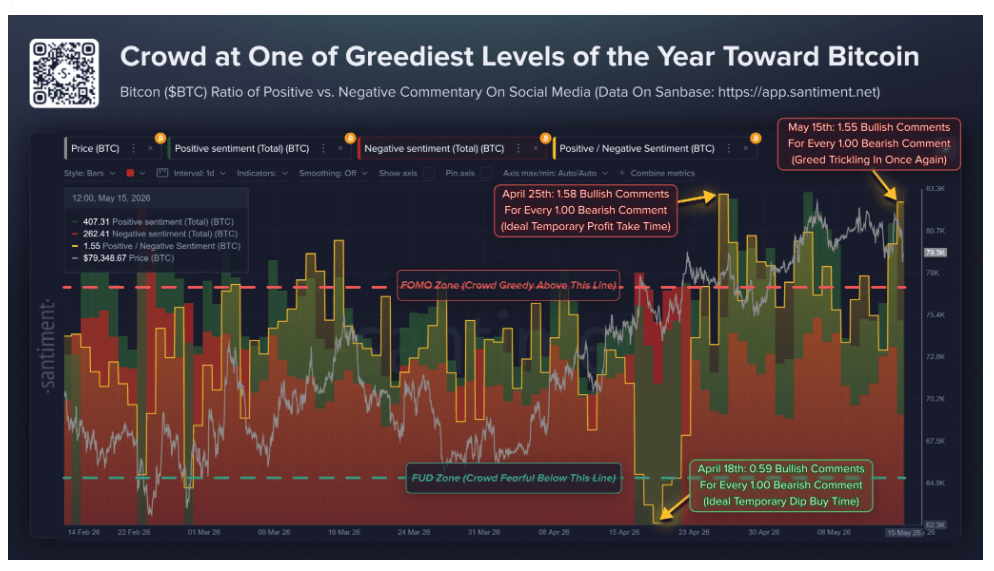
Bitcoin Ratio Of Positive vs. Negative Commentary. Source: @SantimentData On X

CLARITY Act Still Bullish For Bitcoin In The Long Run

The caution around short-term sentiment does not cancel the long-term importance of the CLARITY Act. The bill is designed to create a clearer federal framework for digital assets, including a more defined division of authority between the Securities and Exchange Commission and the Commodity Futures Trading Commission.

BTCUSD currently trading at $78,486. chart: TradingView

The bill was championed by major crypto companies, including Coinbase, Circle, and Ripple, all of which have sought a degree of regulation for the crypto industry. Senior figures linked to these companies also reacted positively on social media after the Senate Banking Committee advanced the legislation.

Coinbase CEO Brian Armstrong, for instance, stated in a post on X: “looking forward to a bipartisan law that cements the US as the world’s crypto capital. Let’s get CLARITY done.”

The bill still needs to be available for a vote from the full Senate, where 60 yes votes will be required. Projections from SoSoValue show a key window between mid-May and early August, with the House recess beginning July 27 and the Senate recess beginning August 10.

If lawmakers fail to complete full Senate consideration and reconciliation before that period, the bill could be pushed deeper into the fall agenda, and the difficulty of passage will rise significantly.
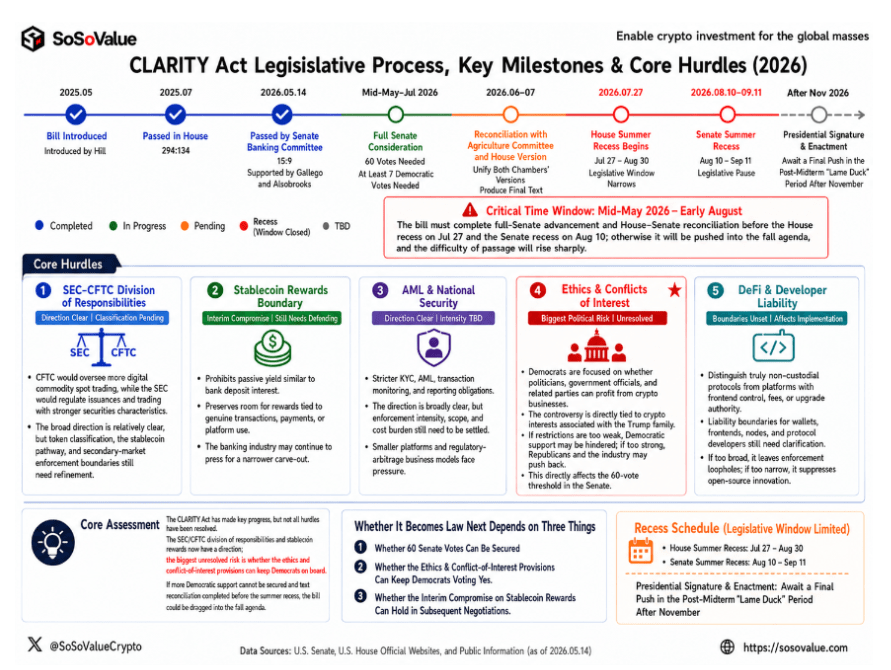
Clarity Act Legislative Process. Source: SoSoValue

Featured image from Unsplash, chart from TradingView

Связанные с этим вопросы

QWhat specific event caused Bitcoin social sentiment to reach a yearly high?

AThe landmark committee approval of the CLARITY Act by the US Senate Banking Committee caused Bitcoin social sentiment to soar to its highest point in months.

QAccording to Santiment's data, what was the ratio of bullish to bearish Bitcoin comments on social media on May 15?

AOn May 15, Santiment's data showed a ratio of 1.55 bullish comments for every 1.00 bearish comment regarding Bitcoin on social media.

QWhat is the main purpose of the CLARITY Act as described in the article?

AThe CLARITY Act is designed to create a clearer federal framework for digital assets, including a more defined division of authority between the Securities and Exchange Commission (SEC) and the Commodity Futures Trading Commission (CFTC).

QWhich major crypto companies are mentioned as champions of the CLARITY Act?

AMajor crypto companies championing the CLARITY Act include Coinbase, Circle, and Ripple.

QWhat are the key legislative deadlines mentioned for the CLARITY Act to be passed by the full Senate?

AProjections show a key window between mid-May and early August, with the House recess beginning July 27 and the Senate recess beginning August 10. If not passed before this period, the bill could be pushed into the fall agenda, making passage significantly more difficult.

Похожее

From Pizza to Unit of Account: A Prehistory of Bitcoin Price Discovery

From Pizza to Unit of Account: The Prehistory of Bitcoin Price Discovery This article traces Bitcoin's earliest price discovery mechanisms, focusing on its functional evolution as a unit of account rather than its price trajectory. The analysis centers on a nine-month period from October 2009 to July 2010, identifying three distinct, sequential layers of price formation. The narrative begins with the cost-of-production anchor established by NewLibertyStandard in October 2009, which calculated a unilateral USD/BTC exchange rate based on the electricity cost of mining. This constituted a posted rate, not a market-discovered price. The second layer emerged with peer-to-peer (P2P) discovery mechanisms starting in March 2010. This included Dustin Dollar's Bitcoin Market platform, which introduced a basic public order book, and forum-based实物 trades. The pivotal event in this phase was Laszlo Hanyecz's purchase of two pizzas for 10,000 BTC on May 22, 2010. Critically, the offer was made exclusively in BTC ("10,000 bitcoins for a couple of pizzas"), marking the first documented instance where Bitcoin functionally acted as a unit of account to price another good in a real transaction, 21 days before Hanyecz later provided a USD anchor (~$25). The third layer commenced in July 2010 with Jed McCaleb's launch of the Mt.Gox exchange. Its continuous order book, with last price, highs, lows, and volume, provided the first standardized, externally referenceable format for BTC/USD prices. The article argues this three-stage evolution—production cost anchor → P2P discovery → centralized continuous quotation—exhibits structural similarities to the historical price discovery paths of other asset classes, such as 17th-century VOC shares in Amsterdam and 19th-century grain futures on the Chicago Board of Trade. It posits that all markets follow a coarse-grained path from private bookkeeping to posted quotes to continuous matching, placing Bitcoin's early development within a centuries-long lineage of financial institutional evolution.

marsbit1 ч. назад

From Pizza to Unit of Account: A Prehistory of Bitcoin Price Discovery

marsbit1 ч. назад

Торговля

Спот
Фьючерсы
活动图片