Shorting the Dip, Buying the Rally? FOMC Outcome Reveals the Truth Behind Bitcoin (BTC) Price Trends
Bitcoin's (BTC) reaction to FOMC decisions often contradicts traders' predictions. Will today's Federal Reserve interest rate decision trigger a market rally or a sell-off?

BTC price broke through $94,000 on Tuesday, coinciding with the day before the Federal Open Market Committee (FOMC) interest rate decision. Historical data indicates that investors should be well-prepared for market volatility.
Looking at 2025, BTC's performance around FOMC meetings reveals that the market typically prices in macroeconomic expectations in advance. This "front-running" behavior by traders often overshadows the actual impact of the policy decisions themselves.
Key Points:
Historical data shows that BTC experiences sell-offs after most FOMC events, even during rate-cutting cycles.
BTC typically sees the largest capital inflows and leverage accumulation before FOMC events, leading to reduced spot liquidity and amplified price volatility after the Fed's decision is announced.
FOMC Results Highlight BTC's Unique Price Pattern
BTC's reaction to the seven FOMC decisions in 2025 reveals a unique pattern: pre-event pricing followed by inconsistent and typically negative post-meeting trends. Below is BTC's specific performance during the seven-day window after each meeting:
Jan 29 — Rates Unchanged: -4.58%
Mar 19 — Rates Unchanged: +5.11%
May 7 — Rates Unchanged: +6.92%
Jun 18 — Rates Unchanged: +1.48%
Jul 30 — Rates Unchanged: -3.15%
Sep 17 — 25 bps Cut: -6.90%
Oct 29 — 25 bps Cut: -8.00%
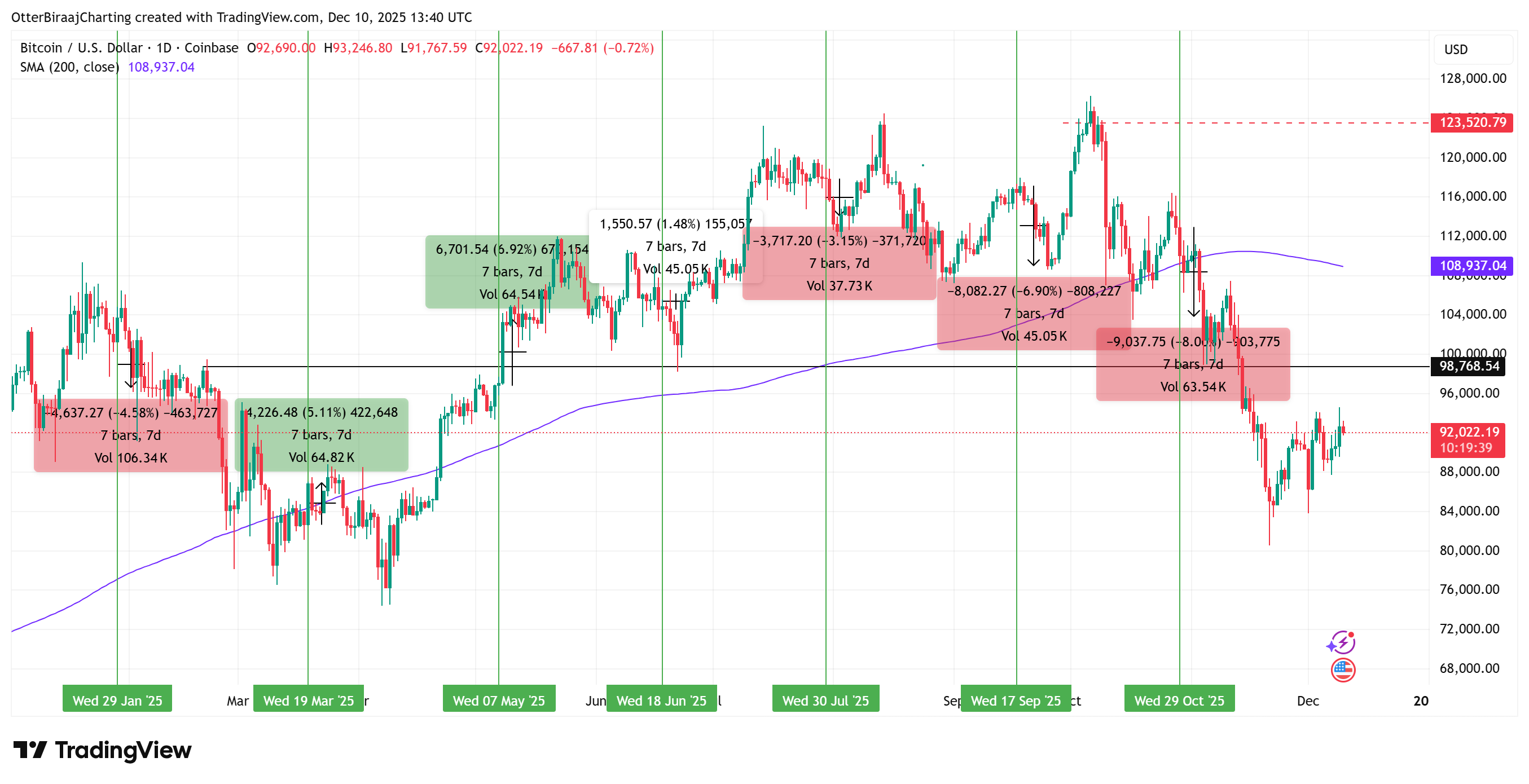
The seven-day return volatility after each meeting ranged from +6.9% to -8%. Notably, the rate-cut meetings resulted in the weakest market performance. This discrepancy is more evident from a market structure perspective rather than macroeconomic headlines. Analysis points to a series of consistent structural factors driving BTC's reaction:
1. Market Positioning Determines Outcome:
Before multiple meetings, particularly in July, September, and October, funding rates and open interest surged significantly, indicating an over-leveraged market. As the chart shows, new capital (1-day to 1-month) realized profits peaked in May, July, and September, which also marked BTC's recent highs.

Most of the "hawkish rally" had already been priced in, resulting in limited buy-side pressure at the time of the FOMC announcement.
2. Rate Cuts Produced the Largest Declines:
The 25 basis point cuts in September and October resulted in seven-day declines of -6.9% and -8%, respectively. Professional analysis indicates that the easing cycle had already been priced in through pre-FOMC capital inflows and aggressive long positions, and the actual implementation of rate cuts instead created market fragility rather than support.
3. Pre-Priced Trends Indicate Fragility, Not Stability:
When policy outcomes are almost certain, pre-meeting volatility is compressed and immediately expands afterward. Traders use confirmed news to reduce exposure, creating predictable short-term market dislocations. Crypto analyst Ardi pointed out:
"History suggests gravity will prevail tomorrow. If we replicate the average decline (approx. 8%), BTC will revisit the $88,000 support level before any upward continuation."
Overall, the data shows that FOMC events act more as market reset points rather than directional catalysts. At these points, overextended positions may be unwound, even if the rate decision itself is hawkish.
Related: Bitcoin's (BTC) year-end push towards $100,000 largely depends on the outcome of the Fed's policy pivot
This article does not contain investment advice or recommendations. Every investment and trading move involves risk, and readers should conduct their own research when making a decision. While we strive to provide accurate and timely information, Cointelegraph does not guarantee the accuracy, completeness, or reliability of any information in this article. This article may contain forward-looking statements that are subject to risks and uncertainties. Cointelegraph shall not be liable for any loss or damage arising from your reliance on this information.