Unfounded panic and worry always emerge and spread for no apparent reason.
This is nothing new throughout history.
The 'Tulip Mania' six hundred years ago was but a fleeting moment; the South Sea Bubble three hundred years ago was merely a passing cloud; the dot-com bubble around the millennium has yet to fully dissipate; the echoes of Lehman Brothers' collapse in the 2008 financial crisis still linger...

The origins of 'Tulip Mania' remain inconclusive to this day.
Now, we are experiencing an unprecedented 'gamble' on AI in history.
Most people do not realize that, unlike the wins and losses of the past few centuries or decades, AI is a gamble where all participants simply cannot afford to lose.
And this time, it's not just about commercial victory or defeat; it's an ultimate game concerning humanity and civilization.
Often, success might just be coincidence

In 2024, Leopold Aschenbrenner, who was fired by OpenAI, founded the hedge fund Situational Awareness, which had an initial size of roughly $200 million. By July of this year, Situational Awareness's size had grown to a staggering $45 billion.
If the story stopped here, this German 'Gen Z' would undoubtedly be vividly written into history as another teenage prodigy, much like SBF, the founder of FTX, once was. SBF's story took a dramatic turn in November 2022, culminating in his imprisonment.
Leopold started with AI and made his fortune through AI. Situational Awareness heavily leveraged positions in storage suppliers like SanDisk, Micron, and SK Hynix.
In the current AI gamble, these once-aging hardware suppliers have become the biggest beneficiaries.
In the second quarter of this year, Samsung Electronics' revenue increased by 130% year-over-year, operating profit surged over 18 times, with the semiconductor division contributing 99% of the company's profits. SK Hynix's revenue grew 257% year-over-year, with operating profit up 557%.
Micron's revenue for Q3 FY2026 grew 345.7% year-over-year, GAAP net profit increased nearly 14-fold. Kioxia's revenue for Q1 FY2026 rose 415.5% year-over-year, net profit increased over 45 times.
SanDisk's revenue for Q4 FY2026 increased 372% year-over-year, GAAP net profit exceeded $6.9 billion, compared to a net loss of $23 million in the same period last year, with a staggering gross margin of 84.6%.
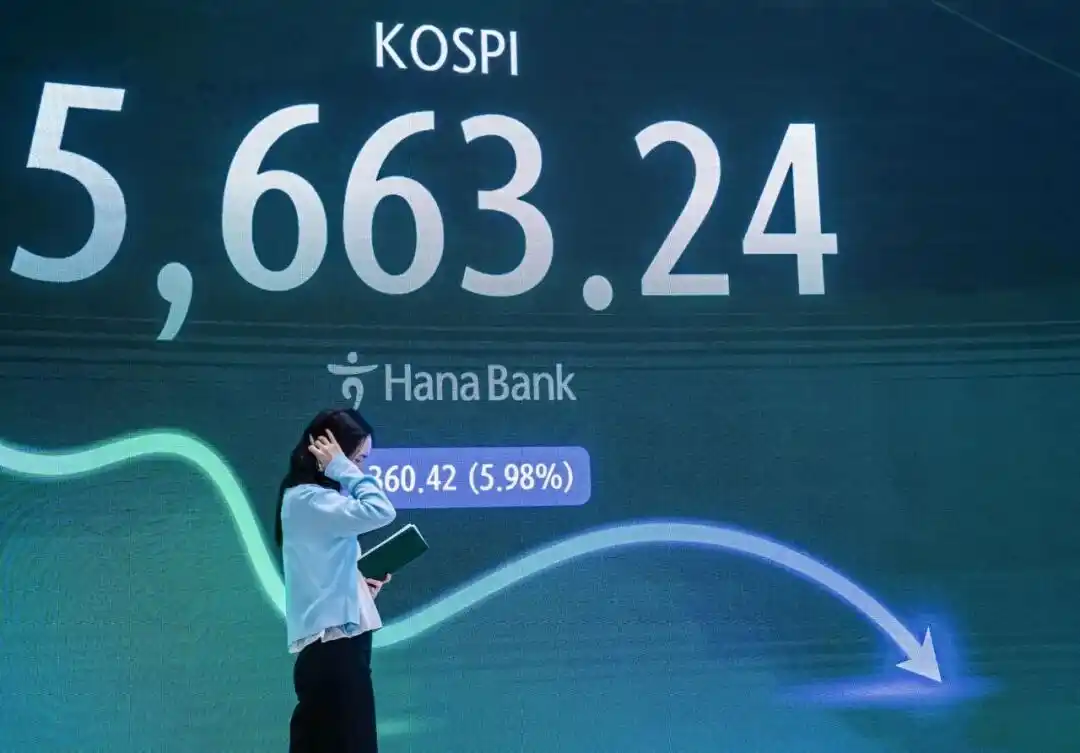
However, by July, the situation took a sharp turn.
Stocks of these manufacturers were sold off on a large scale, with SanDisk's stock price alone falling nearly 47% in July.
The confident Leopold finally met the turning point in his own story. Situational Awareness lost $35 billion in one month, surpassing Bill Hwang's Archegos in 2021 and setting a record for losses in hedge fund history.
The market has its own perception of the situation.
No matter how much we extol the rationality and intellect of the market, no matter how many geniuses with high IQs, or even the use of models and AI as tools, we must still admit that the foundation of market operation remains people—people who cannot remain completely rational and sensible indefinitely.
Thus, one trader takes profits, one institution exits profitable positions, and more market participants follow suit. Eventually, it gradually evolves into a selling storm that spreads across the entire market.
The question is, is this just a 'coincidental' accident?
As the old saying goes, is something changing?
In the United States, social media teen addiction lawsuits (MDL 3047) are exploding. Parents and teens allege that Meta, TikTok, Snapchat, and YouTube designed addictive platforms harmful to adolescent mental health, leading to depression, anxiety, eating disorders, and self-harm. As of August 25, the number of such lawsuits has skyrocketed from less than 1,000 at the beginning of this year to over 3,100.
In the first three years after the lawsuits were initiated, none of the defendants paid any compensation. The sued big companies routinely used Section 230 of the Communications Decency Act as a defense.
However, the situation changed in the first quarter of 2026.
In January, Snap and TikTok secretly settled with plaintiffs before a bellwether trial. In March, a Los Angeles Superior Court jury found Meta and Google negligent in their design choices, ordering them to pay a total of $6 million in damages. In May, the first federal MDL bellwether case reached a settlement before trial, with Snap, TikTok, and YouTube agreeing to a $27 million settlement with plaintiffs.
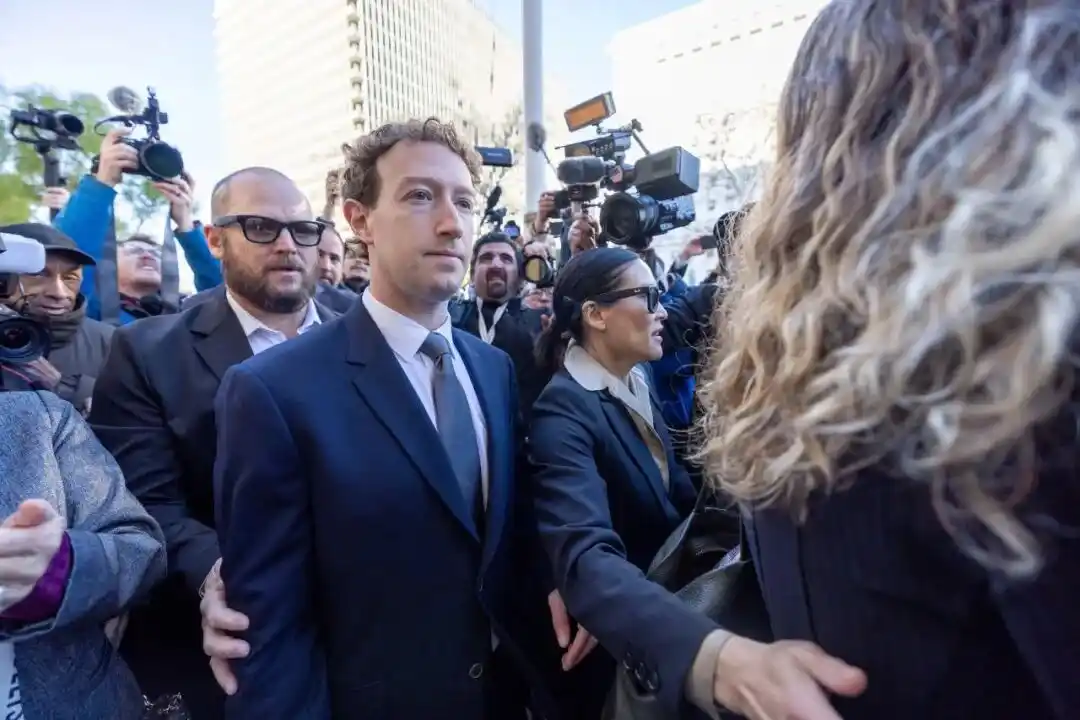
Earlier this year, Zuckerberg attended a hearing in Los Angeles.
On August 18, a lawsuit brought by 29 states against Meta began its trial first in Oakland, with a theoretical maximum penalty of up to $1.4 trillion, which is almost on par with Meta's market capitalization.
This represents a fundamental seismic shift in the business logic of AI.
What does this mean?
For over a decade, user-facing services, platforms, and products have traditionally evaded responsibility with slogans like 'algorithms are blameless' and 'algorithms can be value-neutral.'
However, with the rise of AI, companies and entrepreneurs can no longer use the same justifications to absolve themselves of the risks and drawbacks associated with AI.
Once AI is used to write code or develop products, companies are liable for problems that arise. If user-published AI-generated content infringes on copyrights and the rights of others, platforms must also bear corresponding secondary liability.
In short, the institutional governance of AI in the U.S. still faces significant legal uncertainties in practice, which is the most prominent destabilizing factor in the current massive AI capital gamble.
With the support of the White House establishment and the federal government, companies like Google, Microsoft, OpenAI, Meta, Anthropic, and Pentair are trying desperately to solidify their first-mover advantage in the AI race. However, factional and institutional struggles are, intentionally or unintentionally, imposing resistance.
And uncertainty is not only the root cause of short-term volatility in the AI capital market but also its inevitable trend.
But if we extend our perspective to a scale of five or ten years, we will realize that there exists an even greater crisis of inevitability within this.
Q2 saw Google post its first-ever negative free cash flow of $5.9 billion
In the first half of this year, Google's operating revenue reached $80.5 billion, yet its free cash flow plummeted from approximately $24.3 billion to just $4.3 billion.
From 2024 to 2025, Google's capital expenditures grew from $52.5 billion to $91.4 billion. Its spending is projected to reach $200 billion in 2026 and will continue to increase significantly in 2027.
In 2025, total spending by large companies like Amazon, Google, Meta, Microsoft, and Oracle on artificial intelligence amounted to only $121 billion.
UBS analysts predict that global companies will add up to $900 billion in new debt in 2026. Morgan Stanley and JPMorgan are bolder, predicting that the tech industry may need to issue up to $1.5 trillion in new debt in the coming years to fund artificial intelligence and data center infrastructure construction.
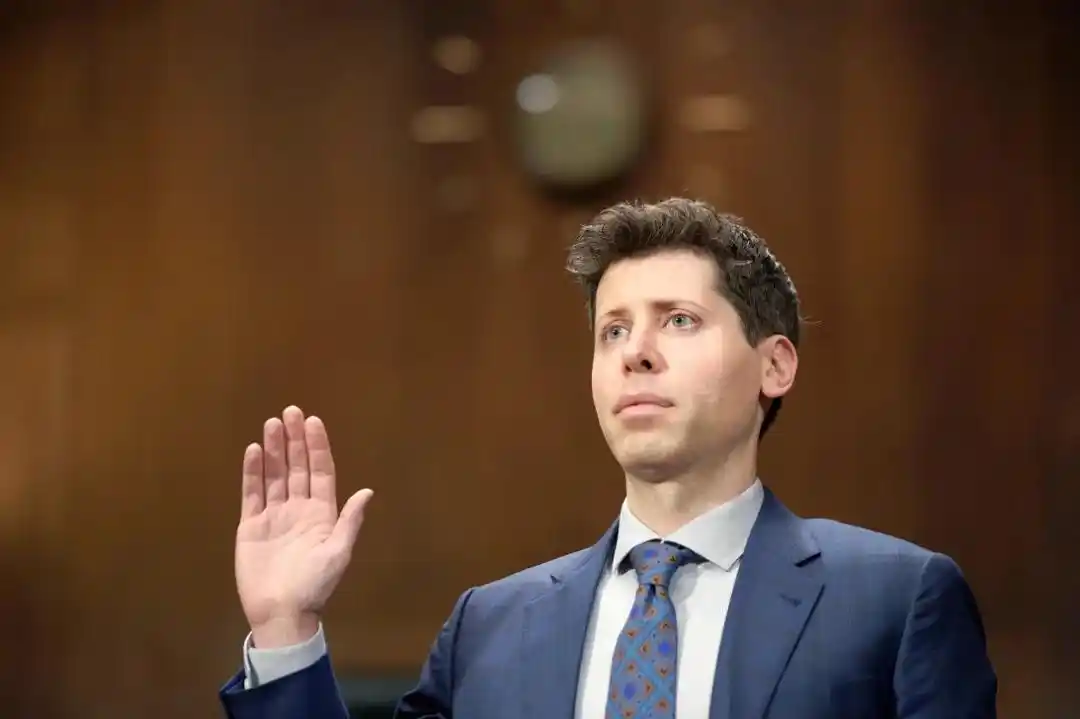
In 2023, OpenAI CEO Sam Altman testified before Congress.
OpenAI's goal is to invest a cumulative $600 billion by 2030, with a previous expectation as high as $1.4 trillion.
Pushing development through debt, if not exactly like drinking poison to quench thirst, at least constitutes a form of intense internal competition in the truest sense.
And what is the result of this internal competition?
In 2023, OpenAI's revenue was approximately $2 billion. In March of this year, the company stated its monthly revenue had reached $2 billion. OpenAI predicts it will become profitable by 2030.
In May of this year, after completing a $65 billion financing round, Anthropic announced its annualized revenue run rate had already reached $47 billion by early May. Three months later, the company claimed its revenue for 2028 would be between $190 and $200 billion. The company's latest forecast is that its Total Addressable Market (TAM) exceeds $30 trillion.
Currently, OpenAI's valuation exceeds $840 billion, and Anthropic's valuation exceeds $965 billion, and both have secretly filed IPO draft prospectuses.
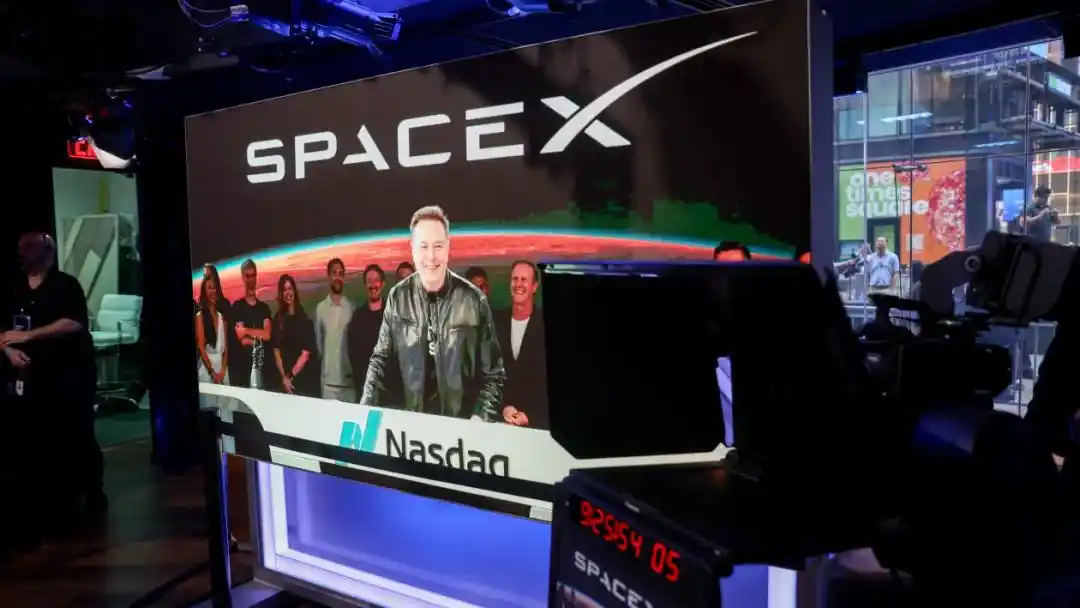
The capital market inevitably compares them to SpaceX, which currently has a market cap exceeding $1.85 trillion.
This company's revenue for April to June this year was $7.8 billion, a year-over-year increase of over 90%, with its artificial intelligence business revenue growing approximately 250% year-over-year. However, SpaceX's capital expenditures surged from $2.83 billion in the same period last year to over $18 billion, and its AI capital expenditures increased significantly from $749 million to $15.83 billion.
Clearly, the development of the AI market heavily relies on the continuous blood transfusion of capital. At first glance, this seems like a game of being friends with time.
However, an obvious but overlooked issue is that, according to OpenAI's established profitability timeline, the company only has four years left. Don't forget, just four years ago, NVIDIA was a gaming graphics card company with a stock price under $20. In the past five years, Beyond Meat, once a highly popular meat substitute company, has seen its stock price plummet over 99%.
AI capital and the market are more like counterparts to time.
Time is money. Capitalist society reveres this principle as a guiding maxim, and how apt it is to describe the development trend and trajectory of AI. Through historically unprecedented levels of investment, the participants in this gamble are attempting to buy time advantages with money, or at least delay certain disadvantages.
This is precisely the current situation in the United States as well.
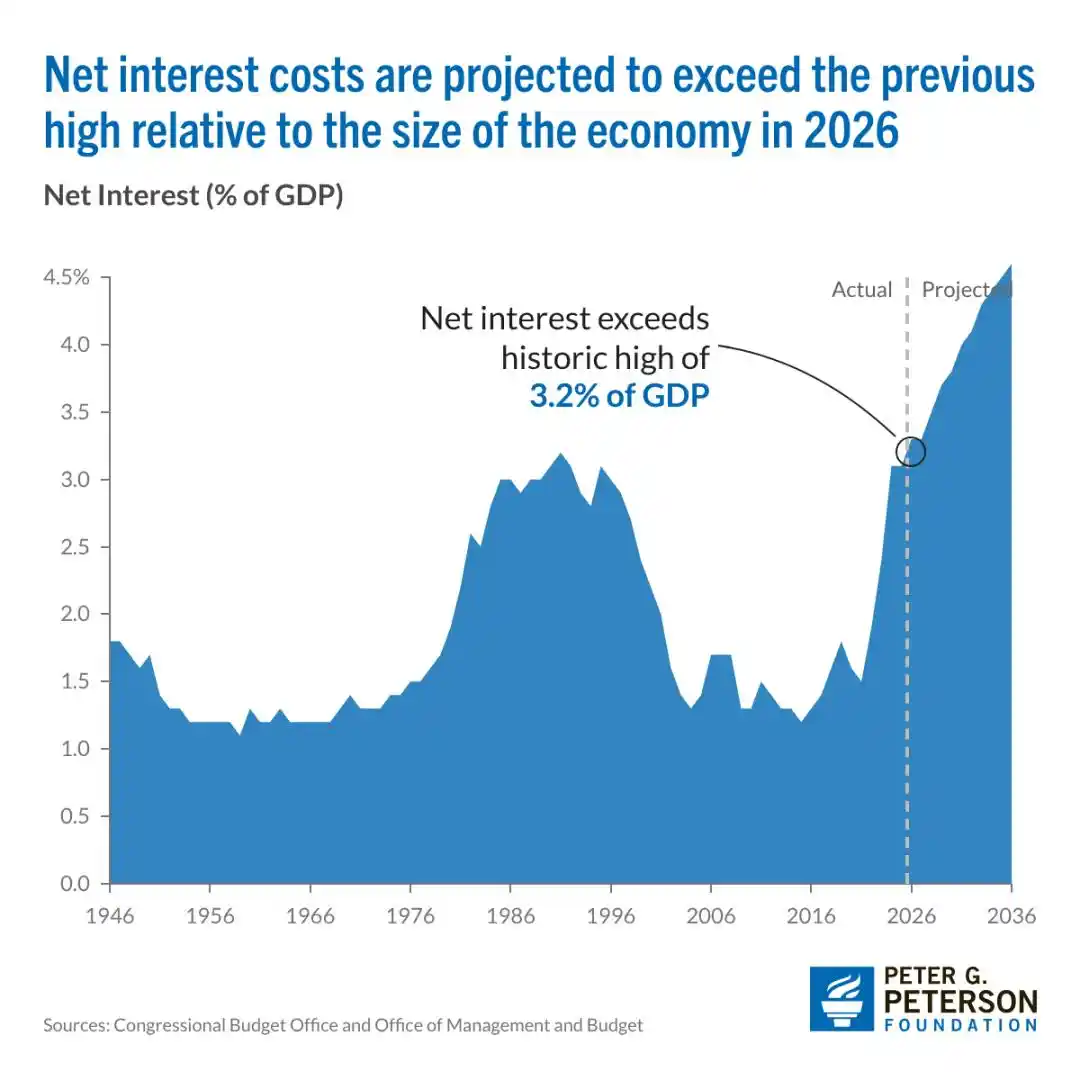
Due to rising short-term and long-term interest rates over the past few years, the interest cost on the national debt has increased significantly. The Congressional Budget Office (CBO) projects that the interest cost will exceed $1 trillion in 2026. By 2027, the interest cost will surpass defense, Medicare, and Medicaid to become the government's second-largest expenditure item. By 2036, it is projected to reach $2.1 trillion. Over the ten years starting from 2026, the interest cost on U.S. debt is projected to be a staggering $16.2 trillion.
It's worth noting that the CBO predicts that if interest rates on new debt rise, the average interest rate will exceed the economic growth rate (R>G) by 2029, and this gap will reach 75 basis points by 2036.
Rising interest rates push up debt, rising debt pushes up interest rates, and rising interest rates in turn continue to increase interest costs. Such a vicious cycle is not alarmist in suggesting it could ultimately trigger a debt crisis.
This crisis is the fundamental reason why the U.S. capital market is investing in the AI field with lightning speed and full force. Capital is convinced that AI, like the internet in the last century, will once again help the U.S. gain and consolidate its position as the sole leader.
Let's imagine one possibility: if the true technological singularity is not AI, or if the scale and returns of the AI market in the next decade are not as vast as capital predicts, what if dual capital crises at both the market and national levels erupt simultaneously? How would we handle such a situation then?
This article is from the WeChat public account "AI Value Officer," author: RELIEX