Bitcoin faces true demand test above $83K as liquidity thickens: Glassnode

cointelegraphPublished on 2026-08-27Last updated on 2026-08-27

Abstract

According to Glassnode, Bitcoin faces a significant test of genuine demand above $83,000 as key overhead resistance thickens between $81,000 and $86,000. This zone contains a substantial supply of coins held by long-term holders who bought during the drawdown and are now at breakeven, posing a major selling risk. Additional resistance comes from new ask liquidity on exchanges and critical technical levels, including the dealer gamma flip point and a liquidation shelf. Furthermore, multiple major trend lines—the 50-week and 100-week exponential moving averages and the 365-day volume-weighted average price—are converging around the current price area, reinforcing its importance. Analysts suggest that for a sustained bullish trend to be confirmed, Bitcoin must convincingly overcome this resistance band and hold above the 50-week EMA.

Bitcoin (BTC) has struggled to flip $80,000 into support in recent days, but bulls’ real challenge is still to come, new research says.


Key points:


  • Bitcoin long-term holders add to BTC price resistance below $86,000, Glassnode reveals.
  • Buyer demand must overcome this area as Bitcoin struggles to advance beyond $80,000.
  • Multiple key trend lines sit around spot price, increasing the implications of an eventual loss or reclaim.


Glassnode: Key overhead liquidity structures sit between $81,000 and $86,000


In the latest edition of its regular newsletter, The Week Onchain, crypto analytics platform Glassnode flagged multiple pools of coins that could be released into the market below $86,000.


Of particular interest are long-term holders (LTHs) — wallets holding BTC without selling for at least six months.


“Above, the first heavy structure is $83K-86K, and effectively all of it is long-term holder supply that has sat through the entire drawdown,” it wrote, predicting that reaching $83,000 would test the resolve of the LTH cohort not to sell at breakeven.
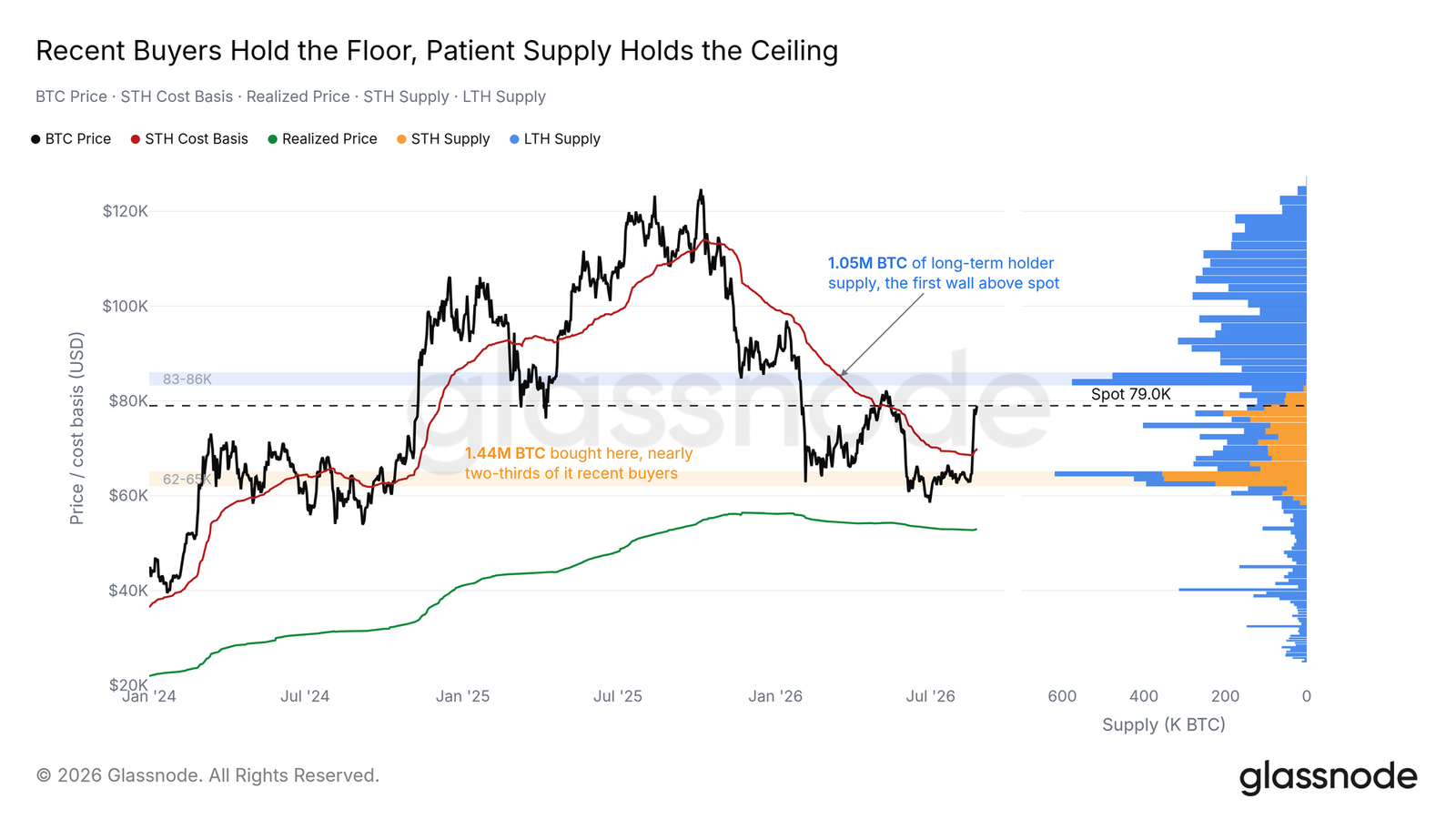
BTC supply distribution by wallet cohort. Source: Glassnode


In the same zone, new ask liquidity has appeared on exchange order books. Its owners, Glassnode notes, may not intend for their orders to be filled, instead aiming to stay above spot price should it rise further.


“The re-laddered asks join a stack of independent structure pointing at one zone. The first self-custody cost-basis shelf begins at $80.8K, dealer gamma flips negative at $82.3K, the surviving liquidation shelf runs to $86K, and the patient-supply wall fills $83K-86K,” it continued.


“Every overhead structure we track now sits between $81K and $86K; that band is where the recovery’s demand meets its test.”
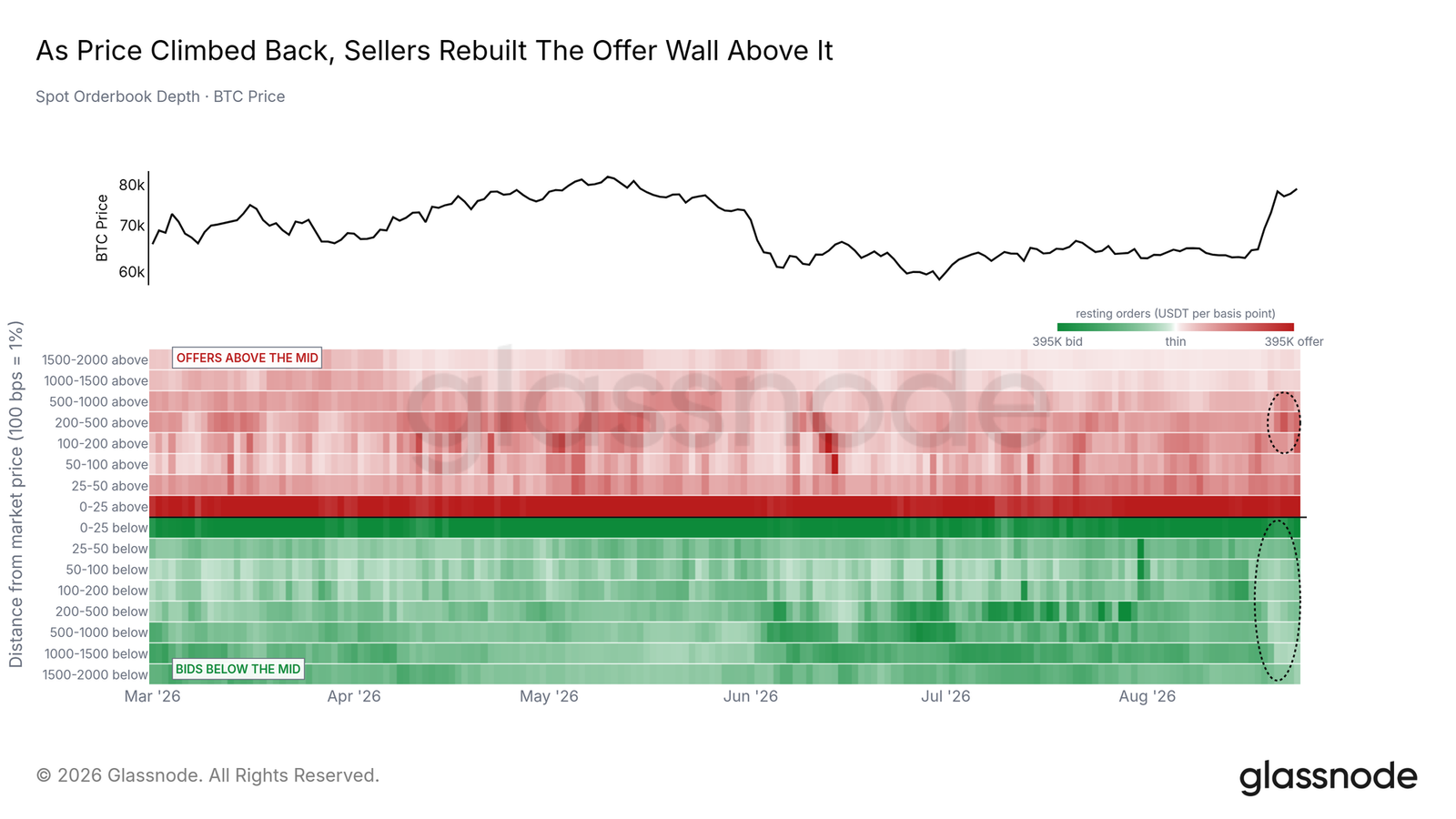
BTC spot order-book heatmap. Source: Glassnode


Trend lines converge on a narrow BTC price corridor


The area around $80,000 has also seen multiple price trend lines converge, strengthening its status as a resistance hurdle.


Related: BTC RSI bullish divergence draws 2022 comparisons as analysis weighs new price trend


Bitcoin’s 50-week and 100-week exponential moving averages (EMAs) currently sit at $77,353 and $78,485, respectively, per data from TradingView. Additionally, Bitcoin’s 365-day volume-weighted average price (VWAP), a moving average that factors in volume, sits around $82,600.
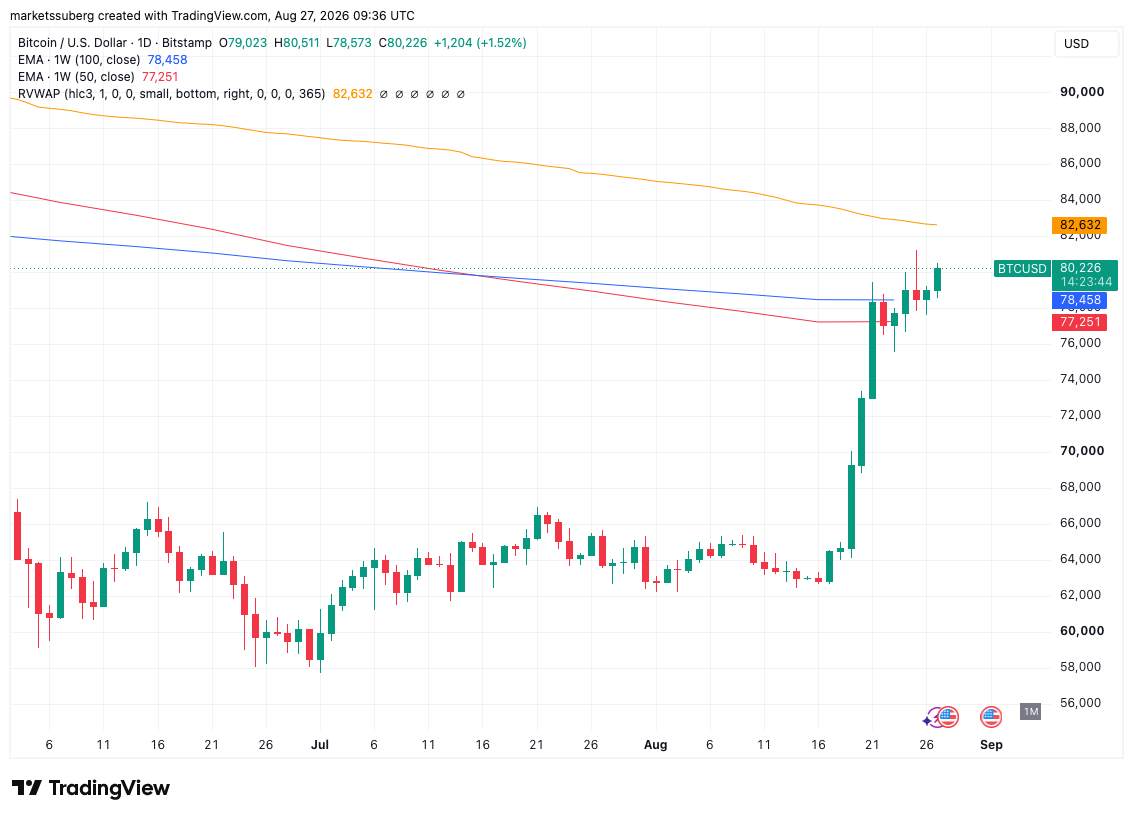

BTC/USD one-day chart with 50-week, 100-week EMA; 365-day rolling VWAP. Source: Cointelegraph/TradingView


Previously, Cointelegraph reported on the skepticism of market participants over whether Bitcoin’s rapid rebound would endure. With regular bear market timing due to continue until the end of 2026, trader and analyst Rekt Capital stressed that price needs to hold the 50-week EMA for longer before a meaningful trend change can be considered.



Related Questions

QAccording to the article, what is the key price range where Bitcoin faces a significant demand test according to Glassnode?

AAccording to Glassnode, the key price range where Bitcoin faces a significant demand test is between $81,000 and $86,000. This band contains multiple overhead liquidity structures that the recovery's demand must overcome.

QWho are the 'long-term holders' (LTHs) mentioned in the article, and what potential role do they play around the $83K-$86K range?

ALong-term holders (LTHs) are wallets that have held Bitcoin (BTC) without selling for at least six months. In the $83K-$86K range, they represent a heavy supply structure, as they have held through the entire drawdown. Reaching $83,000 would test their resolve not to sell at their breakeven cost basis, potentially creating selling pressure.

QBesides long-term holder supply, what other structures contribute to resistance in the $81K-$86K band as detailed by Glassnode?

ABesides long-term holder supply, other resistance structures in the $81K-$86K band include: new ask liquidity on exchange order books (possibly placed to stay above a rising price), the first self-custody cost-basis shelf starting at $80.8K, dealer gamma flipping negative at $82.3K, and a surviving liquidation shelf that runs up to $86K.

QWhat three key moving averages or price metrics are currently converging around the $80,000 level, according to the article?

AThe three key moving averages or price metrics converging around the $80,000 level are: Bitcoin's 50-week Exponential Moving Average (EMA) at $77,353, its 100-week EMA at $78,485, and its 365-day Volume-Weighted Average Price (VWAP) around $82,600.

QWhat condition does analyst Rekt Capital say must be met for a meaningful Bitcoin trend change to be considered?

AAnalyst Rekt Capital stated that for a meaningful Bitcoin trend change to be considered, the price needs to hold above the 50-week Exponential Moving Average (EMA) for a longer period of time.

Related Reads

First Historic Step Taken Against the Main Quantum Threat to Bitcoin! Here Are the Details

A historic first step has been taken to counter the primary quantum threat to Bitcoin. Rapid advancements in quantum computing have heightened concerns that powerful quantum computers could eventually break the cryptographic systems securing cryptocurrencies like Bitcoin, making the transition to quantum-resistant technologies crucial. In a key development, StarkWare announced the completion of the first transaction in the Bitcoin mainnet designed to be secure against quantum computing threats. This was achieved using their Quantum Safe Bitcoin (QSB) method, which was confirmed by Bitcoin miners. QSB replaces the traditional elliptic curve cryptography (used in ECDSA and Schnorr signatures) with a hash-based cryptographic system believed to be resistant to quantum algorithms like Shor's, which could otherwise derive private keys from exposed public keys. A significant feature of QSB is its ability to integrate into Bitcoin's existing scripting standards without needing a consensus change or a soft fork. However, a major current drawback of QSB is its high computational cost. While initial estimates projected costs between $75-$150, actual mainnet testing revealed expenses around $150-$200 or even several hundred dollars per transaction, with the computation process taking several hours. Consequently, QSB is presently viewed as an experimental method for protecting high-value Bitcoin holdings from future quantum attacks, rather than a cost-effective solution for everyday transactions.

cryptonews.ru15m ago

First Historic Step Taken Against the Main Quantum Threat to Bitcoin! Here Are the Details

cryptonews.ru15m ago

Trading

Spot
活动图片