Bitcoin reclaims $95,000 as short liquidations trigger two-month breakout

AmbcryptoPublished on 2026-01-13Last updated on 2026-03-15

Abstract

Bitcoin hits $95,000 for the first time in nearly two months as short liquidations near $250 million.

Bitcoin has surged past $95,000, marking its highest level in nearly two months after breaking out of a prolonged consolidation range that had capped price action.

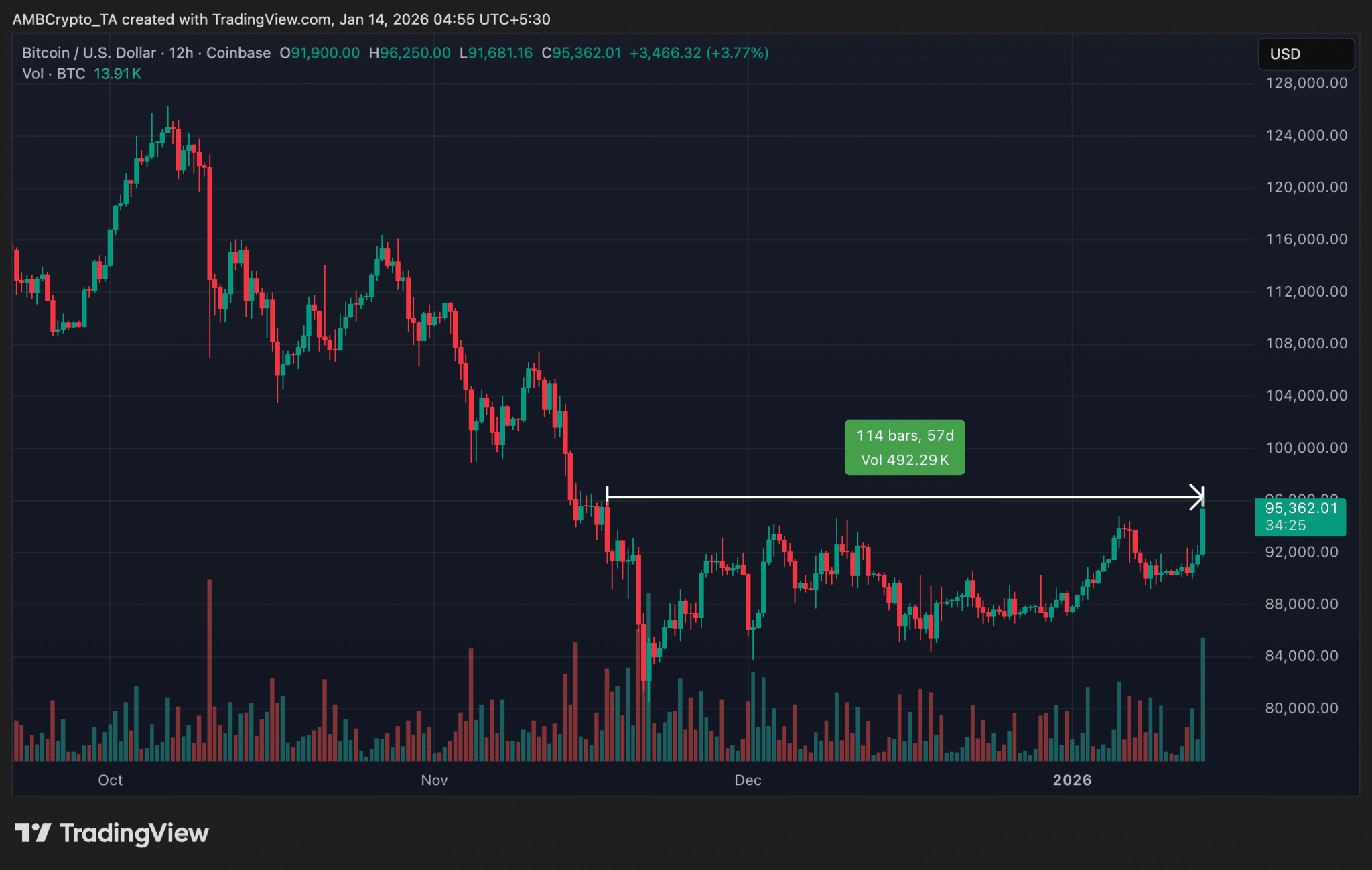
On the 12-hour TradingView chart, BTC reached a high of $96,250 before pulling back slightly, with the price last trading near $95,360.

The move decisively cleared the $93,000–$94,000 resistance zone. This area had contained Bitcoin for roughly 57 days, equivalent to 114 twelve-hour candles. This makes the breakout structurally significant rather than just another short-term spike.
Long consolidation phases like this typically act as pressure chambers, where liquidity builds on both sides of the market.

Traders accumulate positions, stop-loss orders cluster around key levels, and leverage increases. When price finally escapes that range, the release of trapped positions often fuels rapid and exaggerated moves.

That dynamic is clearly visible in Bitcoin’s latest rally.

Short liquidations drove the Bitcoin breakout

Liquidation data from Coinglass shows that an aggressive wave of forced short closures accompanied the surge above $93,000.

In the 12-hour window that coincided with the breakout, short liquidations spiked to nearly $250 million, while long liquidations remained comparatively small.
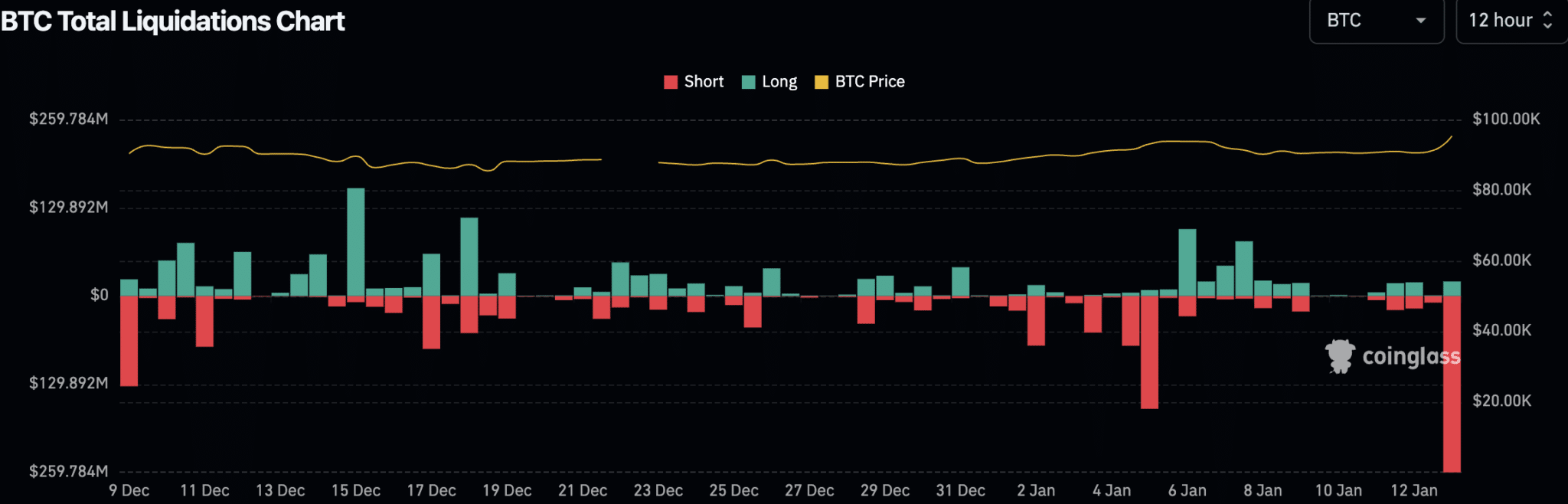
This imbalance confirms that bearish traders were heavily positioned against Bitcoin after weeks of sideways trading. Many had been betting that the $93,000–$94,000 zone would continue to hold as resistance.

When BTC pushed above that ceiling, stop-losses and margin calls were triggered, forcing short sellers to buy back BTC at market price.

That feedback loop, shorts buying into rising price, created a classic short squeeze, accelerating the rally toward $95,000 and beyond.

The price structure also supports this interpretation. After bottoming near $84,000 in late November, Bitcoin began forming higher lows throughout December and early January, even as it failed to break higher.

This gradually tightened the range until bullish pressure finally overwhelmed the sell side.

Why $95,000 matters

The reclaim of $95,000 is not just psychologically important; it shifts the technical landscape. The former consolidation ceiling near $93,000 now acts as first-line support.

At the same time, the next major resistance lies between $96,000 and $98,000, an area that previously marked a distribution point before the November sell-off.

If Bitcoin holds above its breakout level, market participants will interpret the move as a trend transition rather than a temporary squeeze.

With short sellers largely flushed out and liquidity reset, follow-through buying could push BTC toward a retest of six-figure prices in the coming sessions.

Final Thoughts

  • Bitcoin’s breakout was driven by a wave of short liquidations near $250m, forcing bearish traders to buy back into the rally, pushing BTC through the resistance zone.
  • Clearing this two-month ceiling shifts Bitcoin’s market structure back to bullish, with $93,000 now acting as a key support level.


Related Questions

QWhat price level did Bitcoin reclaim and what was the significance of this breakout?

ABitcoin reclaimed the $95,000 level. The breakout was structurally significant because it decisively cleared the $93,000–$94,000 resistance zone that had contained the price for approximately 57 days, marking a potential trend transition rather than a short-term spike.

QWhat was the primary catalyst that drove Bitcoin's price surge above the resistance zone?

AThe primary catalyst was a wave of short liquidations. Aggressive forced closures of bearish positions spiked to nearly $250 million in a 12-hour window, creating a feedback loop where short sellers had to buy back BTC, accelerating the rally in a classic short squeeze.

QAccording to the article, what is the new role of the $93,000 price level after the breakout?

AAfter the breakout, the former consolidation ceiling near $93,000 now acts as the first-line support level.

QHow long had Bitcoin been trading within the consolidation range before breaking out?

ABitcoin had been trading within the consolidation range, capped by the $93,000–$94,000 zone, for roughly 57 days, which is equivalent to 114 twelve-hour candles.

QWhat is the next major resistance area that Bitcoin might face, as mentioned in the article?

AThe next major resistance area lies between $96,000 and $98,000, which previously marked a distribution point before the sell-off in November.

Related Reads

Deconstructing the Capital Game of Public Chain Pharos: A $950 Million Valuation Propped Up by Photovoltaic and Other Assets, A Shell Transaction Under Layers of Betting?

The article investigates the recent $247.3 million investment by Hong Kong-listed GCL New Energy into the Layer 1 blockchain project Pharos at a $950 million valuation. It reveals the deal is not a straightforward investment but a complex, multi-stage transaction bound by stringent performance milestones. The core of the agreement is a set of mutual, conditional investments. Pharos must first purchase up to $1.5 billion HKD worth of GCL shares. However, GCL's reciprocal investment in Pharos tokens is contingent upon a series of strict, performance-based vesting conditions. The entire deal is split into five tranches, each unlocking only if the Pharos token lists on an exchange without falling below its issue price and maintains a high fully diluted valuation (FDV) over successive three-month periods. If any condition fails, the entire agreement can be terminated. The article questions the legitimacy of the $950 million valuation, which was calculated based on a purported $250 million in Total Value Locked (TVL). Notably, over half of this TVL is claimed to be from real-world assets (RWA), specifically photovoltaic and power station assets linked to GCL—a highly unconventional method for valuing a Layer 1 blockchain. Furthermore, the mainnet is not yet live, and the TVL figure is unverified by independent data platforms. The author suggests the deal is a "capital game" designed to boost GCL's stock price, which saw suspicious pre-announcement surges, and to create hype for the upcoming Pharos token launch, ultimately passing the risk onto the market and future investors.

marsbit1h ago

Deconstructing the Capital Game of Public Chain Pharos: A $950 Million Valuation Propped Up by Photovoltaic and Other Assets, A Shell Transaction Under Layers of Betting?

marsbit1h ago

Comprehensive Analysis of Canton Network: Wall Street's Blockchain Ambition

Canton Network is positioned at the convergence of key crypto trends, including real-world asset tokenization, institutional blockchain adoption, privacy infrastructure, and stablecoin settlements. It has attracted major financial institutions like DTCC, Nasdaq, and Broadridge, which are deploying real workflows such as treasury tokenization, repo financing, and collateral management. The network is designed for regulated entities, offering granular transaction privacy and validator-level control while maintaining interoperability. Its architecture separates execution from coordination, using validator nodes operated by participants and synchronizers for atomic settlement. Key adoptions include DTCC tokenizing U.S. Treasuries, Broadridge processing trillions in repo transactions, and Nasdaq integrating its Calypso platform. Tokenomics are usage-driven, with weekly CC burns increasing by 216% since TGE, and the burn-to-mint ratio rising to 0.90, nearing a deflationary state. Despite generating the highest revenue among L1s in February, Canton trades at a discount to peers, possibly due to high emissions and its perception as financial infrastructure. Catalysts include regulatory clarity from the Clarity Act and DTCC’s broader tokenization platform launch in late 2026. Risks include token concentration, with 54% of CC held by a few entities, though these are largely operational holdings. Canton aims to become a core coordination layer for tokenized financial markets.

marsbit1h ago

Comprehensive Analysis of Canton Network: Wall Street's Blockchain Ambition

marsbit1h ago

Which Areas Still Have Moats in the AI Era?

In the AI era, certain moats remain despite rapid technological advancement. The author, a former hedge fund manager, argues that the true inflection point occurred when AI models like ChatGPT’s o1 began generating functional code—even with imperfections—enabling recursive self-optimization and fundamentally altering software development. Key short-term moats identified include: 1. **Proprietary Data**: Firms with unique, inaccessible data (e.g., multi-strategy hedge funds) can fine-tune models, creating defensible advantages. 2. **Regulatory Friction**: Industries requiring human approval (e.g., traditional finance) face slower disruption due to compliance and legal barriers. 3. **Authority-as-a-Service**: Human trust in institutional authority (e.g., legal or audit services) persists even if AI outperforms humans technically. 4. **Physical World Lag**: Hardware-dependent sectors evolve slower, delaying full AI integration. However, these moats only delay, not prevent, disruption. The author emphasizes acting on signals rather than waiting for certainty: identify directional trends, place asymmetric bets (limited downside, high upside), and iterate through action. As AI accelerates, windows of opportunity close quickly. To remain relevant, humans must excel in long-term strategy, complex system-level thinking, and collaboration—areas where AI still lags. The time to act is now, before markets price in the obvious.

marsbit1h ago

Which Areas Still Have Moats in the AI Era?

marsbit1h ago

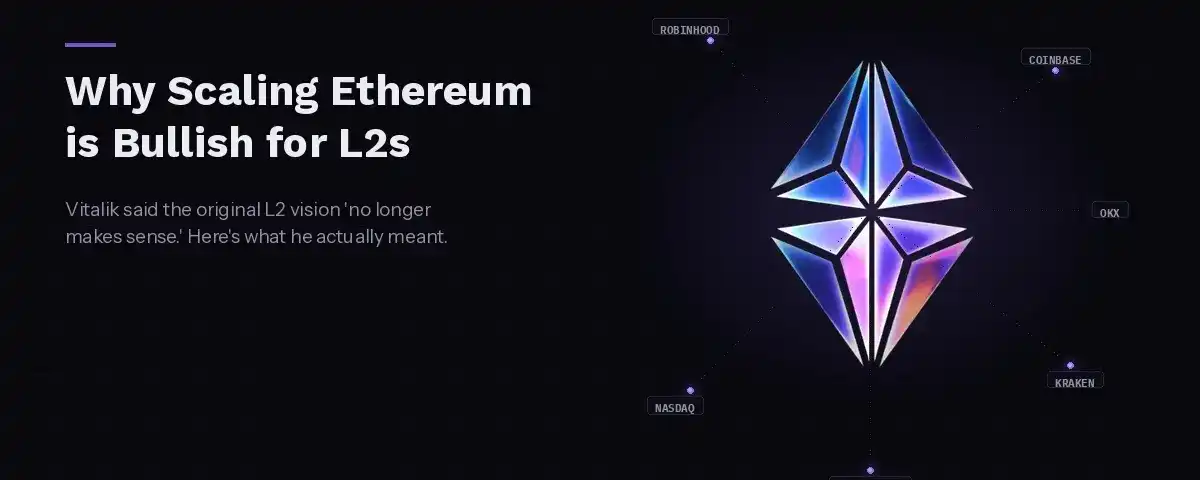
Actually, ETH Scaling is a Major Boon for L2s

Vitalik Buterin's recent comments on Ethereum scaling have been misinterpreted. He did not declare Layer 2s (L2s) a failure but rather signaled a strategic shift: Ethereum is moving from a "rollup-centric" scaling model, where L2s were seen as simple replicas of the base layer, to one where the L1 itself undergoes aggressive scaling. L2s remain crucial, but their primary value proposition has evolved to be customization, not just cheap transactions. Two key developments drove this change. First, Ethereum's base layer is scaling faster than anticipated. After years of cautious progress to preserve decentralization, an ambitious new roadmap aims to drastically increase L1 throughput through a series of upgrades, including a higher gas limit, faster block times, parallel transaction processing, and a fundamental transition to a native zero-knowledge (zkEVM) architecture. This allows Ethereum to scale while maintaining its superior decentralization. Second, L2s have found product-market fit with institutions. Companies like Robinhood, Coinbase, and Kraken are building their own L2s because they need Ethereum's security and access to its liquidity, but also require control for regulatory compliance, custom fee structures, and operational flexibility. This creates a spectrum of L2s, from highly decentralized ones to more controlled, institutionally-focused chains—a reality Vitalik acknowledges is valid as long as marketing is honest. Crucially, scaling the L1 does not compete with L2s; it makes them better. A more powerful L1 means cheaper data availability and settlement costs for L2s, faster withdrawals, and quicker finality. The main unresolved challenge is liquidity fragmentation between L2s, which the Ethereum Foundation is prioritizing with new interoperability solutions for 2026. The narrative that Ethereum is abandoning L2s is incorrect. The ecosystem is maturing into a system with a radically scaling L1 at its core, surrounded by a flourishing ecosystem of specialized L2s.

marsbit3h ago

Actually, ETH Scaling is a Major Boon for L2s

marsbit3h ago

Trading

Spot
Futures

Hot Articles

What is $BITCOIN

DIGITAL GOLD ($BITCOIN): A Comprehensive Analysis Introduction to DIGITAL GOLD ($BITCOIN) DIGITAL GOLD ($BITCOIN) is a blockchain-based project operating on the Solana network, which aims to combine the characteristics of traditional precious metals with the innovation of decentralized technologies. While it shares a name with Bitcoin, often referred to as “digital gold” due to its perception as a store of value, DIGITAL GOLD is a separate token designed to create a unique ecosystem within the Web3 landscape. Its goal is to position itself as a viable alternative digital asset, although specifics regarding its applications and functionalities are still developing. What is DIGITAL GOLD ($BITCOIN)? DIGITAL GOLD ($BITCOIN) is a cryptocurrency token explicitly designed for use on the Solana blockchain. In contrast to Bitcoin, which provides a widely recognized value storage role, this token appears to focus on broader applications and characteristics. Notable aspects include: Blockchain Infrastructure: The token is built on the Solana blockchain, known for its capacity to handle high-speed and low-cost transactions. Supply Dynamics: DIGITAL GOLD has a maximum supply capped at 100 quadrillion tokens (100P $BITCOIN), although details regarding its circulating supply are currently undisclosed. Utility: While precise functionalities are not explicitly outlined, there are indications that the token could be utilized for various applications, potentially involving decentralized applications (dApps) or asset tokenization strategies. Who is the Creator of DIGITAL GOLD ($BITCOIN)? At present, the identity of the creators and development team behind DIGITAL GOLD ($BITCOIN) remains unknown. This situation is typical among many innovative projects within the blockchain space, particularly those aligning with decentralized finance and meme coin phenomena. While such anonymity may foster a community-driven culture, it intensifies concerns about governance and accountability. Who are the Investors of DIGITAL GOLD ($BITCOIN)? The available information indicates that DIGITAL GOLD ($BITCOIN) does not have any known institutional backers or prominent venture capital investments. The project seems to operate on a peer-to-peer model focused on community support and adoption rather than traditional funding routes. Its activity and liquidity are primarily situated on decentralized exchanges (DEXs), such as PumpSwap, rather than established centralized trading platforms, further highlighting its grassroots approach. How DIGITAL GOLD ($BITCOIN) Works The operational mechanics of DIGITAL GOLD ($BITCOIN) can be elaborated on based on its blockchain design and network attributes: Consensus Mechanism: By leveraging Solana’s unique proof-of-history (PoH) combined with a proof-of-stake (PoS) model, the project ensures efficient transaction validation contributing to the network's high performance. Tokenomics: While specific deflationary mechanisms have not been extensively detailed, the vast maximum token supply implies that it may cater to microtransactions or niche use cases that are still to be defined. Interoperability: There exists the potential for integration with Solana’s broader ecosystem, including various decentralized finance (DeFi) platforms. However, the details regarding specific integrations remain unspecified. Timeline of Key Events Here is a timeline that highlights significant milestones concerning DIGITAL GOLD ($BITCOIN): 2023: The initial deployment of the token occurs on the Solana blockchain, marked by its contract address. 2024: DIGITAL GOLD gains visibility as it becomes available for trading on decentralized exchanges like PumpSwap, allowing users to trade it against SOL. 2025: The project witnesses sporadic trading activity and potential interest in community-led engagements, although no noteworthy partnerships or technical advancements have been documented as of yet. Critical Analysis Strengths Scalability: The underlying Solana infrastructure supports high transaction volumes, which could enhance the utility of $BITCOIN in various transaction scenarios. Accessibility: The potential low trading price per token could attract retail investors, facilitating wider participation due to fractional ownership opportunities. Risks Lack of Transparency: The absence of publicly known backers, developers, or an audit process may yield skepticism regarding the project's sustainability and trustworthiness. Market Volatility: The trading activity is heavily reliant on speculative behavior, which can result in significant price volatility and uncertainty for investors. Conclusion DIGITAL GOLD ($BITCOIN) emerges as an intriguing yet ambiguous project within the rapidly evolving Solana ecosystem. While it attempts to leverage the “digital gold” narrative, its departure from Bitcoin's established role as a store of value underscores the need for a clearer differentiation of its intended utility and governance structure. Future acceptance and adoption will likely depend on addressing the current opacity and defining its operational and economic strategies more explicitly. Note: This report encompasses synthesised information available as of October 2023, and developments may have transpired beyond the research period.

363 Total ViewsPublished 2025.05.13Updated 2025.05.13

What is $BITCOIN

Discussions

Welcome to the HTX Community. Here, you can stay informed about the latest platform developments and gain access to professional market insights. Users' opinions on the price of BTC (BTC) are presented below.

活动图片