Strategy’s MSTR falls 79% – Could calls become ‘a weapon’ if STRC restarts?

ambcryptoPublished on 2026-07-17Last updated on 2026-07-17

Abstract

Michael Saylor's company, MicroStrategy's (MSTR) stock has fallen 79% over the past year. This decline coincides with a strategic shift from aggressive Bitcoin (BTC) accumulation to defensive capital management. In recent months, the company sold a small fraction (0.43%) of its Bitcoin holdings, totaling 3,620 BTC, while raising significant cash through share sales. Its USD Reserve has doubled to $3.0 billion, strengthening its balance sheet to cover obligations and increasing its preferred stock (STRC) dividend coverage. The core debate revolves around the company's future path. Critics, like Peter Schiff, question the investment thesis. Supporters, however, speculate that if MicroStrategy restarts its STRC financing mechanism to fund new Bitcoin purchases instead of diluting common shares (MSTR), leveraged call options on MSTR could become highly profitable. The company's next major decision is whether to resume Bitcoin buying in a future bull market and potentially sell some holdings for gains, deviating from its historical buy-and-hold strategy. The article notes these recovery scenarios are speculative.

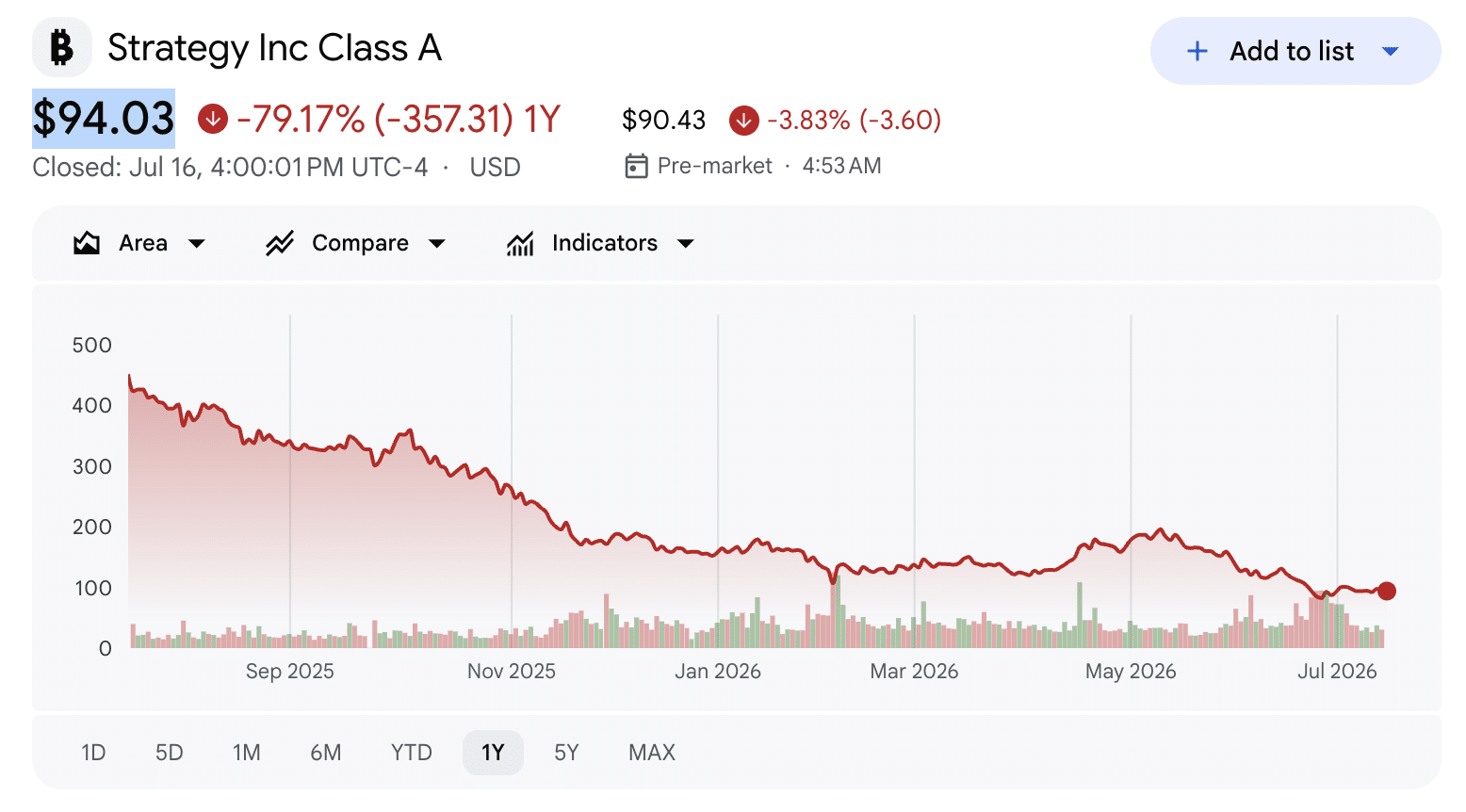
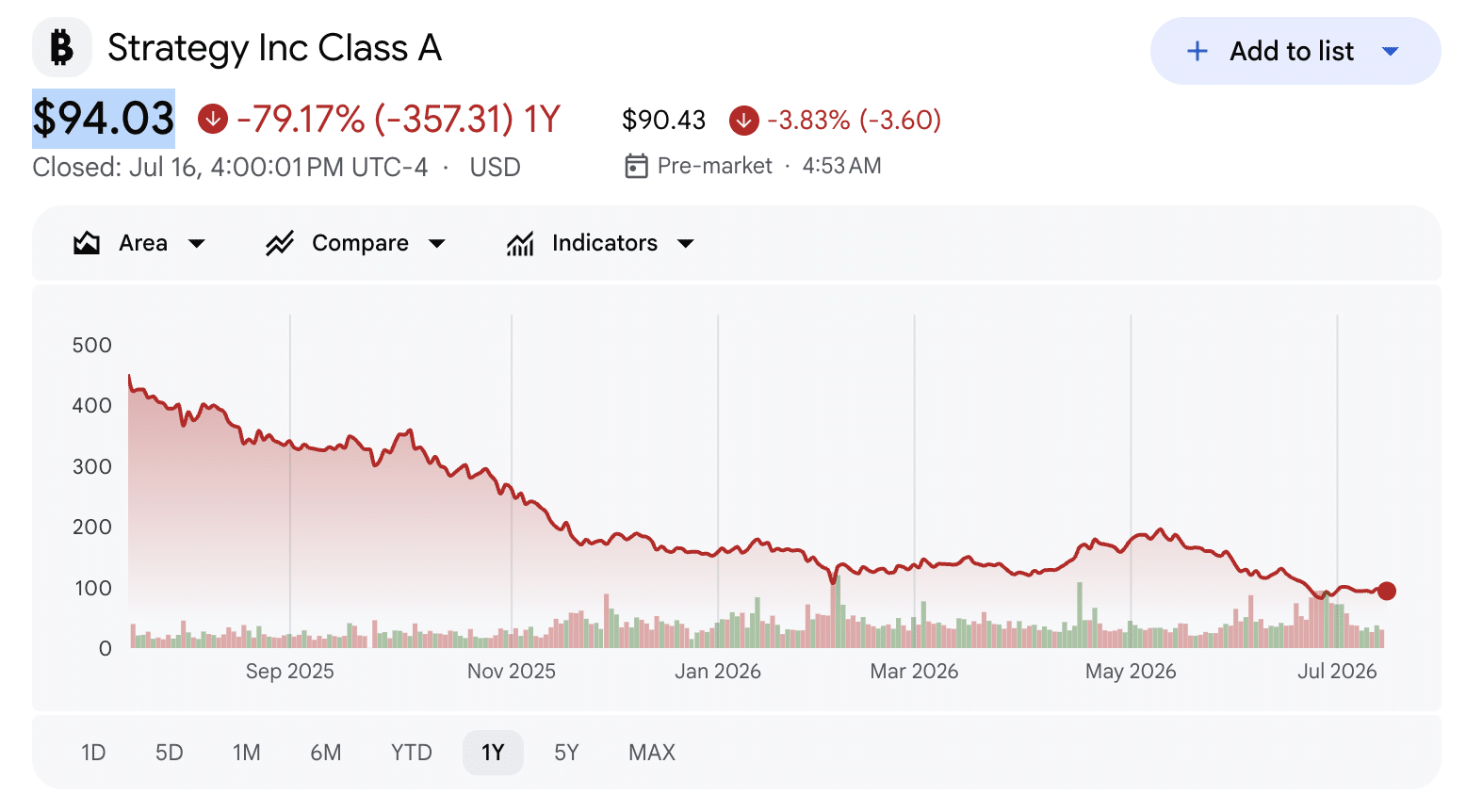
MSTR, the common stock of Michael Saylor’s Strategy, has declined by 79.17% over the last 12 months.

In fact, after falling 3.53% over the previous day, it was trading at $94.03 at the time of writing.

The decline occurred as Strategy shifted from aggressive Bitcoin accumulation toward defensive capital management. However, its limited Bitcoin sales represented only a fraction of its total holdings.
Source: Google Finance

Strategy’s current market dynamic

Following the initial sale of 32 Bitcoin [BTC] in June 2026, Strategy went on to sell 3588 Bitcoin in July. Strategy now owns 843,775 BTC, which is worth $53 billion, after making no new purchases in July.
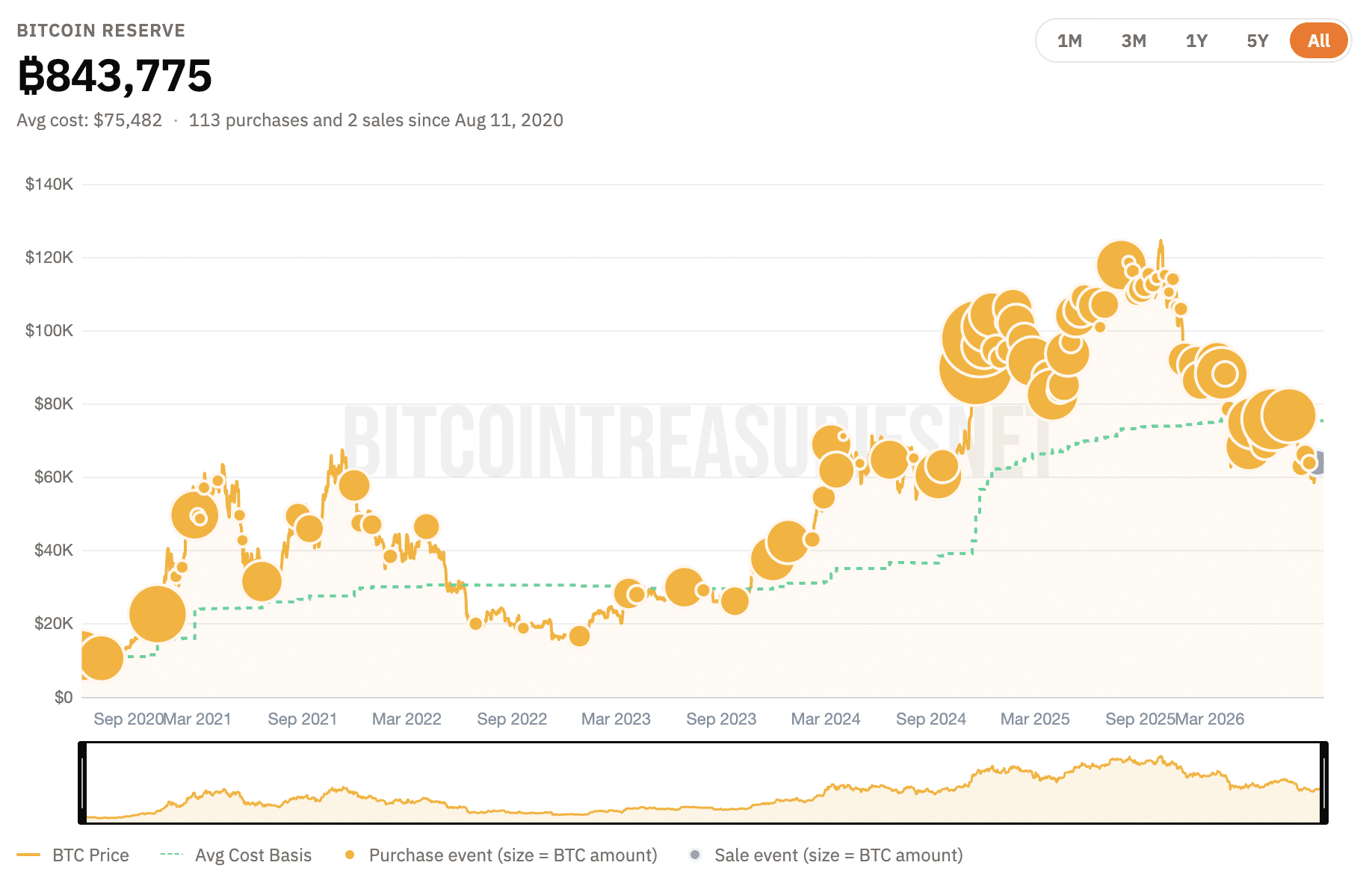
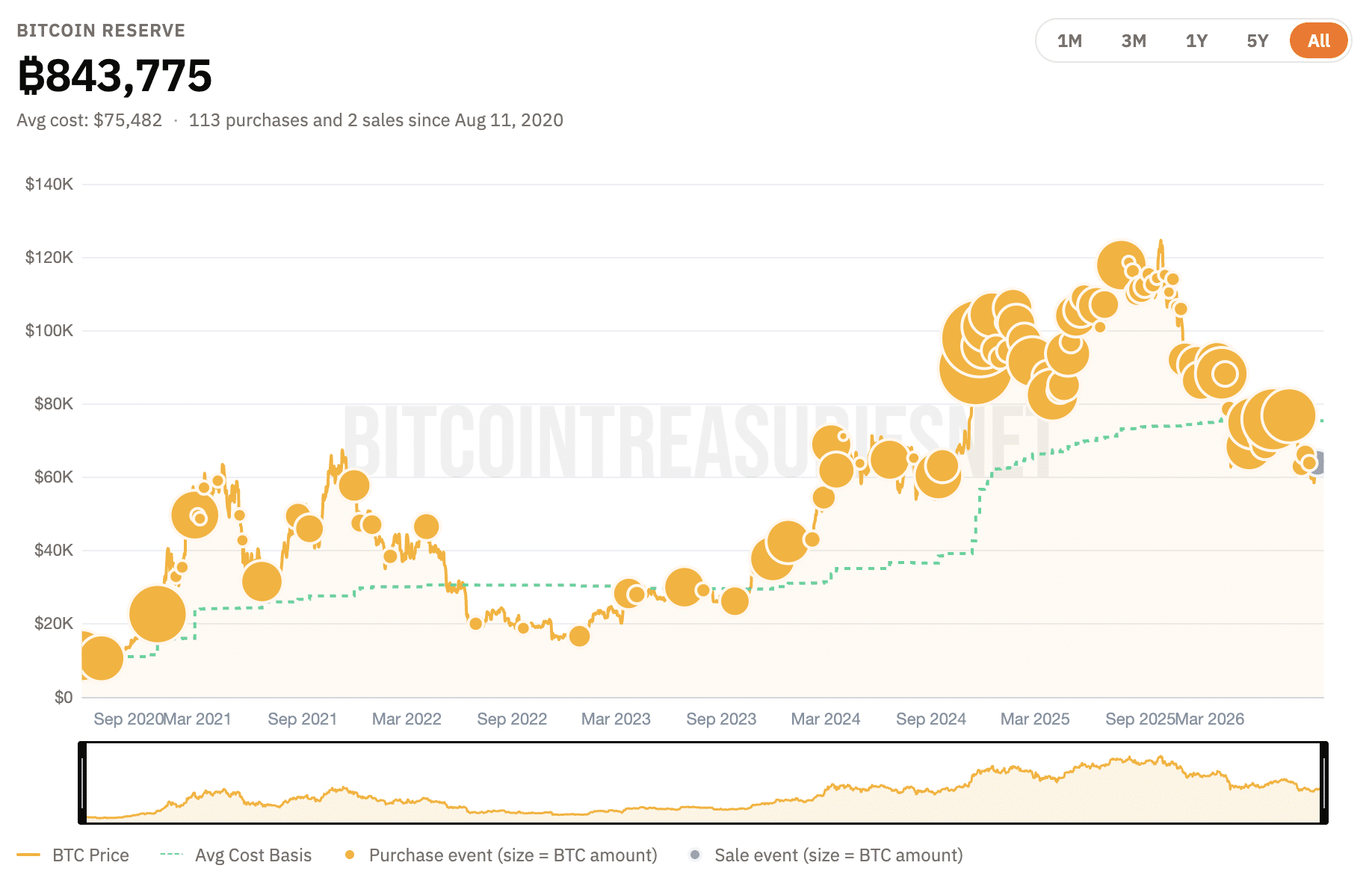
Source: BitcoinTreasuries.NET

The 3,620 BTC sold represented only 0.43% of Strategy’s remaining holdings. Therefore, the sales suggested liquidity management rather than a broader Bitcoin exit.

Additionally, with no share repurchases during that time, Strategy also sold 4.82 million MSTR shares through its at-the-market (ATM) equity program, generating about $466.7 million in net proceeds.

Remarkably, a recent 8-K filing revealed that the company’s USD Reserve, a cash reserve meant to cover debt interest payments and preferred stock dividends, has increased to $3.0 billion.

Change of plans

Meanwhile, CryptoQuant also highlighted the change in Strategy’s model, pointing out that the company has adopted a more cautious approach to capital management.

By raising its USD Reserve from $1.44 billion to $3.0 billion, the company has temporarily halted Bitcoin purchases in favor of fortifying its balance sheet.


Source: CryptoQuant

Because of this increased cash cushion, the company has been able to raise STRC’s annual dividend to 12%, nearly doubling the coverage for dividend payments from approximately 14 months to approximately 29 months.

Even though STRC shares have since rebounded from roughly $75 to $85, CryptoQuant thinks the company’s next big problem will be determining when to start buying Bitcoin again and whether to sell some of its holdings during the next bull market to lock in gains instead of sticking to its buy-and-hold approach.

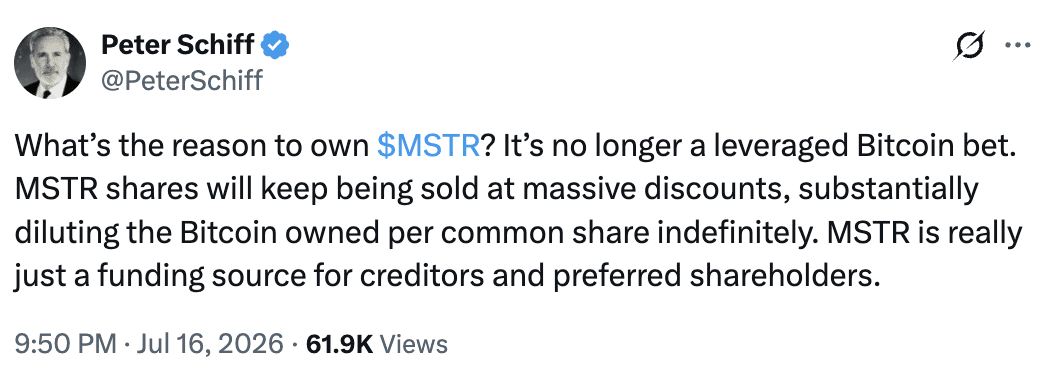
As expected, Peter Schiff took this opportunity to criticize MSTR’s investment case and said,
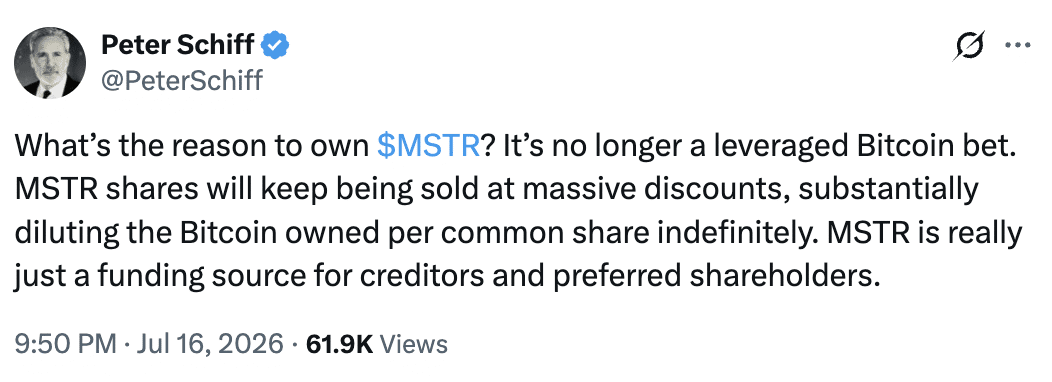
Source: Peter Schiff/X

Supporters of Saylor’s Strategy

Yet, not everyone agreed with Schiff’s criticism, as Bitcoin wizard Adam Livingston contends that if Strategy starts aggressively raising money again through its STRC preferred stock, call options may yield the highest returns.

Livingston thinks that Strategy could raise the price of Bitcoin per share without diluting common shareholders if it can continue to fund Bitcoin purchases with preferred stock instead of issuing more MSTR common shares. This would make leveraged MSTR call options particularly alluring.

THE MSTR CALL BECOMES A WEAPON IF THE STRC MACHINE RESTARTS

Although he offers potential recovery scenarios, he also notes that they are merely speculative estimates, concluding that the post is “financial entertainment,” and not investment advice.

This coincided with Saylor recently shedding light on Bitcoin and putting it best when he stated,

Major-bank Bitcoin adoption is accelerating, but still early: 32% overall as measured by the index.


Final Summary

  • Strategy sold only 0.43% of its remaining Bitcoin while doubling its USD Reserve.
  • STRC financing could restart Bitcoin purchases, but MSTR dilution remains the central shareholder risk.


Trending Cryptos

Related Questions

QWhy did MicroStrategy's stock (MSTR) decline by nearly 80% over the last year according to the article?

AThe article states that MSTR declined as the company shifted from aggressive Bitcoin accumulation towards defensive capital management, strengthening its balance sheet and increasing its USD cash reserve instead of continuing large-scale Bitcoin purchases.

QWhat is the USD Reserve mentioned in the article, and how has its size changed?

AThe USD Reserve is a cash reserve meant to cover debt interest payments and preferred stock dividends. According to the article, it has increased from $1.44 billion to $3.0 billion.

QAccording to Adam Livingston's perspective in the article, why could MSTR call options become 'a weapon'?

AAdam Livingston argues that if MicroStrategy restarts funding Bitcoin purchases through its STRC preferred stock instead of issuing more common MSTR shares, it could raise the Bitcoin-per-share value without diluting common shareholders, making leveraged MSTR call options particularly attractive.

QWhat percentage of its total Bitcoin holdings did MicroStrategy sell, and what was the stated purpose of these sales?

AMicroStrategy sold 3,620 Bitcoin, which represented only 0.43% of its remaining holdings. The article suggests the sales were for liquidity management rather than a broader exit from Bitcoin.

QWhat is the central shareholder risk for MSTR highlighted in the article's final summary?

AThe final summary identifies that MSTR dilution remains the central shareholder risk.

Related Reads

From Somersaults to Working 24/7: We Saw the ‘Working-Class’ Aura in Robots at WAIC

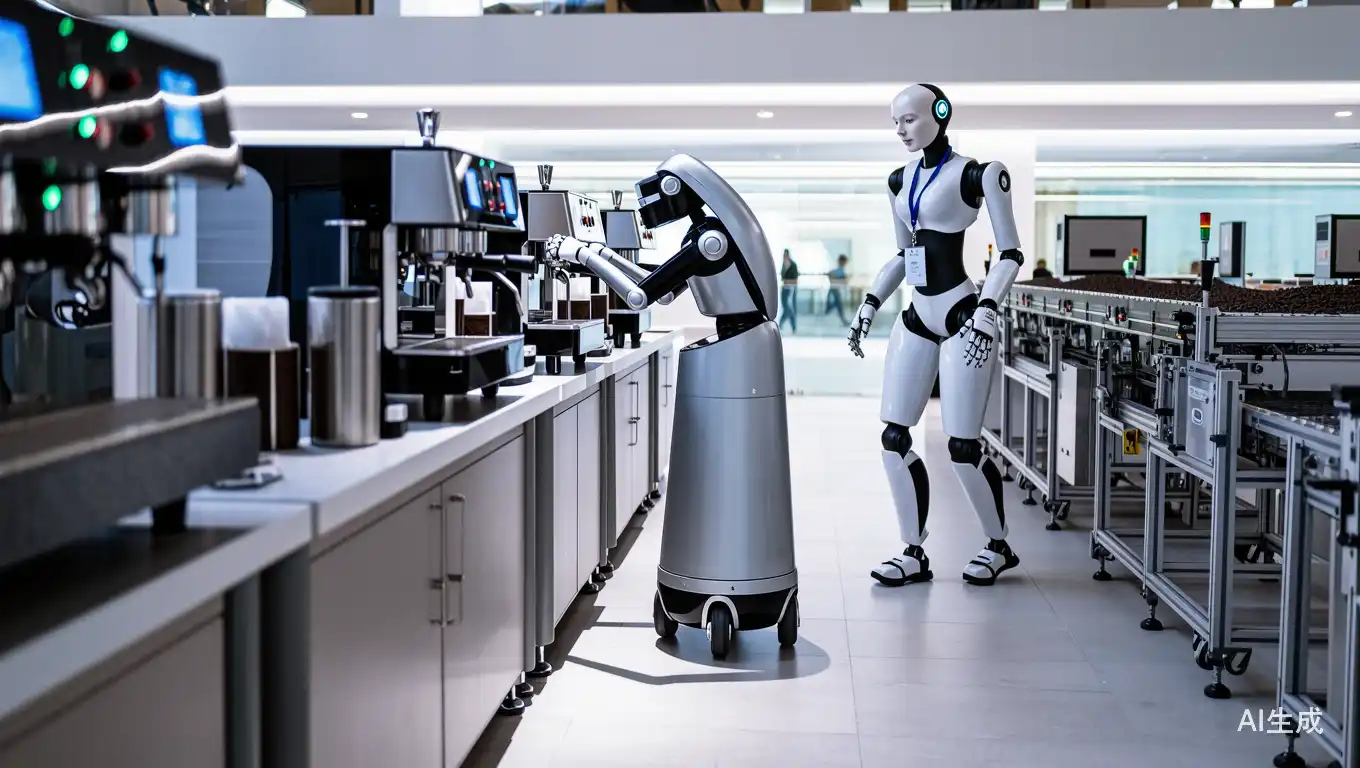
From performing acrobatics to working 24/7: Robots at WAIC are getting down to business. This year's World Artificial Intelligence Conference (WAIC) in Shanghai showcased a significant shift in the robotics industry. While "show-off" robots that dance, play music, or compete in sports are still present, the dominant trend is now practical, task-oriented machines. Hundreds of wheeled and humanoid robots were deployed as guides, baristas, factory workers, and even traffic controllers, moving beyond mere demonstrations to highlight real-world "work capabilities." The focus has pivoted from showcasing technical parameters to pursuing mass production and industrial落地 (landing/implementation). This transition presents major challenges. First, deploying powerful AI models onto robots requires overcoming hardware limitations in computing power and latency. Second, robots demand complex, integrated systems for real-time perception and control. Third, achieving reliable mass production necessitates unprecedented industry-wide collaboration on standards and supply chains. A key bottleneck identified by industry leaders is the robot's "brain"—its AI and cognitive capabilities. While hardware and basic movement ("little brain") have advanced rapidly, the higher-level intelligence for understanding complex instructions and adapting to unstructured environments is progressing more slowly. Companies are investing heavily in developing more advanced "brain" systems, but fully autonomous operation in dynamic settings remains a work in progress. Cost is another critical hurdle. While some consumer-oriented humanoid robots are now priced under $15,000, capable industrial models often cost $50,000 or more. The industry consensus is that bringing robots into unstructured home environments for tasks like comprehensive cleaning is still at least five years away due to technical, safety, and cost barriers. Therefore, 2026 is being called the "first year of mass production," but primarily for industrial and specific commercial applications. WAIC 2026 served less as a stage for spectacular tricks and more as a serious examination of robots' commercial viability, marking their transition from laboratory prototypes to real-world products that must prove their value through stable, repetitive work.

marsbit2h ago

From Somersaults to Working 24/7: We Saw the ‘Working-Class’ Aura in Robots at WAIC

marsbit2h ago

Trading

Spot

Hot Articles

Discussions

Welcome to the HTX Community. Here, you can stay informed about the latest platform developments and gain access to professional market insights. Users' opinions on the price of S (S) are presented below.

活动图片