6 more months of bearish pressure? THESE metrics flash warnings

ambcryptoPublished on 2026-02-25Last updated on 2026-02-25

Abstract

Bitcoin (BTC) and Ethereum (ETH) continued their bearish trend, with BTC dropping 4.58% and the Crypto Fear and Greed Index hitting an extreme low of 5. According to Glassnode, the 90-day realized profit/loss ratio has remained below 1 for the past three months, indicating a sustained period where investors are selling at a loss. This signals a full transition to a loss-realizing regime, often lasting around six months. The Net Unrealized Profit/Loss (NUPL) metric has also been declining since October 2025. A NUPL reading below 0, where market cap falls below realized cap, could present a potential buy signal for value investors, suggesting BTC may be deeply discounted. Current metrics warn of continued bearish pressure for the next six months.

Bitcoin [BTC] continued its streak of bearish days on Tuesday, the 24th of February. It was down 4.58% in the past 24 hours, and the Crypto Fear and Greed Index fell to 5. This was an extremely low reading, last seen in 2019.

Ethereum [ETH] also posted losses, spurred by co-founder Buterin’s selling. The synchronized selling seen for the two leading crypto assets highlighted the risk-off sentiment, traders reducing exposure, and investors exiting the market.

More Bitcoin is sold at a loss than at a profit

In a recent post on X, blockchain intelligence platform Glassnode pointed out that the 90-day realized profit/loss ratio was below 1. This meant that for the past three months, the average holder was selling Bitcoin at a loss.

This represented a “full transition to a regime of excess loss-realizing”, the post read. The extreme fear values and correlated sell-offs pointed to the same thing. Any greed in the market has been wiped out.

But that is not all. These kinds of extreme phases with a reading of under 1 tend to be sustained for six months. Once the realized profit/loss ratio climbs back above 1 and stays there, investors can take it as an onchain “buy signal”.

The Bitcoin Net Unrealized Profit/Loss has been falling since October 2025. The metric indicates the total amount of profit/loss in all the coins, represented as a ratio. The lower it falls, the less pressure there is on Bitcoin from profit-taking.

By itself, it does not give a buy signal for Bitcoin unless the ratio falls below 0. In this situation, the market cap is less than the realized cap- another sign that investors were facing losses on average.

The further the market cap falls from the realized cap, the more motive there would be for value buyers to enter the market.

Investors can keep an eye on the metric for parallels to the previous cycle before trying to buy Bitcoin near the bottom. As things stand, the next 6 months are likely to see further bearish price action.


Final Summary

  • The realized profit/loss ratio showed that Bitcoin holders were realizing more losses than profits over the past three months, a sign of a transition to a market extreme.
  • There is likely to be another six months of such bearishness, and NUPL readings below 0 will inform investors of a deep discount on BTC.

Related Questions

QWhat does a realized profit/loss ratio below 1 indicate for Bitcoin holders?

AIt indicates that the average Bitcoin holder has been selling at a loss over the measured period, signaling a transition to a regime of excess loss-realizing.

QAccording to the article, how long do these extreme phases with a realized profit/loss ratio under 1 typically last?

AThese extreme phases tend to be sustained for six months.

QWhat on-chain metric is suggested as a potential 'buy signal' for investors?

AThe realized profit/loss ratio climbing back above 1 and staying there is suggested as an on-chain buy signal.

QWhat does a Bitcoin Net Unrealized Profit/Loss (NUPL) ratio below 0 signify?

AA NUPL ratio below 0 signifies that the market cap is less than the realized cap, meaning investors are facing losses on average and the asset is at a deep discount.

QWhat recent event was cited as contributing to Ethereum's (ETH) losses?

AEthereum's losses were spurred by selling from its co-founder, Vitalik Buterin.

Related Reads

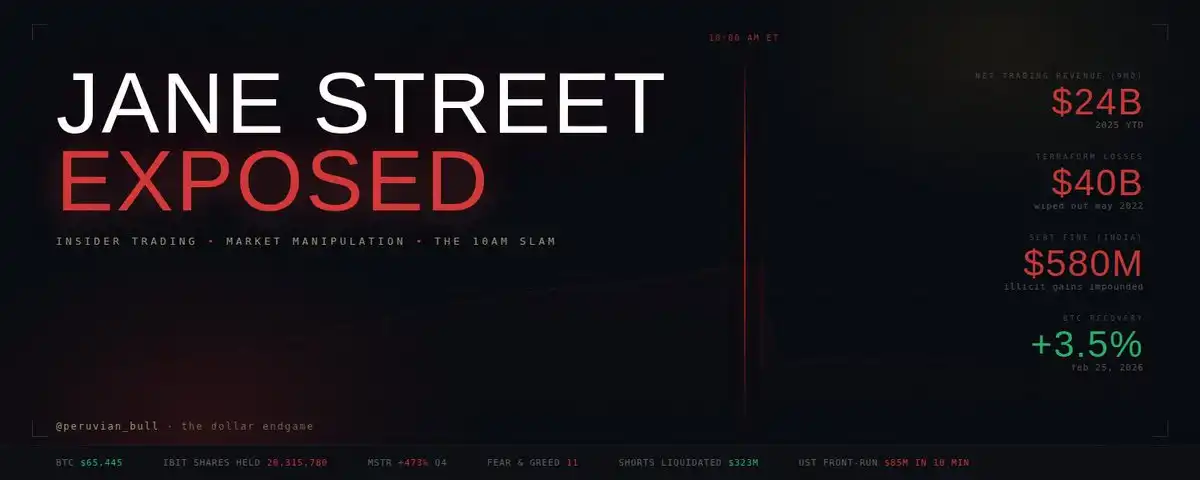
Jane Street's Three Sins: Insider Trading, Index Manipulation, and the Bitcoin 'Morning Massacre'

Jane Street, a highly profitable quantitative trading firm, faces serious allegations across multiple continents. In the U.S., Terraform Labs’ bankruptcy trustee has sued Jane Street, accusing it of insider trading related to the May 2022 collapse of Terra Luna. The suit claims Jane Street withdrew $85 million from a liquidity pool just minutes after Terraform secretly removed $150 million, allegedly using non-public information from a former intern. The action allegedly helped trigger a $40 billion crash. Simultaneously, in India, the Securities and Exchange Board (SEBI) has accused Jane Street of manipulating the Bank Nifty index through a “pump-and-dump” scheme over 18 expiration dates, resulting in alleged illegal profits of ~$580 million. Jane Street has been barred from Indian markets and is appealing. Additionally, Bitcoin traders had observed a pattern of sharp sell-offs at 10 AM ET—dubbed the "10 AM Crashes"—coinciding with U.S. market open, which many attributed to Jane Street’s trading activity. Notably, Jane Street is an authorized participant of BlackRock’s IBIT Bitcoin ETF, holding significant shares. After the Terra lawsuit was filed, the predictable sell-offs stopped, and Bitcoin saw a notable price rebound. The broader implication is the risk of market manipulation by privileged intermediaries within ETF structures—a problem Bitcoin was designed to overcome. If Jane Street halts its alleged manipulative strategies due to legal pressure, a major selling pressure on Bitcoin may be removed.

marsbit57m ago

Jane Street's Three Sins: Insider Trading, Index Manipulation, and the Bitcoin 'Morning Massacre'

marsbit57m ago

Stock Price Surges Over 35%! Circle's Earnings Report Exceeds Expectations: USDC Circulation Soars 72%

Circle (CRCL) reported strong Q4 and full-year 2025 financial results, with total revenue and reserve income reaching $770 million in Q4, up 77% year-over-year, exceeding expectations. This drove a 35% surge in its stock price. Key highlights include a 72% YoY increase in USDC circulation to $75.3 billion and a 247% rise in on-chain transaction volume to $11.9 trillion in Q4. Reserve income remained the core revenue driver at $733 million, while non-interest income reached $37 million. For the full year, total revenue grew 64% to $2.7 billion. Although the company reported a net loss of $70 million due to a one-time $424 million stock-based compensation expense from its IPO, adjusted EBITDA doubled to $582 million, indicating profitable core operations. Strategic developments include the stable testnet performance of its Arc blockchain, expansion of the Circle Payments Network with 55 financial institutions onboarded, and a key partnership with Polymarket to use native USDC. Regulatory progress includes conditional approval for a national trust bank. Looking ahead, Circle targets a 40% compound annual growth rate for USDC circulation. CEO Jeremy Allaire emphasized AI-driven payment demand, with 99% of agent-based payments currently using USDC. Despite challenges like declining yields and new competitors like USAT, Circle continues to execute its strategy as a growing internet financial infrastructure provider.

marsbit1h ago

Stock Price Surges Over 35%! Circle's Earnings Report Exceeds Expectations: USDC Circulation Soars 72%

marsbit1h ago

Trading

Spot
Futures

Hot Articles

What is $BITCOIN

DIGITAL GOLD ($BITCOIN): A Comprehensive Analysis Introduction to DIGITAL GOLD ($BITCOIN) DIGITAL GOLD ($BITCOIN) is a blockchain-based project operating on the Solana network, which aims to combine the characteristics of traditional precious metals with the innovation of decentralized technologies. While it shares a name with Bitcoin, often referred to as “digital gold” due to its perception as a store of value, DIGITAL GOLD is a separate token designed to create a unique ecosystem within the Web3 landscape. Its goal is to position itself as a viable alternative digital asset, although specifics regarding its applications and functionalities are still developing. What is DIGITAL GOLD ($BITCOIN)? DIGITAL GOLD ($BITCOIN) is a cryptocurrency token explicitly designed for use on the Solana blockchain. In contrast to Bitcoin, which provides a widely recognized value storage role, this token appears to focus on broader applications and characteristics. Notable aspects include: Blockchain Infrastructure: The token is built on the Solana blockchain, known for its capacity to handle high-speed and low-cost transactions. Supply Dynamics: DIGITAL GOLD has a maximum supply capped at 100 quadrillion tokens (100P $BITCOIN), although details regarding its circulating supply are currently undisclosed. Utility: While precise functionalities are not explicitly outlined, there are indications that the token could be utilized for various applications, potentially involving decentralized applications (dApps) or asset tokenization strategies. Who is the Creator of DIGITAL GOLD ($BITCOIN)? At present, the identity of the creators and development team behind DIGITAL GOLD ($BITCOIN) remains unknown. This situation is typical among many innovative projects within the blockchain space, particularly those aligning with decentralized finance and meme coin phenomena. While such anonymity may foster a community-driven culture, it intensifies concerns about governance and accountability. Who are the Investors of DIGITAL GOLD ($BITCOIN)? The available information indicates that DIGITAL GOLD ($BITCOIN) does not have any known institutional backers or prominent venture capital investments. The project seems to operate on a peer-to-peer model focused on community support and adoption rather than traditional funding routes. Its activity and liquidity are primarily situated on decentralized exchanges (DEXs), such as PumpSwap, rather than established centralized trading platforms, further highlighting its grassroots approach. How DIGITAL GOLD ($BITCOIN) Works The operational mechanics of DIGITAL GOLD ($BITCOIN) can be elaborated on based on its blockchain design and network attributes: Consensus Mechanism: By leveraging Solana’s unique proof-of-history (PoH) combined with a proof-of-stake (PoS) model, the project ensures efficient transaction validation contributing to the network's high performance. Tokenomics: While specific deflationary mechanisms have not been extensively detailed, the vast maximum token supply implies that it may cater to microtransactions or niche use cases that are still to be defined. Interoperability: There exists the potential for integration with Solana’s broader ecosystem, including various decentralized finance (DeFi) platforms. However, the details regarding specific integrations remain unspecified. Timeline of Key Events Here is a timeline that highlights significant milestones concerning DIGITAL GOLD ($BITCOIN): 2023: The initial deployment of the token occurs on the Solana blockchain, marked by its contract address. 2024: DIGITAL GOLD gains visibility as it becomes available for trading on decentralized exchanges like PumpSwap, allowing users to trade it against SOL. 2025: The project witnesses sporadic trading activity and potential interest in community-led engagements, although no noteworthy partnerships or technical advancements have been documented as of yet. Critical Analysis Strengths Scalability: The underlying Solana infrastructure supports high transaction volumes, which could enhance the utility of $BITCOIN in various transaction scenarios. Accessibility: The potential low trading price per token could attract retail investors, facilitating wider participation due to fractional ownership opportunities. Risks Lack of Transparency: The absence of publicly known backers, developers, or an audit process may yield skepticism regarding the project's sustainability and trustworthiness. Market Volatility: The trading activity is heavily reliant on speculative behavior, which can result in significant price volatility and uncertainty for investors. Conclusion DIGITAL GOLD ($BITCOIN) emerges as an intriguing yet ambiguous project within the rapidly evolving Solana ecosystem. While it attempts to leverage the “digital gold” narrative, its departure from Bitcoin's established role as a store of value underscores the need for a clearer differentiation of its intended utility and governance structure. Future acceptance and adoption will likely depend on addressing the current opacity and defining its operational and economic strategies more explicitly. Note: This report encompasses synthesised information available as of October 2023, and developments may have transpired beyond the research period.

363 Total ViewsPublished 2025.05.13Updated 2025.05.13

Discussions

Welcome to the HTX Community. Here, you can stay informed about the latest platform developments and gain access to professional market insights. Users' opinions on the price of BTC (BTC) are presented below.

活动图片