This Key Bitcoin Metric Signals That The Downside May Persist A Bit Longer

bitcoinistPublished on 2026-02-13Last updated on 2026-02-13

Abstract

After a sharp pullback in Bitcoin's price, speculation suggests the market may have entered a bearish phase. A key metric, the Bitcoin Z-Score, indicates that the downside movement has not yet climaxed, with BTC hitting a historically extreme -3σ downside deviation near the $60,000 mark. This suggests selling pressure and weak demand are likely to persist in the coming days, weeks, or even months. Analysts note that final market bottoms are typically formed through prolonged choppy compression rather than sharp crashes. Additionally, the Bull Score Signals metric, which assesses on-chain health, shows most indicators are still negative, indicating a challenging environment for Bitcoin to reach new all-time highs in the short term. The drop below $60,000 has also pressured Bitcoin whales, who have increased their inflows to exchanges like Binance, with over 50,000 BTC moved since February 1. This activity often signals heightened selling pressure, especially in a tightening liquidity environment.

After a sharp pullback in Bitcoin’s price, there are speculations that the cryptocurrency market has shifted into a bearish phase, marking an end to the bull market. Despite this significant drop, a key metric is showing signs that the market pain is likely to continue, reinforcing this current downward pressure.

Bitcoin Metric Warns The Pullback Isn’t Over Yet

Bitcoin’s ongoing downside movement does not seem to have reached its climax yet. An indicator of the Bitcoin market that is closely monitored indicates that the current dip has not ended, and the correction may continue for a short time.

This data from the Bitcoin Z-Score metric suggests that selling pressure and weak demand conditions are highly likely to continue in the upcoming days, weeks, or even months. Following an analysis of the metric, On-Chain Mind disclosed that BTC has hit a -3σ downside deviation in the recent crash.

The -3σ downside deviation, which is sitting at the $60,000 price mark, is the most extreme statistical stretch in the history of BTC. On-Chain Mind outlined that a continued severe breakdown below this level now would be historically unprecedented.

Given the data from the metric, the crypto expert predicts that the negative chop will continue for a little while longer. Interestingly, the final bottoms are created by monotonous, choppy compression and now vertical crashes. In the meantime, the possibility of a continued short-term weakness before a stronger recovery emerges remains high.
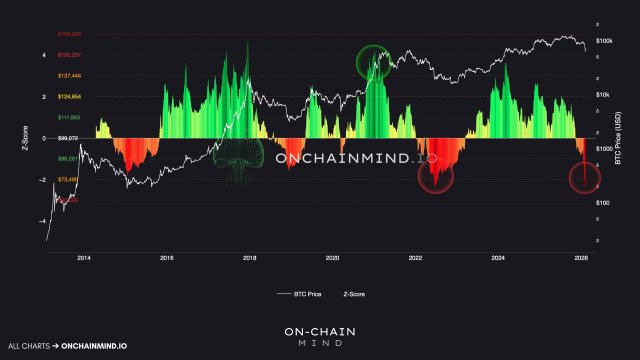
Source: Chart from On-Chain Mind on X

Darkfost, a market expert and author at CryptoQuant, has shed light on the current state of the BTC environment using the Bull Score Signals metric. This metric provides an overview of the market’s on-chain health and highlights multiple key elements affecting Bitcoin’s price behavior.

It further covers a variety of significant information regarding demand, liquidity, and the value of Bitcoin. Currently, the majority of these indicators are still in the red, which suggests that the environment is not improving yet. As long as this is the case, Bitcoin’s difficulty of reaching a new all-time high in the short term becomes extremely hard.

Whales Under Pressure Due To BTC’s Drop

With a temporary break below $60,000, a wave of nervousness has been ignited across the market, putting Bitcoin whales under pressure. Despite popular opinion, these big holders do not consistently constitute a type of patient and logical smart money because they react to market shocks either opportunistically or under pressure.

Examining their inflows on the Binance platform, Darkfost has highlighted an increase in the monthly time frame. The monthly inflow rose from around 1,000 BTC to nearly 3,000 BTC, with a notable spike of roughly 12,000 BTC on February 6 alone. When there is significant price stress, this kind of action indicates that transfers to exchanges are more intense.

Since February 1, more than 50,000 BTC inflows were observed from this group, suggesting sensitivity to rapid market swings from the investors as they adjust their positions. These investors can abruptly influence price dynamics, which can be good in gauging the forces shaping the market. In an environment where overall market liquidity is tightening, rising inflows are often a sign of increased selling pressure.

BTC trading at $66,141 on the 1D chart | Source: BTCUSDT on Tradingview.com

Related Questions

QWhat does the Bitcoin Z-Score metric's -3σ downside deviation at the $60,000 mark indicate?

AIt indicates the most extreme statistical stretch in Bitcoin's history, suggesting that selling pressure and weak demand conditions are highly likely to continue, and a continued severe breakdown below this level would be historically unprecedented.

QAccording to the Bull Score Signals metric, why is it difficult for Bitcoin to reach a new all-time high in the short term?

ABecause the majority of the indicators in the Bull Score Signals metric are still in the red, suggesting that the on-chain market environment is not improving yet.

QHow have Bitcoin whales reacted to the recent price drop, as observed on the Binance platform?

AThere has been an increase in monthly inflows from whales, rising from around 1,000 BTC to nearly 3,000 BTC, with a notable spike of roughly 12,000 BTC on February 6 alone, indicating intensified transfers to exchanges during price stress.

QWhat does the analysis from On-Chain Mind suggest about the nature of final market bottoms?

AIt suggests that final bottoms are created by monotonous, choppy compression and not by vertical crashes.

QWhat is the overall prediction for Bitcoin's market movement based on the key metrics discussed?

AThe prediction is that the negative chop and downward pressure will continue for a little while longer, with a high possibility of continued short-term weakness before a stronger recovery emerges.

Related Reads

Trading

Spot
Futures

Hot Articles

What is $BITCOIN

DIGITAL GOLD ($BITCOIN): A Comprehensive Analysis Introduction to DIGITAL GOLD ($BITCOIN) DIGITAL GOLD ($BITCOIN) is a blockchain-based project operating on the Solana network, which aims to combine the characteristics of traditional precious metals with the innovation of decentralized technologies. While it shares a name with Bitcoin, often referred to as “digital gold” due to its perception as a store of value, DIGITAL GOLD is a separate token designed to create a unique ecosystem within the Web3 landscape. Its goal is to position itself as a viable alternative digital asset, although specifics regarding its applications and functionalities are still developing. What is DIGITAL GOLD ($BITCOIN)? DIGITAL GOLD ($BITCOIN) is a cryptocurrency token explicitly designed for use on the Solana blockchain. In contrast to Bitcoin, which provides a widely recognized value storage role, this token appears to focus on broader applications and characteristics. Notable aspects include: Blockchain Infrastructure: The token is built on the Solana blockchain, known for its capacity to handle high-speed and low-cost transactions. Supply Dynamics: DIGITAL GOLD has a maximum supply capped at 100 quadrillion tokens (100P $BITCOIN), although details regarding its circulating supply are currently undisclosed. Utility: While precise functionalities are not explicitly outlined, there are indications that the token could be utilized for various applications, potentially involving decentralized applications (dApps) or asset tokenization strategies. Who is the Creator of DIGITAL GOLD ($BITCOIN)? At present, the identity of the creators and development team behind DIGITAL GOLD ($BITCOIN) remains unknown. This situation is typical among many innovative projects within the blockchain space, particularly those aligning with decentralized finance and meme coin phenomena. While such anonymity may foster a community-driven culture, it intensifies concerns about governance and accountability. Who are the Investors of DIGITAL GOLD ($BITCOIN)? The available information indicates that DIGITAL GOLD ($BITCOIN) does not have any known institutional backers or prominent venture capital investments. The project seems to operate on a peer-to-peer model focused on community support and adoption rather than traditional funding routes. Its activity and liquidity are primarily situated on decentralized exchanges (DEXs), such as PumpSwap, rather than established centralized trading platforms, further highlighting its grassroots approach. How DIGITAL GOLD ($BITCOIN) Works The operational mechanics of DIGITAL GOLD ($BITCOIN) can be elaborated on based on its blockchain design and network attributes: Consensus Mechanism: By leveraging Solana’s unique proof-of-history (PoH) combined with a proof-of-stake (PoS) model, the project ensures efficient transaction validation contributing to the network's high performance. Tokenomics: While specific deflationary mechanisms have not been extensively detailed, the vast maximum token supply implies that it may cater to microtransactions or niche use cases that are still to be defined. Interoperability: There exists the potential for integration with Solana’s broader ecosystem, including various decentralized finance (DeFi) platforms. However, the details regarding specific integrations remain unspecified. Timeline of Key Events Here is a timeline that highlights significant milestones concerning DIGITAL GOLD ($BITCOIN): 2023: The initial deployment of the token occurs on the Solana blockchain, marked by its contract address. 2024: DIGITAL GOLD gains visibility as it becomes available for trading on decentralized exchanges like PumpSwap, allowing users to trade it against SOL. 2025: The project witnesses sporadic trading activity and potential interest in community-led engagements, although no noteworthy partnerships or technical advancements have been documented as of yet. Critical Analysis Strengths Scalability: The underlying Solana infrastructure supports high transaction volumes, which could enhance the utility of $BITCOIN in various transaction scenarios. Accessibility: The potential low trading price per token could attract retail investors, facilitating wider participation due to fractional ownership opportunities. Risks Lack of Transparency: The absence of publicly known backers, developers, or an audit process may yield skepticism regarding the project's sustainability and trustworthiness. Market Volatility: The trading activity is heavily reliant on speculative behavior, which can result in significant price volatility and uncertainty for investors. Conclusion DIGITAL GOLD ($BITCOIN) emerges as an intriguing yet ambiguous project within the rapidly evolving Solana ecosystem. While it attempts to leverage the “digital gold” narrative, its departure from Bitcoin's established role as a store of value underscores the need for a clearer differentiation of its intended utility and governance structure. Future acceptance and adoption will likely depend on addressing the current opacity and defining its operational and economic strategies more explicitly. Note: This report encompasses synthesised information available as of October 2023, and developments may have transpired beyond the research period.

363 Total ViewsPublished 2025.05.13Updated 2025.05.13

Discussions

Welcome to the HTX Community. Here, you can stay informed about the latest platform developments and gain access to professional market insights. Users' opinions on the price of BTC (BTC) are presented below.

活动图片