Bitcoin Plunged on Christmas Eve, Loses 'Santa Rally', Set for Worst Quarterly Performance in Three Years

华尔街日报Published on 2025-12-25Last updated on 2025-12-25

Abstract

Bitcoin experienced a rare flash crash on Binance’s BTC/USD1 trading pair, plummeting over 70% from $87.6k to $24.1k before quickly rebounding. The incident, attributed to thin liquidity in the emerging stablecoin pair, did not affect other major trading pairs. Currently trading around $87k, Bitcoin is down over 7% year-to-date and is on track for its worst quarterly performance since Q2 2022. The flash crash highlights the risks of low-liquidity trading environments, where large orders or technical issues can cause extreme short-term price deviations. Meanwhile, Bitcoin has missed the typical "Santa rally," underperforming compared to traditional assets like the S&P 500 and gold, which hit all-time highs. Gold has surged over 70% this year, while Bitcoin has failed to attract similar safe-haven inflows. Technical factors like falling below the 365-day moving average and significant options expiries have contributed to the stagnation. Persistent selling by long-term holders and ongoing outflows from Bitcoin and Ethereum ETFs—$175 million and $57 million respectively on December 24—have further dampened momentum. Analysts expect limited movement until January due to year-end risk reduction and tax-related selling.

While traditional financial markets are enjoying a year-end rebound, Bitcoin has not only missed out on the 'Santa Rally' but also experienced a rare flash crash on the Binance exchange.

On Wednesday evening U.S. time, Bitcoin on the Binance BTC/USD1 trading pair suddenly flash-crashed from $87,600 to $24,100, a plunge of over 70%, before rapidly rebounding to around $87,000 within seconds.

This extreme volatility was confined to the USD1 pair, a stablecoin issued by the Trump family-backed World Liberty Financial, and was not seen on other major trading pairs.

Bitcoin is currently hovering around $87,000, trapped in a range between $85,000 and $90,000, with a year-to-date decline of over 7%. Since retreating from its all-time high in October, Bitcoin has fallen approximately 30% and is on track for its worst quarterly performance since the Q2 2022 collapse of TerraUSD and Three Arrows Capital.

This asset, known for its high volatility and speculative sentiment, has unexpectedly stalled at year-end, standing in stark contrast to the S&P 500 and gold, which are repeatedly hitting new highs.

Technical Flash Crash Triggered by Insufficient Liquidity

Analysts point out that such 'flash candles' are typically triggered by insufficient liquidity or display issues.

Emerging or low-volume stablecoin trading pairs often lack market makers providing dense quotes, resulting in shallow order book depth.A large market sell order, forced liquidation, or automated trading can quickly exhaust the buy-side liquidity, causing the price to briefly deviate from true market levels.

Cryptocurrency analyst and Coin Bureau co-founder Cryptonews stated:

This highlights the risks of executing operations on illiquid trading pairs, especially when the stablecoin trading path is still in its liquidity-building phase. Many spot investors found their positions largely unaffected before and after the flash crash.

He believes that in an environment of geopolitical uncertainty and fluctuating market liquidity, this serves as a warning against excessive leverage.

Temporary pricing issues caused by widening spreads, faulty market maker quotes, or trading bots reacting to anomalous quotes can also trigger such price dislocations.During thin trading hours, this effect is amplified as there are fewer participants to absorb the order flow and restore price equilibrium.

Missing the 'Santa Rally' and Diverging from Gold

In sharp contrast to Bitcoin's sluggish trend, traditional markets are sending截然不同的 signals.

U.S. stocks are experiencing a typical 'Santa Rally', with the S&P 500 closing at a record high of 6,921.42 points on December 24th, as tech stocks and momentum trading once again rewarded retail traders who held their positions.

Gold is also performing strongly, with the spot price hitting a record high of $4,525.18 per ounce on December 24th. Although it has since pulled back, its yearly gain remains over 70%, poised for its best annual performance since 1979 and the second strongest annual gain in over a century.
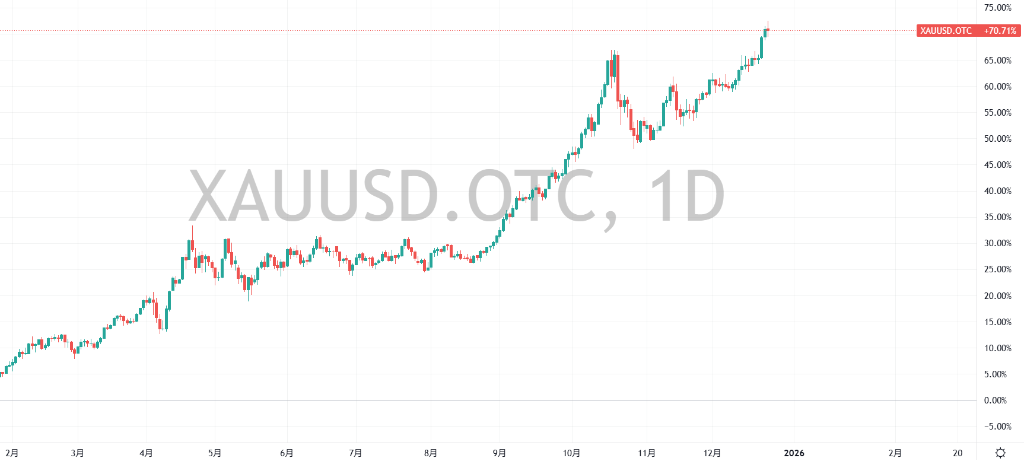
(Spot gold is up over 70% year-to-date)

Bitcoin, however, is missing out on both fronts. For a period in early 2025, Bitcoin's movement was highly synchronized with risk assets, but it has fallen behind noticeably in the year-end行情.

Furthermore, its long-touted 'digital gold' attribute has failed to attract the defensive capital inflows driving the gold price higher. Timothy Misir, Head of Research at digital asset research firm BRN, stated:

“Hard assets” are attracting funds as long-term hedges, while crypto assets remain marginalized.

Historically, Bitcoin's performance during the 'Santa Rally' has been unstable.

Although it posted gains of 33% and 46% during the Christmas to New Year period in 2011 and 2016 respectively, it fell 14% and 10% in 2014 and 2021.Since 2011, Bitcoin has averaged a gain of 7.9% during the Christmas period.

Deteriorating Technicals and Lack of Buying

Some market inertia stems from technical factors.

Bitcoin has broken below its 365-day moving average around $102,000, a level that had acted as key support during this cycle. Failure to reclaim this threshold increases the risk of a deeper correction.

Over $23 billion in options expiring on December 26th have locked in directional bets, reinforcing the stalemate. Thin holiday liquidity has further reduced market activity. But these factors only highlight a deeper缺失: a clear absence of buyers willing to step in.

Continued selling by long-term holders constitutes another drag.

Pratik Kala, Portfolio Manager at hedge fund Apollo Crypto, said Bitcoin's price action this year has been "clearly disconnected from the extremely bullish news cycle surrounding the asset".

He attributes this gap to persistent selling by early holders, including the sharp pullback in October, factors that have collectively prevented rallies from gaining momentum.

Kala stated that much of the selling pressure now appears to have subsided, leaving Bitcoin in a consolidation range,which he believes could lay the groundwork for stronger performance next year.

Continued ETF Outflows

As traders entered the Christmas holiday, market liquidity declining and risk appetite waning, spot Bitcoin and Ethereum ETFs saw renewed outflows on December 24th.

According to SoSoValue data, spot Bitcoin ETFs recorded net outflows of $175 million on Wednesday, while spot Ethereum ETFs saw outflows of $57 million.

The single largest outflow came from BlackRock's IBIT, which lost $91.37 million, followed by Grayscale's GBTC with net outflows of $24.62 million.

Spot Ethereum ETFs saw net outflows of $52.7 million that day, with Grayscale's ETHE leading the selling pressure with outflows of $33.78 million, bringing its historical cumulative net outflows to $5.083 billion.

This pattern aligns with market norms during major holidays: trading volume plummets, market making desks reduce positions, and持仓 strategies turn defensive.

Konstantin Vasilenko, co-founder of Paybis cryptocurrency exchange, told media thathe did not expect a 'Santa Rally'.

Due to tax reasons, traders in some regions liquidate cryptocurrencies and exit some risk positions before the new year, so he does not anticipate major moves before January.

For now, while U.S. stocks rise and gold shines, Bitcoin's stagnation is sending its own signal: an asset built on excitement has little to be excited about at year's end.

Related Questions

QWhat caused the flash crash of Bitcoin on Binance's BTC/USD1 trading pair?

AThe flash crash was caused by liquidity issues in the emerging stablecoin trading pair, where a large market sell order, forced liquidation, or automated trading quickly depleted the buy-side order book, leading to a temporary price deviation from the true market level.

QHow did Bitcoin's performance compare to traditional assets like the S&P 500 and gold during the Christmas period?

ABitcoin underperformed significantly, with a year-to-date decline of over 7% and a drop of 'Christmas rally,' while the S&P 500 hit a record high and gold surged over 70% for the year, marking its best annual performance since 1979.

QWhat technical factors contributed to Bitcoin's stagnant performance and increased risk of a deeper correction?

ABitcoin broke below the 365-day moving average around $102,000, a key support level in this cycle, and faced over $23 billion in options expiring on December 26, which froze directional bets and highlighted a lack of buyers.

QWhy did Bitcoin fail to attract defensive inflows as a 'digital gold' despite gold's strong rally?

AAccording to digital asset research, 'hard assets' like gold attracted long-term hedging funds, while crypto assets remained marginalized, failing to draw the same defensive capital.

QWhat was the trend in Bitcoin and Ethereum ETF flows during the holiday period, and what does it indicate?

ABitcoin spot ETFs saw a net outflow of $175 million, and Ethereum spot ETFs had an outflow of $57 million, reflecting reduced risk appetite and typical holiday market behavior with lower liquidity and defensive positioning.

Related Reads

Trading

Spot
Futures

Hot Articles

What is $BITCOIN

DIGITAL GOLD ($BITCOIN): A Comprehensive Analysis Introduction to DIGITAL GOLD ($BITCOIN) DIGITAL GOLD ($BITCOIN) is a blockchain-based project operating on the Solana network, which aims to combine the characteristics of traditional precious metals with the innovation of decentralized technologies. While it shares a name with Bitcoin, often referred to as “digital gold” due to its perception as a store of value, DIGITAL GOLD is a separate token designed to create a unique ecosystem within the Web3 landscape. Its goal is to position itself as a viable alternative digital asset, although specifics regarding its applications and functionalities are still developing. What is DIGITAL GOLD ($BITCOIN)? DIGITAL GOLD ($BITCOIN) is a cryptocurrency token explicitly designed for use on the Solana blockchain. In contrast to Bitcoin, which provides a widely recognized value storage role, this token appears to focus on broader applications and characteristics. Notable aspects include: Blockchain Infrastructure: The token is built on the Solana blockchain, known for its capacity to handle high-speed and low-cost transactions. Supply Dynamics: DIGITAL GOLD has a maximum supply capped at 100 quadrillion tokens (100P $BITCOIN), although details regarding its circulating supply are currently undisclosed. Utility: While precise functionalities are not explicitly outlined, there are indications that the token could be utilized for various applications, potentially involving decentralized applications (dApps) or asset tokenization strategies. Who is the Creator of DIGITAL GOLD ($BITCOIN)? At present, the identity of the creators and development team behind DIGITAL GOLD ($BITCOIN) remains unknown. This situation is typical among many innovative projects within the blockchain space, particularly those aligning with decentralized finance and meme coin phenomena. While such anonymity may foster a community-driven culture, it intensifies concerns about governance and accountability. Who are the Investors of DIGITAL GOLD ($BITCOIN)? The available information indicates that DIGITAL GOLD ($BITCOIN) does not have any known institutional backers or prominent venture capital investments. The project seems to operate on a peer-to-peer model focused on community support and adoption rather than traditional funding routes. Its activity and liquidity are primarily situated on decentralized exchanges (DEXs), such as PumpSwap, rather than established centralized trading platforms, further highlighting its grassroots approach. How DIGITAL GOLD ($BITCOIN) Works The operational mechanics of DIGITAL GOLD ($BITCOIN) can be elaborated on based on its blockchain design and network attributes: Consensus Mechanism: By leveraging Solana’s unique proof-of-history (PoH) combined with a proof-of-stake (PoS) model, the project ensures efficient transaction validation contributing to the network's high performance. Tokenomics: While specific deflationary mechanisms have not been extensively detailed, the vast maximum token supply implies that it may cater to microtransactions or niche use cases that are still to be defined. Interoperability: There exists the potential for integration with Solana’s broader ecosystem, including various decentralized finance (DeFi) platforms. However, the details regarding specific integrations remain unspecified. Timeline of Key Events Here is a timeline that highlights significant milestones concerning DIGITAL GOLD ($BITCOIN): 2023: The initial deployment of the token occurs on the Solana blockchain, marked by its contract address. 2024: DIGITAL GOLD gains visibility as it becomes available for trading on decentralized exchanges like PumpSwap, allowing users to trade it against SOL. 2025: The project witnesses sporadic trading activity and potential interest in community-led engagements, although no noteworthy partnerships or technical advancements have been documented as of yet. Critical Analysis Strengths Scalability: The underlying Solana infrastructure supports high transaction volumes, which could enhance the utility of $BITCOIN in various transaction scenarios. Accessibility: The potential low trading price per token could attract retail investors, facilitating wider participation due to fractional ownership opportunities. Risks Lack of Transparency: The absence of publicly known backers, developers, or an audit process may yield skepticism regarding the project's sustainability and trustworthiness. Market Volatility: The trading activity is heavily reliant on speculative behavior, which can result in significant price volatility and uncertainty for investors. Conclusion DIGITAL GOLD ($BITCOIN) emerges as an intriguing yet ambiguous project within the rapidly evolving Solana ecosystem. While it attempts to leverage the “digital gold” narrative, its departure from Bitcoin's established role as a store of value underscores the need for a clearer differentiation of its intended utility and governance structure. Future acceptance and adoption will likely depend on addressing the current opacity and defining its operational and economic strategies more explicitly. Note: This report encompasses synthesised information available as of October 2023, and developments may have transpired beyond the research period.

363 Total ViewsPublished 2025.05.13Updated 2025.05.13

Discussions

Welcome to the HTX Community. Here, you can stay informed about the latest platform developments and gain access to professional market insights. Users' opinions on the price of BTC (BTC) are presented below.

活动图片