94,500 May Become the Bull-Bear Battle Line for Bitcoin, Daily Chart Structure Enters Key Observation Zone | Guest Analysis

Odaily星球日报Published on 2026-01-12Last updated on 2026-01-12

Abstract

Bitcoin Price Analysis: $94,500 as Key Pivot Level, Weekly Outlook and Trading Strategies In this weekly analysis, crypto market analyst Cody Feng reviews Bitcoin's performance and outlines key levels and strategies for the coming week. Last week, BTC traded within the predicted range of $84,000–$94,500, hitting a high of $94,789 and a low of $89,311. A short trade executed at the $94,500 resistance level yielded a 3.4% gain using a 1x leverage. The trade was based on a "short at resistance" strategy, supported by proprietary quantitative models for momentum and spread trading. Current model readings suggest mixed signals: - Weekly charts indicate a bearish trend with momentum below zero, though selling pressure is slowing. - Daily charts show consolidation near the zero line, indicating a battle between bulls and bears. This week (Jan 12–18), BTC is expected to continue trading between $84,000–$94,500. A break below $84,000 could lead to a test of $80,000, while a sustained move above $94,500 may signal a stronger rebound. Key resistance levels are $92k–$93k, $94.5k–$95k, and $97.5k–$99.5k. Support levels are $89.5k–$91k, $86k–$86.5k, $83.5k–$84.5k, and $80k. Trading strategies include: - Maintaining a 65% mid-term short position unless $94,500 is broken. - Using 30% capital for short-term trades based on range-bound (A), breakdown (B), or breakout (C) scenarios. Macro focus this week features multiple Fed speakers whose comments may influence liqui...

Odaily Guest Market Analyst Cody Feng, Master of Financial Statistics from Columbia University, USA, focused on quantitative trading in US stocks during university and gradually expanded into digital assets like Bitcoin. He has built a systematic quantitative trading model and risk control system through practical experience; possesses a sharp data-driven insight into market fluctuations and is committed to continuous growth in the professional trading field, pursuing steady returns; will delve into BTC technicals, macro trends, capital flows, and other changes weekly, review and showcase practical strategies, and preview noteworthy upcoming events for reference.

Trading Weekly Report Core Summary:

Strategy Execution (Short-term) Effectiveness Verified: Last week's trading strictly followed the established strategy, successfully completing one short-term operation (1x leverage), cumulatively achieving a 3.4% return.

Core View (Short-term) Verified: The core view proposed last week that "Bitcoin may maintain a range-bound oscillation between $84,000~$94,500" has been precisely validated by the market. Over the past week, the price reached a high of $94,789 and a low of $89,311, highly consistent with the given resistance level of $94,500 and support level of $89,500. This result strongly confirms our judgment of key levels.

The following will detail the market forecast, strategy execution, and specific trading process.

I. Trading Market Review: (01.05~01.11)

1. Last Week's Short-term Operation Review:

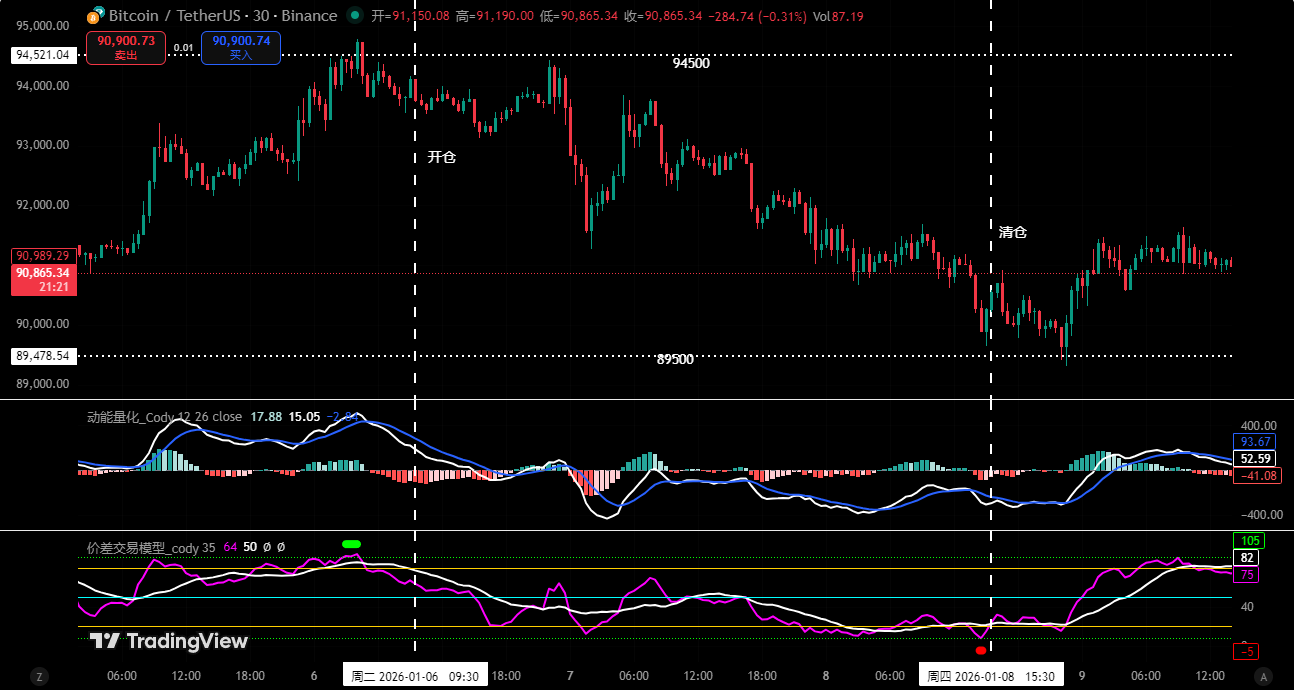
Strictly following the trading signals from our self-built "Spread Trading" and "Momentum Quant" models (see red and green block signals in Figure 1), and combined with accurate market trend predictions, we successfully completed one short-term operation, cumulatively achieving a 3.4% return. Specific trade details and review are as follows:

1. Trade Details Summary: (No leverage)

2. Short-term Trade Review:

• Trade (Profit 3.4%): This operation perfectly executed the "Shorting at Resistance Level" strategy: Step one, when the price rose to impact the key resistance level of 94,500 USD, resonating with the top signal (green dot) of the Spread Trading model, we decisively entered the market to establish a 30% short position; Step two, after the price fell back to the target support zone and triggered the model's bottom signal (red dot), we closed the position to lock in profits.

2. Last Week's Trend Forecast and Operation Strategy Review:

1. Clearly stated last week: Focus on observing the gains and losses in the 84,000~94,500 USD area. Before effectively breaking through the upper or lower bounds of this area, the price will maintain a range-bound oscillation pattern.

2. Core Level Review: First resistance watched the 93,000~94,500 USD area, first support watched the 89,500~91,000 USD area.

2. Operation Strategy Review:

• Midline Strategy: If the market maintains oscillation within the 84,000~94,500 USD range, continue holding the midline position (short) of about 65%.

• Short-term Strategy: If the price maintains oscillation within the 84,000~94,500 USD range, execute operations according to Plan A:

• Open Position: When the price rebounds to the 93,000~94,500 USD area and shows signs of resistance, a 30% short position can be established.

• Risk Control: Set the short stop-loss above 95,500 USD.

• Reduce Position: When the price falls to the 86,000~86,500 USD area and shows signs of stabilization, gradually close part of the short position.

• Close Position: When the price probes near 84,000 USD and shows signs of stabilization, close all positions to take profits.

Figure 1

II. Trend Model Judgment: Bitcoin's Future Trend and How to Enter

Combining market movements, the author provides an in-depth analysis of Bitcoin's price structure from multiple models and dimensions based on a self-built trading system.

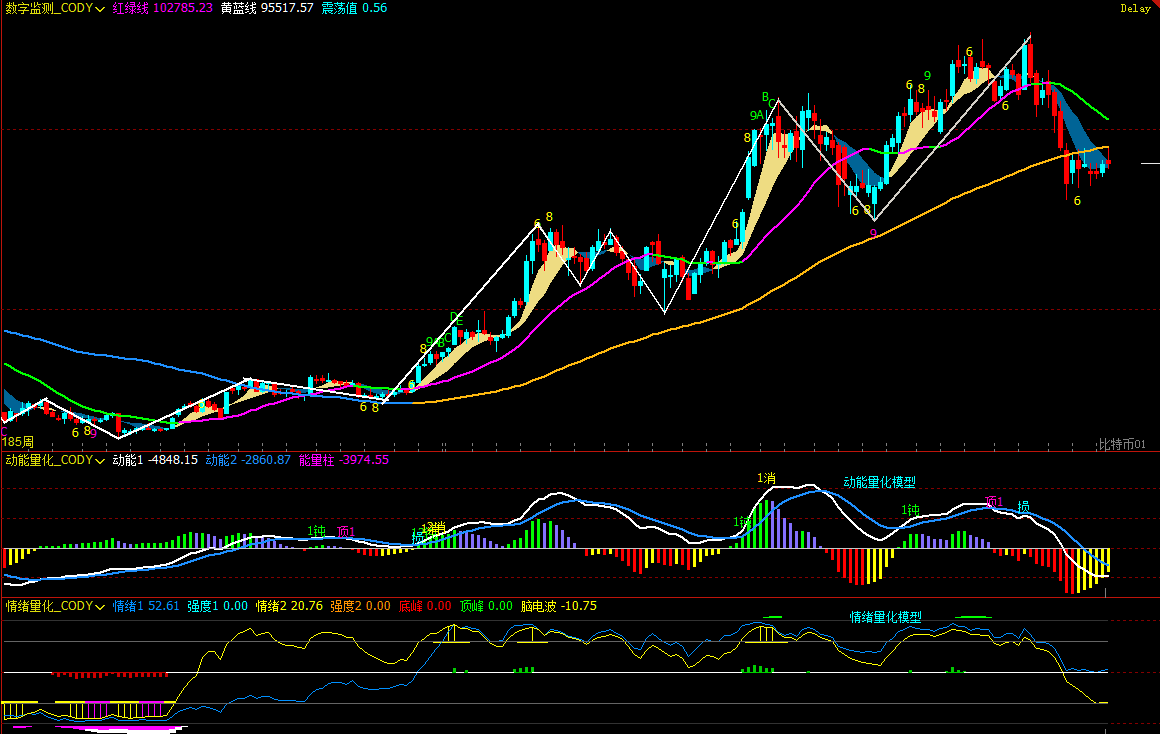
1. As shown in (Figure 2), analysis from the weekly chart:

Momentum Quant Model: Technical indicators show the momentum line converging below the zero axis, while the negative energy bars continue to shrink, indicating a slowdown in the rate of decline. However, the current signals do not confirm that the trend has reversed.

Momentum Quant Model indicates: Probability of price decline: High

Sentiment Quant Model: Blue sentiment line value 52.61, strength zero; Yellow sentiment line value 20.76, strength zero, peak value is 0.

Sentiment Quant Model indicates: Price pressure and support index: Neutral

Digital Monitoring Model: The price has been below the bull-bear (yellow-blue line) dividing line for 8 weeks. Last week, bulls again冲击ed this line but fell back after encountering resistance from bears. This failed attempt means bears still control the market dominance.

Digital Monitoring Model indicates: Monitoring (top/bottom) digital signals have not appeared; Weekly K-line closed as a doji with an upper shadow, down about 0.57%.

The above data indicates: Bitcoin's weekly chart has entered a bearish trend, be wary of oscillation and adjustment risks.

Figure 2

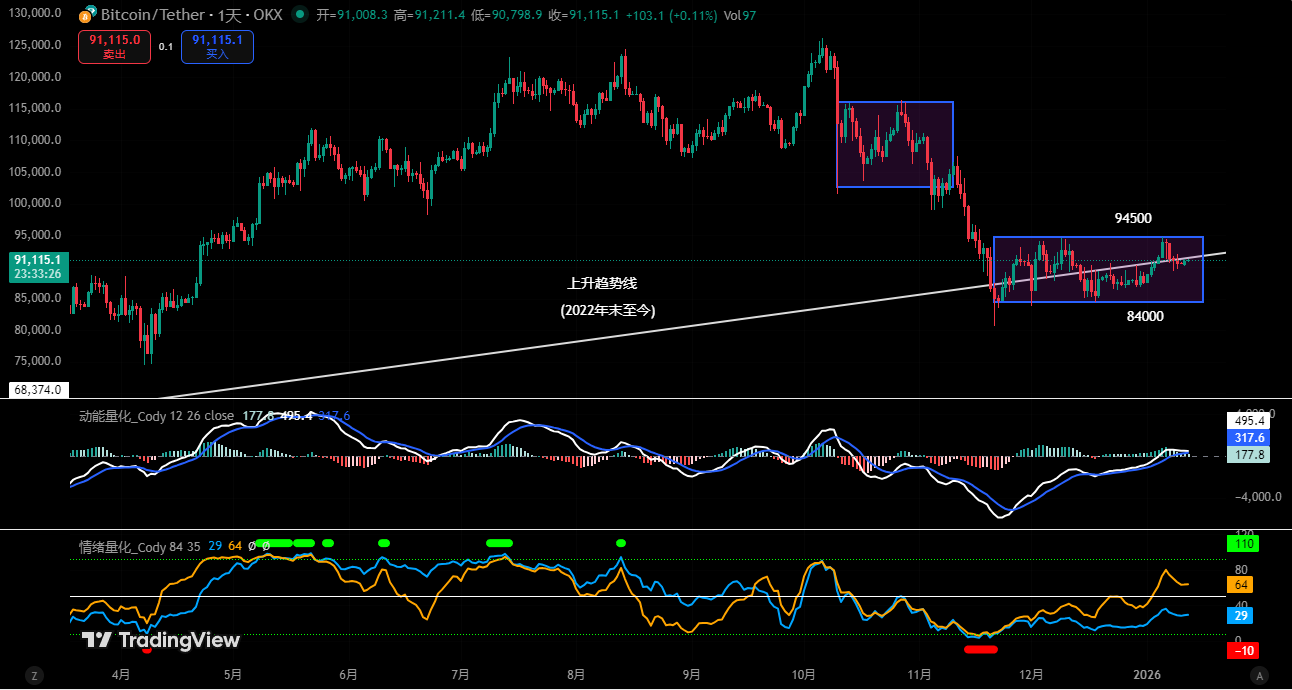
2. As shown in (Figure 3), analysis from the daily chart:

Momentum Quant Model: Last week overall showed a "rise first then fall" pattern. In the first half of the week, the momentum line crossed above the zero axis, and positive energy bars continued to expand; but in the latter half, the momentum line tended to converge again, and energy bars明显 shrank, indicating weakened buying momentum.

Momentum Quant Model indicates: The daily level is in a bull-bear contest phase, watch the zero axis gain/loss.

Sentiment Quant Model: After last week's daily close, blue sentiment line value 28, strength zero; yellow sentiment line value 62, strength zero.

Sentiment Quant Model indicates: Pressure and support index: Neutral

The above data suggests: The daily level is at a bull-bear watershed, the trend direction awaits further confirmation.

Figure 3

III. This Week's Market Prediction: (01.12~01.18)

1. This Week's Core View:

• Bitcoin is expected to continue oscillating repeatedly within the 84,000~94,500 USD range, but focus on observing the bull-bear battle at both ends of the range.

Breakdown: Once it effectively breaks below 84,000 USD, the trend will turn downward, with the first test target at 80,000 USD.

Breakout: If it can firmly stand above 94,500 USD, it is expected to start a relatively strong technical rebound.

2. Core Resistance Levels:

• First Resistance Area: 92,000~93,000 USD area

• Second Resistance Area: 94,500~95,000 USD area

• Important Resistance Level: Near 97,500~99,500 USD.

3. Core Support Levels:

• First Support Level: 89,500~91,000 USD area

• Second Support Level: 86,000~86,500 USD area

• Third Support Level: 83,500~84,500 USD area

• Important Support Level: Near 80,000 USD.

IV. This Week's Operation Strategy (Excluding Sudden News Impact): (01.12~01.18)

1. Midline Strategy:

• Before the price effectively breaks through 94,500 USD, continue maintaining the midline position (short) of about 65%.

• If the price successfully breaks through and stabilizes above 94,500 USD, close all midline positions (short), hold funds and observe.

2. Short-term Strategy: Use 30% of the position, set stop-loss points, and look for "spread" opportunities based on support and resistance levels. (Use 30 minutes as the operation cycle).

3. To dynamically respond to market evolution and combine real-time model signals, we have prepared three short-term operation plans A/B/C:

Plan A: If the price maintains oscillation within 84,000~94,500 USD:

• Open Position: Based on core resistance level judgment (see this week's market prediction), when rebounding to the 93,000~94,500 USD area and combined with the hourly chart model top signal, a 30% short position can be established.

• Risk Control: Initial short stop-loss set about 1.5% above the entry price (i.e., 1.015 * entry price).

• Close Position: When probing near core support levels and combined with model signals, gradually close the position to take profits.

Plan B: If the price effectively breaks below the 84,000 USD support:

• Open Position: If it effectively breaks down through core support levels, chase the drop to establish a 30% short position.

• Risk Control: Initial short stop-loss set about 1.5% above the entry price (i.e., 1.015 * entry price).

• Close Position: When probing near 80,000 USD and combined with model signals, gradually close the position to take profits.

Plan C: If it successfully breaks through and stabilizes above the 94,500 USD resistance:

• Open Position: If it successfully breaks through the core resistance level and combined with model signals, a 30% long position can be established.

• Risk Control: Initial long stop-loss set about 1.5% below the entry price (i.e., 0.985 * entry price).

• Close Position: When rebounding to near 97,500 USD and combined with model signals, gradually close the position to take profits.

V. Macro & Liquidity Weekly Observation:(01.12~01.18)

I. Dense Schedule of FOMC Official Speeches: A Key Window for Policy Expectation Recalibration

This week, the Federal Reserve system will usher in a rare window of密集 official speeches. Multiple Fed Presidents and Governors with voting rights in different years will集中 express their views on economic prospects, inflation trends, and policy stance, providing key information for the market to judge the future monetary policy path.

Looking at the speaker lineup, it includes both permanent FOMC voters and rotating voters for 2026-2028, covering information dimensions from short-term policy orientation to medium-term decision-making frameworks, which is of great guiding significance for the interest rate expectation structure.

Main events include:

Tuesday: 2027 FOMC voter, Atlanta Fed President Bostic speaks;

2027 FOMC voter, Richmond Fed President Barkin speaks;

Permanent FOMC voter, New York Fed President Williams speaks;

2028 FOMC voter, St. Louis Fed President Musalem speaks;

Wednesday: Richmond Fed President Barkin speaks again;

2026 FOMC voter, Philadelphia Fed President Harker speaks on economic outlook;

Fed Governor Waller speaks in a public setting;

Thursday: 2026 FOMC voter, Minneapolis Fed President Kashkari speaks,同时 2027 FOMC voter, Atlanta Fed President Bostic speaks again;

Fed releases Beige Book;

Permanent FOMC voter, New York Fed President Williams gives opening remarks at an event;

Bostic speaks again on economic and policy issues;

Friday: Richmond Fed President Barkin speaks on regional economic prospects.

II. Market Focus: Whether to Release Policy Pivot Signals Early

Against the backdrop of marginal decline in inflation and signs of cooling in the job market, the market's core focus is whether officials will continue to emphasize the necessity of "maintaining restrictive policy for a longer time," or begin to provide clearer forward guidance for the next phase of policy shift.

It should be noted that officials' speeches affect the expectation structure more than the short-term direction, and their effect is usually reflected in the medium-term adjustment of the interest rate curve, the US dollar index, and the valuation system of risk assets.

III. Potential Impact on Risk Assets and Crypto Markets

If multiple officials maintain a cautious stance, emphasizing that the inflation path remains uncertain, it may suppress risk appetite in the short term;

But if the speeches gradually acknowledge the economic slowdown trend and weaken the necessity for further policy tightening, it will help the medium-term easing expectation to be repriced.

For crypto assets like Bitcoin, the core impact of Fed officials' speeches lies in liquidity expectations and discount rate changes. The effect is medium-term and more suitable as a macro pricing reference than a short-term trading signal.

VI. Special Notes:

1. When opening a position: Immediately set the initial stop-loss level.

2. When profit reaches 1%: Move the stop-loss to the entry price (breakeven point) to ensure capital safety.

3. When profit reaches 2%: Move the stop-loss to the 1% profit level.

4. Continuous tracking: Thereafter, for every additional 1% profit the price makes, move the stop-loss up 1% accordingly, dynamically protecting and locking in existing profits.

(Note: The above 1% profit trigger threshold can be flexibly adjusted by investors according to their own risk preference and the volatility of the asset.)

Financial markets change rapidly, all market analysis and trading strategies need dynamic adjustment. All views, analytical models, and operation strategies involved in this article are derived from personal technical analysis, for personal trading log purposes only, and do not constitute any investment advice or operational basis. The market carries risks, investment requires caution, DYOR.

Related Questions

QWhat is the key resistance level that Bitcoin needs to break to potentially start a technical rebound according to the analyst?

A94,500 USD.

QWhat was the total return from the short-term trading operation executed last week as described in the report?

A3.4%.

QWhat are the three short-term trading plans (A, B, and C) based on for the upcoming week?

APlan A is for if the price remains in the 84,000–94,500 USD range. Plan B is for if the price effectively breaks below 84,000 USD. Plan C is for if the price successfully breaks and holds above 94,500 USD.

QAccording to the weekly analysis, what does the 'Sentiment Quantification Model' indicate for Bitcoin's price pressure and support index on the daily chart?

ANeutral.

QWhat major macroeconomic factor is highlighted for the week of January 12-18 that could influence market liquidity expectations?

AA dense schedule of speeches from various FOMC officials, which will provide key information for judging the future monetary policy path.

Related Reads

$292 Million KelpDAO Cross-Chain Bridge Hack: Who Should Foot the Bill?

On April 18, 2026, an attacker stole 116,500 rsETH (worth ~$292M) from KelpDAO’s cross-chain bridge in 46 minutes—the largest DeFi exploit of 2026. The stolen assets were deposited into Aave V3 as collateral, causing $177–200M in bad debt and triggering a cascade of losses across nine DeFi protocols. Aave’s TVL dropped by ~$6B overnight. This legal analysis argues that KelpDAO and LayerZero Labs share concurrent liability, with fault apportioned 60%/40%. KelpDAO negligently configured its bridge with a 1-of-1 decentralized verifier network (DVN)—a single point of failure—despite LayerZero’s explicit recommendation of a 2-of-3 setup. LayerZero, which operated the compromised DVN, failed to secure its RPC infrastructure against a known poisoning attack vector. Both protocols’ terms of service cap liability at $200 (KelpDAO) or $50 (LayerZero), but these limits are likely unenforceable due to unconscionability, gross negligence exceptions, and potential securities law invalidation (if rsETH is deemed a security under the Howey test). Aave’s governance also faces fiduciary duty claims for raising rsETH’s loan-to-value ratio to 93%—far above competitors’ 72–75%—without adequately assessing bridge risks, amplifying the systemic fallout. Practical recovery targets include LayerZero Labs (a registered Canadian entity), KelpDAO’s founders, auditors, and identifiable Aave governance delegates. The incident underscores escalating legal risks for DeFi protocols, infrastructure providers, and governance participants.

marsbit54m ago

$292 Million KelpDAO Cross-Chain Bridge Hack: Who Should Foot the Bill?

marsbit54m ago

Insider Trading in War: 5 People Involved, the Highest Earner Was Arrested

On April 24, the U.S. Department of Justice arrested U.S. Army Special Forces Staff Sergeant Gannon Ken Van Dyke for insider trading related to the capture of Venezuelan President Nicolás Maduro on January 3. Van Dyke allegedly profited over $400,000 by placing bets on a prediction market, Polymarket, using insider knowledge of the covert operation. According to the indictment, Van Dyke registered an account (0x31a5) on December 26 and made a series of bets predicting Maduro’s capture and U.S. military involvement in Venezuela. He withdrew most of his funds on the day of the operation and attempted to obscure his tracks by transferring assets through crypto and brokerage accounts. This case marks the first time the DOJ has prosecuted insider trading on Polymarket. PolyBeats had previously identified five suspicious accounts, including Van Dyke’s—the highest earner—in January. The other accounts, with profits ranging from $34,000 to $145,000, remain under unofficial scrutiny but have not been charged. Their lower profits, indirect access to information, and unclear legal boundaries may complicate prosecution. Polymarket has since strengthened its market integrity rules, explicitly prohibiting trading based on confidential or insider information. Van Dyke’s arrest, nearly four months after his trades, signals increased regulatory attention and the persistent traceability of blockchain-based transactions.

marsbit56m ago

Insider Trading in War: 5 People Involved, the Highest Earner Was Arrested

marsbit56m ago

Bitwise: Bullish on Bitcoin's Performance in the Second Half of the Year, AI and Regulation Will Spark a New Altcoin Season

Bitwise CIO Matt Hougan and Research Lead Ryan Rasmussen express strong bullish sentiment on Bitcoin's long-term prospects, suggesting that its $1 million price target may be too conservative. They argue Bitcoin serves a dual role: as digital gold and a potential global settlement asset, especially amid declining trust in traditional monetary systems. Despite a weak Q1 2026 where nearly all crypto assets and prices saw double-digit declines, the analysts remain optimistic due to strong forward-looking catalysts, including institutional adoption via Bitcoin ETFs from major firms like Morgan Stanley and Goldman Sachs. Geopolitical instability, such as Iran’s mention of using Bitcoin for international payments, increases the value of Bitcoin’s “out-of-the-money call option” as a non-political, global settlement currency. This enhances its appeal beyond a mere store of value. . Additionally, Hougan highlights that a clearer regulatory token framework under current SEC leadership, combined with AI efficiency gains and high-performance blockchains, could fuel a new “altseason” by late 2026. This may lead to a wave of legitimate, value-capturing token projects, unlike the earlier ICO boom. . Bitwise also announced an Avalanche ETF, citing its unique architecture and rapid growth in real-world asset (RWA) tokenization, which has surged 10x to nearly $30 billion in two years. The firm believes Layer 1 blockchains are still early in their growth cycle, with significant potential ahead.

marsbit1h ago

Bitwise: Bullish on Bitcoin's Performance in the Second Half of the Year, AI and Regulation Will Spark a New Altcoin Season

marsbit1h ago

Trading

Spot
Futures
活动图片