Цены на ASIC-майнеры упали до двухлетних минимумов – выгодная сделка для майнеров из России

CointelegraphPublished on 2022-12-27Last updated on 2022-12-27

Abstract

ASIC биткоин-майнеры – машины, оптимизированные исключительно для добычи биткоина - в настоящее время продаются по ценам, которых не было с 2020 и 2021 годов.

ASIC биткоин-майнеры – машины, оптимизированные исключительно для добычи биткоина - в настоящее время продаются по ценам, которых не было с 2020 и 2021 годов.

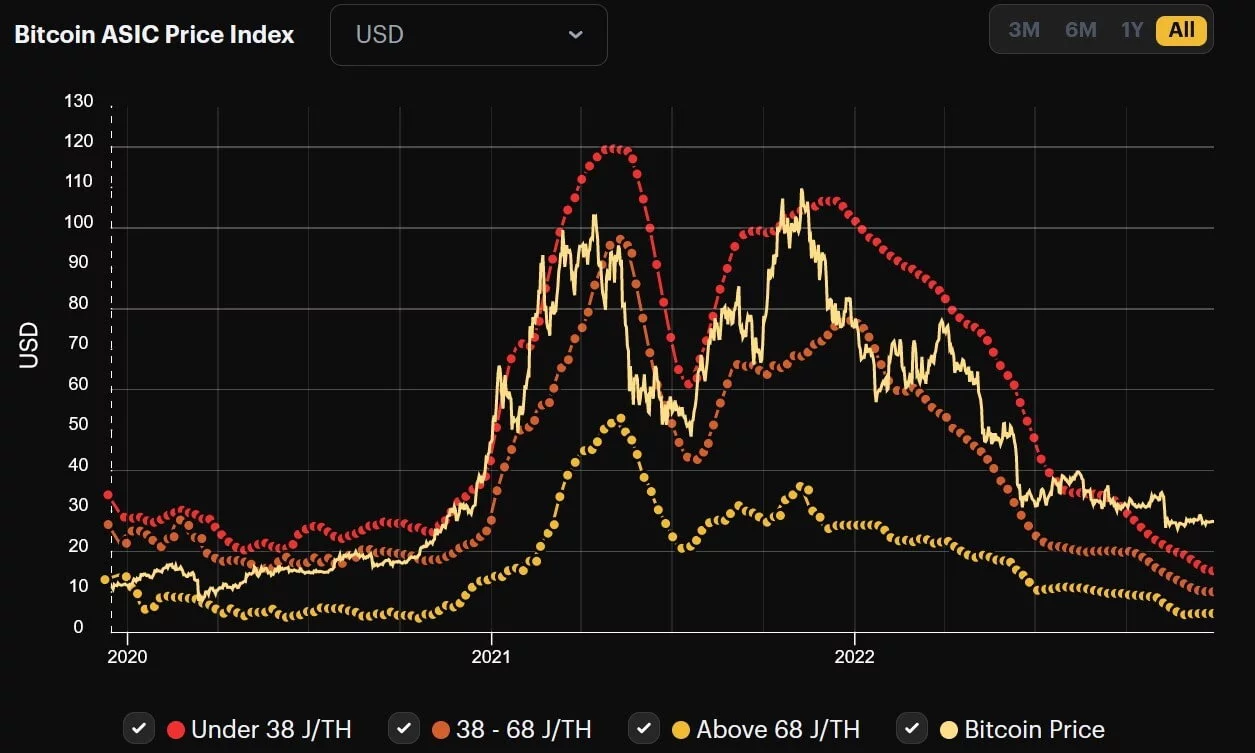
Согласно последним данным Hashrate Index, цены на самые эффективные ASIC-майнеры, мощностью не менее одного терахеша на 38 джоулей энергии, упали на 86,82% с пикового значения, зафиксированного 7 мая 2021 года: с $119,25 за терахэш до $15,71 по состоянию на 25 декабря.

К майнерам этой категории относятся Antminer S19 от Bitmain и Whatsminer M30s от MicroBTC.

То же самое можно сказать и о машинах среднего уровня: цены на них сейчас в среднем составляют $10,23 за терахэш. С пиковой значения в $96,24 7 мая 2021 года цена упала на на 89,36%.

При этом, для наименее эффективных машин, расходующих более 68 Дж на 1 терахэш вычислительной мощности, падение цены за терахэш составило 91% - $52,85 до $4,72. Последний раз цена была близка к этой отметке 5 ноября 2020 года.

Индекс цен на ASIC биткоина-майнеры для машин с разным уровнем эффективности. Источник: Hashrate Index.

Падение цен в значительной степени связано с проблемами у крупных майнинговых компаний, которые борются за сохранение прибыльности на протяжении всего медвежьего тренда на рынке криптовалют. Многие из них либо подали заявление о банкротстве, либо взяли на себя долговые обязательства, либо продали свои запасы BTC и оборудование, чтобы остаться на плаву.

К числу таких компаний относятся Core Scientific, Marathon Digital, Riot Blockchain, Bitfarms и Argo Blockchain.

Однако, такое резкое падение цен вызвало интерес у некоторых покупателей. Среди них многие майнинговые предприятия из России, такие как BitRiver, которые работают в плюс за счёт выгодных условий на размещение мощностей, поскольку стоимость электроэнергии в стране гораздо ниже, чем во многих регионах мира. На некоторых современных аппаратных средствах майнеры из России способны добывать один биткойн (BTC) по цене около $0,07 за киловатт-час.

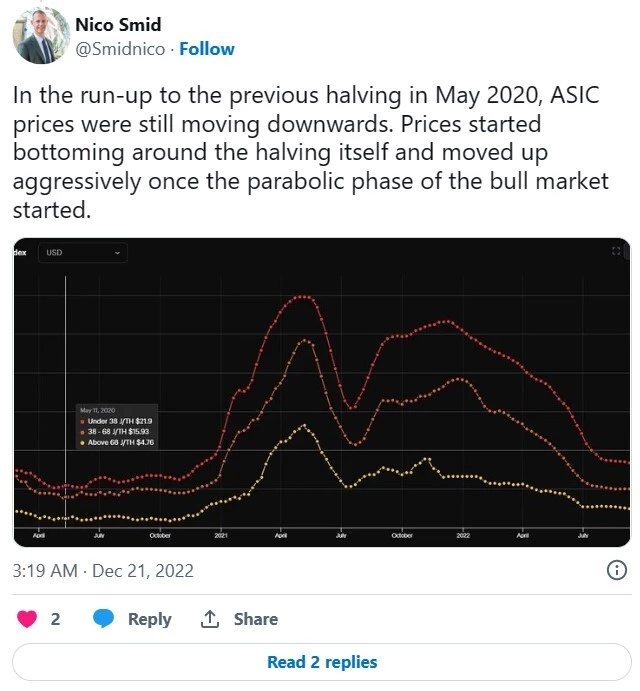
Хотя трудно предсказать, в каком направлении будут двигаться цены на ASIC-майнеры дальше, Нико Смид из Digital Mining Solutions отметил в своем твите от 21 декабря, что цены на ASIC-майнеры достигли дна во время последнего халвинга биткоина 11 мая 2020 года и вскоре после этого активно пошли вверх. Подобный сценарий может повториться во время следующего халвинга, который, как ожидается, произойдет 20 апреля 2024 года.

Источник: @Smidnico/Twitter

«В преддверии предыдущего халвинга в мае 2020 года цены на ASIC-майнеры стремились вниз. Они достигли дна около самого халвинга и активно пошли вверх, когда рынок перешёл к бычьей стадии параболического роста».

Автор: Brayden Lindrea. Источник: Cointelegraph.

Related Reads

2026, Survive: A Manual for Crypto Enthusiasts on Bear Market Survival and Counterattack

Surviving 2026: A Crypto Bear Market Survival and Counterattack Guide As the crypto market remains stagnant around $85,000-$90,000, this guide offers strategies for navigating the prolonged bear market. Key recommendations include: 1. **Diversify into Stocks (Stocks + Crypto Strategy):** With liquidity flowing into the rising U.S. stock market and AI bubble, investors are advised to engage in "stock-token co-cultivation." Utilize traditional brokerages or tokenized stock platforms (e.g., MSX.com, xStocks) to apply crypto trading experience (e.g., news trading) to equities, especially crypto-concept stocks, for arbitrage opportunities. 2. **Invest in Commodities:** Given ongoing global geopolitical tensions, traditional safe-haven assets like gold, silver, and strategic metals (copper, lithium) are expected to continue rising. Investors can gain exposure through tokenized assets or direct investment. 3. **Adopt Defensive Yield Strategies:** For capital preservation, a three-pronged approach is recommended: * **Staking:** Earn yields on mainstream coins (ETH, SOL) via exchanges or vetted DeFi protocols, being cautious of platform risks. * **Lending:** Use established lending protocols like Aave (Ethereum) and Kamino (Solana) for stable returns. * **Fixed Investment & CEX Promotions:** Regularly invest (DCA) into major cryptocurrencies and actively participate in high-yield deposit/earn campaigns on centralized exchanges (e.g., Binance, OKX), which offer substantial subsidies during market lulls. 4. **Explore Prediction Markets:** Prediction markets (e.g., Polymarket, Kalshi) are poised for significant growth, potentially reaching $100B in monthly volume, driven by events like the World Cup and U.S. mid-term elections. Strategies include "buying early" on high-probability outcomes or following successful bettors, while avoiding risky "sweeping the tail" bets. The guide concludes by highlighting the growing convergence of AI and crypto, specifically the x402 protocol on Solana, which is advancing AI-powered payments and stablecoins. The core message is to build resilient, diversified income streams to survive the bear market and be prepared for the next bull run.

marsbit1h ago

2026, Survive: A Manual for Crypto Enthusiasts on Bear Market Survival and Counterattack

marsbit1h ago

2026, Survive: A Manual for Crypto Enthusiasts on Bear Market Survival and Counterattack

"Surviving 2026: A Bear Market Survival and Counterattack Guide for Crypto Participants" This article provides strategic advice for navigating the prolonged crypto bear market of late 2025, characterized by stagnation between $85k-$90k for Bitcoin and declining retail activity. The author, a seasoned participant, outlines a multi-faceted approach. Key strategies include: * **Crypto-Stock Dual Strategy:** With liquidity drawn to rising AI-inflated stock markets, engaging with both asset classes is now essential. Investors should leverage their crypto-honed news trading skills in traditional markets via brokers or tokenized stock platforms (e.g., MSX.com, xStocks). * **Commodities as a Hedge:** Amidst tense global macro-political tensions, precious metals (gold, silver) and strategic resources (copper, lithium) are predicted to continue rising, serving as reliable hard assets. These can be accessed via tokenized assets. * **Defensive Yield Strategies:** For capital preservation, a combination of staking (on exchanges or within ETH/SOL ecosystems), lending on robust DeFi protocols (e.g., Aave, Kamino), and participating in high-yield CEX deposit/earn programs is recommended to build "anti-fragile" income streams. * **Betting on Prediction Markets:** With major events like the World Cup and US mid-term elections, prediction markets (e.g., Polymarket's upcoming token launch) are poised for significant growth. Strategies involve "buying early" on probable outcomes or following successful bettors, while avoiding risky "sweeping the tail" bets. The conclusion highlights the growing convergence of AI and crypto, specifically pointing to Solana's prioritization of the x402 protocol for AI-powered payments as a key trend for 2026. The overarching message is to diversify strategies, preserve capital, and stay agile to survive the downturn and capitalize on the next bull market.

Odaily星球日报1h ago

2026, Survive: A Manual for Crypto Enthusiasts on Bear Market Survival and Counterattack

Odaily星球日报1h ago

Advancing MM 1: Market Maker Inventory Quoting System

"Attack of the MM 1: Market Maker Inventory Quoting System" by Dave explores why altcoin prices often move against retail traders immediately after their purchases, debunking the myth of intentional manipulation by "market manipulators." The article explains that this phenomenon is not due to malicious intent but is a result of automated market maker (MM) systems using the Avellaneda-Stoikov model for inventory-based pricing and protection against toxic order flow. When retail traders execute large buy orders, MMs sell, leading to a short inventory exposure. To mitigate risk, MMs adjust their strategies in two ways: 1. **Quote Skew**: They lower prices to attract sellers and discourage further buys, aiming to replenish inventory and protect their short position. 2. **Spread Widening**: They widen bid-ask spreads to reduce transaction probability and earn more spread profit to offset potential losses. The core mechanism involves the "Reservation Price," calculated as Mid Price − γ⋅q (where q is inventory and γ is risk aversion). Large retail orders disrupt inventory balance, causing MMs to adjust prices dynamically. Retail traders often face this due to their concentrated, unconcealed, and unhedged orders, especially in low-liquidity altcoins where their trades significantly impact pricing. The article concludes with a practical tip: instead of executing large orders at once, retail traders can break them into smaller, staggered orders to exploit MM pricing adjustments, achieving better average entry prices. A follow-up will discuss toxic order flow and order book dynamics.

深潮1h ago

Advancing MM 1: Market Maker Inventory Quoting System

深潮1h ago

Trading

Spot
Futures

Hot Articles

Discussions

Welcome to the HTX Community. Here, you can stay informed about the latest platform developments and gain access to professional market insights. Users' opinions on the price of BTC (BTC) are presented below.

活动图片