Crypto Watchlist: The Key Catalysts To Track This Week

bitcoinistPublished on 2026-02-17Last updated on 2026-02-17

Abstract

This week is significant for crypto with key events including ETHDenver starting February 18, where Ethereum's ecosystem developments and partnerships will be showcased. On February 17, Jupiter DAO will vote on pausing token emissions to address supply dilution. Hyperliquid faces speculation about a potential second airdrop on February 18, though nothing is confirmed. Macro factors include US markets closed on February 16 for Presidents’ Day, potentially increasing crypto volatility. The FOMC minutes on February 18 and PCE inflation data on February 20 will influence rate-cut expectations and risk sentiment. A Supreme Court decision on tariffs could also impact macro markets and crypto. The total crypto market cap is $2.32 trillion.

Crypto’s week is stacked: ETHDenver pulls builders into Denver, a major DAO votes on supply, and US macro hits just as liquidity comes back after the holiday. Here’s what to watch:

Ethereum (Feb. 18): ETHDenver Kicks Off

ETHDenver’s main programming and opening ceremony are slated for Wednesday, Feb. 18, with a multi-day run into the weekend and a packed schedule across stages, side events, and builder tracks.

ETHDenver is where the Ethereum stack gets judged in real time: tooling, L2/app UX, account-abstraction product choices and the ecosystem’s current priorities, for better or worse. Don’t trade it like a single catalyst, but it’s still an info dump: partnerships get soft-launched, roadmaps get clarified, and the politics show up in Q&As before anyone writes the post-mortem.

Jupiter (Feb. 17): JUP’s ‘Pause Emissions’ Vote Goes Live

On Feb. 17, Jupiter DAO is expected to put a blunt question to holders: pause emissions and take dilution off the table, or keep incentives running as the default cost of growth.

The proposal goes beyond optics. It targets net emissions, including team-reserve flows and how team liquidity events get handled, which makes it a real token-policy decision: near-term distribution versus tighter supply discipline. If this passes, it’s not just a parameter tweak; it’s a message about what Jupiter thinks the market will reward this cycle.

Hyperliquid (Feb. 18): Second Airdrop Chatter

The real trade here is expectations. X is leaning into “Season 2” airdrop talk for Feb. 18 — but there’s still nothing official from the team.

The reason it keeps coming back is simple: the November 2024 drop was huge (big allocation, bigger mindshare) so traders keep trying to front-run a sequel. Until Hyperliquid pins anything down (team announcement, governance post, or an explicit timeline), this is positioning risk, not a confirmed event.

Macro Events To Watch This Week For Bitcoin And Crypto

Monday (Feb. 16): Presidents’ Day Shuts US Markets

With NYSE and Nasdaq shut for Presidents’ Day, macro flows are thinner and that’s when crypto tends to overreact to relatively small pushes. The bigger point is timing: for a lot of US-based participants, the “real” week starts Tuesday, which compresses reaction windows ahead of Wednesday’s Fed minutes and Friday’s inflation print.

Wednesday (Feb. 18): FOMC Minutes Hit

The minutes from the Fed’s late-January meeting land Wednesday, three weeks after the decision. Traders will read them for internal disagreement, how officials framed inflation persistence versus labor-market cooling, and what would actually have to break to move the rate path.

In practice, the market tends to move on nuance. The key is whether “higher for longer” reads like the base case or just one scenario, and how confident the committee sounds that disinflation is still doing the work.

Friday (Feb. 20): PCE Inflation Print

The BEA’s Personal Income and Outlays release hits Friday, Feb. 20, including headline and core PCE, the Fed’s preferred inflation gauge, right into the close of a holiday-shortened week.

For crypto, it’s rarely about the number in isolation. The trade is the knock-on effects: rate-cut timing, real yields, and whether macro funds re-risk into the weekend. If PCE surprises in either direction, it can dominate the weekly close and set the tone for the next stretch.

Friday (Feb. 20): Supreme Court Tariffs Decision?

Feb. 20 is also on the radar as a potential opinion day in the Supreme Court case tied to President Trump’s signature tariff policy. Markets don’t need a full rewrite to move, they need direction. Any signal that the tariff framework stands, gets narrowed, or gets clipped feeds straight into rates, the dollar, and broader risk pricing.

Crypto won’t trade the ruling directly, but the linkage is real. If tariffs reprice growth and inflation expectations, crypto is likely to move with the broader risk complex, especially in a week where liquidity and macro timing are already doing the heavy lifting.

At press time, the total crypto market cap stood at $2.32 trillion.
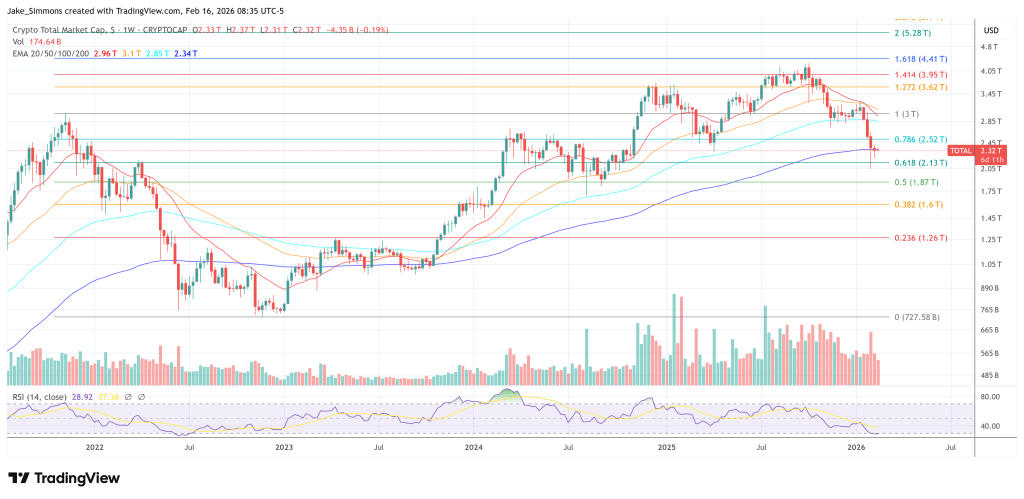
Total crypto market cap hovers below the 200-week EMA, 1-week chart | Source: TOTAL on TradingView.com

Related Questions

QWhat is the main event happening in the Ethereum ecosystem on February 18th, and what is its significance?

AETHDenver's main programming and opening ceremony are scheduled for February 18th. It's a significant event where the Ethereum stack is judged in real time, featuring tooling, L2/app UX, and account-abstraction product choices. It serves as an information hub for soft-launched partnerships, clarified roadmaps, and ecosystem politics.

QWhat major decision is the Jupiter DAO putting to a vote on February 17th, and what are the implications of this vote?

AThe Jupiter DAO is voting on whether to pause token emissions and remove dilution. This is a substantial token-policy decision that goes beyond optics, targeting net emissions, including team-reserve flows. A 'yes' vote would signal a shift towards tighter supply discipline and what the market might reward this cycle.

QWhat is the key macroeconomic event for crypto traders to watch on Friday, February 20th, and why is it important?

AThe key event is the release of the PCE inflation print, the Federal Reserve's preferred inflation gauge. It's important because it influences rate-cut timing, real yields, and whether macro funds re-risk. A surprise in either direction can dominate the weekly market close and set the tone for subsequent trading.

QHow does the US Presidents' Day holiday on February 16th potentially affect the crypto market?

AWith US markets closed, macro flows are thinner, which can cause the crypto market to overreact to relatively small pushes. It also compresses the reaction window for the week's later major events, like the FOMC minutes and the PCE inflation data.

QWhat is the source of the 'Second Airdrop Chatter' for Hyperliquid on February 18th, and how should traders approach this information?

AThe chatter originates from social media platform X (Twitter) and is not an official announcement from the Hyperliquid team. Traders are trying to front-run a potential sequel to the huge November 2024 airdrop. Until the team provides an official announcement or timeline, this represents positioning risk, not a confirmed event.

Related Reads

Three Frameworks for Ordinary People to Achieve AI Capability Leap: Say Goodbye to the Dilemma of 'Repeating Inputs Every Day'

Summary: This article outlines three frameworks for maximizing AI efficiency, moving beyond basic prompt usage. 1. **Three-Layer Evolution**: Users progress from (1) **Prompt** (one-off instructions, reset each session), to (2) **Project** (context-aware within a specific project), to (3) **Skill** (permanent, auto-applied knowledge). Most users stagnate at the first layer, repeating the same instructions daily with no cumulative improvement. Skills transform the AI from a chat tool into a personalized work system. 2. **Transaction vs. Compound Interest Mindset**: Using prompts is a linear transaction—effort and output are 1:1, and stopping resets progress. Investing time in building Skills is compound interest; a small initial time investment pays continuous dividends, as each Skill permanently elevates the AI's baseline performance. 3. **Thin Harness, Fat Skills**: The system architecture should prioritize thick, well-defined Skills (90% of the value—containing processes, standards, and domain knowledge) and a thin "harness" (the minimal technical environment). Avoid over-engineering the toolchain while neglecting the AI's actual knowledge. Skills are permanent assets that automatically improve with model updates. The key takeaway: Identify tasks you repeat, encode them into Skills (using tools like Claude's Skill Creator), and shift focus from daily prompting to building a compounding, self-improving AI system.

marsbit49m ago

Three Frameworks for Ordinary People to Achieve AI Capability Leap: Say Goodbye to the Dilemma of 'Repeating Inputs Every Day'

marsbit49m ago

Trading

Spot
Futures

Hot Articles

Discussions

Welcome to the HTX Community. Here, you can stay informed about the latest platform developments and gain access to professional market insights. Users' opinions on the price of S (S) are presented below.

活动图片