3 reasons why Ethereum price keeps rejecting at the $1,300 level

CointelegraphPublished on 2022-12-07Last updated on 2022-12-07

Abstract

Traders are not sure if ETH will be able to hold the $1,200 level while the S&P 500 rapidly approaches the crucial 3,900 support and ETH derivatives data hints at more downside.

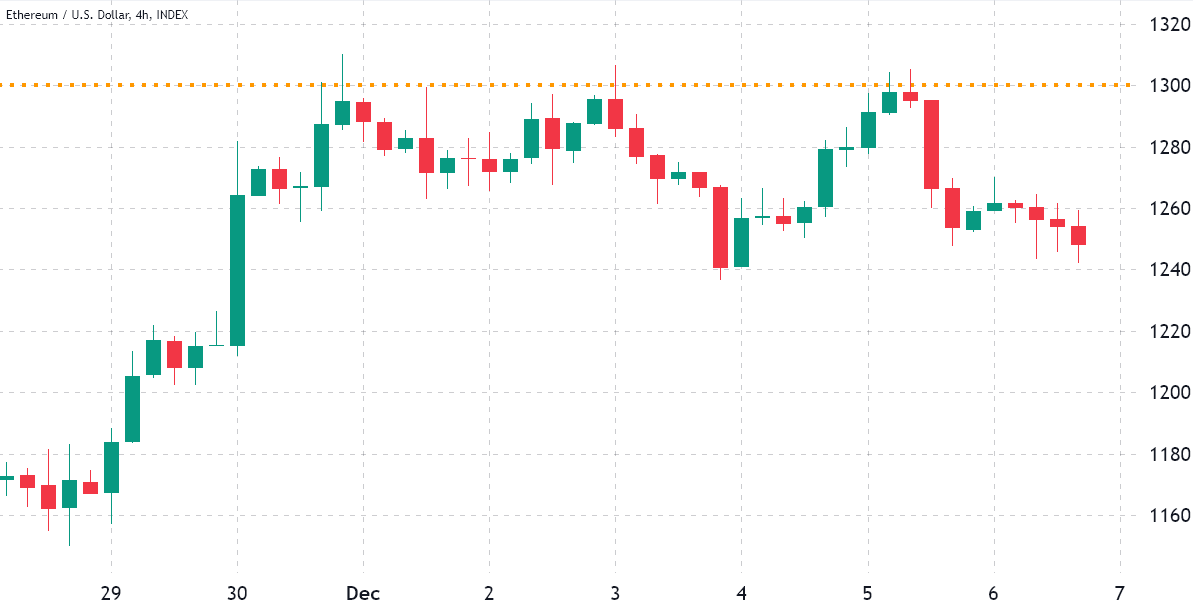
Ether rallied 11.3% between Nov. 28 and Dec. 5, peaking at $1,300 before facing a 4.6% rejection. The $1,300 resistance level has been holding ground for twenty-six days and is the most likely explanation for the correction to $1,240 on Dec. 6.

Ether/USD price index, 12-hour. Source: TradingView

So from one side, traders are relieved that Ether is trading 16% above the $1,070 low reached on Nov. 22, but it must be frustrating to fail at the same level the entire week. In addition to the price rejection, investors' mood worsened after three members of the United States Senate reportedly requested information from Silvergate Bank regarding its relationship with FTX.

The lawmakers raised questions after "reports suggesting that Silvergate facilitated the transfer of FTX customer funds to Alameda'' and gave the bank until Dec. 19 to issue a response.

On Dec. 5, NBC News reported that Silvergate claimed to be a "victim" of FTX's and Alameda Research's "apparent misuse of customer assets and other lapses of judgment."

Newsflow remained negative after the Financial Times reported that the United Kingdom Treasury is finalizing some guidelines to restrict cryptocurrency sales from abroad. The changes would enable the Financial Conduct Authority (FCA) to monitor the crypto companies' operations in the region. The guidelines are being prepared as a part of the financial services and markets bill.

Investors are afraid that Ether could lose the $1,200 support, but as highlighted by trader CashMontee, the S&P 500 stock market index will be the key — but for now, "market too bullish."

Let's look at Ether derivatives data to understand if the bearish newsflow has impacted crypto investors' sentiment.

Slight uptick in bearish demand for ETH futures' leverage

Retail traders usually avoid quarterly futures due to their price difference from spot markets. Meanwhile, professional traders prefer these instruments because they prevent the fluctuation of funding rates in a perpetual futures contract.

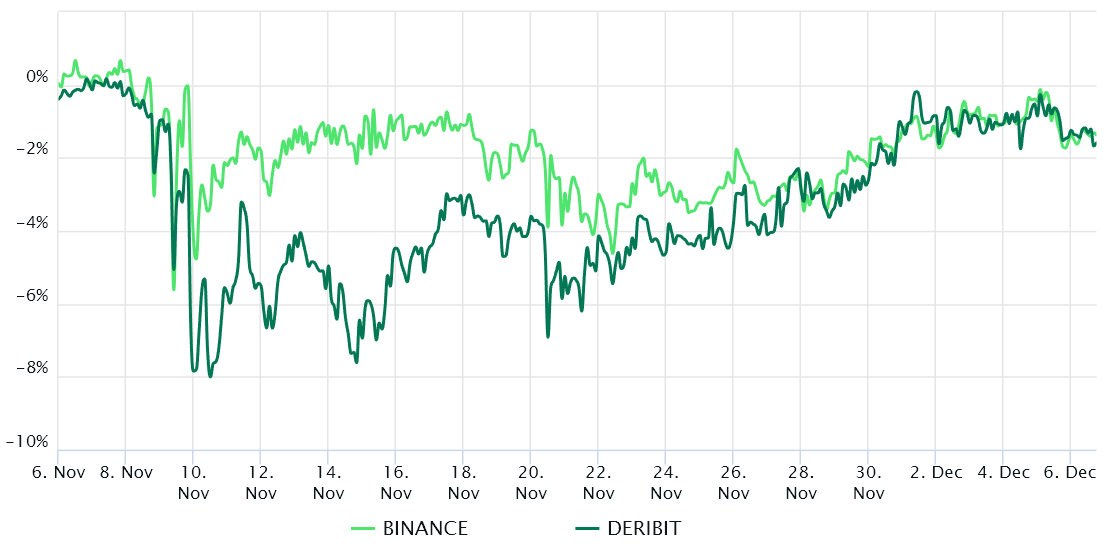
The two-month futures annualized premium should trade between +4% to +8% in healthy markets to cover costs and associated risks. Thus, when the futures trade at a discount versus regular spot markets, it shows a lack of confidence from leverage buyers — a bearish indicator.

Ether 2-month futures annualized premium. Source: Laevitas.ch

The above chart shows that derivatives traders remain bearish as the Ether futures premium is negative. So, bears can celebrate that the indicator is far from the neutral 0% to 4% premium, but that does not mean traders expect an immediate adverse price action.

For this reason, traders should analyze Ether's options markets to exclude externalities specific to the futures instrument.

Options traders are getting comfortable with the downside risks

The 25% delta skew is a telling sign when market makers and arbitrage desks are overcharging for upside or downside protection.

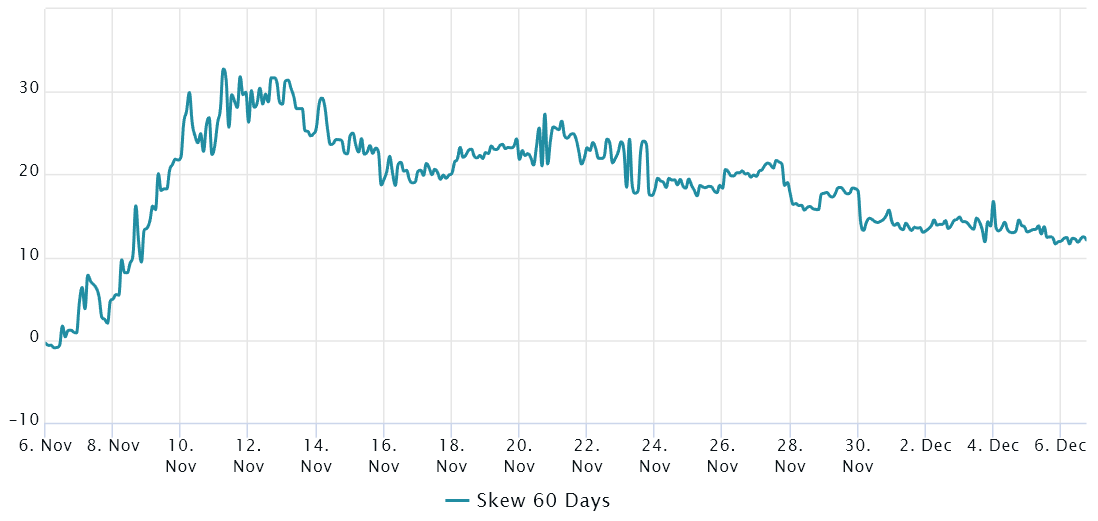
In bear markets, options investors give higher odds for a price dump, causing the skew indicator to rise above 10%. On the other hand, bullish markets tend to drive the skew indicator below -10%, meaning the bearish put options are discounted.

Ether 60-day options 25% delta skew: Source: Laevitas.ch

The delta skew has stabilized in the past week, signaling that options traders are more comfortable with downside risks.

As the 60-day delta skew stands at 12%, whales and market makers are getting closer to a neutral sentiment for Ether. Ultimately, both options and futures markets point to pro traders fearing that the $1,200 support retest is the natural course for ETH.

The answer might as well be hidden under the macroeconomic calendar ahead, which includes the EuroZone's and Canada's Gross Domestic Product (GDP) on Dec. 7 and the United States Consumer Price Index (CPI) on Dec. 13.

Currently, the odds favor Ether bears because the newsflow implies that the possibility of stricter regulation is weighing down the market.


Related Reads

AI Agents Can Be Verified, But Who Protects Their Privacy?

As AI Agents evolve from automated tools into active participants in on-chain economies, a critical challenge emerges: establishing trust while preserving privacy. While standards like ERC-8004 aim to provide verifiable identity and reputation for agents, their public nature could expose sensitive operational strategies, user preferences, and business relationships in fields like DeFi, governance, and prediction markets. The proposed ACTA (Anonymous Credentials for Trustless Agents) framework addresses this by adding a privacy layer. It allows agents to cryptographically prove they meet certain criteria (e.g., having passed an audit or possessing sufficient reputation) without revealing the underlying sensitive data, using zero-knowledge proofs. This shifts trust from "public identity" to "policy-based proof." This shift is crucial because agents act dynamically on behalf of users, making their behavior a potential proxy for user intent. ACTA would enable verification of an agent's legitimacy or authorization without creating a permanent, public map of all its activities and relationships. ACTA remains a research direction with open challenges, including scalability, decentralization of credential issuers, and implementation costs. However, it highlights a fundamental need: a robust Agent economy requires not just mechanisms for verification, but also for protecting the privacy of agents, their users, and the protocols they interact with.

marsbit21m ago

AI Agents Can Be Verified, But Who Protects Their Privacy?

marsbit21m ago

Suzerain State: Anthropic

Anthropic, a five-year-old AI lab dubbed a "suzerain," has rapidly gained unprecedented influence by securing massive financial and computational commitments from tech giants, positioning itself at the center of AI infrastructure power dynamics. In May 2026, it announced securing over 300 MW of computing power from SpaceX's Colossus 1 data center, on top of earlier multi-billion dollar deals with Amazon and Google, effectively locking in over 20 GW of future compute. These investments are tied to reciprocal spending commitments on the investors' cloud platforms, resembling infrastructure pre-sales. This "suzerain" status is fueled by explosive growth. By May 2026, Anthropic's annualized revenue reportedly surged to over $44 billion, with Claude surpassing OpenAI in LLM market share. Its high-revenue-per-user efficiency and flagship product Claude Code have secured a strong enterprise foothold. However, its pre-IPO status faces scrutiny. OpenAI challenged Anthropic's accounting, alleging its reported revenue includes gross payments shared with cloud partners, unlike OpenAI's net revenue reporting. The resolution of this debate is critical as both companies approach public listings. Currently, Anthropic holds unique leverage as the only top-tier model available across AWS, Google Cloud, and Microsoft Azure, inverting traditional vendor-customer dynamics. Yet, its suzerainty is considered a time-limited game, dependent on converting its current advantages into sustainable, audited profitability and navigating the complex web of strategic dependencies with its powerful patrons.

marsbit1h ago

Suzerain State: Anthropic

marsbit1h ago

Tian Yuandong Announces Startup Venture After Leaving Meta

After leaving Meta, Tian Yuan Dong has announced his new venture. The startup Recursive_SI has officially launched with a list of founders including Tian Yuan Dong. The founding team also comprises Richard Socher (CEO), Tim Rocktäschel, Jeff Clune, Tim Shi, Caiming Xiong, and Alexey Dosovitskiy, among others. These members have experience building AI research labs at companies like Salesforce and Uber, and have held leadership roles at OpenAI, DeepMind, Google Brain, and Meta. Recursive_SI aims to develop artificial intelligence capable of conducting experiments autonomously and safely improving itself through an open-ended, automated scientific discovery process. This is seen as a promising path toward superintelligence. The company has raised $650 million at a valuation of $4.65 billion, led by GV (Google Ventures) and Greycroft, with significant investments from AMD Ventures and NVIDIA. The team has grown to over 25 members, including new additions like Zhuge Mingchen. Zhuge, a Founding Member, holds a Ph.D. in Computer Science from KAUST under Professor Jürgen Schmidhuber. His research focuses on Coding Agents, Recursive Self-Improvement (RSI), and next-generation machine paradigms, with contributions including early RSI systems like GPTSwarm and work on agentic AI frameworks. The founders shared their vision on X: building AI that can automatically discover knowledge and recursively self-improve, fundamentally changing the way science and technology advance. The team is recognized as a leader in core areas of recursive self-improving AI, with past breakthroughs in open-ended algorithms, AI-generated algorithms, automated testing, world models, Vision Transformers, RAG, and AI scientists. There is high anticipation for Recursive_SI's future research.

marsbit1h ago

Tian Yuandong Announces Startup Venture After Leaving Meta

marsbit1h ago

Trading

Spot
Futures
活动图片