Analysis of crypto transaction fees suggests exchanges prefer to move in Bitcoin

cryptoslatePublished on 2022-12-02Last updated on 2022-12-02

Abstract

Crypto exchanges can earn revenue through various means, including lending to margin traders, liquidation fees, and on/off ramping charges.

Crypto exchanges can earn revenue through various means, including lending to margin traders, liquidation fees, and on/off ramping charges. However, the core revenue generator remains taking a fee on transactions.

There are multiple types of transactions and, therefore, many types of transaction fees. When comparing different transaction fees on the Bitcoin and Ethereum chains, the data suggested exchanges prefer to use the former to transfer value internally.

Transaction fees

On-chain data provided by Glassnode and analyzed by CryptoSlate showed an erratic history for fees earned by exchanges on Bitcoin transactions.

The chart below features a considerable spike in fees towards the end of 2017, as BTC hit its $20,000 previous cycle peak.

The 2021 bull market saw another fee spike in April 2021, albeit significantly less than the 2017 bull, as BTC approached $65,000.

Strangely, the most recent bull market top, of $69,000 in Nov. 2021, was not accompanied by another fee spike, suggesting comparatively less exchange activity versus April 2021.

Since April 2021, fees through Bitcoin transactions have sunk significantly and remain truncated.
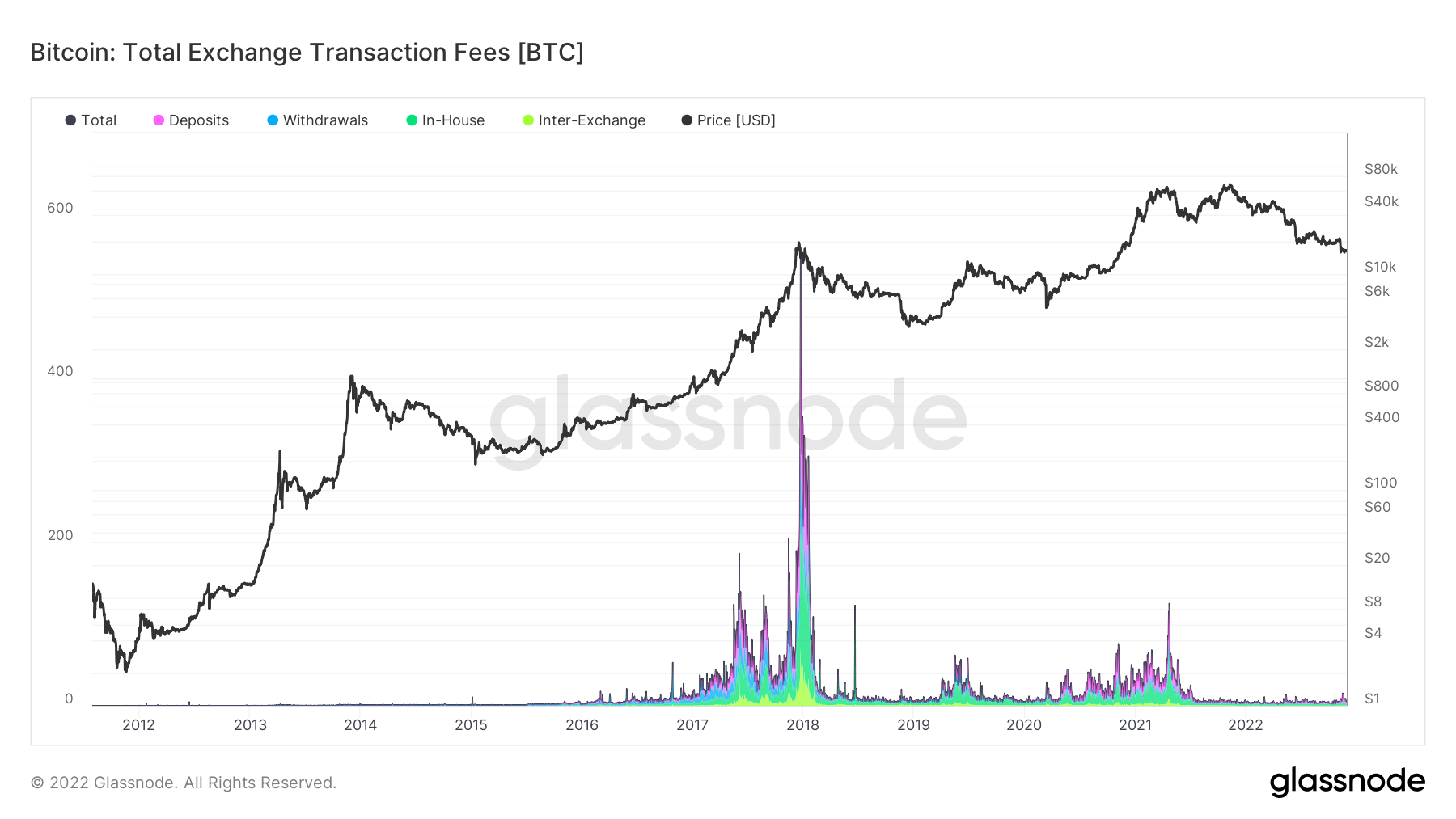
Bitcoin: Total Exchange Transaction Fees

Source: Glassnode.com

Bitcoin: Exchange Fee Dominance

The Exchange Fee Dominance metric is defined as the percentage of total transaction fees paid in relation to on-chain exchange activity. This is further split into the type of transaction that earned the fee as follows:

  • Deposits: Transactions that include an exchange address as the receiver of funds.
  • Withdrawals: Transactions that include an exchange address as the sender of funds.
  • In-House: Transactions that include addresses of a single exchange as both the sender and receiver of funds.
  • Inter-Exchange: Transactions that include addresses of (distinct) exchanges as both the sender and receiver of funds.

The chart below shows Bitcoin transaction fees made up 36% of all exchange revenue sources related to BTC. This is further split:

  • Deposits – 21%
  • Withdrawals – 4%
  • In-House – 10%
  • Inter-Exchange – 1%

Over the past five years, the categories of Deposits and In-House have grown exponentially.
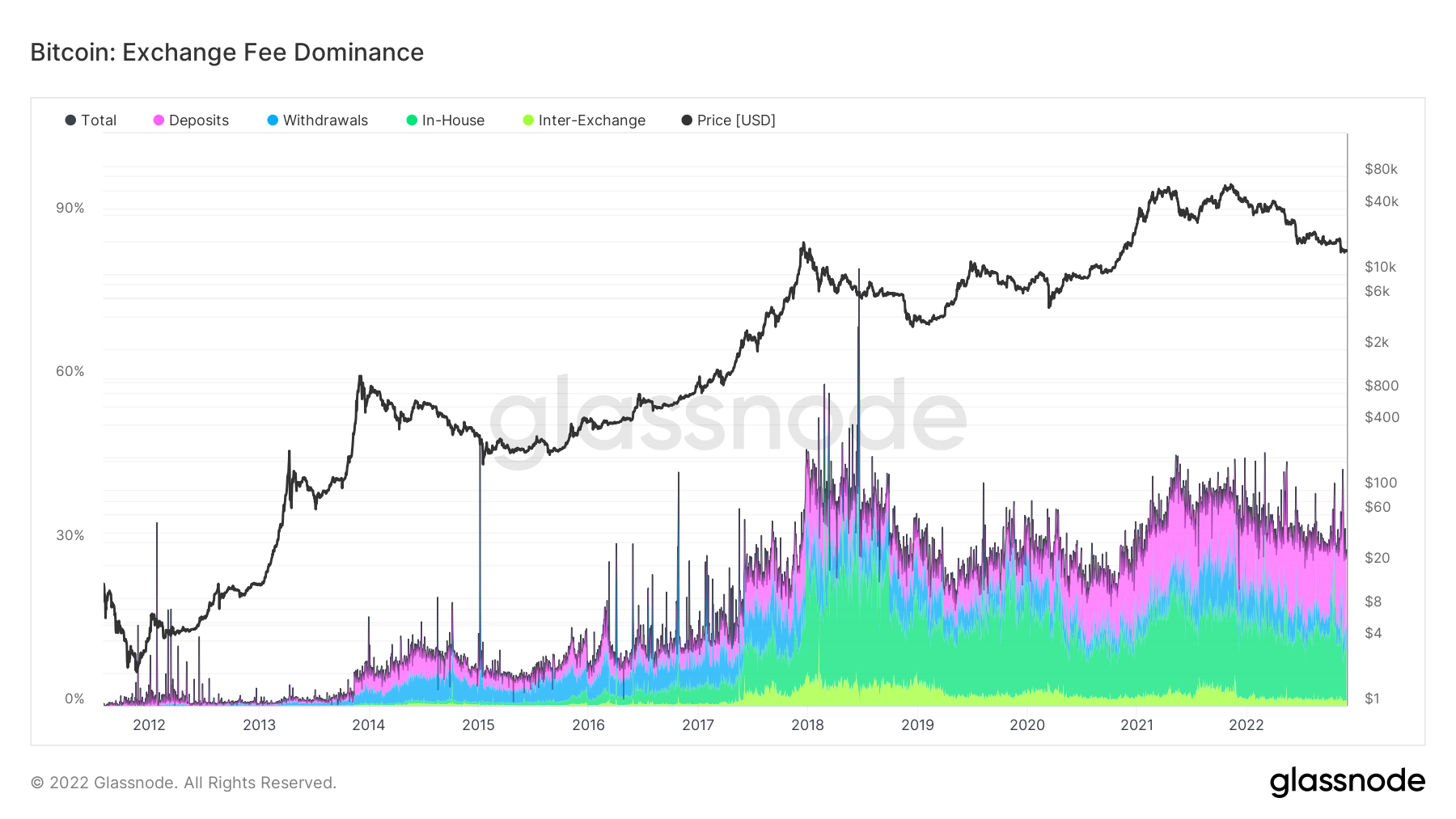
Bitcoin: Exchange Fee Dominance

Source: Glassnode.com

Ethereum: Exchange Fee Dominance

Analysis of Ethereum’s Exchange Fee Dominance paints a very different picture. Currently, Ethereum transaction fees account for 5% of exchange revenue sources related to ETH.

Withdrawals make up the most significant category of transaction fee type, which has been the case since July 2017.

The relative lack of In-House fees compared to Bitcoin suggests exchanges prefer not to use ETH when transferring funds between internal wallets.
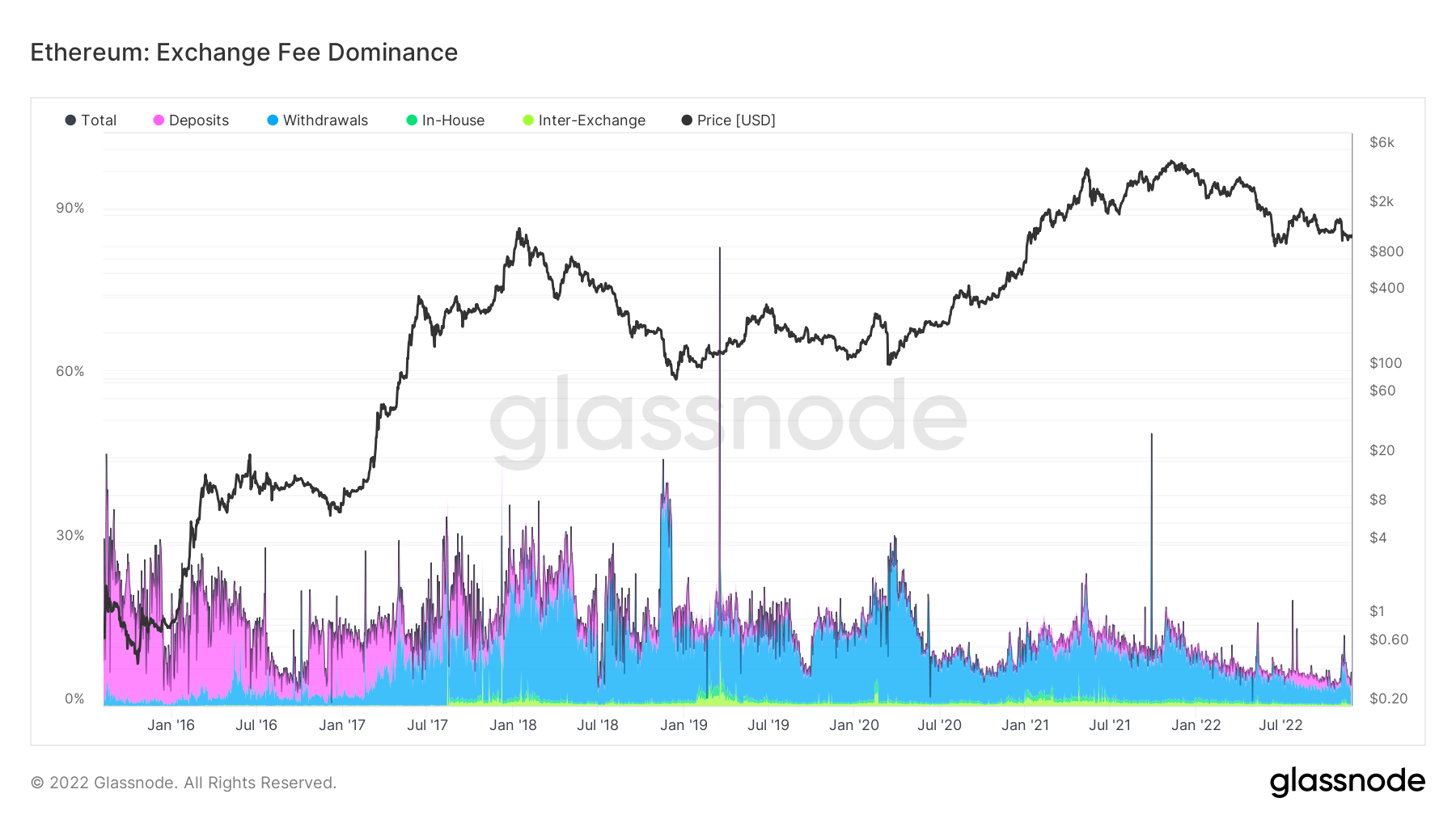
Ethereum: Exchange Fee Dominance

Source: Glassnode.com

Related Reads

Anthropic Founder's Handbook: How to Build an AI-Native Company!

Anthropic has released "The Founder's Playbook: How to Build an AI Native Company," a guide that reimagines the startup lifecycle (Ideation, MVP, Launch, Scale) for 2026-era AI capabilities. The core thesis is that AI is fundamentally changing how ideas become reality, shifting the founder's role from an individual contributor to an orchestrator of AI agents. This lowers execution barriers, allowing domain experts (e.g., in medicine, law, education) to build products without deep technical skills, as AI can handle prototyping, coding, research, and operations. However, the playbook warns that easier prototyping increases the risk of building products no one needs, emphasizing that validation, not just building, is critical. It highlights that AI enables small teams to possess capabilities once reserved for large organizations, compressing functions like development, marketing, and support. This challenges traditional competitive advantages based on organizational size. For AI-native companies, sustainable moats will not come from the AI model alone but from deep domain knowledge, user data flywheels (behavioral fingerprints from real usage), and workflow lock-in that makes switching costly. Ultimately, the guide signals a shift in focus from raw model capability to how AI fundamentally reshapes company structure, processes, and competitive strategy. An AI-native company is defined not by using AI tools but by embedding AI into its core operational DNA from inception.

marsbit38m ago

Anthropic Founder's Handbook: How to Build an AI-Native Company!

marsbit38m ago

Trading

Spot
Futures

Hot Articles

What is $BITCOIN

DIGITAL GOLD ($BITCOIN): A Comprehensive Analysis Introduction to DIGITAL GOLD ($BITCOIN) DIGITAL GOLD ($BITCOIN) is a blockchain-based project operating on the Solana network, which aims to combine the characteristics of traditional precious metals with the innovation of decentralized technologies. While it shares a name with Bitcoin, often referred to as “digital gold” due to its perception as a store of value, DIGITAL GOLD is a separate token designed to create a unique ecosystem within the Web3 landscape. Its goal is to position itself as a viable alternative digital asset, although specifics regarding its applications and functionalities are still developing. What is DIGITAL GOLD ($BITCOIN)? DIGITAL GOLD ($BITCOIN) is a cryptocurrency token explicitly designed for use on the Solana blockchain. In contrast to Bitcoin, which provides a widely recognized value storage role, this token appears to focus on broader applications and characteristics. Notable aspects include: Blockchain Infrastructure: The token is built on the Solana blockchain, known for its capacity to handle high-speed and low-cost transactions. Supply Dynamics: DIGITAL GOLD has a maximum supply capped at 100 quadrillion tokens (100P $BITCOIN), although details regarding its circulating supply are currently undisclosed. Utility: While precise functionalities are not explicitly outlined, there are indications that the token could be utilized for various applications, potentially involving decentralized applications (dApps) or asset tokenization strategies. Who is the Creator of DIGITAL GOLD ($BITCOIN)? At present, the identity of the creators and development team behind DIGITAL GOLD ($BITCOIN) remains unknown. This situation is typical among many innovative projects within the blockchain space, particularly those aligning with decentralized finance and meme coin phenomena. While such anonymity may foster a community-driven culture, it intensifies concerns about governance and accountability. Who are the Investors of DIGITAL GOLD ($BITCOIN)? The available information indicates that DIGITAL GOLD ($BITCOIN) does not have any known institutional backers or prominent venture capital investments. The project seems to operate on a peer-to-peer model focused on community support and adoption rather than traditional funding routes. Its activity and liquidity are primarily situated on decentralized exchanges (DEXs), such as PumpSwap, rather than established centralized trading platforms, further highlighting its grassroots approach. How DIGITAL GOLD ($BITCOIN) Works The operational mechanics of DIGITAL GOLD ($BITCOIN) can be elaborated on based on its blockchain design and network attributes: Consensus Mechanism: By leveraging Solana’s unique proof-of-history (PoH) combined with a proof-of-stake (PoS) model, the project ensures efficient transaction validation contributing to the network's high performance. Tokenomics: While specific deflationary mechanisms have not been extensively detailed, the vast maximum token supply implies that it may cater to microtransactions or niche use cases that are still to be defined. Interoperability: There exists the potential for integration with Solana’s broader ecosystem, including various decentralized finance (DeFi) platforms. However, the details regarding specific integrations remain unspecified. Timeline of Key Events Here is a timeline that highlights significant milestones concerning DIGITAL GOLD ($BITCOIN): 2023: The initial deployment of the token occurs on the Solana blockchain, marked by its contract address. 2024: DIGITAL GOLD gains visibility as it becomes available for trading on decentralized exchanges like PumpSwap, allowing users to trade it against SOL. 2025: The project witnesses sporadic trading activity and potential interest in community-led engagements, although no noteworthy partnerships or technical advancements have been documented as of yet. Critical Analysis Strengths Scalability: The underlying Solana infrastructure supports high transaction volumes, which could enhance the utility of $BITCOIN in various transaction scenarios. Accessibility: The potential low trading price per token could attract retail investors, facilitating wider participation due to fractional ownership opportunities. Risks Lack of Transparency: The absence of publicly known backers, developers, or an audit process may yield skepticism regarding the project's sustainability and trustworthiness. Market Volatility: The trading activity is heavily reliant on speculative behavior, which can result in significant price volatility and uncertainty for investors. Conclusion DIGITAL GOLD ($BITCOIN) emerges as an intriguing yet ambiguous project within the rapidly evolving Solana ecosystem. While it attempts to leverage the “digital gold” narrative, its departure from Bitcoin's established role as a store of value underscores the need for a clearer differentiation of its intended utility and governance structure. Future acceptance and adoption will likely depend on addressing the current opacity and defining its operational and economic strategies more explicitly. Note: This report encompasses synthesised information available as of October 2023, and developments may have transpired beyond the research period.

363 Total ViewsPublished 2025.05.13Updated 2025.05.13

What is $BITCOIN

Discussions

Welcome to the HTX Community. Here, you can stay informed about the latest platform developments and gain access to professional market insights. Users' opinions on the price of BTC (BTC) are presented below.

活动图片