NFT collections brought to life at SXSW: Doodles and FLUF World

CointelegraphPublished on 2022-03-19Last updated on 2022-03-21

Abstract

Two NFT communities with the largest physical presences at SXSW were Doodles and FLUF World who ran immersive, multi-day and multi-sensory experiences.

Cointelegraph journalists at South by Southwest, or SXSW, in Austin, Texas reported that NFTs were everywhere this year, marking a new phenomenon for what began as a music festival in 1987. Since evolving into a film, tech and general culture gathering, and after a two-year hiatus, SXSW added blockchain programming to the mix with crypto-related panels, blockchain company sponsors and NFT community interactive experiences. 
Two NFT communities with the largest physical presences at SXSW were Doodles and FLUF World who ran immersive, multi-day and multi-sensory experiences. They built physical installations at which attendees would wait in long lines to enter and interact with these virtual communities in real life. Cointelegraph got to the bottom of how these digital collections came to life at SXSW.
Doodles is a collection of generative hand-drawn NFTs of skeletons, cats, aliens, apes and mascots. Doodle holders and curious passersby could enter a Doodle-themed structure to buy a drink at the bar, get Doodles painted on their nails, eat some noodles and display owned Doodle NFTs throughout the exhibit. If a t-shirt or sticker purchase was made at the Shopify-powered gift shop, customers entered a raffle to win a Doodle.
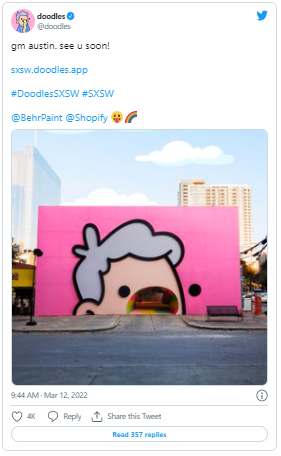

Cointelegraph spoke with the Doodles founding team about their mission at SXSW and the collection's roadmap. According to co-founder Jordan Castro, AKA Poopie, Doodles hopes to leverage its brand strength, reach and resources to help NFT owners with their own entrepreneurial efforts by monetizing their Doodles. 
"We are showing the world by example what we believe the future of brands to be; communities becoming stakeholders. It is our philosophy that communities will be the future flywheel of brand growth, and our approach is to foster successful, creative, technical and entrepreneurial talent from within our community."
Doodles launched in October 2021, and has since grown its Doodlebank, the community treasury, to a balance of over $3 million. Castro explained how Doodles holders can propose expansion initiatives, products, experiences or governance ideas in the Doodlebank Forum, and all Doodle holders get to vote on these proposals. Two of these proposals-turned-businesses were showcased at SXSW: Noodles and Coffeedoods. Noodles became an entirely new NFT collection and brand that grew to generate more than $550 thousand in sales and $500 thousand in royalties. 
Visitors at the activation lined up to get a taste, while those who needed a caffeine pick-me-up queued up at the coffee bar. Coffeedoods is a separate Web3 coffee distribution company founded by owners of Coffeehead Doodles, with a subscription NFT to receive monthly shipments of CoffeeDoods coffee. There are currently more than 5 thousand pre-sale customers, according to the company.
Future plans for the Doodles community include "continuing to bring Doodles into mainstream public consciousness" through additional IRL activations, said Castro. The team revealed that they will set up a permanent installation in a yet to be announced American city with support from local government and businesses.

Inside the Doodles installation.Doodles also recently expanded their universe of "joy and rainbow puke" to include Space Doodles, which all Doodlers can claim for free in addition to an extended license NFT that grants them new commercialization rights into Doodle Toys. These toys or collectibles will target users with NFT figurines inspired by the original Doodles collection.
The FLUF World pop-up village appeared a few blocks away from Doodles. FLUF World is a metaverse ecosystem of virtual land, music and games, known for its 3D rabbit avatar characters. FLUF developed the FLUF Haus arm of the company to create global IRL experiences, from Art Basel in Miami to the Super Bowl in Los Angeles and now to SXSW in Austin. The FLUF Haus SXSW edition blocked off an open area of bars, food trucks and three giant domes home to panel discussions, VR activities and artist workshops. In the evening, the NFT community could gather to enjoy DJ sets and musical performances.

According to Alex Smeele, co-founder and chief executive officer of Non-Fungible Labs and F World, SXSW offered the opportunity for industry leaders to connect in person and bring these traditionally online relationships into the real world.
"True power comes from how these digital and physical worlds intersect. NFT communities are a great way for people all around the world to come together around shared passions and form strong social bonds."
The FLUF team shared that part of the mission for being at SXSW was to advocate for an open metaverse and get the community to sign the Metaverse Manifesto. Smeele expressed that the crypto and NFT industries "can be very toxic and male-dominated for the most part," and that FLUF World intends to "weave ethics, diversity, and sustainability into the very fabric of our community" by helping to establish certain standards for Web3 companies.
Smeele added that FLUF aims to build a "scalable metaverse with play-to-earn mechanics, as well as invent new ways for content creators to engage with their fans." They partnered with the NFT collection Seekers, built by the Sylo Network that allows NFT owners to communicate their wallet address with any other wallet address, and with Altered State Machine, a protocol that enables AI ownership via NFTs. Together they set up an AR Snapchat experience for users to activate the FLUF World lens and enter the FLUF Dome via the app in order to enter for a chance to win FLUF characters or a Seeker NFT.
In addition to IRL events, the community has helped the New Zealand-based team to raise an estimated 2 million New Zealand dollars in support of sustainability initiatives, homelessness and Ukrainian refugees. Smeele described that their main focuses over the next quarter include collaborating with leading and up-and-coming music and visual artists, and launching their own token called Mycelium. Additionally, FLUF plans to bring further functionality to its metaverse-ready characters and introduce breeding for their rabbit avatars to reportedly allow people to join the community at a lower price point.
Both of these communities took to the streets of Austin to showcase what their respective communities can expect from them: interaction, engagement and support to be their own creators. Another company, Blockchain Creative Labs, FOX Entertainment's NFT studio, also hosted its own Web3 discussions, events and giveaways at SXSW. Their main attraction included a Dolly Parton live performance on the blockchain on Friday evening and the launch of the Dollyverse, a NFT drop of Dolly's newest album.
Related Reads

Claude Code Introduces Dynamic Workflows: Enabling AI to Form Teams and Collaborate

Claude Code introduces dynamic workflows, enabling AI to coordinate teams of specialized agents for complex tasks. This transforms Claude from a code assistant into a programmable workbench. Workflows address key limitations of single-agent systems: agentic laziness (premature task completion), self-preferential bias (favoring own outputs), and goal drift (losing sight of original objectives). The system allows Claude to dynamically create execution frameworks using JavaScript. It can split tasks, dispatch parallel agents for isolated work (e.g., in separate worktrees), implement adversarial validation, run tournaments, and synthesize results. This multi-agent approach is valuable for tasks requiring deep research, factual verification, code migration, root cause analysis, large-scale triage, and qualitative sorting. Key patterns include: classify-and-route, fan-out-and-synthesize, adversarial verification, generate-and-filter, tournaments, and loop-until-done. While token usage is higher, workflows excel where tasks resemble programming—needing problem decomposition, isolated context, hypothesis testing, and handling many details. They extend Claude Code's utility beyond technical work to areas like business plan review, resume screening, and naming brainstorm. The feature is not a universal solution but points to a future where AI tool competitiveness depends on organizing reliable, reusable, and auditable execution flows for complex goals.

marsbit28m ago

Claude Code Introduces Dynamic Workflows: Enabling AI to Form Teams and Collaborate

marsbit28m ago

Hyperliquid, Wall Street's 24/7 Trading Convenience Store

Hyperliquid: The 24/7 Trading "Convenience Store" for Wall Street Hyperliquid, a decentralized cryptocurrency exchange, has become a go-to platform for Wall Street traders seeking to trade around the clock, especially during traditional market closures. Founded by Jeff Yan, a former quantitative trader, after the FTX collapse, the platform emphasizes user self-custody of assets. It offers a wide range of perpetual contracts—leveraged derivatives with no expiry—on assets from Bitcoin and crude oil to the S&P 500 and even pre-IPO companies like SpaceX. A notable example involves a hedge fund trader who capitalized on geopolitical news over a weekend, securing a 243% return on oil derivatives before markets reopened. The platform, run by just 11 employees, generated approximately $800 million in revenue last year, and its native token HYPE has seen significant growth. Its rise highlights the merging of traditional finance and crypto. While U.S. users are currently restricted, recent CFTC rule changes could open access. The platform is known for its transparency, having processed $10 billion in liquidations during a market crash while competitors faltered. Regulators warn of the high risks and complexity of perpetual contracts for retail investors. Key to its appeal is a strong community culture, direct engagement with founders, and a simple interface. Despite rules against VPN use, it attracts global users with its permissionless approach. Hyperliquid plans to expand into prediction markets and options, aiming to eventually host all financial activity.

marsbit29m ago

Hyperliquid, Wall Street's 24/7 Trading Convenience Store

marsbit29m ago

Who Funds the Agents?

**Summary: Who Funds AI Agents?** OpenAI recently shut down a feature allowing AI agents to shop for users, highlighting the challenge of creating a secure and regulated environment for agent-driven transactions. While payment infrastructure exists, a crucial governance layer—defining spending limits, fraud detection, tax handling, and return policies—is largely missing. The potential is enormous: AI agents already processed $73M across 176M transactions last year, with McKinsey forecasting this could grow to $3-5T in global consumer commerce by 2030. The core competition isn't just about processing payments, which can be very cheap (especially with crypto-based settlement), but about controlling the rules that govern agent spending. Key players like Stripe and Coinbase are racing to dominate this governance layer. Stripe's acquisition of wallet provider Privy allows it to set spending policies, identity checks, and human-in-the-loop approvals directly at the wallet level. Similarly, Coinbase's stack, including its x402 protocol and AgentKit, embeds governance rules. This vertical integration across settlement, wallet, and governance layers is becoming the dominant strategy. Control over the governance layer is where significant future value lies. If agents handle trillions in transactions, even a small fee for managing compliance, fraud prevention, and policy enforcement could generate billions in annual revenue. The companies that successfully integrate across the payment stack will capture value from idle agent balances, transaction fees, and governance services, positioning themselves as the foundational banks of the AI agent economy.

marsbit56m ago

Who Funds the Agents?

marsbit56m ago

Trading

Spot
Futures

Hot Articles

How to Buy SUPER

Welcome to HTX.com! We've made purchasing SuperFarm (SUPER) simple and convenient. Follow our step-by-step guide to embark on your crypto journey.Step 1: Create Your HTX AccountUse your email or phone number to sign up for a free account on HTX. Experience a hassle-free registration journey and unlock all features.Get My AccountStep 2: Go to Buy Crypto and Choose Your Payment MethodCredit/Debit Card: Use your Visa or Mastercard to buy SuperFarm (SUPER) instantly.Balance: Use funds from your HTX account balance to trade seamlessly.Third Parties: We've added popular payment methods such as Google Pay and Apple Pay to enhance convenience.P2P: Trade directly with other users on HTX.Over-the-Counter (OTC): We offer tailor-made services and competitive exchange rates for traders.Step 3: Store Your SuperFarm (SUPER)After purchasing your SuperFarm (SUPER), store it in your HTX account. Alternatively, you can send it elsewhere via blockchain transfer or use it to trade other cryptocurrencies.Step 4: Trade SuperFarm (SUPER)Easily trade SuperFarm (SUPER) on HTX's spot market. Simply access your account, select your trading pair, execute your trades, and monitor in real-time. We offer a user-friendly experience for both beginners and seasoned traders.

5.2k Total ViewsPublished 2024.03.29Updated 2026.06.02

How to Buy SUPER

Discussions

Welcome to the HTX Community. Here, you can stay informed about the latest platform developments and gain access to professional market insights. Users' opinions on the price of SUPER (SUPER) are presented below.

活动图片