Solana reduced slot time to 350 ms

cryptonews.ruPublished on 2026-08-22Last updated on 2026-08-22

Abstract

Solana has successfully implemented the first stage of its plan to reduce slot times, lowering the target from 400ms to 350ms in mainnet epoch 1020. This 12.5% reduction is part of the approved SIMD-0525 upgrade, the first of four planned steps to ultimately achieve a 200ms slot time. The change, activated by validators on the Agave v4.2 client, aims to accelerate transaction confirmations and improve network resilience. Future reductions to 300ms, 250ms, and finally 200ms will each be activated in subsequent epochs, with the upgrade schedule allowing for a pause if missed block rates increase. Following the update, the network's average slot time was approximately 366-370ms. The SOL token price reacted positively, gaining nearly 4.5% to approach $95. The article also notes a recent incident where Solana neared a transaction finality halt due to multiple validator outages.

The Solana team has enabled the first stage of reducing the average slot time — from 400 to 350 ms — in the mainnet, as part of implementing the SIMD-0525 improvement proposal.

BREAKING: @Solana slot time has dropped to 350ms for the first time as the first reduction under SIMD-0525 goes live at epoch 1020, cutting the previous 400ms target by 12.5%.

The upgrade is the first of four planned steps toward 200ms slots. pic.twitter.com/fnC4AsQS8Y

— SolanaFloor (@SolanaFloor) August 21, 2026

Solana validators on the Agave v4.2 client have activated the first of four stages to reduce slot time. This is the first reduction in slot length since the network's launch.

A slot is a fixed window during which the validator-leader forms a block. Shortening the slot should accelerate transaction confirmations. Further plans include moving to 300, 250, and 200 ms.

Each subsequent stage has its own activation mechanism and is enabled sequentially in a later epoch. One such period in Solana lasts 432,000 slots, or approximately two to three days. The approved schedule allows the upgrade to be halted if the rate of missed blocks increases.

At the time of writing, the average slot time is 370 ms, and over a 10-minute timeframe — 366 ms.
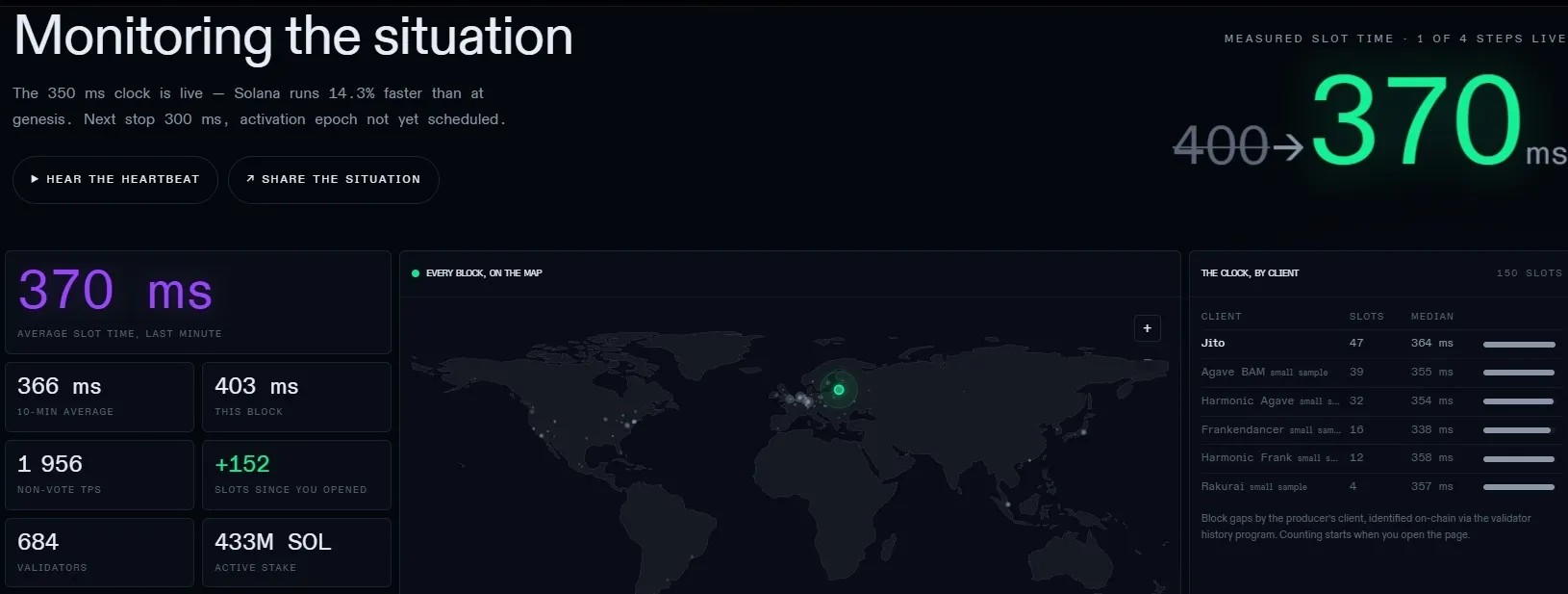
Source: Solana.

The Solana Foundation lists among the update's goals reducing latency and increasing censorship resistance. A shorter slot reduces the time during which a single leader controls block assembly. The Solana team has also linked these changes to already implemented improvements, including Turbine and Replay, which optimized block propagation and re-processing by clients.

The price of $SOL has gained nearly 4.5% over the past day, approaching $95. The token has outperformed Bitcoin (+1.6%) or Ethereum (+2.6%) in terms of dynamics but lags significantly behind, for example, XRP and Dogecoin — 21% and 10% respectively.
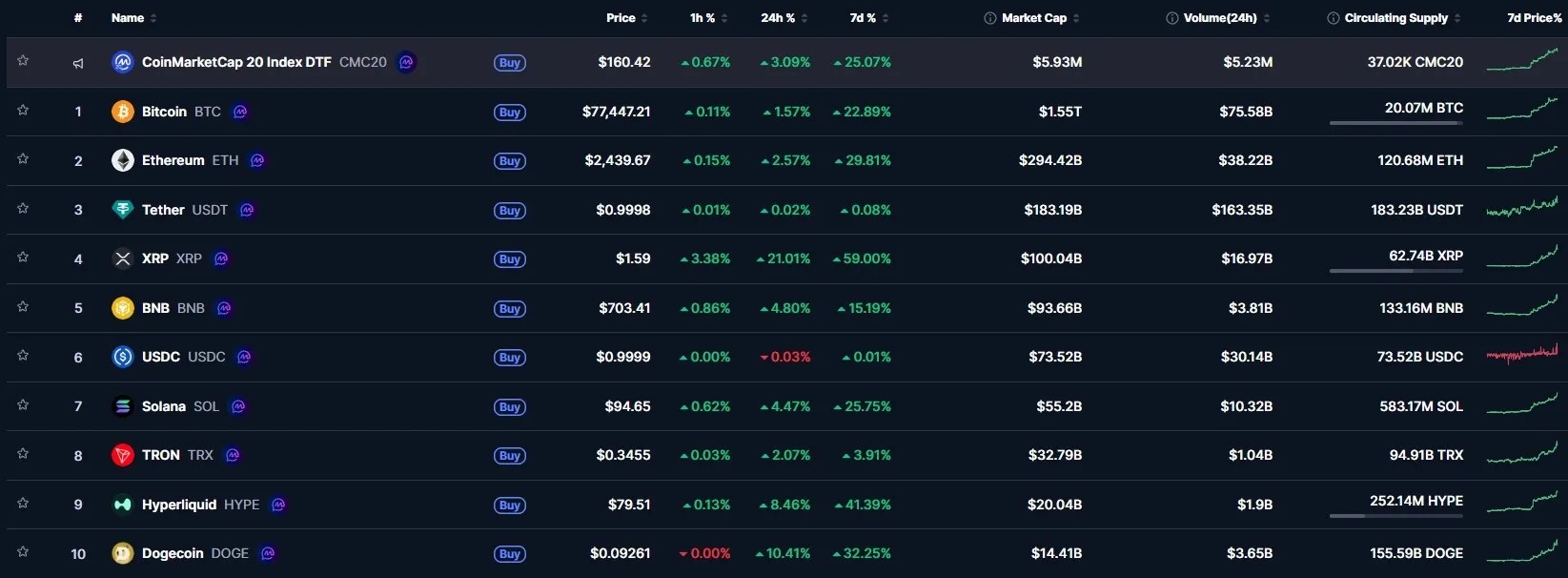
Source: CoinMarketCap.

Recall that in August, Solana came within a step of stopping transaction finalization — validators with a total combined stake of 28.83% $SOL went offline simultaneously, with the critical threshold being 33.34%.

The Chaos of Rising $SOL
end-content

Trending Cryptos

Related Questions

QWhat is the new slot time for the Solana network after the first stage of reduction?

AThe new average slot time for Solana has been reduced to 350 milliseconds.

QWhat is the proposal or improvement that this slot time reduction is part of?

AThis reduction is part of the implementation of the SIMD-0525 improvement proposal.

QHow many total reduction stages are planned to eventually achieve a target slot time of 200ms?

AThere are a total of four planned reduction stages to achieve the 200ms slot time target.

QAccording to the article, what are the two main goals of this upgrade cited by the Solana Foundation?

AThe Solana Foundation cites reducing latency and increasing resistance to censorship as the main goals of this upgrade.

QWhat recent event highlighted a vulnerability in the Solana network, bringing it close to a halt?

AIn August, validators with a combined 28.83% stake in $SOL went offline simultaneously, bringing the network close to the 33.34% critical threshold for halting transaction finalization.

Related Reads

Changes in reward and commission systems on cryptocurrency exchanges should be expected due to strategy shifts

As the bear market continued in Q2, leading crypto exchanges Coinbase, Bullish, and Gemini reported declines in trading revenue. In response, they are shifting strategies toward newer products like stablecoins and prediction markets, which is expected to change their reward and commission structures. Coinbase is focusing on its USD Coin (USDC) offerings, with average balances surging 44% to $20 billion, and has cut costs to fund increased USDC rewards. Gemini is tripling down on prediction markets, adding market makers and offering user rebates, though related revenue grew only 18% despite a near-doubling in bets. Bullish, targeting professional traders, launched a new rewards program. While its adjusted transaction revenue fell 21% quarterly, it was still up 24% year-over-year—the only exchange of the three to achieve annual growth. Despite falling trading volumes, commission economics improved for some, like Gemini, even as its overall revenue dropped. If the crypto price rally continues and ends the bear market, trading revenues could recover. However, as exchanges try to reduce dependence on market volatility, users can expect more rewards and incentives for using new products. Competition over fees may also intensify. The blurring lines between crypto and traditional finance platforms could further drive this competition, potentially benefiting retail traders and investors.

cryptonews.ru2m ago

Changes in reward and commission systems on cryptocurrency exchanges should be expected due to strategy shifts

cryptonews.ru2m ago

Cryptocurrency Transfers Abroad: What Changes for Russians Starting September 1st

From September 1, 2026, a new Russian law will legalize cryptocurrency transfers abroad for citizens. The regulations will allow sending crypto to personal foreign wallets and using it for payments to foreign businesses, provided established rules are followed. The law recognizes crypto as property and introduces a legal framework for its circulation, permitting both qualified and non-qualified investors (with an annual limit of 300,000 rubles for the latter) to buy cryptocurrencies and stablecoins. Notably, using crypto for domestic payments within Russia remains illegal and subject to fines. Companies can use crypto for foreign trade contracts, but these transactions remain under currency control and anti-money laundering (AML) scrutiny. Major banks are increasing oversight of crypto operations, requiring detailed explanations for business transactions, with stricter controls expected from July 2027. While providing new legal avenues, the article warns of risks. Users must choose transfer methods (exchanges, P2P platforms, crypto exchangers) carefully, considering fees, speed, and service reliability. Key risks include service providers freezing transactions, demanding documentation, or blocking accounts. Experts caution that even popular assets like Bitcoin can be tracked or potentially targeted, and sanctions may restrict access to international platforms. Ultimately, while legalized, cross-border crypto transfers will operate within a framework of enhanced state control over fund origins and counterparties.

cryptonews.ru5m ago

Cryptocurrency Transfers Abroad: What Changes for Russians Starting September 1st

cryptonews.ru5m ago

GensynAI's Jeff Amico States That Real-World Asset (RWA) Investors May Lose Creditor Rights

Jeff Amico of GensynAI warns that investors in Real-World Asset (RWA) tokenized lending pools may lack creditor rights in case of borrower default. He notes a common structure where users receive a yield-bearing stablecoin from a platform, but the underlying loan and collateral are held by separate legal entities. This setup means investors have no enforceable claims against the borrower, the special purpose vehicles (SPVs), or the collateral itself, relying instead on the platform's promise to return funds. Amico emphasizes that investors must first identify who legally owes them money and what credit enhancement mechanisms exist, rather than focusing solely on nominal yield. Protections like collateral or first-loss capital are meaningless unless the lien is properly perfected and an agent is designated to enforce it on the investor's behalf. Investors without a formal credit agreement are particularly vulnerable. He cites Pareto/FalconX as a better model where depositors are direct contractual creditors, though this comes with higher minimum investments and KYC requirements. This highlights a trade-off: the crypto industry's permissionless ideals often conflict with the legal protections required for secure lending. Amico argues that weak legal structures could limit the RWA sector's growth. Traditional finance offers a clear template with defined creditor rights and perfected liens. Tokenized lending needs infrastructure, like oracles, to verify off-chain loan agreement status and collateral perfection, as smart contracts cannot do this autonomously. Ultimately, transparency is key. Some investors may accept weaker protections for open access, while others may prefer stronger legal rights. The legal structure of a lending pool will be as critical as its advertised yield, especially during a default, determining whether a token holder has enforceable rights or merely a platform promise.

cryptonews.ru8m ago

GensynAI's Jeff Amico States That Real-World Asset (RWA) Investors May Lose Creditor Rights

cryptonews.ru8m ago

Trading

Spot

Hot Articles

Discussions

Welcome to the HTX Community. Here, you can stay informed about the latest platform developments and gain access to professional market insights. Users' opinions on the price of SOL (SOL) are presented below.

活动图片