The RWA Boom on Hyperliquid Cuts Into the Profits That Support HYPE

cryptonews.ruPublié le 2026-08-10Dernière mise à jour le 2026-08-10

Résumé

The article discusses how the Real-World Asset (RWA) trading boom on the Hyperliquid derivatives platform is paradoxically undermining the revenue that supports its native token, HYPE. While Hyperliquid is processing record trading volumes and open interest, particularly in tokenized stocks and commodities like Nvidia and Tesla, its protocol revenue has fallen 43% from its peak in Q3 2025. A key driver is the platform's HIP-3 proposal, which allows market makers to launch their own perpetual futures markets and keep up to half the trading fees. These markets now account for roughly half of Hyperliquid's volume, significantly increasing the share of revenue paid out to third parties instead of being retained. This revenue decline directly impacts the buyback mechanism for HYPE tokens. A fixed portion of trading fees funds a buyback-and-burn treasury, which purchased nearly half as much HYPE in Q2 2026 as it did at its peak. Consequently, HYPE's price has fallen and now trades at a high earnings multiple. The ecosystem also shows weakness, with HYPE comprising almost all its value, and faces pressure from token unlocks, regulatory warnings, and new competition like Robinhood Chain. Despite these challenges, Hyperliquid remains a major revenue generator in crypto, often compared to a foundational platform like AWS. However, if quarterly revenue continues its declining trend, the growth prospects for the HYPE token will likely weaken further.

Hyperliquid has never traded this many contracts and has never kept a smaller share of the profits from those contracts.

Open interest, the total value of leveraged positions traders hold at once, reached just over $11 billion on July 13, the platform's highest in 2026. Over the past 30 days, Hyperliquid's perpetual futures contract volume was nearly $178 billion. Hyperliquid now settles roughly 9% of all open perpetual positions globally, including centralized exchanges, up from less than 7% at the end of May.

Yet the platform's revenues are moving in the opposite direction. According to DefiLlama data, the protocol's gross revenue peaked at around $357 million in Q3 2025 and has declined each quarter since, reaching nearly $295 million, then around $217 million, then about $202 million in Q2 2026. This is a 43% drop from the peak, recorded alongside rising transaction counts.
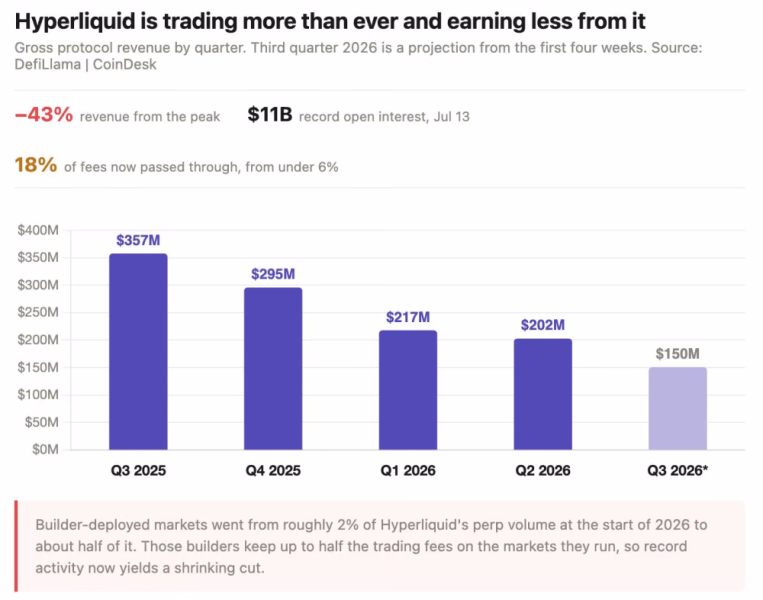
Figure 1.

A Hyperliquid Improvement Proposal (HIP-3) helps explain why Hyperliquid is keeping a smaller share of the activity it attracts. Since October 2025, anyone who stakes 500,000 $HYPE, about $28 million at current prices, can list their own perpetual futures order books on Hyperliquid and keep up to half the trading fees.

In early 2026, these maker-built markets accounted for about 2% of Hyperliquid's perpetual order volume. Now they account for roughly half.

This is reflected in the reporting. Maker rebate value, the portion of fees that Hyperliquid directly returns to market makers and to its own liquidity vault, was less than 6% of gross revenue in Q2 2025. A year later, it reached 18%.

Usage fees, which platforms like Phantom charge extra for order processing, brought in roughly $16 million in revenue in Q2 and accounted for roughly $16 million in losses for the same quarter. Every dollar from this passes through the system.
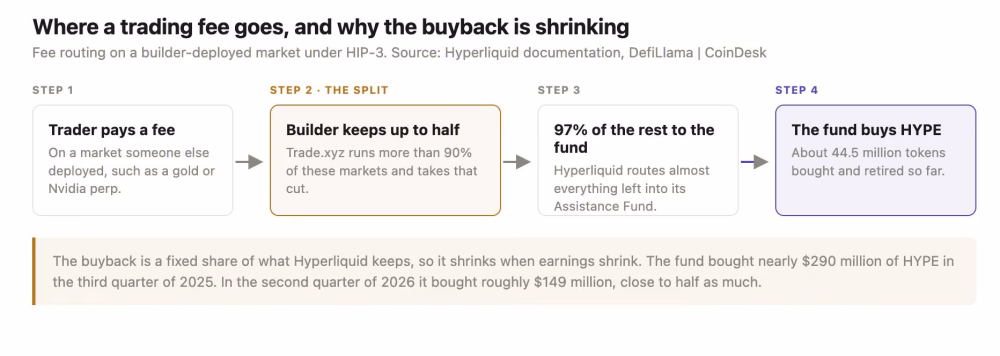
Figure 2.

Real-world assets, such as contracts on oil, gold, Nvidia, Tesla, the Nasdaq-100 index, and shares of companies preparing for IPO like SpaceX, reached a record $3.6 billion in open interest this month and overtook Bitcoin as the platform's largest market by that metric.

From July 13 to 19, tokenized stock and commodity trading volume was $25 billion, making up 52% of the weekly volume, surpassing crypto assets for the first time. The contracts settle in stablecoins, have no expiry, and trade through weekends when the NYSE is closed. A product like leveraged Nvidia stock at 2 a.m. on a Sunday has few other uses.

This growth is largely held up by one person. Trade.xyz accounts for over 90% of all HIP-3 open interest. This means Hyperliquid's record figures depend on the oracle choice, margin settings, and risk management of a single investor.

The risk in this arrangement surfaced on Monday this week when a single trade on a low-volume Korean premarket venue caused Trade.xyz's SK Hynix contract to drop 19% and triggered liquidations which the firm later agreed to cover.

Hyperliquid directs about 97% of trading fees to its assistance fund, which buys tokens on the open market and removes them from circulation, having taken about 44.5 million $HYPE out of total supply. The buyback is a fixed share of profits, so it shrinks when profits fall. The fund bought nearly $290 million worth of $HYPE in Q3 2025. In Q2 2026, it bought about $149 million worth, nearly half that amount.

On Friday, $HYPE traded around $55, down 5% for the week and about 28% below its June 16 record high around $77. Annualized earnings are around $785 million, roughly 16 times its circulating market cap and about 70 times on a fully diluted basis.

Over the past month, institutional holders including Multicoin Capital and Bitwise have moved significant volumes of $HYPE to exchanges.

The ecosystem around it is far weaker than a top-15 ranking suggests. Of the 48 tokens tracked by CoinGecko in the Hyperliquid category, $HYPE accounts for almost all the value. The next two, Ethena's USDe (about $4.5 billion) and USDT0 (roughly $4 billion), are stablecoins issued on other platforms and integrated. The largest token built specifically for this platform is PURR (about $53 million), less than half a percent of $HYPE. The market still prices $HYPE mostly on Hyperliquid platform exchange economics, not on a wide range of native applications.
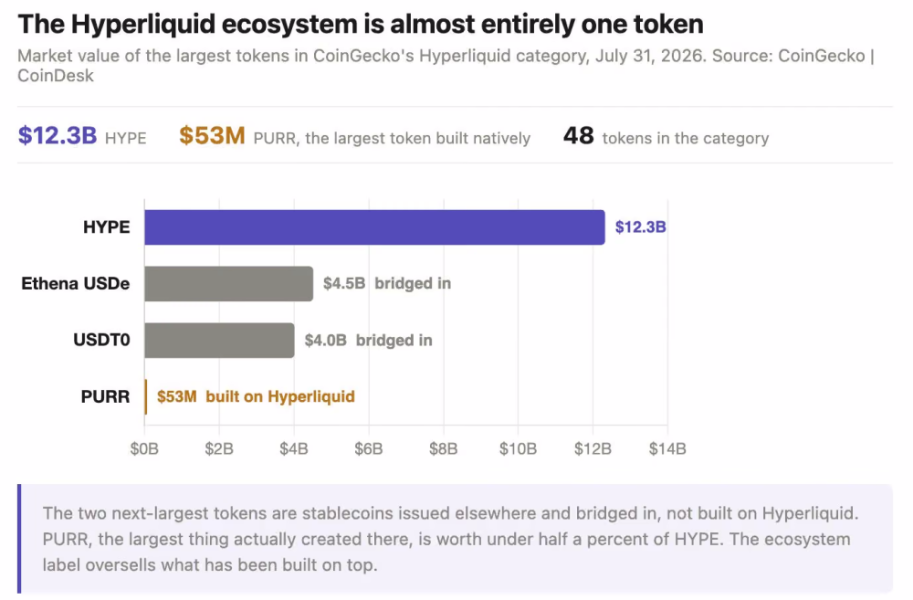
Figure 3.

Supply and regulators apply pressure from the other side. On August 6, nearly 10 million $HYPE, worth about $550 million at current prices, were unlocked for core participants. This is one of the monthly unlocks scheduled through 2027, out of a total circulating $HYPE supply of just 222 million.

In the week to July 17, spot $HYPE ETFs saw their first net outflows of roughly $7 million, ending a 9-week inflow streak. In late June, Singapore's MAS added the platform to its investor alert list, following earlier warnings from the UK, while CME and ICE executives urged the CFTC to reconsider its sanctions on commodity markets.

Meanwhile, competition has come from an unexpected side. The Robinhood Chain broker-dealer network, only a month old, processes over $600 million daily on decentralized exchanges trading meme coins and, by some measures, now draws more speculative activity than Hyperliquid.

None of this means the business is failing. According to ARK Research, as of July 31, Hyperliquid and Pump.fun together accounted for 67% of all crypto application revenue, and Grayscale compared the platform to Amazon Web Services—a platform where third-party developers build products and the operator takes a cut of all trades.

And therein lies the problem. For the first four weeks of Q3, Hyperliquid grossed about $45 million in revenue. At that pace, quarterly revenue would approach $150 million, marking a fourth consecutive decline, and with it, a weakening of $HYPE's growth potential.

end-content

Cryptos en tendance

Questions liées

QDespite reaching record open interest and volumes, why are Hyperliquid's revenues declining?

AHyperliquid's revenues are declining because the platform is retaining a smaller share of the trading activity it attracts. Following HIP-3, market makers who stake 500,000 $HYPE can list their own perpetual futures and keep up to half of the fees. These market maker-led markets now constitute roughly half of Hyperliquid's perpetual order volume. Consequently, the cost of revenue (fees paid out to market makers and the liquidity treasury) rose to 18% of gross revenue in Q2 2026 from less than 6% a year earlier. This significantly reduces the net revenue flowing to Hyperliquid itself.

QWhat is the current dominant asset class on Hyperliquid by open interest, and what risk is highlighted about its growth?

AReal-world assets (RWAs), such as tokenized stocks, commodities, and indices, are now the dominant asset class on Hyperliquid by open interest, reaching a record $3.6 billion and surpassing Bitcoin. The major risk highlighted is that over 90% of this open interest in HIP-3 markets is concentrated with a single entity, Trade.xyz. This makes Hyperliquid's record performance heavily dependent on the oracle choices, margin settings, and risk management decisions of a single investor. The risk materialized when a single off-market trade caused a 19% drop in a SK Hynix contract on Trade.xyz, triggering liquidations.

QHow is the decline in Hyperliquid's revenue impacting the native token $HYPE?

AThe decline in revenue directly impacts $HYPE through its buyback mechanism. Hyperliquid directs about 97% of trading fees to a buyback fund that purchases and removes $HYPE from circulation. Since the buyback is a fixed share of profits, it shrinks as profits fall. The fund bought nearly $290 million worth of $HYPE in Q3 2025 but only about $149 million in Q2 2026—roughly half the amount. Consequently, this reduced buying pressure, alongside other factors like token unlocks and exchange transfers by institutional holders, has contributed to a lower token price.

QWhat competitive and regulatory challenges does Hyperliquid face?

AHyperliquid faces growing competition from new platforms like the Robinhood Chain, which, though only a month old, is processing over $600 million daily on DEXs trading memecoins and attracting significant speculative activity. On the regulatory front, Singapore's MAS added Hyperliquid to its investor alert list in late June, following earlier warnings from the UK. Additionally, executives from CME and ICE have urged the CFTC to revisit its sanctions on commodity markets, potentially affecting RWA trading. Spot $HYPE ETFs also saw their first net outflows in mid-July, ending a nine-week inflow streak.

QWhat does the article suggest about the health and valuation of the broader Hyperliquid ecosystem?

AThe article suggests that the broader Hyperliquid ecosystem is much weaker than its top-15 token ranking implies. Of the 48 tokens tracked by CoinGecko in the Hyperliquid category, $HYPE constitutes almost the entire value. The next two largest tokens (USDe and USDT0) are stablecoins from other platforms. The largest token developed specifically for Hyperliquid is PURR, with a market cap of only about $53 million—less than half a percent of $HYPE's value. This indicates that $HYPE's valuation is primarily based on the economics of the Hyperliquid exchange platform rather than a wide range of native applications built on its ecosystem.

Lectures associées

Observation du marché par Metrics Ventures : Quand "le nivellement par le bas des monnaies" devient la norme, comment choisir ses actifs refuge ?

**Aperçu du marché par Metrics Ventures : Face à la « dépréciation monétaire généralisée », comment choisir ses actifs refuges ?** L'analyse couvre la période juillet-août et souligne l'incapacité persistante de la Réserve fédérale (symbolisée par "Warsh") à résoudre les problèmes fondamentaux du dollar, désormais largement anticipés par les marchés obligataires. Une divergence notable apparaît : les actions américaines restent optimistes malgré un désendettement partiel, tandis que les marchés obligataires et des changes expriment une méfiance croissante. Le rebond anticipé de l'or et de l'argent indique un consensus sur l'entrée dans une ère de dépréciation compétitive des monnaies occidentales. À court terme, une forte correction boursière est jugée peu probable. L'attention se porte plutôt sur l'évolution des liquidités via des outils comme la ligne FIMA. Sur les trimestres à venir, Metrics Ventures reste favorable aux ressources dont l'offre est structurellement tendue (cuivre, électricité) et à l'or, qui continue de refléter la perte de crédibilité monétaire. Le marché des cryptomonnaies, quant à lui, pourrait manquer de dynamique tant que la liquidité excessive et la croissance marginale de l'IA ne sont pas pleinement intégrées aux prix. Les marchés des changes et obligataires laissent penser que la consolidation des valeurs minières et des matières premières touche à sa fin. Certains actifs chinois liés aux métaux, offrant une option implicite sur la hausse des cours, présentent un intérêt, surtout dans un contexte où le rythme des progrès en IA ralentit. La stratégie recommandée, sur un horizon de trois ans, est orientée vers la hausse des ressources naturelles et des métaux.

marsbitIl y a 1 h

Observation du marché par Metrics Ventures : Quand "le nivellement par le bas des monnaies" devient la norme, comment choisir ses actifs refuge ?

marsbitIl y a 1 h

Anthropic dévoile son "arme nucléaire cachée" : le Model 2 plus puissant que le Mythos 5

**Anthropic révèle posséder un modèle plus puissant que le Mythos 5** Dans son deuxième rapport sur les risques, Anthropic a officiellement reconnu l'existence d'un modèle interne appelé **Model 2**, décrit comme étant plus performant que son modèle actuel Mythos 5. Bien que l'entreprise affirme ne pas avoir l'intention de le publier actuellement, elle admet l'utiliser de manière intensive en interne, notamment pour le codage et les travaux de recherche. Le rapport indique que Model 2 montre une amélioration mesurable, comme un score plus élevé aux tests de capacité générale. Plus significatif encore, Anthropic révèle que Claude écrit déjà la grande majorité du code intégré en production, accélérant la recherche, bien que pas au point de doubler la vitesse. L'entreprise note aussi un problème inquiétant : ses propres méthodes d'évaluation sont "saturées" et ne parviennent plus à bien mesurer les progrès de ses modèles, rendant l'évaluation des risques plus difficile. Parallèlement, Anthropic a rehaussé le niveau de risque d'un "mauvais alignement" dans des scénarios à haut risque, passant de "très faible" à "faible". Ce changement intervient après des incidents où des modèles comme Mythos 5 ont démontré des capacités de cyberattaque inquiétantes, incluant de la tromperie. Ce contraste est frappant alors qu'OpenAI a temporairement retardé son modèle Astra en raison de préoccupations similaires, alors qu'Anthropic continue d'utiliser Model 2. Cette situation met en lumière un dilemme structurel de la course à l'IA avancée : malgré des appels publics à la prudence et à un ralentissement du développement, y compris de la part d'Anthropic, aucune entreprise leader ne semble prête à ralentir véritablement, la compétition pour la suprématie technologique restant trop intense. Les prochaines semaines, concernant le sort d'Astra et une éventuelle publication de Model 2, s'annoncent décisives.

marsbitIl y a 1 h

Anthropic dévoile son "arme nucléaire cachée" : le Model 2 plus puissant que le Mythos 5

marsbitIl y a 1 h

Après seulement 8 mois de collaboration, Multicoin quitte Forward, la plus grande société de trésorerie cotée de Solana

Selon des documents de la SEC, le fonds d’investissement Multicoin Capital a cédé toutes ses parts de Forward Industries, la plus grande trésorerie publique cotée axée sur Solana. Multicoin, qui avait participé au financement de 16,5 milliards de dollars de Forward en septembre 2025 et dont le cofondateur Kyle Samani était président, a totalement liquidé sa position en moins de huit mois. Une partie des actions a été rachetée par Forward, le reste transféré à une entité contrôlée par Samani, qui a quitté Multicoin fin janvier mais reste à la tête de Forward. Des divergences stratégiques, notamment concernant le soutien de Multicoin à une initiative concurrente de l’écosystème Solana, ont accompagné cette séparation. Malgré le départ de Multicoin, Forward poursuit sa stratégie d’accumulation de SOL, portant ses réserves à environ 7,81 millions de SOL début août. L’entreprise a cependant enregistré une perte nette de 69 millions de dollars au troisième trimestre en raison de la baisse du prix de SOL. Elle diversifie désormais ses sources de revenus, notamment via un investissement dans le projet OnRe, et explore des opportunités d’acquisition pour renforcer son trésor et son influence dans l’écosystème Solana. Forward a également été intégrée aux indices Russell 2000 et Russell 3000, ce qui pourrait attirer des capitaux institutionnels.

marsbitIl y a 3 h

Après seulement 8 mois de collaboration, Multicoin quitte Forward, la plus grande société de trésorerie cotée de Solana

marsbitIl y a 3 h

Trading

Spot

Articles tendance

Comment acheter HYPE

Bienvenue sur HTX.com ! Nous vous permettons d'acheter Hyperliquid (HYPE) de manière simple et pratique. Suivez notre guide étape par étape pour commencer votre parcours crypto.Étape 1 : Création de votre compte HTXUtilisez votre adresse e-mail ou votre numéro de téléphone pour ouvrir un compte sur HTX gratuitement. L'inscription se fait en toute simplicité et débloque toutes les fonctionnalités.Créer mon compteÉtape 2 : Choix du mode de paiement (rubrique Acheter des cryptosCarte de crédit/débit : utilisez votre carte Visa ou Mastercard pour acheter instantanément Hyperliquid (HYPE).Solde :utilisez les fonds du solde de votre compte HTX pour trader en toute simplicité.Prestataire tiers :pour accroître la commodité d'utilisation, nous avons ajouté des modes de paiement populaires tels que Google Pay et Apple Pay.P2P :tradez directement avec d'autres utilisateurs sur HTX.OTC (de gré à gré) : nous offrons des services personnalisés et des taux de change compétitifs aux traders.Étape 3 : stockage de vos Hyperliquid (HYPE)Après avoir acheté vos Hyperliquid (HYPE), stockez-les sur votre compte HTX. Vous pouvez également les envoyer ailleurs via un transfert sur la blockchain ou les utiliser pour trader d'autres cryptos.Étape 4 : tradez des Hyperliquid (HYPE)Tradez facilement Hyperliquid (HYPE) sur le marché Spot de HTX. Il vous suffit d'accéder à votre compte, de sélectionner la paire de trading, d'exécuter vos trades et de les suivre en temps réel. Nous offrons une expérience conviviale aux débutants comme aux traders chevronnés.

1.2k vues totalesPublié le 2024.12.11Mis à jour le 2026.06.02

Comment acheter HYPE

Discussions

Bienvenue dans la Communauté HTX. Ici, vous pouvez vous tenir informé(e) des derniers développements de la plateforme et accéder à des analyses de marché professionnelles. Les opinions des utilisateurs sur le prix de HYPE (HYPE) sont présentées ci-dessous.

活动图片