Ethereum Price Forecast: Why Does ETH Remain Stable After Five Consecutive Weeks of ETF Inflows?

cryptonews.ruPublished on 2026-08-05Last updated on 2026-08-05

Abstract

Ethereum Price Forecast: Why ETH Stays Stable After Five Consecutive Weeks of ETF Inflows? Ethereum (ETH) is trading around $1,867.68, showing little movement despite five consecutive weeks of net inflows into spot ETFs and a new community-dividing proposal, EIP-8363, that could significantly alter ETH's supply dynamics. Technically, ETH is consolidating between key support at $1,837.76 (0.382 Fibonacci) and resistance around $1,939. A descending trendline from May near $1,900 continues to cap price rallies. The MACD indicator remains bearish, suggesting sideways momentum persists until a breakout occurs. On August 4th, spot ETH ETFs saw a strong $53.75 million daily inflow, led by BlackRock's ETHA. This marks the fifth straight week of positive inflows, with total net inflows reaching $11.25 billion. A major talking point is EIP-8363, the "Tapered Issuance Burn" proposal backed by researchers like Justin Drake. It aims to burn an increasing share of validator rewards as the staked ETH ratio grows, reaching 100% burn when 60.25 million ETH (≈50% of supply) is staked. Proponents see it as a long-term positive supply shock for price. However, opponents warn it could disadvantage small validators and reduce staking yields, potentially dampening institutional demand. **Price Outlook:** * **Bull Case (Target: $2,042):** A daily close above the $1,940 resistance and the descending trendline, fueled by sustained ETF inflows and EIP-8363 supply narrative, could open a path tow...

Five consecutive weeks of ETF inflows and a validator reward burn proposal that could change the supply of $ETH, yet the price is barely moving. $ETH is trading at $1,867.68 on August 5, unchanged on the day, while the $1,900 trend line remains overhead, and the market is still waiting for something to force a decision.

$ETH Holds the 0.382 Fibonacci, But the Downtrend Line Remains Unbroken
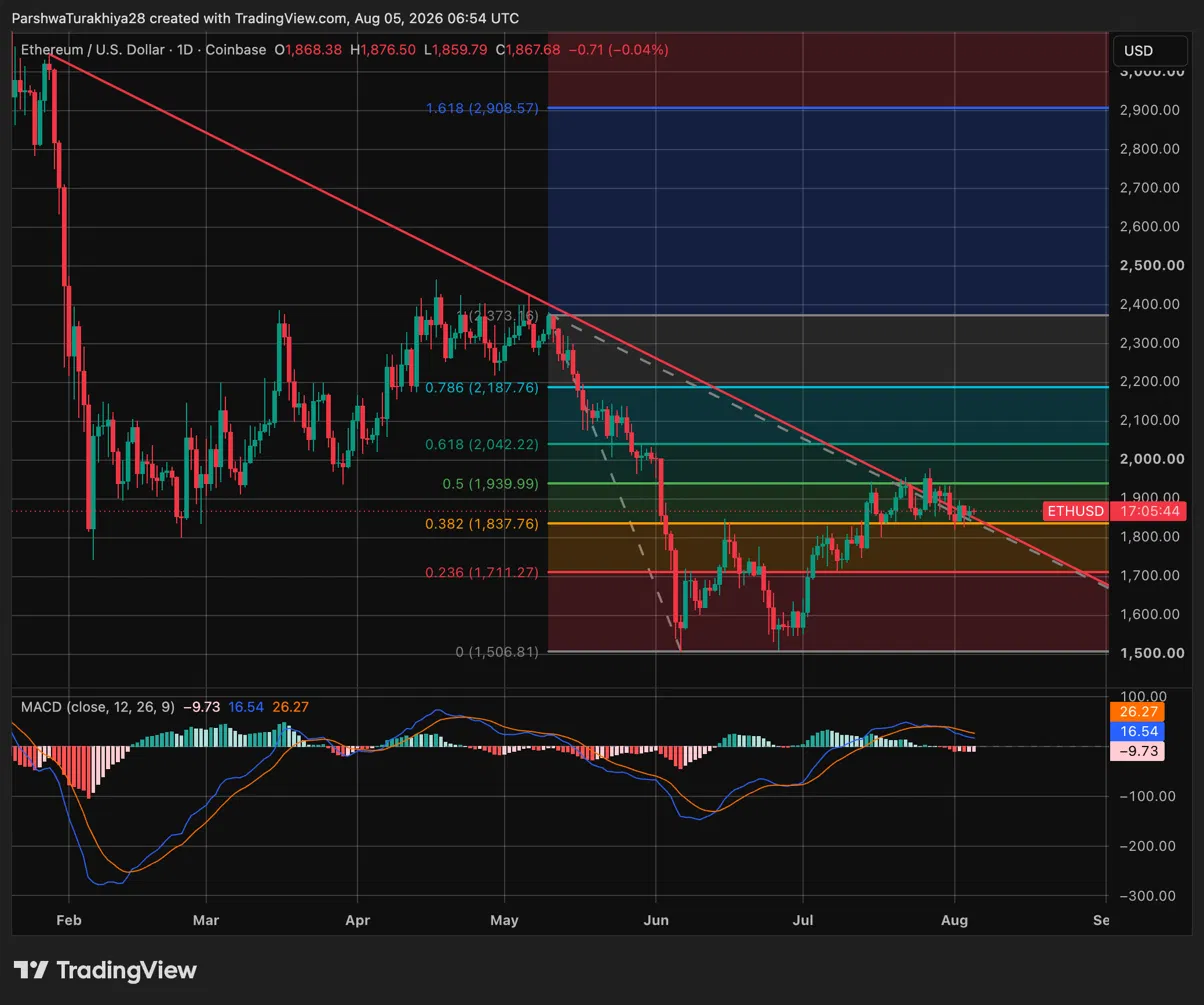
Price Analysis for $ETH (Source: TradingView)

$ETH is trading at $1,867.68, sitting between the key support level at $1,837 below and resistance at $1,939 above. Today's session was tight — ranging from $1,859.79 to $1,876.50 — with no directional conviction on either side.

The descending trend line from the May peak around $2,373 continues to slope around the $1,900 area and has rejected all meaningful recovery attempts since June. It converges with the $1,939 resistance, creating a $1,900–$1,940 zone that price must overcome before $2,000 comes into play.

Related: Pi Network Price Forecast: Can Protocol 26 and RoboPay Lift PI Above $0.10?

The MACD tells the same cautious story. The MACD line at -9.73 is still below the signal line at 16.54, and the histogram has not yet entered bullish territory. Momentum has not confirmed a recovery. Until the MACD crosses over or the trend line is broken, the path of least resistance remains to the side.

Support and Resistance Levels for $ETH, August 5, 2026

Type Price Level
Resistance $1,939.99 0.5 Fibonacci, confluence with descending trend line
Resistance $2,042.22 0.618 Fibonacci
Resistance $2,187.76 0.786 Fibonacci
Resistance $2,908.57 1.618 Fibonacci Extension
Support $1,837.76 0.382 Fibonacci, key floor
Support $1,711.27 0.236 Fibonacci
Support $1,506.81 June low, Fibonacci base

Spot $ETH ETFs Open Fifth Consecutive Week in the Green

Spot Ethereum ETFs recorded a daily net inflow of $53.75 million on August 4, the strongest single-day figure since late July. BlackRock's ETHA led with $42.46 million, followed by Fidelity's FETH with $9.34 million and Bitwise's ETHW with $1.34 million. Morgan Stanley's MSSE added $605.21K. All other products recorded zero flow for the day.

The current week has already gathered $42.33 million in just the first two sessions — Monday and Tuesday — with three days still remaining. This puts the week on track to extend the already fifth consecutive positive week for $ETH ETFs. Total net inflows across all products now stand at $11.25 billion with total net assets of $10.32 billion.

Week Weekly Net Inflow
August 4 (partial, 2 days) $42.33M
July 31 $27.42M
July 24 $103.90M
July 17 $105.44M
July 10 $84.42M

EIP-8363: The Supply Shock Proposal Splitting the Community

🚨 🛠️ ETHEREUM PROPOSAL WATCH

A new proposal backed by Ethereum researchers, including Justin Drake, seeks to lower validator rewards as $ETH staking nears the 50% threshold.

Opponents say the change could disadvantage solo validators and put pressure on DeFi yields.

Could this... pic.twitter.com/QtGzvK7w4r

— Coin Edition: Your Crypto News Edge ️ (@CoinEdition) August 5, 2026

Six Ethereum developers, including Justin Drake, proposed a new issuance policy on August 5 called "Tapered Issuance Burn", previously EIP-8363. This proposal would burn an increasing portion of validator rewards as the amount of staked $ETH grows, with the burn rate reaching 100% once staked $ETH reaches 60.25 million, roughly half of the total supply. Implementation was envisioned to take place over 18 months.

Co-author Jérôme de Tychey described uncontrolled issuance as a "dilution tax" for every $ETH holder, arguing that the plan would hinder large custodians and liquid staking providers from concentrating supply. Analyst Zac Pundle called this development a negative supply shock and argued it is directly positive for the price of $ETH.

Related: $BNB Price Forecast for August 2026: Can $BNB Break $600 Amid Former Employee Scandal Clash and Index Inclusion?

However, the proposal has faced significant pushback. Solo validators, small stakers, and DeFi builders warn that the burn mechanism will squeeze out small participants before large institutions feel the real effect, and that it could lower staking yields in a way that reduces institutional demand for $ETH.

The proposal is in the discussion stage and is not scheduled for an upgrade, yet its supply implications are already being debated within the ecosystem as a potential long-term price catalyst.

EIP-8363 Details Value
Proposal Name Tapered Issuance Burn
Lead Authors Justin Drake and Jérôme de Tychey, among others.
Mechanism Burns an increasing portion of validator rewards as staked $ETH grows
Full Burn Threshold 60.25 million $ETH staked (~50% of total supply)
Launch Timeline 18 months
Bull Argument Negative supply shock positive for $ETH price
Bear Argument Squeezes out solo validators, may reduce institutional staking demand

Ethereum Price Forecast: Upside and Downside Targets

Bull Case, Target: $2,042 (0.618 Fibonacci)

$ETH holds the 0.382 Fibonacci retracement at $1,837.76, and the MACD histogram is beginning to shrink towards a bullish crossover. ETF inflows, continuing for a fifth straight week, are attracting fresh institutional attention, and the EIP-8363 supply shock narrative is gaining traction as a long-term price driver. A break of the downtrend line on a daily close above $1,940 opens the path to the 0.618 Fibonacci at $2,042.22 and the $2,000 level.

Bear Case, Risk Level: $1,711 (0.236 Fibonacci)

The descending trend line continues to reject price, and the MACD fails to crossover bullishly, keeping momentum in sellers' control. The controversy around EIP-8363 dampens staking sentiment, and ETF inflow pace slows in the second half of the week. $ETH loses the 0.382 Fibonacci level at $1,837.76 and slides towards the 0.236 level at $1,711.27, with the June low at $1,506.81 coming into view on accelerating deeper lows on selling pressure.

Related: Biconomy Price Forecast: BICO Surges 126% Weekly as Bulls Target $0.03

end-content

Trending Cryptos

Related Questions

QAfter five consecutive weeks of ETF inflows, what is the current price action of Ethereum (ETH) and its key technical levels according to the article?

AAs of August 5, 2026, ETH is trading at $1,867.68, showing little daily movement. It remains between key support at $1,837 (the 0.382 Fibonacci level) and resistance at $1,939. The market is consolidating below a key descending trendline from the May peak, located around $1,900, and is waiting for a catalyst to break this range.

QWhat is EIP-8363 (Tapered Issuance Burn) and what are the main arguments for and against it?

AEIP-8363, proposed by Ethereum researchers including Justin Drake, is a mechanism that would burn an increasing share of validator rewards as the amount of staked ETH grows, reaching 100% burning when staked ETH hits 60.25 million (approx. 50% of supply). Proponents argue it creates a negative supply shock, which is bullish for ETH's price. Opponents warn it could disadvantage solo/small validators, pressure DeFi yields, and potentially reduce institutional staking demand.

QHow have spot Ethereum ETFs performed recently in terms of fund flows?

ASpot Ethereum ETFs have recorded five consecutive weeks of net inflows. As of the partial week ending August 4 (with 2 days of data), they attracted $42.33 million. This follows weekly inflows of $27.42 million (July 31), $103.90 million (July 24), $105.44 million (July 17), and $84.42 million (July 10). The total net inflows for all products have reached $11.25 billion.

QWhat are the bullish and bearish price targets for ETH outlined in the article's forecast?

AThe bullish case targets $2,042.22 (the 0.618 Fibonacci level), contingent on a daily close above the $1,940 resistance and the descending trendline. The bearish risk level is $1,711.27 (the 0.236 Fibonacci level), which could be tested if ETH loses the $1,837.76 support, potentially leading to a deeper sell-off towards the June low of $1,506.81.

QWhat technical indicator is mentioned as still showing caution and lacking confirmation for an ETH recovery?

AThe Moving Average Convergence Divergence (MACD) indicator. As per the article, the MACD line at -9.73 remains below the signal line at 16.54, and the histogram has not yet crossed into bullish territory. This lack of momentum confirmation suggests the path of least resistance remains sideways until a bullish crossover occurs or the descending trendline is broken.

Related Reads

Investors Begin 'Switching Tables'

Investors Begin to “Change Tables” A notable shift is occurring in China's venture capital landscape. While the hard tech sector, especially AI, experiences a funding frenzy with record-breaking investment rounds, many investors are opting to leave traditional investment firms to join portfolio companies. This movement, termed "changing tables," marks a departure from past downturns where such moves were often a last resort. Currently, the trend is driven by proactive choice. Seasoned investors, including partners and managing directors, are being lured by attractive salaries, equity incentives, and core roles like VP, General Manager, or even co-founder at fast-growing startups in hot sectors like AI, embodied intelligence, and aerospace. This "going ashore" to companies is seen as a strategic career move. The shift is a two-way street. Booming fundraising and feverish investment activity have created intense competition among VCs for a narrow set of "star projects." Simultaneously, these high-flying tech companies, engaged in rapid, multi-round financing, urgently need talent with deep capital market expertise and institutional connections to manage their complex funding needs. Companies like Zhiyuan Robot, MoonDark AI, and MiniMax are actively recruiting from investment firms. For investors, the move also reflects concerns about the sustainability of the current market. Risks like valuation inversion between primary and secondary markets, high IPO破发 rates, increased regulatory scrutiny, and the uncertainty of eventual exits are prompting a reevaluation of the traditional VC path. While this transition offers new opportunities, it is not without challenges. Success requires adapting from evaluating companies to operating within one, focusing on execution over analysis. Nevertheless, this trend underscores the expanding career boundaries and fluidity within China's innovation ecosystem.

marsbit13m ago

Investors Begin 'Switching Tables'

marsbit13m ago

Ethereum Community in Uproar! Whose Cake is EIP-8363 Cutting Into?

**Ethereum Community Debates Controversial Staking Proposal EIP-8363** A new Ethereum proposal, EIP-8363, dubbed "Tapered Issuance Burn," has ignited heated debate within the community. The core idea is to reduce and eventually eliminate new issuance rewards for validators as the total amount of staked ETH approaches 50% of the total supply (around 60.25 million ETH). The authors, including EthCC founder Jérôme de Tychey and Ethereum Foundation researcher Justin Drake, argue the current system perpetually incentivizes more staking, potentially leading to centralization as stake flows to large custodians and liquid staking tokens (LSTs). They also aim to reduce dilution pressure on non-staking ETH holders. Under the proposal, validator rewards from consensus-layer issuance would be partially burned based on a formula tied to the total staked amount. Net rewards would gradually approach zero as staking nears the 50% threshold. Notably, execution-layer rewards (tips, MEV) are unaffected. A proposed 18-month transition period would soften the initial impact. The community reaction has been predominantly critical. Key concerns include: * **Centralization Risk:** Critics like Obol's Oisín Kyne argue very low rewards could drive out solo stakers and smaller operators, leaving only large, cost-insensitive institutions, thus increasing validator centralization. * **Ecosystem Impact:** Aave's Stani Kulechov warns it could hurt ETH's predictable yield appeal for institutions and compress yields for LST-based DeFi strategies (e.g., recursive lending). * **Process & Timing:** Some, like ether.fi's Mike Silagadze, criticize the proposal's late submission ahead of a key upgrade deadline, limiting discussion time. Supporters believe the change is necessary to maintain ETH as a neutral reserve asset and avoid excessive security costs and holder dilution. If implemented, solo stakers would face higher relative operational costs and longer recovery times from penalties. LST yields would converge with native ETH, challenging their value proposition. The entire DeFi interest rate ecosystem, built around staking yield, could be pressured. While all ETH holders would benefit from reduced dilution, the net effect on ETH's price and adoption remains uncertain due to potential demand-side impacts from lower yields. The proposal is currently an early-stage draft and has not been officially slated for inclusion in any upcoming network upgrade.

marsbit43m ago

Ethereum Community in Uproar! Whose Cake is EIP-8363 Cutting Into?

marsbit43m ago

Trading

Spot

Hot Articles

Discussions

Welcome to the HTX Community. Here, you can stay informed about the latest platform developments and gain access to professional market insights. Users' opinions on the price of ETH (ETH) are presented below.

活动图片