100,000 university researchers, each getting one year of free access to flagship models!
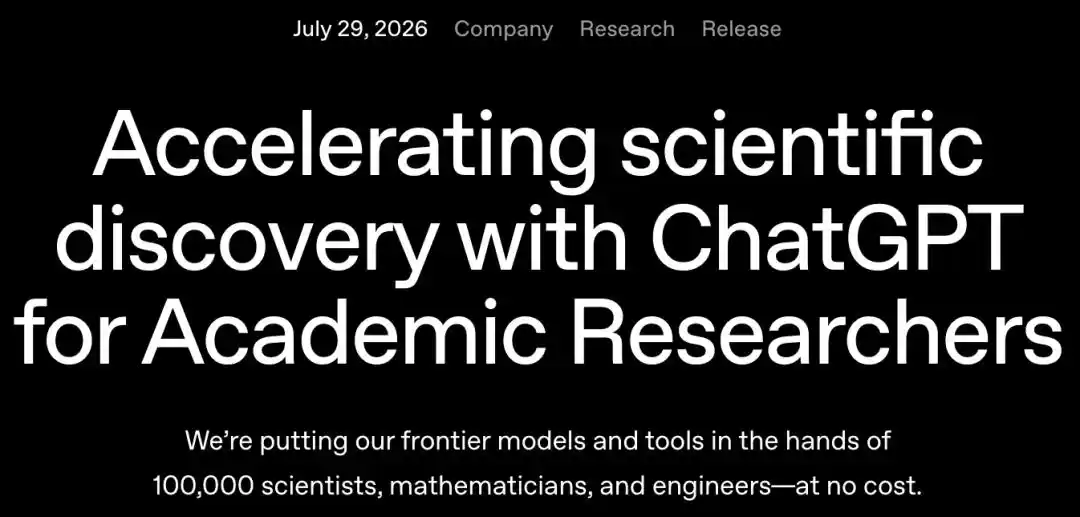
On July 29, OpenAI gave a big gift to the academic community, officially launching 'ChatGPT for Academic Researchers,' offering 100,000 researchers free access to cutting-edge models.
Prestigious institutions like École Normale Supérieure (ENS), which has produced many Nobel and Fields Medal laureates, and the Institute for Advanced Study (IAS) where Einstein worked, are among the first batch of selected institutions.
Eligible researchers can use GPT-5.6 Sol Pro, OpenAI's current top-tier flagship model.
It's important to clarify that the 100,000 target is for 2027, with the first 10,000 spots being released this summer.
An Entire Research Pipeline, Packaged and Delivered
What can this suite change for a researcher?
Reading literature in the morning, querying an idea, and letting it generate a few hypotheses on the fly can be done with ChatGPT.
Writing code, running data, and performing formal verification in the afternoon can be done with Codex.
When it's time to apply for funding, write grant proposals, or draft manuscripts, ChatGPT Work can take over.
This isn't just 'one more chat window'; it's your entire research workflow, which was previously scattered across editors, reference management software, terminals, and chat windows, all packaged into a single workspace.
Researchers approved for this program receive precisely this entire suite: ChatGPT, ChatGPT Work, Codex, along with an expanded Deep Research, higher usage limits, and a larger context window.
It's also stacked with over 75 life sciences skills: from genetics, genomics, single-cell analysis, all the way to protein modeling and drug discovery.
Additionally, there's a bunch of connectors; hook up literature databases, public genome and clinical databases, satellite imagery, even Zotero and GitHub, and they're ready to use.
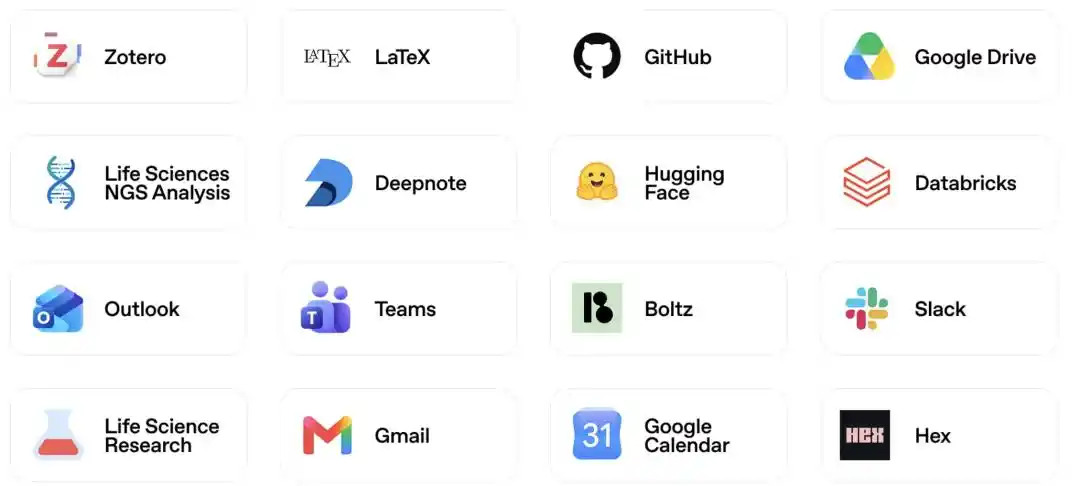
From Zotero, GitHub to Boltz, NGS analysis, commonly used research tools are packaged and connected into the same workspace.
The models also have their specialties: GPT-5.6 Terra handles daily tasks, Luna runs lightweight tasks, and Sol tackles the hardest scientific and mathematical problems.
On FrontierMath Tier 4, which measures research-level mathematical reasoning, Sol scored 83%, while the previous generation GPT-5.5 scored only 72.5%. On GeneBench Pro, which tests complex biological data analysis, Sol Pro solved 31.5% of the problems.
From searching literature, writing code, running analysis, to finalizing and submitting drafts, every step of a researcher's process is integrated into the same system.
OpenAI's goal is clear: move your entire research workflow into ChatGPT.
1.3 Million People Weekly Are Already Using ChatGPT for Research
Scientists, in fact, have been using it this way for a while.
OpenAI's official data states: approximately 1.3 million people use ChatGPT weekly for advanced science and mathematics, generating about 8.4 million messages.
A more direct signal comes from the mathematics community: arXiv math papers acknowledging ChatGPT grew from 14 in February to 100 in just the first three weeks of July.
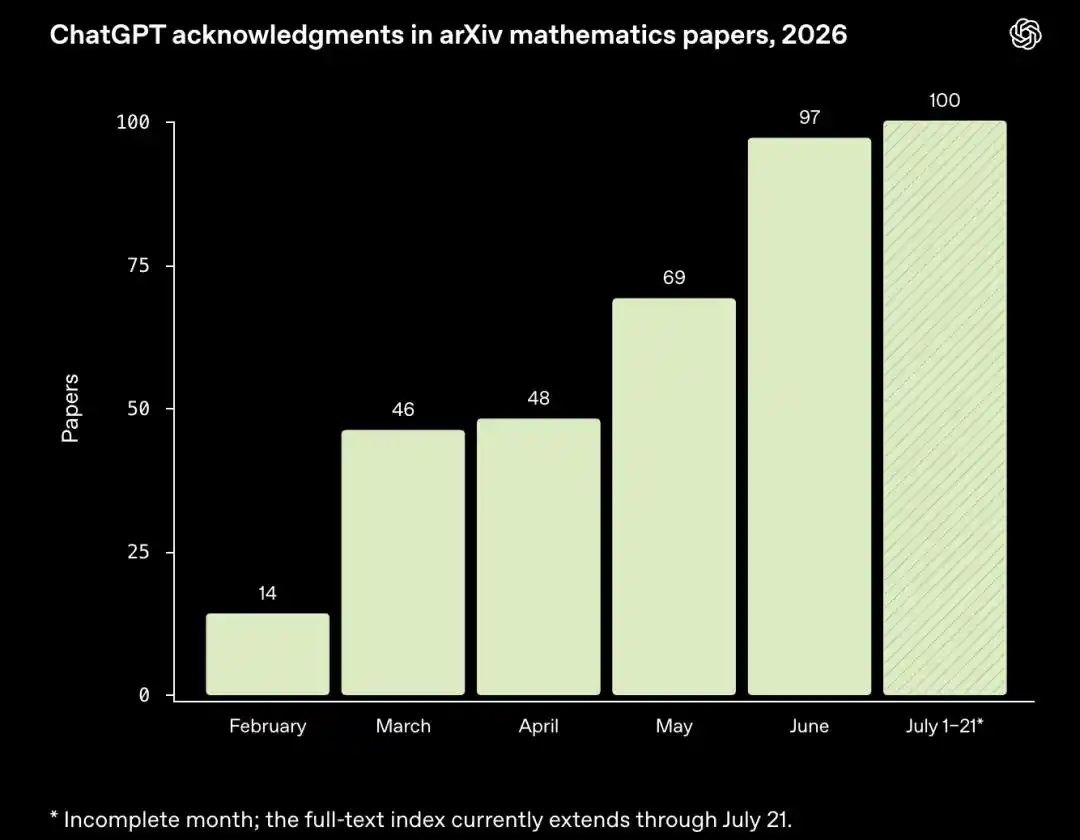
Number of arXiv math papers acknowledging ChatGPT: increased from 14 in February to 97 in June; reached 100 in just the first 3 weeks of July (up to the 21st). (Source: OpenAI)
Furthermore, the more intensely it's used, the more people dare to delegate entire large tasks:
Among the top 20% of scientists in terms of AI usage, close to 7% are willing to hand over entire tasks estimated to take over 4 hours to AI; this is only 3.5% among other peers, exactly double.
This shows that once a tool becomes familiar, people actively delegate increasingly heavy work to it. Habits are formed this way, gradually.
Seeing these numbers, OpenAI's motivation for giving away something this expensive for free to 100,000 scientists isn't hard to understand.
This workspace by default doesn't use your content to train models and provides ample enterprise-grade privacy protection. What it wants isn't your data, but your habits.
When a postdoc completes a full year of research solidly within this workflow: all the instincts for searching, analyzing, and writing become ingrained in ChatGPT and Codex.
By the time the one-year free window closes, the switching cost will have become too high to bother with.
As one industry observer bluntly stated: What lab leaders should really pay attention to is which company's tools their team members are quietly making their default choice upon opening their computers.
That choice will continue to compound long after the free period ends.
Three Limitations of the Free Lunch
This free offer comes with three limitations.
First, it's not unlimited use. The official statement is clear: the limits are similar to ChatGPT Pro, and exceeding them requires purchasing additional credits.
Second, it doesn't include API access. The self-serve plan explicitly states: it does not include OpenAI API credits.
Third, and most crucial: this is not open-source; no model weights are provided at all.
Researchers receive 12 months of product access, the ability to call the models, but cannot see the weights or modify the models.
Furthermore, the bar to get this free lunch is not low.
Applicants must be faculty or postdoctoral researchers at universities, pass SheerID institutional verification, be from a supported country, and submit a paper published in the last 3 years on arXiv, bioRxiv, or ChemRxiv with their name on it.
The most subtle point: the very group that actually wants the model weights is precisely bypassed.
Those doing AI research have been calling for weights and training data. Because only with these can they independently evaluate model behavior, verify reproducibility, and conduct safety audits.
OpenAI's response is: to prevent misuse, weights cannot be given.
In essence, OpenAI is opening up usage rights but firmly guarding the model itself. The underlying system remains a black box.
Anthropic Has Been in the Game, Just With a Different Approach
As early as May 2025, Anthropic launched its AI for Science initiative:
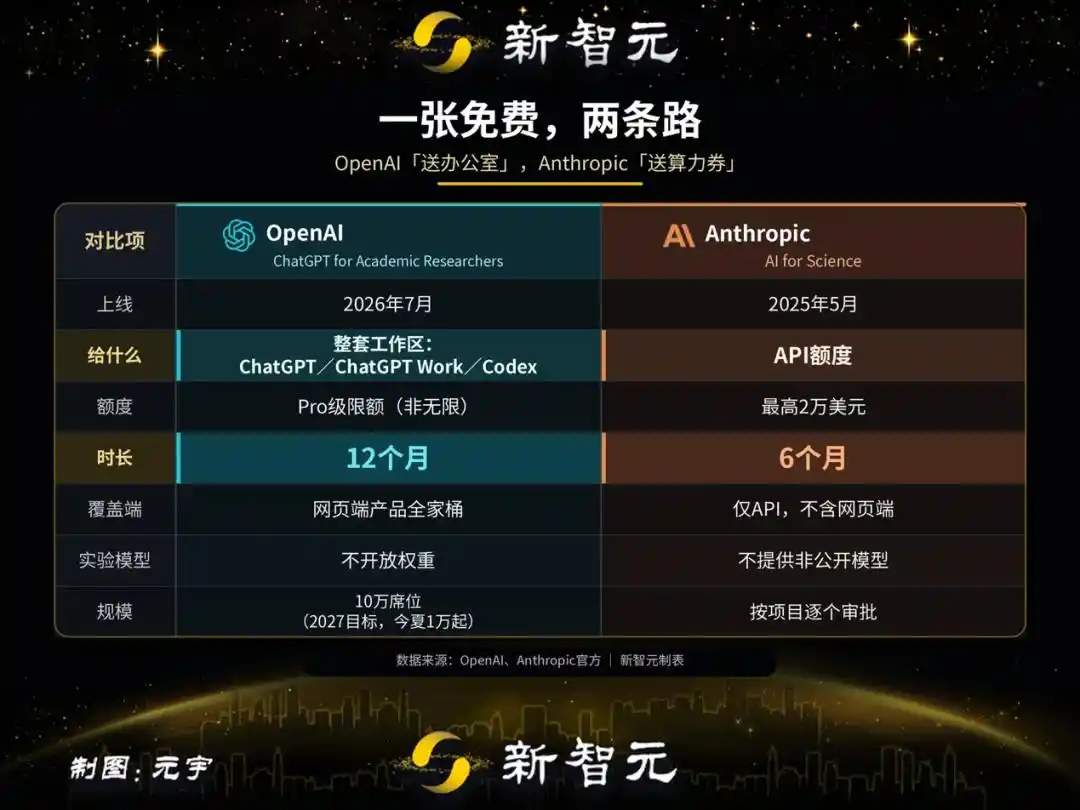
Offering up to $20,000 in API credits for researchers at academic and non-profit institutions, valid for 6 months, with a focus on biology and life sciences.
But what the two companies are offering is not the same thing.
Anthropic provides API credits, usable only via the interface, not the Claude web interface, and without access to non-public experimental models. Essentially, it's a compute credit.
OpenAI provides the entire workspace, Pro-level limits, and seats for a team of 5.
One provides AI tools, the other provides an AI work environment. The latter's binding effect on usage habits is much deeper.
However, the two companies are strikingly aligned on one point: neither opens up model weights.
The very scientists researching 'AI itself' are precisely the ones who want the weights and training data.
Because only with these can they independently evaluate model behavior, reproduce results, and conduct safety audits.
This program targets math, physics, chemistry, biology, medicine, and engineering, neatly sidestepping the core demands of this group.
The reason given by both OpenAI and Anthropic: limiting weight access prevents abuse.
Regardless, for a researcher who has just received a year of free credits, the utility of this tool is real and substantial.
But, when the free period ends, will you still be able to walk away?
References:
https://x.com/OpenAI/status/2082516370949062989
https://openai.com/index/chatgpt-for-academic-researchers/
This article is from the WeChat public account "Xinzhiyuan" (New Intelligence), author: ASI启示录 (ASI Revelation)