Galaxy Digital makes a major bet on AI, creating a 500-acre campus in Texas, while GLXY stock plunged 17%

cryptonews.ruPublished on 2026-07-28Last updated on 2026-07-28

Abstract

Galaxy Digital is making a major AI and high-performance computing bet with a new 500-acre campus in McGregor, Texas. The development agreement, which brought the city roughly $7.5 million, expands Galaxy's data center footprint from its existing 1.6-gigawatt Helios campus. The McGregor site is planned to start operations in 2028, initially targeting 74 megawatts with potential to scale to hundreds of megawatts by 2030. The project will use a water-saving closed-loop cooling system. Galaxy will fund its own private electrical substation and pay full taxes from the start, estimated to add at least $130 million to the local tax base and create hundreds of construction and permanent jobs. Despite this long-term strategic move, Galaxy's stock (GLXY) has been volatile, falling 17% over the past month and 27% over the past year, reflecting its high correlation to crypto market sentiment. The company ties the investment to a structural, not cyclical, demand shift for AI computing power.

The deal, concluded as part of a development agreement with the city of McGregor, provides for the creation of an artificial intelligence and high-performance computing campus on the site of the McGregor industrial park. The land sale brought the city revenue of approximately $7.5 million.

Galaxy is expanding its 1.6-gigawatt Helios campus in Dickens County, West Texas, where the company states it is already the largest employer and taxpayer.

"McGregor is the next step in our strategy of building a disciplined, multi-campus data center business," Galaxy Founder and CEO Mike Novogratz noted on Tuesday. He characterized the demand for computing power as a structural shift, not a temporary cycle.

What Galaxy intends to build

The company has signed a preliminary agreement with the local energy company to begin construction of interconnection facilities. The first phase of development aims to achieve a capacity of 74 megawatts.

Galaxy plans to coordinate with the energy company to push the project over the 75 MW threshold, which ERCOT classifies as a "large load." The company expects the McGregor facility to begin receiving power in 2028, with subsequent expansion of operations. Galaxy believes that by 2030, the complex could become a facility with a capacity of several hundred megawatts, depending on the development of new power transmission infrastructure.

The project will operate on a closed-loop cooling system—the same water-saving design used at the Helios facility, which ensures water is recirculated within the system rather than constantly drawn from the local water supply.

Tax base and jobs

Under the agreement, Galaxy will fund and build its own private electrical substation—a move intended to avoid shifting infrastructure costs onto local taxpayers. The company will also fulfill its full tax obligations from the outset, which is estimated to add at least $130 million to McGregor's tax base, intended to fund schools and emergency services.

The construction is expected to provide several hundred trade and construction jobs, followed by permanent operational jobs with, the company states, competitive wages.

What this means for GLXY investors

Galaxy Digital stock trades on the Nasdaq under the ticker GLXY. As of the close on July 27, the share price was $22.70, up $0.02 (0.09%) from the previous day in pre-market trading.

Short-term stock performance is unfavorable. Over five days, GLXY shares have declined by 7.01%, over the past month by 17.48%, and over six months by 32.23%. Since the beginning of the year, shares are down 0.83%, and over the past year, they are down 27.73%.
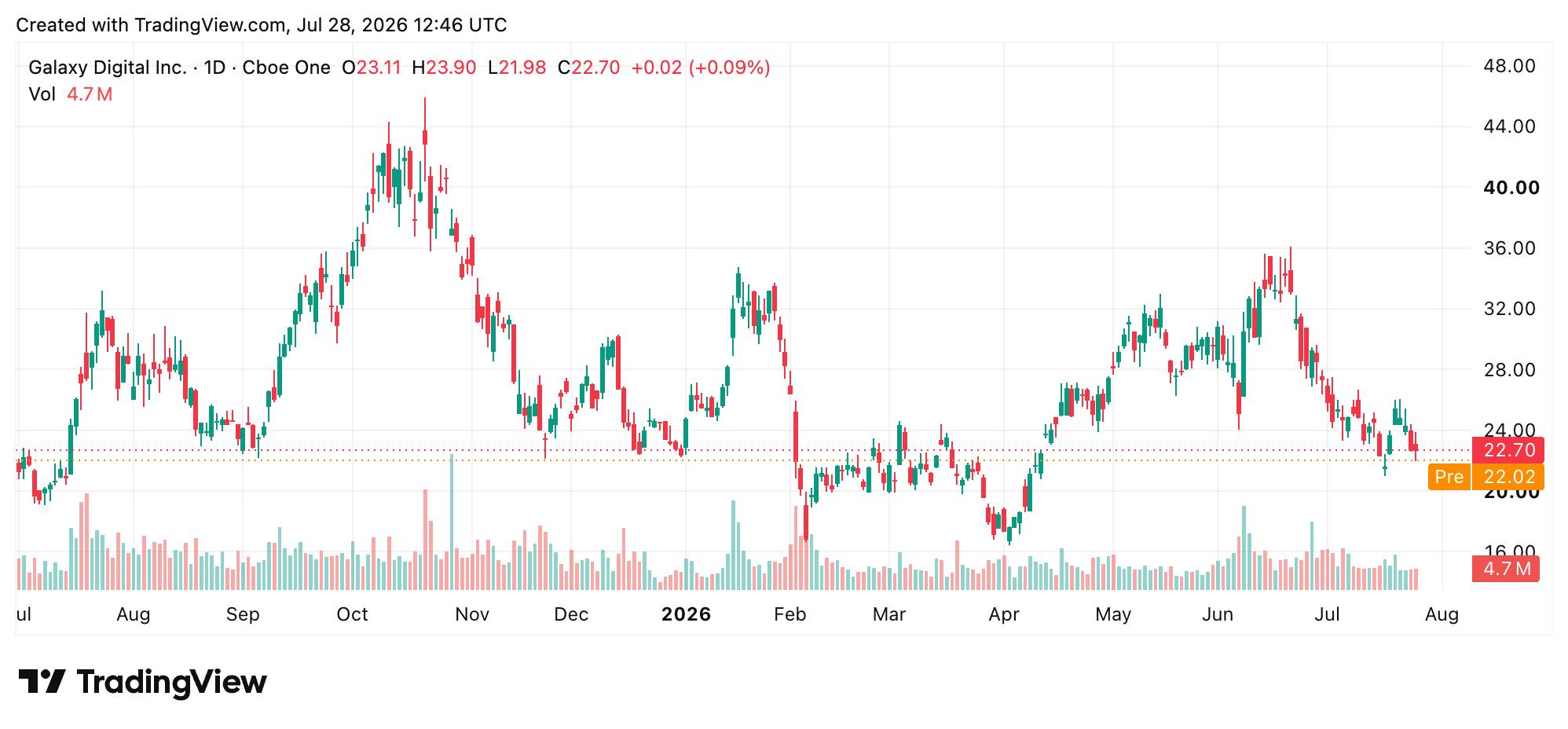
Galaxy Digital stock on Tradingview.

This volatility reflects the stock's high beta relative to the overall sentiment in the cryptocurrency market. Earlier this year, Galaxy placed priority secured bonds worth about $3.5 billion, tied to data center operations, and on August 5, the company will release its earnings report.

The McGregor deal provides Galaxy with a second concrete facility as part of what the company describes as a "multi-campus" strategy, built on long-term demand for AI computing power, regardless of stock price fluctuations.

end-content

Trending Cryptos

Related Questions

QWhat major investment is Galaxy Digital making, and where will it be located?

AGalaxy Digital is making a major bet on AI by creating a 500-acre AI and high-performance computing campus in McGregor, Texas.

QWhy has the stock price of Galaxy Digital (GLXY) been declining recently?

AGalaxy Digital's stock (GLXY) has been declining due to high volatility and sensitivity to the overall cryptocurrency market sentiment. In the past month, shares fell 17.48%, and over six months, they are down 32.23%.

QWhat are the power and infrastructure details for the first phase of the new McGregor campus?

AThe first phase of the McGregor campus aims to achieve a capacity of 74 megawatts. Galaxy plans to coordinate with a local energy company to exceed the 75 MW threshold, classified as a 'Large Load' by ERCOT, and expects the facility to start receiving power in 2028.

QHow does Galaxy Digital's project benefit the local community of McGregor, Texas?

AThe project benefits McGregor by providing the city with approximately $7.5 million from the land sale, adding at least $130 million to the local tax base for funding schools and emergency services, creating hundreds of construction and permanent operational jobs, and financing its own private electrical substation to avoid burdening local taxpayers.

QWhat is the long-term strategic vision behind Galaxy Digital's multi-campus data center business?

AGalaxy Digital's long-term strategic vision is to build a disciplined, multi-campus data center business based on the structural, long-term demand for computing power for artificial intelligence, independent of short-term stock price fluctuations.

Related Reads

Net Profit Soars 1299.9%, Samsung's Q2 Reports the Most Profitable Quarter in History

Samsung Electronics posts record-breaking Q2 2026 results, driven primarily by explosive AI-driven demand for its semiconductor business. Revenue surged 130% year-on-year (YoY) to 171.5 trillion won, while operating profit skyrocketed 1,813.8% to 89.49 trillion won. Net profit reached 71.62 trillion won, a 1,299.9% increase YoY. The Device Solutions (DS) division, which includes memory chips, was the core engine, contributing over 99% of total operating profit. Sales for the DS unit hit a record 127.5 trillion won, with memory revenue reaching 120.8 trillion won, fueled by AI server demand for products like HBM. The company has begun mass production of next-generation HBM4. In contrast, the Device eXperience (DX) division, covering mobile phones and consumer electronics, reported an operating loss of 0.8 trillion won due to rising component costs, highlighting a significant performance split within the company. Other segments showed improvement: Samsung Display's profit rose to 0.7 trillion won, and Harman's profit recovered to 0.4 trillion won. Financially, Samsung's position strengthened dramatically, with cash and equivalents reaching 190 trillion won and operating cash flow hitting a record 105.1 trillion won. The company also engaged in significant share buybacks and dividend payments. Looking ahead, Samsung expects sustained strong demand from AI infrastructure, though acknowledges softer demand in some consumer segments.

marsbit15m ago

Net Profit Soars 1299.9%, Samsung's Q2 Reports the Most Profitable Quarter in History

marsbit15m ago

E Fund "Quits Drinking"

"Yi Fang Da 'Gives Up Alcohol'" - Summary The article analyzes the recent portfolio adjustments of star fund manager Zhang Kun, focusing on his flagship funds, the Yi Fang Da Blue Chip Select and Yi Fang Da Quality Select. The key trend highlighted is a significant and ongoing reduction in exposure to the consumer sector, particularly liquor (baijiu) stocks like Kweichow Moutai and Wuliangye, which were once core holdings. This shift is driven by several factors: a downturn in the consumer sector's business cycle post-pandemic, with slowing earnings growth for major players; a change in consumer behavior towards value over premium brands; and high channel inventory pressures, especially in the liquor industry. These fundamentals have led to a prolonged phase of valuation contraction for consumer stocks. Concurrently, market capital has rotated aggressively towards the high-growth technology sector, especially AI-related chains, which have dominated fund inflows. This style shift has further diminished the attractiveness of traditional consumer "core assets" for many funds. As a result, Zhang Kun's funds have drastically cut their consumer stock allocations. For example, the Blue Chip Select's baijiu holding proportion has fallen from over 40% to around 20%, and its overall top 10 holdings concentration dropped sharply. This mirrors a broader trend in the active equity fund industry, where allocations to consumer staples have plummeted to multi-year lows while technology holdings have surged. The article concludes that while the consumer sector's valuations are now at historical lows, offering some margin of safety, the fundamental outlook remains challenging due to weak macro consumption recovery and intense internal competition. Therefore, the sector is likely to see only sporadic rebounds rather than a sustained recovery, continuing to weigh on the performance of funds still heavily invested in it. Zhang Kun's timely reduction of Korean semiconductor holdings in his Asia Select fund amid a market crash is also noted as a contrast to his domestic strategy.

marsbit44m ago

E Fund "Quits Drinking"

marsbit44m ago

Trading

Spot

Hot Articles

Discussions

Welcome to the HTX Community. Here, you can stay informed about the latest platform developments and gain access to professional market insights. Users' opinions on the price of AI (AI) are presented below.

活动图片