TRON included in S&P Pantera Digital Asset Index as institutional benchmarking expands to blockchain networks

cointelegraphPublished on 2026-07-27Last updated on 2026-07-27

Abstract

TRON DAO welcomes the inclusion of the TRON blockchain in the newly launched S&P Pantera Digital Asset Index, a benchmark co-developed by S&P Dow Jones Indices and Pantera Capital. The index's methodology, focusing on protocol utility, onchain liquidity, and network activity, signals the extension of traditional financial market frameworks to digital assets. TRON's selection reflects its significant scale, supporting over 394 million user accounts and facilitating more than $90 billion in USDT. The network leads in USDT transfer volume, with approximately $4.5 trillion year-to-date. Recent integrations with regulated U.S. firms have expanded institutional access. TRON founder Justin Sun stated that such transparent benchmarks mark the maturation of digital assets as an institutional asset class, where utility and adoption are key measures of a network's significance.

Geneva, Switzerland, July 23, 2026TRON DAO, the community-governed DAO dedicated to accelerating the decentralization of the internet through blockchain technology and decentralized applications (dApps), today welcomes the launch of the S&P Pantera Digital Asset Index and the inclusion of the TRON blockchain among the top protocols represented in the benchmark.

Developed by S&P Dow Jones Indices and Pantera Capital, the index applies a methodology centered on protocol utility, onchain liquidity, and network activity. The launch marks one of the clearest signs to date that established financial market frameworks are being extended to digital assets, applying benchmark methodologies traditionally used across equities and other asset classes to blockchain networks.

TRON’s inclusion comes as the network continues to expand its scale and role within the digital asset ecosystem. Today, the blockchain supports more than 394 million user accounts and more than USD 90 billion of USDT, serving as one of the primary settlement networks for stablecoin activity globally. According to Token Terminal, TRON leads all networks in USDT transfer volume year to date, with approximately $4.5 trillion. Recent integrations with Anchorage Digital, Securitize, and Bitnomial have further expanded institutional access to the TRON ecosystem through regulated U.S. market infrastructure.

“As digital assets become part of mainstream financial markets, the frameworks used to evaluate them must evolve as well,” said Justin Sun, Founder of TRON. “Transparent benchmarks have long served as essential reference points across global financial markets. Applying those same principles to blockchain networks reflects the continued maturation of digital assets as an institutional asset class, where utility, adoption, and onchain activity are becoming fundamental measures of a network’s significance.”

The benchmark represents another step in applying traditional financial market frameworks to digital assets, providing participants with a standardized approach to evaluate a network token’s everyday utility and adoption.

About TRON DAO

TRON DAO is a community-governed DAO dedicated to accelerating the decentralization of the internet via blockchain technology and dApps.

Founded in September 2017, the TRON blockchain has experienced significant growth since its MainNet launch in May 2018. Until recently, TRON hosted the largest circulating supply of USD Tether (USDT) stablecoin, which currently exceeds $90 billion. As of July 2026, the TRON blockchain has recorded over 394 million in total user accounts, more than 14 billion in total transactions, and over $26 billion in total value locked (TVL), based on TRONSCAN. Recognized as the global settlement layer for stablecoin transactions and everyday purchases with proven success, TRON is “Moving Trillions, Empowering Billions.”

TRONNetwork | TRONDAO | X | YouTube | Telegram | Discord | Reddit | GitHub | Medium | Forum

Media contact

Yeweon Park

press@tron.network

Trending Cryptos

Related Questions

QWhat is the name of the new digital asset index that includes TRON, and which organizations developed it?

AThe new digital asset index is called the S&P Pantera Digital Asset Index. It was developed by S&P Dow Jones Indices and Pantera Capital.

QAccording to the article, what three core metrics does the S&P Pantera Digital Asset Index methodology focus on for evaluating protocols?

AThe index methodology focuses on protocol utility, onchain liquidity, and network activity.

QHow does Justin Sun, Founder of TRON, describe the significance of applying transparent benchmarks to blockchain networks?

AJustin Sun states that applying transparent benchmarks to blockchain networks reflects the continued maturation of digital assets as an institutional asset class. He emphasizes that utility, adoption, and onchain activity are becoming fundamental measures of a network's significance.

QWhat key statistic regarding stablecoin (USDT) activity on the TRON network is highlighted to demonstrate its role in the ecosystem?

AThe article highlights that TRON leads all networks in USDT transfer volume year to date, with approximately $4.5 trillion transferred.

QWhich recent integrations have expanded institutional access to the TRON ecosystem through regulated U.S. market infrastructure?

ARecent integrations with Anchorage Digital, Securitize, and Bitnomial have expanded institutional access to the TRON ecosystem.

Related Reads

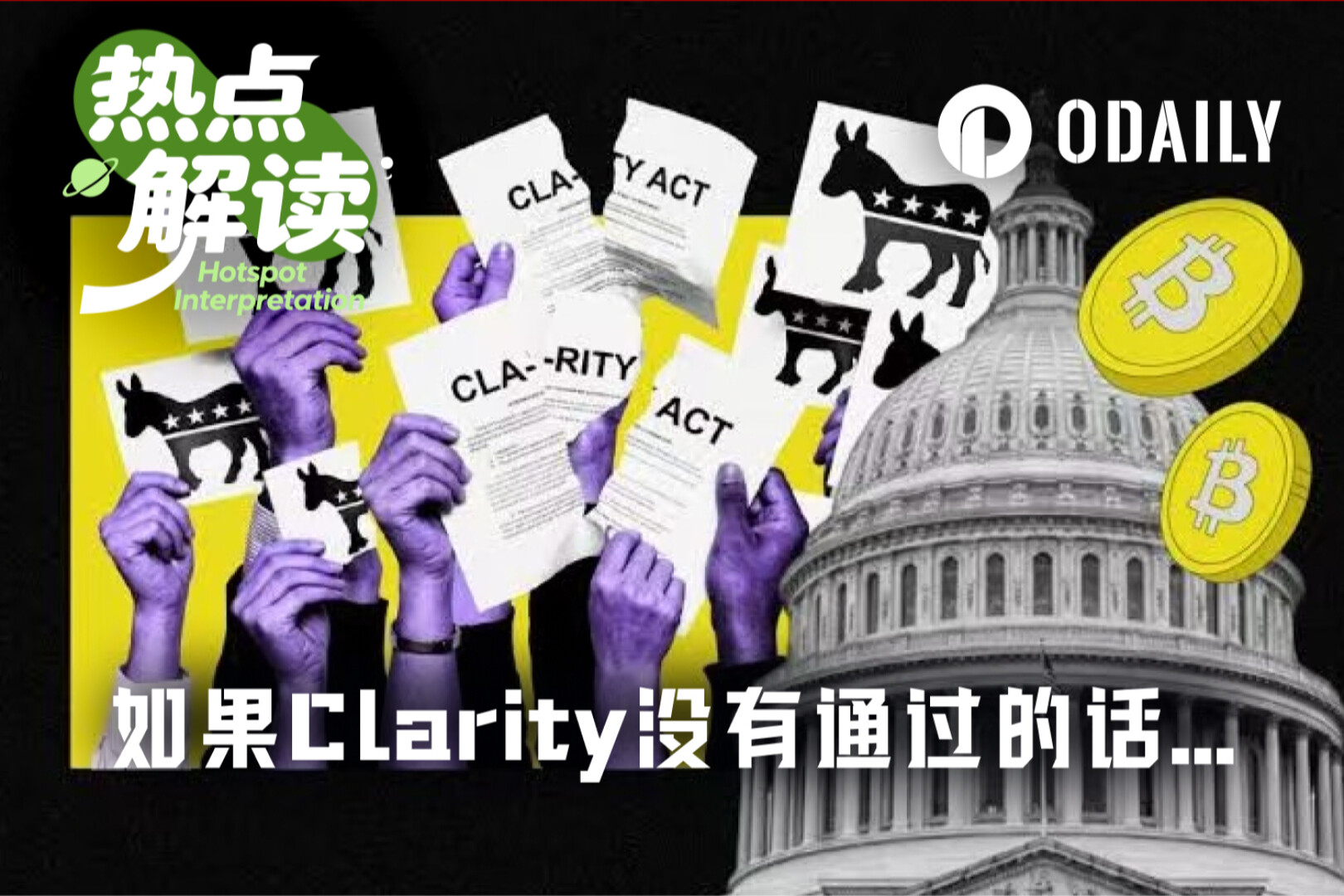
What If the CLARITY Act Ultimately Fails to Pass?

This article examines the potential consequences if the CLARITY Act, a major US crypto market structure bill, fails to pass in the Senate. Having cleared the House in July 2025 and a key committee in May 2026, the bill's passage into law this year is now considered uncertain, with prediction markets showing its probability dropping from 82% in February to 35%. The article analyzes three main areas of impact should the bill fail. First, for the crypto market, analysts believe a negative reaction is limited and partially priced in already, with Bitcoin's recent weakness attributed more to macro factors. The specific details of the failed bill would matter more than its failure alone. Second, for US stocks, Coinbase (COIN) could see short-term pressure, with analysts citing a potential drop to the $140-$160 range, though its long-term thesis is not solely tied to the bill. For Circle, failure might be neutral or even positive long-term, as a passed bill could invite more stablecoin competition. Bitcoin-treasury firms like Strategy (MSTR) are seen as more directly tied to Bitcoin's price than the legislation. Third, in Washington, the failure is framed within a broader political struggle. Democratic resistance is partly linked to concerns over former President Trump's crypto holdings, making the bill a political tool. If it fails in 2026, the industry would likely rely on existing frameworks like the GENIUS Act and agency-level rules. Missing the August window likely pushes any significant progress to 2027, a period of political reshuffling after midterm elections, making consensus harder to achieve.

Odaily星球日报Just now

What If the CLARITY Act Ultimately Fails to Pass?

Odaily星球日报Just now

SK Hynix Q2 Profit Soars Sixfold, Still 'Misses Expectations'; Secures Long-Term Agreements with 10 Clients, HBM4 to Accelerate Volume Ramp in Second Half

SK Hynix reported record-breaking Q2 2026 financial results, with operating profit soaring 557% year-over-year to 60.5 trillion won and revenue increasing 257% to 79.3 trillion won, driven by strong demand for AI server memory, HBM, and enterprise SSDs. The operating profit margin reached 76.3%. However, both figures fell short of analyst expectations, leading to a drop in its share price. The company attributed the earnings miss to three factors: a high sales mix of HBM, which limited upside from surging prices of general-purpose DRAM; a deceleration in memory price increases compared to Q1; and long-term supply agreements (LTAs) with major customers that lock in prices, reducing sensitivity to spot market gains. SK Hynix has signed LTAs with about 10 clients, covering roughly half of its sales. Despite the miss, the company remains optimistic about AI-driven demand. Its net profit of 93.9 trillion won was significantly boosted by a one-time gain from the partial sale of its Kioxia stake. Financially, it strengthened its cash position, ending the quarter with a net cash position of 69.4 trillion won. Looking ahead, SK Hynix plans capital expenditures at the high end of its 40-50 trillion won range for 2026 to expand capacity for HBM and advanced NAND products, including accelerating the mass production of HBM4 in the second half of the year.

marsbit21m ago

SK Hynix Q2 Profit Soars Sixfold, Still 'Misses Expectations'; Secures Long-Term Agreements with 10 Clients, HBM4 to Accelerate Volume Ramp in Second Half

marsbit21m ago

Behind the 67,000 Semiconductor Talent Shortage: U.S. Industrial Policy Game and Implications for China

The U.S. push to reshore semiconductor manufacturing faces a core challenge: a significant talent shortage. While over $770 billion in investments are planned across 160 projects, a key hurdle is finding enough people to run the new fabs. According to industry projections, the U.S. could face a shortage of approximately 67,000 technicians, engineers, and computer scientists by 2030. This shortage is multi-faceted. It includes not only high-level chip design engineers requiring advanced degrees but also a substantial need for technicians to operate and maintain fab equipment. Technician roles, while often requiring less formal education, are hard to fill due to factors like shift work, factory locations, and local community infrastructure. Conversely, for high-end engineers, the issue is less about salary—which is already competitive—and more about intense competition for specialized skills from other tech sectors and the long lead time to develop such expertise. The geographic dispersion of new investments complicates recruitment, as fabs need large numbers of local, stable employees. In response, U.S. policy emphasizes building workforce development as critical infrastructure. Strategies include expanding community college programs for technician training, fostering industry-education partnerships, and pursuing immigration reforms for high-skilled talent, aiming to balance immediate needs with long-term domestic pipeline development. For China, the key takeaway is the need to integrate talent supply planning with factory construction from the outset. This involves requiring companies to submit workforce plans, strengthening vocational education aligned with industry needs, and building supportive local ecosystems to retain talent. Ultimately, a sustainable semiconductor industry depends not just on building fabs, but on cultivating a continuous, local talent pipeline capable of keeping them running and advancing.

marsbit1h ago

Behind the 67,000 Semiconductor Talent Shortage: U.S. Industrial Policy Game and Implications for China

marsbit1h ago

Trading

Spot

Hot Articles

Discussions

Welcome to the HTX Community. Here, you can stay informed about the latest platform developments and gain access to professional market insights. Users' opinions on the price of S (S) are presented below.

活动图片