SK海力士美股单日暴涨27%,较韩股溢价超50%!期权上市刺激交投,资金押注短期看涨

华尔街见闻Published on 2026-07-15Last updated on 2026-07-15

Abstract

SK海力士ADR上市仅三个交易日,相对韩国本地股溢价已骤扩至51%。韩国本地股与ADR之间存在转换限制,传统套利难以低成本实施。周二美国各大期权交易所正式提供SK海力士ADR期权产品,进一步刺激了交投热情,短期看涨期权成为资金最密集的攻击方向。

SK Hynix美国存托凭证(ADR)上市仅三个交易日,相对韩国本地股的溢价已急剧扩大至逾50%,折射出美国投资者对这只全球头部存储芯片股的强烈需求,也凸显了ADR与韩国本地股之间套利机制的天然局限。

周二,SK Hynix ADR单日大涨27%,不仅完全收复前一日9.3%的跌幅,还将ADR相对首尔上市普通股的溢价推升至51%。这一溢价水平远超上周发行时约3%的价差,而彼时该公司通过此次ADR发行募资265亿美元。
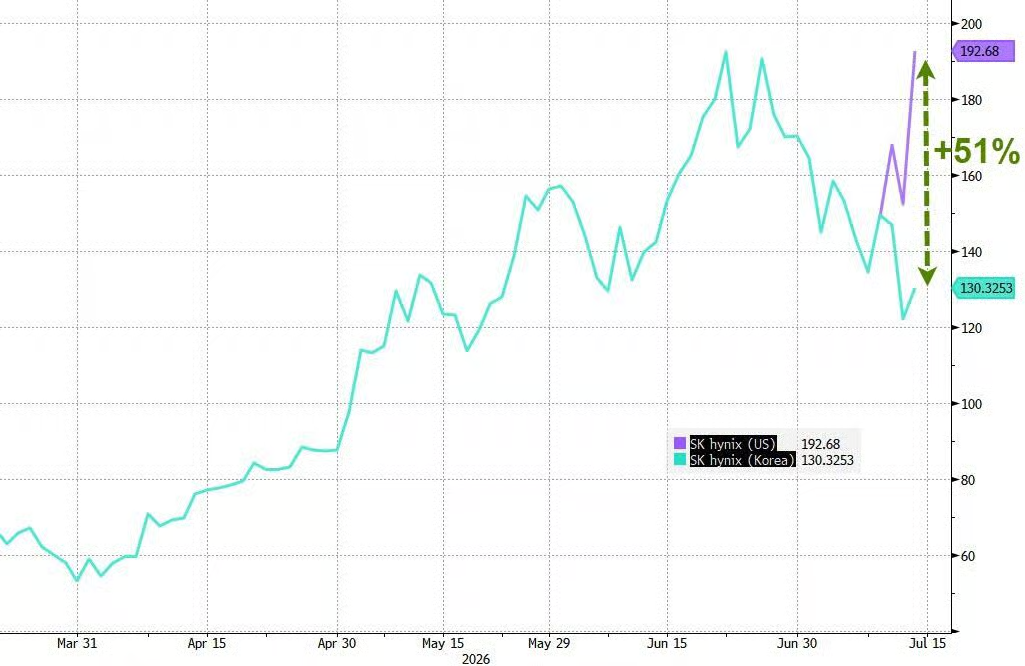
溢价的骤然扩大,在一定程度上源于韩国本地股与ADR之间的兑换限制,使套利难以顺畅运作。与此同时,周二美国各大期权交易所正式开始提供SK海力士ADR期权产品,进一步刺激了交投热情,短期看涨期权成为资金最密集的攻击方向。

ADR结构性溢价:转换限制埋下伏笔

根据SK Hynix向美国证券交易委员会(SEC)提交的文件,每份ADR等值于普通股的十分之一。在ADR发行之初,市场普遍预期其交易价格将高于首尔对应股价,根本原因在于韩国普通股与ADR之间存在转换限制,使得传统套利难以低成本实施。

正是这一结构性制约,让ADR溢价在短期内得以自由扩张,而无法被快速套利力量压缩回合理水平。当前51%的溢价,表明美国市场对该股的边际定价已显著脱离韩国本地市场。

波动行情背后:AI估值忧虑与期权交易启动

SK Hynix ADR上市以来的剧烈波动,折射出当前市场对AI生态系统整体估值偏高以及半导体资本支出是否已触及阶段性峰值的担忧。这两大因素在上市初期对ADR形成明显压制,并在上周引发单日近10%的大幅回调。

ADR期权周二正式登陆美国期权交易所,为全球最大衍生品市场的投资者提供了博弈这家AI存储龙头的新工具。上市首日,早盘成交量迅速触及约3.3万张合约,短期看涨期权成为资金最密集的攻击方向。

从成交结构看,逾三分之二的期权成交量集中在当周到期的短期合约,反映出资金对短线行情的押注偏好。成交最活跃的是执行价185美元的看涨期权,约2900张;执行价145美元的看跌期权紧随其后,表明部分资金也在配置下行保护。

此外,8月到期、执行价200美元的看涨期权成交超1500张,反映出投资者对股价中期突破200美元的信心。

Piper Sandler期权业务主管Daniel Kirsch指出,预计投资者将主要布局SK海力士ADR本周继续上涨的短线机会。随着期权工具上线,零售投资者预计将迅速涌入,当周到期的短期看涨期权可能成为最受欢迎的交易品种。

波动中的风向标:ASML与台积电财报

在期权交投火热之际,本周芯片板块将迎来重要催化剂。荷兰光刻机巨头ASML和台积电将陆续公布最新季度业绩,相关财报表现有望进一步影响整个半导体板块及SK海力士ADR的股价走势。

值得注意的是,摩根士丹利财富管理首席投资官Lisa Shalett对芯片股发出谨慎信号,认为AI数据中心技术栈正被重新设计,越来越多成本更低的自研芯片被纳入其中,且AI资本开支增速可能已进入"放缓的初期阶段"。

SK海力士韩股较6月历史高点已回落约25%,但年内仍累涨约235%,波动显著加剧。

Related Reads

Founder of Real Vision: We Are Living in the Era of Exponential Growth

Real Vision founder Raoul Pal argues that humanity is now in an "Age of Exponential Growth," a reality the human brain's linear intuition struggles to comprehend. The core drivers are the convergence of multiple, mutually-reinforcing technological curves: Artificial Intelligence, robotics, solar & storage, biotechnology, and blockchain networks. He notes that while his 2021 analysis correctly identified fiat currency debasement and assets like Bitcoin as inflation hedges, he underestimated the scale of change. Beyond monetary liquidity, a more profound force is at work: these key technologies have moved from theoretical promise into simultaneous, accelerating commercialization. They are no longer growing in parallel but are fusing, creating a "double exponential" growth curve. AI and robotics create an "artificial labor supply," breaking the cycle of debt-driven growth needed to offset aging demographics. Energy, particularly solar power guided by Wright's Law, is seeing collapsing costs, removing a key bottleneck for compute-hungry AI. Cryptocurrencies are evolving from monetary assets into the essential, programmable settlement layer for transactions between future AI agents. This fusion creates a feedback loop: AI optimizes energy grids, cheaper energy powers more compute, which builds better AI, and crypto networks settle the transactions. This leads to "Reed's Law" playing out at scale, where intelligent nodes (AI agents) form and re-form groups at machine speed, creating network value that grows at 2^n. Pal concludes that the critical question is no longer how to protect jobs from machines, but how to own a share of the machines and their foundational infrastructure. He sees the 2030-2032 period as a potential "Economic Singularity" where these trends fully merge, fundamentally transforming the economy. The data, he asserts, shows this is not a bubble but an observable, quantifiable new era.

Foresight News16m ago

Founder of Real Vision: We Are Living in the Era of Exponential Growth

Foresight News16m ago

Golden Age VS Crisis Era? Bank of Korea Set to Hike Rates, Brokerage Margin Requirements May Increase 5-Fold

South Korea's financial authorities are taking coordinated action to cool an overheated and volatile stock market. The Bank of Korea is widely expected to raise its benchmark interest rate by 25 basis points to 2.75% on Thursday, which would be its first hike in approximately three and a half years since January 2023. Analysts predict further increases, potentially bringing the rate to 3.00% by year-end. This move aims to tighten market liquidity, raising costs for leveraged investments. Concurrently, major Korean brokerages have agreed to raise the minimum investment requirement for single-stock leveraged ETFs fivefold, from 10 million won to 50 million won, to curb excessive retail speculation. This follows extreme market swings focused on major chip stocks like Samsung Electronics and SK Hynix, which together account for nearly half of the KOSPI index's weight. The index itself has seen a dramatic 204% surge from its recent low. President Yoon Suk Yeol acknowledged market instability and urged regulators to address risks from leveraged products. Meanwhile, financial watchdogs are imposing new limits on stock-backed loans to individual investors to prevent bubble formation. These measures come as foreign investors have been massive net sellers this year, offloading a record $110 billion in assets, while domestic retail investors, using significant leverage, have been the primary buyers, absorbing the sales pressure. The government's multi-pronged strategy seeks to stabilize the market by restricting leverage, raising barriers, and tightening monetary policy.

Odaily星球日报26m ago

Golden Age VS Crisis Era? Bank of Korea Set to Hike Rates, Brokerage Margin Requirements May Increase 5-Fold

Odaily星球日报26m ago

Trading

Spot
活动图片