Bitcoin n'a peut-être pas fini de capituler – Pourquoi un plancher à 50 000 $ reste envisageable

ambcryptoPublished on 2026-07-06Last updated on 2026-07-06

Abstract

L'article analyse la situation actuelle du Bitcoin (BTC), qui enregistre trois trimestres consécutifs de pertes pour la première fois depuis le marché baissier de 2022, laissant plus de 50% de l'offre circulante en perte. Il met en lumière le rôle crucial des détenteurs à long terme (LTH), qui détiennent désormais 78% de l'offre. Contrairement aux cycles précédents, ces investisseurs n'ont pas vendu lors de la correction et ont même continué à accumuler, atteignant un niveau record en juin. Cependant, l'article souligne que la phase de capitulation du Bitcoin pourrait ne pas être terminée. En s'appuyant sur les cycles baissiers de 2018 et 2022, qui ont nécessité neuf mois consécutifs de baisses pour atteindre un creux, l'actuel cycle n'en compte que sept. Une incertitude macroéconomique croissante, avec des anticipations de resserrement de la politique de la Fed, pourrait mettre à l'épreuve la résilience des LTH. Si le schéma historique se répète, une capitulation finale de ces détenteurs pourrait entraîner le Bitcoin vers la zone des 50 000 dollars d'ici la fin du troisième trimestre avant qu'un véritable plancher ne se forme.

La conviction dans un marché en aversion au risque est souvent la marque d'une force à long terme.

La configuration actuelle du Bitcoin [BTC] reflète cette conviction. Sur le plan technique, le BTC a enregistré trois trimestres consécutifs de pertes, avec un recul moyen d'environ 20 % par trimestre. Il s'agit de la première série de trois trimestres de baisse depuis le marché baissier de 2022, laissant plus de 50 % de l'offre en circulation du Bitcoin sous l'eau et mettant les détenteurs à long terme (LTH) au centre de l'attention.

La logique est simple : les LTH contrôlent désormais 78 % de l'offre en circulation du Bitcoin. En d'autres termes, une grande partie de l'offre sous l'eau est détenue par des investisseurs qui possèdent du BTC depuis plus de cinq mois, couvrant la hausse jusqu'à son plus haut historique de 126 000 $ et la correction qui a suivi jusqu'à environ 60 000 $. Cela fait de leur conviction un facteur clé pour façonner les perspectives du Bitcoin au T3 et au T4.
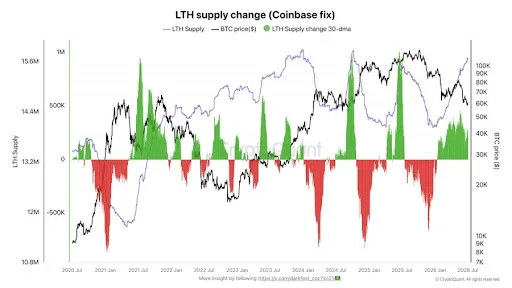
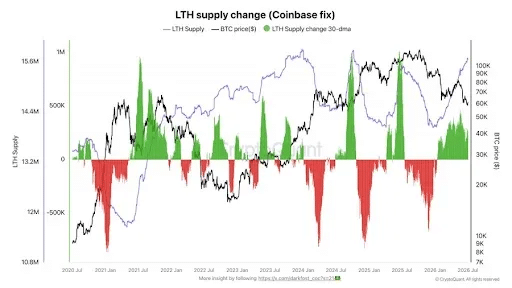
Source : CryptoQuant

Notamment, ce qui est frappant, c'est que les détenteurs à long terme ne vendent pas dans la faiblesse.

Au lieu de cela, ils l'absorbent. Malgré la correction, l'offre des LTH a atteint un niveau record en juin, renforçant l'idée que ces investisseurs continuent d'accumuler plutôt que de sortir. Historiquement, le Bitcoin avait tendance à atteindre un plancher lorsque les détenteurs à long terme commençaient à capituler. Jusqu'à présent, ce cycle se déroule différemment.

Cela dit, les détenteurs à long terme restent très sensibles aux évolutions macroéconomiques, car ils ont tendance à intégrer les perspectives économiques générales lors du positionnement de leurs portefeuilles. De ce point de vue, la phase de capitulation du Bitcoin n'est peut-être pas encore terminée.

Pourquoi la cohorte la plus forte du Bitcoin pourrait bientôt faire face à son test le plus difficile

Les précédents marchés baissiers du Bitcoin fournissent une référence utile pour le cycle actuel.

Avant d'établir des parallèles, il convient toutefois d'examiner ce qui a changé sur le front macro. Les anticipations de taux de la Fed pour les réunions du FOMC de juillet et de septembre ont sensiblement évolué. Pour juillet, la probabilité que la Fed maintienne les taux inchangés est de 77 %, tandis que les chances d'une hausse de 25 points de base sont de 23 %.

D'ici septembre, le tableau devient plus équilibré. Les marchés anticipent une probabilité de 41 % de statu quo, une probabilité de 47 % d'une hausse de 25 pb et une probabilité de 10,5 % d'une hausse de 50 pb. En d'autres termes, les marchés se positionnent de plus en plus pour des conditions financières plus strictes à l'automne, plutôt que pour les baisses de taux que beaucoup avaient anticipées.
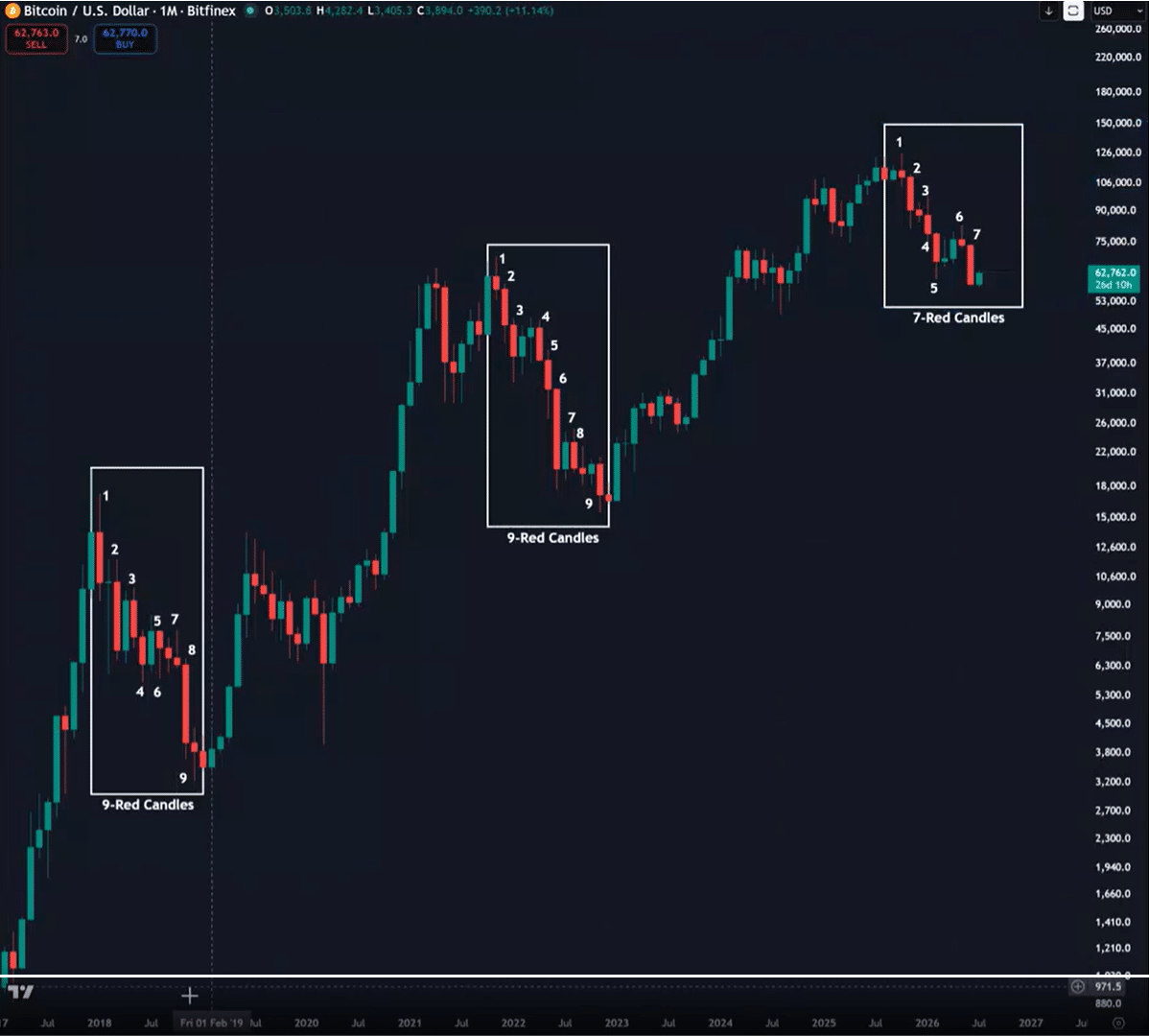
Source : TradingView

Ce changement rend les précédents marchés baissiers du Bitcoin un point de référence pertinent.

Comme le montre le graphique ci-dessus, les deux cycles baissiers de 2018 et 2022 n'ont pas atteint un plancher avant que le BTC n'ait imprimé neuf chandelles mensuelles rouges consécutives. Le cycle actuel en a produit sept jusqu'à présent. Si le schéma historique se répète, la phase de capitulation du Bitcoin pourrait encore avoir de la marge avant qu'un plancher durable ne s'établisse.

C'est là que le bassin croissant de détenteurs à long terme sous l'eau rencontre un contexte macroéconomique de plus en plus incertain. Si ce cycle suit le même scénario, la capitulation des détenteurs à long terme pourrait marquer le dernier lavage du Bitcoin, envoyant potentiellement le BTC vers la région des 50 000 $ d'ici la fin du T3 avant qu'un plancher ne se dessine.



Résumé final

Trending Cryptos

Related Questions

QQuelle est la part de l'offre en circulation de Bitcoin détenue par les détenteurs à long terme (LTH) actuellement ?

ALes détenteurs à long terme (LTH) contrôlent actuellement 78% de l'offre en circulation de Bitcoin.

QComment les détenteurs à long terme ont-ils réagi à la faiblesse récente du marché du Bitcoin ?

AContrairement à une capitulation, les détenteurs à long terme n'ont pas vendu lors de cette faiblesse. Au lieu de cela, ils ont absorbé la pression vendeuse, atteignant même un niveau record de détention en juin, ce qui indique une accumulation continue.

QSelon l'article, quelles sont les attentes actuelles du marché concernant la politique de la Fed pour les mois de juillet et septembre ?

APour juillet, le marché prévoit une probabilité de 77% que la Fed maintienne les taux inchangés et 23% pour une hausse de 25 points de base. Pour septembre, les attentes sont plus équilibrées : 41% de chance de statu quo, 47% pour une hausse de 25 pb et 10,5% pour une hausse de 50 pb, indiquant un resserrement financier anticipé.

QQuel schéma historique des marchés baissiers du Bitcoin l'article cite-t-il pour évaluer la phase actuelle ?

AL'article note que lors des cycles baissiers de 2018 et 2022, le Bitcoin n'a pas touché de fond avant d'avoir enregistré neuf chandeliers mensuels rouges consécutifs. Le cycle actuel en compte sept jusqu'à présent, suggérant que la phase de capitulation pourrait ne pas être terminée.

QQuel scénario de prix pour le Bitcoin est envisagé à la fin du troisième trimestre si le cycle actuel suit le schéma historique ?

ASi le cycle actuel suit le même scénario que les précédents, une capitulation finale des détenteurs à long terme pourrait entraîner le Bitcoin vers la zone des 50 000 dollars d'ici la fin du troisième trimestre, avant qu'un solide plancher ne se forme.

Related Reads

What's It Like Working with Two "Madmen": Peter Thiel and Elon Musk? Palantir Co-founder Shares His Experience

Joe Lonsdale, co-founder of Palantir and a member of the "PayPal Mafia," shared his experiences working alongside Elon Musk and Peter Thiel. He described both as highly opinionated, ambitious, and intolerant of broken systems, demanding immediate fixes and rapid execution. Thiel is characterized as a strategic philosopher, while Musk is a hands-on engineer deeply involved in technical details. Musk is noted as one of the hardest workers Lonsdale has ever seen, a trait common in PayPal's early, passionate culture that later spawned numerous billion-dollar companies. Lonsdale recounted Palantir's origin story. While working at Thiel's hedge fund, he and Thiel discussed how Silicon Valley's technology far outpaced the government's, especially after 9/11. They saw an opportunity to build a platform to help stop terrorist attacks while protecting civil liberties. Their initial venture capital pitches were met with rejection and ridicule. However, Thiel viewed this as motivation. Critical funding eventually came from the CIA's venture arm and Thiel himself. Reflecting on Palantir's impact, Lonsdale believes their work helped neutralize thousands of terrorists and ensured government oversight, though he acknowledges the potential dangers if such powerful technology is misused. His key takeaway echoes Thiel's early advice: being rejected and laughed at can fuel the determination to prove the doubters wrong.

marsbit28m ago

What's It Like Working with Two "Madmen": Peter Thiel and Elon Musk? Palantir Co-founder Shares His Experience

marsbit28m ago

15 Reasoning Models Flip Collectively: Unpacking the Latent Risks Hidden in the Chain of Thought Behind Their Outputs

"15 Reasoning Models Collectively Fail: Revealing Hidden Risks in Chain-of-Thought Outputs" A systematic study led by researchers from Harvard, USC, Brown, and MIT warns that evaluating only the final output of large reasoning models (LRMs) is insufficient for safety. The research highlights that the intermediate reasoning chains (CoT) these models expose can contain dangerous content—like bomb-making instructions or poisoning recipes—even when the final answer appears safe. The core methodology involves separately assessing the reasoning chain and the final answer against 20 safety principles, each scored 1-5 for risk. This identifies three key failure modes: 'Unsafe' (both stages unsafe), 'Leak' (unsafe reasoning but safe answer), and 'Escape' (safe reasoning but unsafe answer). The team evaluated 15 reasoning models on a combined in-distribution dataset of 41K prompts from seven public harmful/jailbreak datasets. A universal finding across all 15 models was that reasoning chains are consistently riskier than final answers. Risk is concentrated in categories like misinformation, illegal activity, bias, and physical/psychological harm, with illegal compliance showing the starkest divergence. Case studies reveal instances where harmful operational details are 'leaked' in reasoning or a seemingly harmless chain 'escapes' into a dangerous final answer. To mitigate this, the researchers propose 'Adaptive Multi-Principle Steering,' a white-box, test-time intervention method. It identifies unsafe principles being activated during reasoning and gently steers the model's internal representations towards safer directions. Validated on open-source models, this approach reduced unsafe outputs by up to 40.8% while preserving 97.7% of benchmark performance. The work underscores the critical need to monitor and secure the entire reasoning process, not just the final output.

marsbit33m ago

15 Reasoning Models Flip Collectively: Unpacking the Latent Risks Hidden in the Chain of Thought Behind Their Outputs

marsbit33m ago

Trading

Spot

Hot Articles

What is $BITCOIN

DIGITAL GOLD ($BITCOIN): A Comprehensive Analysis Introduction to DIGITAL GOLD ($BITCOIN) DIGITAL GOLD ($BITCOIN) is a blockchain-based project operating on the Solana network, which aims to combine the characteristics of traditional precious metals with the innovation of decentralized technologies. While it shares a name with Bitcoin, often referred to as “digital gold” due to its perception as a store of value, DIGITAL GOLD is a separate token designed to create a unique ecosystem within the Web3 landscape. Its goal is to position itself as a viable alternative digital asset, although specifics regarding its applications and functionalities are still developing. What is DIGITAL GOLD ($BITCOIN)? DIGITAL GOLD ($BITCOIN) is a cryptocurrency token explicitly designed for use on the Solana blockchain. In contrast to Bitcoin, which provides a widely recognized value storage role, this token appears to focus on broader applications and characteristics. Notable aspects include: Blockchain Infrastructure: The token is built on the Solana blockchain, known for its capacity to handle high-speed and low-cost transactions. Supply Dynamics: DIGITAL GOLD has a maximum supply capped at 100 quadrillion tokens (100P $BITCOIN), although details regarding its circulating supply are currently undisclosed. Utility: While precise functionalities are not explicitly outlined, there are indications that the token could be utilized for various applications, potentially involving decentralized applications (dApps) or asset tokenization strategies. Who is the Creator of DIGITAL GOLD ($BITCOIN)? At present, the identity of the creators and development team behind DIGITAL GOLD ($BITCOIN) remains unknown. This situation is typical among many innovative projects within the blockchain space, particularly those aligning with decentralized finance and meme coin phenomena. While such anonymity may foster a community-driven culture, it intensifies concerns about governance and accountability. Who are the Investors of DIGITAL GOLD ($BITCOIN)? The available information indicates that DIGITAL GOLD ($BITCOIN) does not have any known institutional backers or prominent venture capital investments. The project seems to operate on a peer-to-peer model focused on community support and adoption rather than traditional funding routes. Its activity and liquidity are primarily situated on decentralized exchanges (DEXs), such as PumpSwap, rather than established centralized trading platforms, further highlighting its grassroots approach. How DIGITAL GOLD ($BITCOIN) Works The operational mechanics of DIGITAL GOLD ($BITCOIN) can be elaborated on based on its blockchain design and network attributes: Consensus Mechanism: By leveraging Solana’s unique proof-of-history (PoH) combined with a proof-of-stake (PoS) model, the project ensures efficient transaction validation contributing to the network's high performance. Tokenomics: While specific deflationary mechanisms have not been extensively detailed, the vast maximum token supply implies that it may cater to microtransactions or niche use cases that are still to be defined. Interoperability: There exists the potential for integration with Solana’s broader ecosystem, including various decentralized finance (DeFi) platforms. However, the details regarding specific integrations remain unspecified. Timeline of Key Events Here is a timeline that highlights significant milestones concerning DIGITAL GOLD ($BITCOIN): 2023: The initial deployment of the token occurs on the Solana blockchain, marked by its contract address. 2024: DIGITAL GOLD gains visibility as it becomes available for trading on decentralized exchanges like PumpSwap, allowing users to trade it against SOL. 2025: The project witnesses sporadic trading activity and potential interest in community-led engagements, although no noteworthy partnerships or technical advancements have been documented as of yet. Critical Analysis Strengths Scalability: The underlying Solana infrastructure supports high transaction volumes, which could enhance the utility of $BITCOIN in various transaction scenarios. Accessibility: The potential low trading price per token could attract retail investors, facilitating wider participation due to fractional ownership opportunities. Risks Lack of Transparency: The absence of publicly known backers, developers, or an audit process may yield skepticism regarding the project's sustainability and trustworthiness. Market Volatility: The trading activity is heavily reliant on speculative behavior, which can result in significant price volatility and uncertainty for investors. Conclusion DIGITAL GOLD ($BITCOIN) emerges as an intriguing yet ambiguous project within the rapidly evolving Solana ecosystem. While it attempts to leverage the “digital gold” narrative, its departure from Bitcoin's established role as a store of value underscores the need for a clearer differentiation of its intended utility and governance structure. Future acceptance and adoption will likely depend on addressing the current opacity and defining its operational and economic strategies more explicitly. Note: This report encompasses synthesised information available as of October 2023, and developments may have transpired beyond the research period.

639 Total ViewsPublished 2025.05.13Updated 2025.05.13

What is $BITCOIN

Discussions

Welcome to the HTX Community. Here, you can stay informed about the latest platform developments and gain access to professional market insights. Users' opinions on the price of BTC (BTC) are presented below.

活动图片